Maresha is an ancient fortified city located in Beit Guvrin-Maresha National Park in Israel's Judean lowlands. The site features extensive underground complexes carved into soft limestone, including residential quarters, industrial workshops, water systems, and elaborate burial caves. Originally an Edomite settlement, it became a prominent Hellenistic city before being destroyed by the Hasmoneans in 112 BCE.
Maresha National Park conceals one of Israel’s most remarkable underground cities beneath an unassuming hill in the Judean countryside. The ancient settlement sprawls across a labyrinth of caves, chambers, and tunnels carved into soft chalk bedrock, revealing 2,500 years of continuous habitation.
Location
Maresha National Park sits in the rolling hills of the Judean Lowlands (Shfela), approximately 40 kilometers southwest of Jerusalem and 15 kilometers northeast of the coastal city of Ashkelon. The park encompasses both Tel Maresha and the nearby Beit Guvrin caves, forming part of Israel’s UNESCO World Heritage Site designation for the “Caves of Maresha and Bet-Guvrin.”
Biblical context
Maresha emerges from the pages of scripture as a strategically important city in the tribal inheritance of Judah. The biblical narrative traces its significance through several pivotal moments in ancient Israel’s history, establishing it as both a defensive stronghold and a witness to divine intervention.
The Hebrew Bible first mentions Maresha in the territorial distribution recorded in Joshua, where it appears among the cities allocated to the tribe of Judah:
“This is the inheritance of the tribe of the children of Judah according to their families… And Keilah, and Achzib, and Mareshah”
— Joshua 15:20, 44
During the reign of King Rehoboam, Solomon’s son, Maresha was fortified as part of a strategic initiative to strengthen Judah’s defenses:
“Rehoboam lived in Jerusalem and built up towns for defense in Judah: Bethlehem, Etam, Tekoa, Beth Zur, Soco, Adullam, Gath, Mareshah, Ziph…”
— 2 Chronicles 11:5–8
Maresha also served as the backdrop for a significant military encounter. King Asa of Judah faced an invasion by Zerah the Cushite, commanding a vast army. The ensuing battle took place in the Valley of Zephathah near Maresha, where Asa’s forces achieved a decisive victory:
“Zerah the Cushite marched out against them with an army of thousands upon thousands and three hundred chariots, and came as far as Mareshah. Asa went out to meet him, and they took up battle positions in the Valley of Zephathah near Mareshah.”
— 2 Chronicles 14:9–10
The prophet Micah, originating from the region, referenced Maresha in his prophecies concerning the judgment and future of Judah:
“I will bring a conqueror against you, inhabitants of Mareshah. The glory of Israel will come to Adullam.”
— Micah 1:15
The Sites History
Maresha’s transformation from biblical fortress to Hellenistic metropolis represents one of the most dramatic cultural shifts in ancient Israel. Following the Babylonian exile and the subsequent Persian period, the region witnessed a massive demographic change as Edomite populations migrated northward into the former territory of Judah, establishing what would become known as Idumea.
Maresha Under Edomite Rule
During the Hellenistic period (4th-2nd centuries BCE), Maresha flourished as a cosmopolitan trading center under Edomite control. The city attracted diverse populations including Greeks, Phoenicians, and Sidonians, creating a vibrant multicultural society. Recent archaeological research reveals extensive evidence of this prosperity through luxury imported goods, including stamped amphora handles from Rhodes, Cos, and Thasos, indicating active Mediterranean trade networks.
The city’s economy thrived on its strategic position along the ancient trade route connecting Gaza with Jerusalem. Local industries included olive oil production, evidenced by 22 subterranean olive presses, and large-scale pigeon breeding in elaborate columbaria carved into the bedrock. These activities generated substantial wealth, allowing residents to construct elaborate underground residential complexes complete with sophisticated water collection systems.
Conquest by the Hasmoneans and Forced Conversion
The pivotal moment in Maresha’s history occurred in 125 BCE when John Hyrcanus I launched his southern campaign to expand Judean territory. His conquest of Maresha and the broader Idumean region represented more than military victory – it initiated one of history’s most significant forced religious conversions.
According to Josephus Flavius in “Antiquities of the Jews,” Hyrcanus presented the conquered Edomites with an ultimatum: adopt Jewish religious practices, including circumcision and observance of the Torah, or face exile from their ancestral lands. The vast majority chose conversion, fundamentally altering the demographic and religious composition of the region.
This mass conversion had profound implications for Jewish history. The Idumeans became fully integrated into Jewish society, with some families, most notably the Herodian dynasty, eventually rising to positions of supreme power. Herod the Great, whose grandfather Antipas was among these converts, would later rule as king of the Jews under Roman authority.
However, tensions persisted between ethnic Jews and the Idumean converts. During the Great Revolt against Rome (66-73 CE), these tensions erupted into violence, with Josephus recording that some Jewish factions viewed the Idumeans with suspicion despite their centuries-long integration into Jewish society.
Decline of Maresha
Following the Hasmonean conquest, Maresha’s importance gradually diminished. The nearby settlement of Beit Guvrin, initially established during the Hellenistic period, began to overshadow Maresha during the Roman era. By the time of Emperor Septimius Severus (193-211 CE), Beit Guvrin had been elevated to municipal status as “Eleutheropolis” (City of the Free), becoming the administrative center of the region.
Archaeological evidence suggests that Maresha was largely abandoned by the 1st century CE, with its population having migrated to Beit Guvrin or other urban centers. The Bar Kokhba Revolt (132-135 CE) may have dealt the final blow to any remaining settlement, as Roman forces systematically destroyed Jewish strongholds throughout Judea.
Inside the Maresha National Park
Maresha’s underground world reveals a sophisticated urban society that mastered the art of subterranean living. The extensive network of caves, chambers, and tunnels demonstrates remarkable engineering skills and provides unprecedented insight into daily life during the Hellenistic period. These installations served multiple functions from industrial production to domestic life, creating a hidden city beneath the surface.
Columbaria (Dovecotes)
The most visually striking features at Maresha are the elaborate columbaria, underground chambers lined with thousands of carved niches designed to house pigeons. These installations represent sophisticated agricultural planning, as pigeons provided multiple economic benefits: their meat supplemented the local diet, their droppings created high-quality fertilizer essential for intensive agriculture, and young pigeons served as ritual sacrifices in religious ceremonies.
The largest columbarium contains over 2,000 individual niches arranged in precise geometric patterns across walls and ceilings. The chambers include central collection areas where workers could gather eggs and birds, while sophisticated ventilation systems maintained optimal air circulation.
Olive Presses
Olive oil production formed the economic backbone of Hellenistic Maresha, as evidenced by subterranean olive press installations discovered throughout the site. These facilities employed a standardized three-stage process: crushing olives using massive stone rollers, pressing the crushed fruit in specialized beam presses, and collecting the extracted oil in carefully constructed stone basins.
The underground location provided crucial temperature control, maintaining consistent conditions necessary for producing high-grade olive oil. Storage chambers adjacent to the presses contain large ceramic vessels (pithoi) capable of holding hundreds of liters of oil. Chemical analysis of residues confirms that Maresha produced premium-quality oil suitable for export throughout the Mediterranean.
Burial Caves and the Sidonian Cave
Maresha’s burial practices reflect the city’s multicultural character and Hellenistic influences. The elaborate family tombs carved into the chalk bedrock combine local traditions with Greek artistic elements, creating unique funeral monuments. The most spectacular example, the Sidonian Cave (detailed separately below), features the only surviving Hellenistic wall paintings in Israel.
These burial complexes typically include multiple chambers connected by narrow passages, allowing extended families to inter generations of deceased relatives. Kokhim (burial slots) line the walls, while central chambers provided space for funeral ceremonies and memorial gatherings. Stone sarcophagi and ossuary collections demonstrate diverse burial practices reflecting the city’s mixed population.
Subterranean Industrial Complexes
Beyond individual installations, Maresha contains extensive underground industrial districts comprising interconnected chambers, workshops, and storage facilities. These complexes housed textile production, metalworking, pottery manufacturing, and food processing operations. Sophisticated drainage systems prevented flooding, while carefully planned ventilation shafts maintained air quality in working areas.
Archaeological excavations have uncovered evidence of specialized crafts including purple dye production using murex shells imported from the Mediterranean coast. Lead weights, bronze scales, and standardized measuring vessels indicate strictly regulated commercial activities, suggesting strong civic administration.
Residential Caves and Cisterns
The most numerous installations at Maresha are residential cave complexes where families lived year-round. These underground homes included multiple rooms carved around central courtyards, with sophisticated water collection systems ensuring reliable supply during dry seasons. Plastered cisterns beneath each residence collected rainwater through networks of carefully graded channels cut into the bedrock.
Greek Inscriptions and Ostraca
Over 2,000 inscribed artifacts discovered at Maresha provide unprecedented insight into daily life in a Hellenistic city. These include official administrative documents, private letters, commercial contracts, and personal dedications written primarily in Greek, with smaller numbers in Aramaic and Hebrew.
The inscriptions reveal a highly literate society engaged in extensive commercial networks stretching from Egypt to Asia Minor. Personal names reflect the city’s diverse population, including Greek, Semitic, and Egyptian elements. Business documents detail transactions involving luxury goods, agricultural products, and slave trading, while personal letters offer intimate glimpses into family relationships and social concerns.
Apollophanes Cave: The Sidonian Burial Cave of Maresha
The Apollophanes Cave represents the pinnacle of Hellenistic artistic achievement at Maresha, serving as both family tomb and cultural monument. This remarkable burial complex combines sophisticated Greek artistic traditions with local customs, creating the only surviving example of Hellenistic wall painting in Israel.
A Painted Legacy
The cave’s frescoes display extraordinary artistic sophistication, employing advanced techniques including perspective, shading, and naturalistic color palettes rarely seen in ancient Middle Eastern art. The central chamber features a crowing rooster painted in brilliant red and gold, positioned to ward off evil spirits according to Greek superstition.
The mythological scenes include Cerberus, the three-headed guardian dog of Hades, rendered in dramatic black and red against a white background. A magnificent phoenix spreads its wings across one wall, its feathers detailed in gold leaf that still gleams after two millennia. These images reflect the sophisticated religious syncretism characteristic of Hellenistic culture, blending Greek mythological elements with local protective traditions.
Honoring a Community Leader
Apollophanes, son of Sesmaeus, led Maresha’s Sidonian community for 33 years during the height of the city’s prosperity in the 2nd century BCE. His Greek epitaph, carved in elegant letters, provides rare insight into the social structure of Hellenistic Maresha:
“Apollophanes, son of Sesmaeus, thirty-three years chief of the Sidonians at Marisa, reputed the best and most kin-loving of all those of his time; he died, having lived seventy-four years.”
The title “chief of the Sidonians” indicates that Maresha’s foreign communities maintained separate administrative structures while participating in the broader civic life. This arrangement allowed diverse ethnic groups to preserve their cultural identities while contributing to the city’s economic prosperity.
A Glimpse into Personal Lives
One inscription discovered in the cave provides an unusually intimate window into personal relationships among Maresha’s elite families:
“There is nothing left I could do for you, or anything that will give you pleasure. I lay with another but I love you, the one most dear to me… Do not bang on the wall, the noise is heard inside. We will signal each other with movements. Let this be our signal.”
This emotional message suggests that burial caves occasionally served as clandestine meeting places, particularly for illicit relationships that challenged social conventions. The reference to secret signals indicates sophisticated methods for arranging private encounters away from public scrutiny, revealing the complex social dynamics of Hellenistic urban life.
The inscription’s intimate tone contrasts sharply with the formal epitaphs typically found in ancient tombs, providing archaeologists with rare evidence of personal emotions and private relationships in ancient society.
Practical Information
Maresha National Park operates year-round with seasonal schedule variations. During standard hours (October-March), the park opens from 8:00 AM to 4:00 PM Sunday through Thursday, 8:00 AM to 3:00 PM on Friday, and 8:00 AM to 4:00 PM on Saturday. Summer hours (April-September) extend to 5:00 PM on weekdays and Saturday.
Admission costs 28 NIS for adults (approximately $8 USD) and 14 NIS for children, students, and seniors (about $4 USD).
The site requires moderate physical fitness, as visitors must navigate uneven terrain and climb stairs within cave complexes. Comfortable walking shoes with good traction are essential. While most major installations are accessible, some narrow passages and steep areas may challenge visitors with mobility limitations.
Additional Information
What makes Maresha different from other archaeological sites in Israel?
Maresha’s unique character stems from its extensive underground city, which provides exceptional preservation of ancient daily life. Unlike surface ruins, the subterranean installations retain their original form and function, allowing visitors to experience authentic ancient spaces.
What is the main highlight of Maresha-Beit Guvrin National Park?
The park is most famous for its “City Beneath a City”, a vast network of thousands of man-made caves. These include the massive Bell Caves, which were used as ancient quarries, and the Sidonian Burial Caves, which are unique for their colorful restored frescoes depicting animals, musicians, and mythological creatures.
Why are the caves shaped like bells?
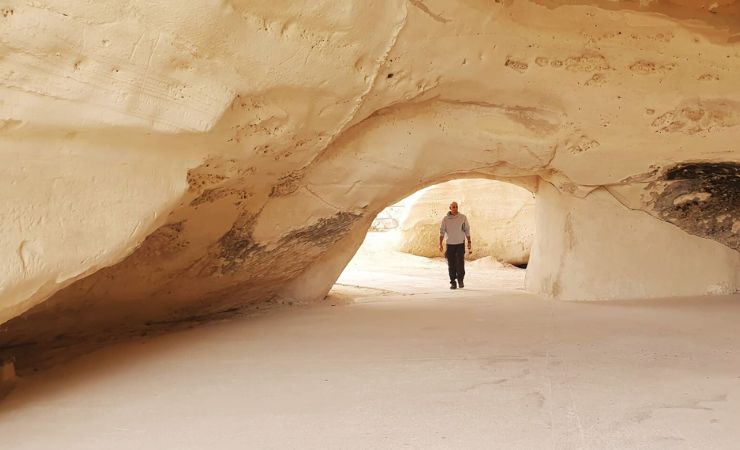
The “Bell Caves” were dug starting from a small hole in the hard upper crust of the earth (the nari). As workers reached the softer chalk layer below, they excavated outwards to ensure the ceiling remained stable and did not collapse, naturally creating a bell-like shape.
What was the purpose of the “Columbarium” caves?
The Columbarium caves contain thousands of small niches carved into the walls. These were used to raise pigeons and doves. In ancient times, these birds were a vital resource: they were used for food, ritual sacrifices, and their droppings served as high-quality fertilizer for the region’s agriculture.
Nearby Sites
Beit Guvrin Amphitheater – Just a short walk from Tel Maresha, this Roman amphitheater once seated thousands and hosted gladiator battles and public events.
Lachish National Park – One of the most important cities of the Kingdom of Judah, famously besieged by the Assyrians. The ramp built by Sennacherib is still visible.
British Park (Park Britannia) – A peaceful forested area perfect for a scenic drive, hike, or picnic. It also includes lookout points and hidden ruins among the trees.
Stalactite Cave Nature Reserve (Avshalom Cave) – About 40 minutes’ drive, this underground cave is filled with dramatic stalactite and stalagmite formations.
Keep reading
Part of our Shephelah & Central Israel Guide →