The Church of the Resurrection in Abu Ghosh is a 12th-century Crusader church located 10 kilometers west of Jerusalem. Built around 1140, it features exceptionally well-preserved medieval frescoes and sits atop earlier Byzantine and Roman ruins. The church is maintained by French Benedictine monks and represents one of Israel's finest examples of Crusader architecture.
The Church of the Resurrection Abu Ghosh stands as one of the most remarkably preserved Crusader churches in the Holy Land. Built in the 1140s by the Knights Hospitaller on the site of an ancient Roman reservoir, this architectural gem houses 1,000-year-old Byzantine frescoes that survived centuries of changing rulers. Visitors to this sacred site discover not only exceptional medieval art but also the deep biblical significance of Abu Ghosh, traditionally identified with Emmaus where Jesus appeared to his disciples after the resurrection.
Location
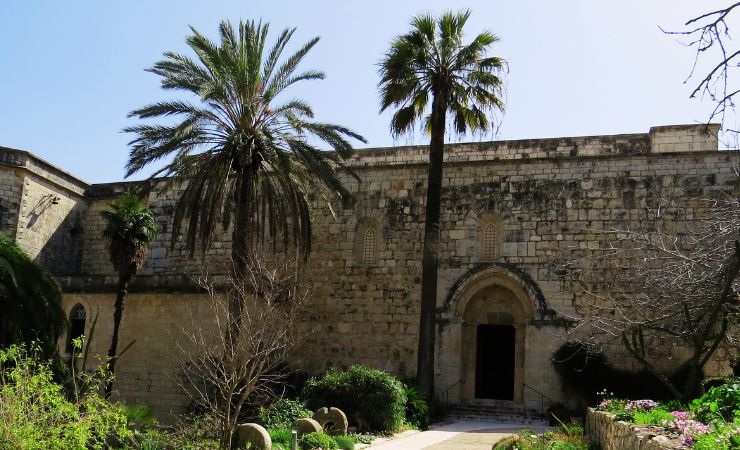
The Church of the Resurrection Abu Ghosh sits in the village of Abu Ghosh, precisely 10 kilometers west of Jerusalem along the historic highway connecting the capital to Tel Aviv. This strategic location on ancient trade routes explains the substantial Roman presence in the area, evidenced by the massive reservoir beneath the church and numerous archaeological finds.
Biblical context
Abu Ghosh holds deep significance in Christian tradition as one of several proposed locations for biblical Emmaus, where Jesus appeared to two disciples after his resurrection (Luke 24:13-35). The Gospel account describes Emmaus as being “sixty stadia” (approximately 11 kilometers) from Jerusalem, closely matching Abu Ghosh’s distance from the holy city. Early Christian pilgrims, including the 4th-century nun Egeria, documented their visits to this area, supporting the identification. The site’s continuous spring and strategic location on the main route to Jerusalem further strengthen its connection to the biblical narrative, as travelers would naturally stop here for water and rest.
Now that same day two of them were going to a village called Emmaus, about seven miles from Jerusalem. They were talking with each other about everything that had happened. As they talked and discussed these things with each other, Jesus himself came up and walked along with them; but they were kept from recognizing him.
Luke 24:13-16


The Site's History
The Church of the Resurrection Abu Ghosh has witnessed over two millennia of continuous occupation, with each era leaving its distinct archaeological and architectural imprint:
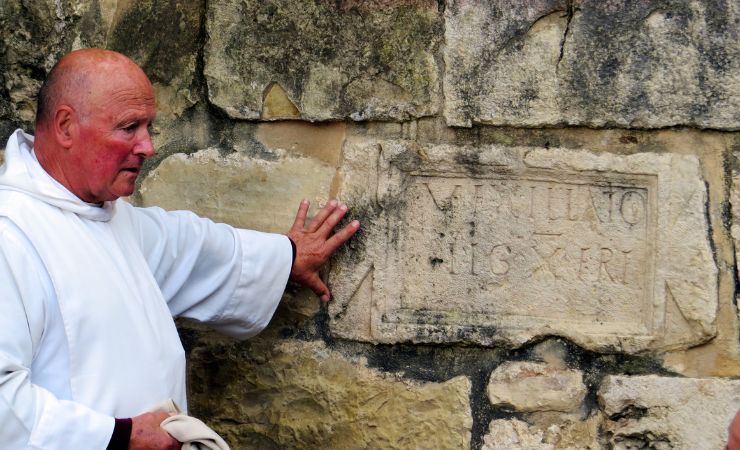
- Roman Period (1st-4th centuries): The Romans built a massive underground cistern system here to collect spring water for travelers on the Jerusalem-Caesarea route. The Tenth Legion Fretensis, stationed nearby after 70 CE, constructed the substantial reservoir that forms the church’s current crypt. Archaeological excavations have uncovered an inscribed milestone from 162 CE marking the road repairs under Emperor Antoninus Pius, along with Latin inscriptions documenting the legion’s engineering projects. The spring-fed water system could hold approximately 700 cubic meters of water.
- Byzantine Period (4th-7th centuries): Byzantine Christians built the first church on this site, recognizing its significance as a stopping point for pilgrims traveling to Jerusalem. Fragments of Byzantine-era mosaic floors and column capitals found during restoration suggest a substantial ecclesiastical complex served the growing Christian pilgrimage traffic.
- Crusader Period (1099-1187): The Knights Hospitaller constructed the current church between 1140 and 1150, incorporating the Roman reservoir as a crypt. Master builder craftsmen from France designed the structure in the transitional Romanesque-Gothic style, with thick walls capable of withstanding siege conditions. The church served both as a place of worship and a fortified way station for pilgrims and military forces traveling between the coast and Jerusalem.
- Ayyubid and Mamluk Periods (1187-1517): After Saladin’s conquest in 1187, the church was abandoned by Christian clergy. Local Muslim inhabitants converted the building into a caravanserai and grain storage facility. In the 14th century, a small mosque was built adjacent to the site, acknowledging the location’s continued sacred significance under Islamic rule.
- Ottoman and Modern Periods (1517-present): The French government purchased the ruins in 1873, recognizing their historical importance. The Benedictine order took control in 1901, undertaking systematic restoration that uncovered the remarkably preserved frescoes beneath centuries of plaster and debris. The restored church was rededicated in 1902 and continues to function as an active monastery and pilgrimage site.
The Structure of the Church of the Resurrection, Abu Ghosh
The Church of the Resurrection in Abu Ghosh represents one of the finest examples of Crusader architecture in the Holy Land, demonstrating the sophisticated engineering and artistic sensibilities of 12th-century monastic builders. The structure harmoniously blends defensive military architecture with sacred religious space, reflecting the dual challenges of worship and security in Crusader Palestine.
Basilica Layout The church follows the classic three-aisled basilica plan favored by medieval monastic architects, with precise proportional relationships between its components:
- Three Apses: Each of the three semicircular apses serves specific liturgical functions. The central apse houses the main altar and measures 4.5 meters in diameter, while the flanking apses, each 3 meters wide, served as side chapels for private prayer and additional masses. The apses feature distinctive half-dome vaulting with ribs that demonstrate early Gothic influence.
- Central Nave: The nave stretches 27 meters in length and 8 meters in width, with a soaring height of 15 meters to the vault apex. Six massive compound piers, each measuring 1.2 meters square, support the ribbed vaulting system that distributes weight efficiently across the structure.
- Side Aisles: The northern and southern aisles, each 4.5 meters wide, feature pointed barrel vaults that spring from engaged columns with elaborately carved capitals depicting stylized acanthus leaves and geometric patterns.
Architectural Features
- Romanesque Foundation: The lower portions of the church exhibit classic Romanesque characteristics: walls measuring up to 2.5 meters thick, small rounded windows designed for defense, and massive masonry construction using local limestone blocks.
- Gothic Innovation: The upper sections reveal early Gothic elements including pointed arches that reduce lateral thrust, ribbed vaulting that channels weight to specific points, and larger window openings that flood the interior with natural light.
- Defensive Elements: The church incorporates fortress-like features including arrow slits in the western wall, a single fortified entrance that could be easily barricaded, and thick walls capable of withstanding siege engines.
Interior Design
- Sculptural Program: Twenty-four carved capitals crown the interior columns, each unique in design and featuring motifs ranging from biblical scenes to foliate patterns. The craftsmanship suggests the work of master stonecutters trained in French cathedral workshops.
- Lighting System: Strategically placed windows create dramatic lighting effects throughout the day. The eastern windows illuminate the altar area during morning prayers, while western openings provide afternoon light for vespers services.
- Acoustic Design: The vaulted ceiling and stone surfaces create exceptional acoustics for Gregorian chant, with a reverberation time of approximately 4 seconds that enhances the meditative quality of monastic prayer.
Crypt and Infrastructure
- Roman Reservoir: The massive underground crypt, originally a Roman cistern, measures 35 by 15 meters and reaches depths of 7 meters. The walls, constructed from dressed limestone blocks, remain watertight after nearly 2,000 years.
- Spring System: The natural spring produces approximately 50 cubic meters of water daily, flowing through channels carved by Roman engineers. The spring chamber features a vaulted ceiling and steps leading down to the water source.
- Storage Facilities: Adjacent chambers served as storage for grain, oil, and wine, essential for the monastery’s self-sufficiency during times of conflict.
Exterior Design
- Facade Treatment: The western facade features a central portal with multiple receding arches (archivolt) decorated with geometric moldings. Above the entrance, a large rose window, now partially reconstructed, originally provided interior illumination.
- Bell Tower Foundation: Archaeological evidence suggests plans for a substantial bell tower on the northwestern corner, though construction was apparently halted during the Crusader period.
- Monastic Complex: Foundations visible east of the church indicate a complete monastic complex including dormitories, refectory, and scriptorium, suggesting a community of 30-40 monks.
The Frescoes
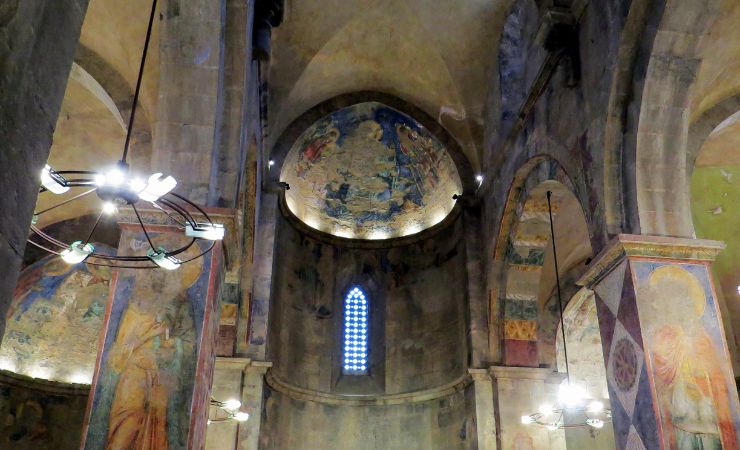
The frescoes of the Church of the Resurrection Abu Ghosh rank among the most exceptional examples of Crusader-era religious art in the Holy Land. Created in the second half of the 12th century by Byzantine artists working under Crusader patronage, these paintings survived eight centuries through miraculous preservation beneath protective plaster layers applied during the Islamic period.
Artistic Technique and Materials The frescoes employ the traditional Byzantine technique of painting on wet lime plaster (buon fresco), using mineral pigments including lapis lazuli blue, cinnabar red, and gold leaf highlights. Analysis reveals that the artists mixed crushed local limestone with their plaster base, creating exceptional adhesion and durability. The sophisticated use of perspective and modeling demonstrates the high skill level of the painters, likely trained in Constantinople workshops.
Iconographic Program The frescoes present a comprehensive theological narrative focused on salvation and the afterlife, arranged according to Byzantine liturgical tradition:
- Northern Wall – The Dormition: This masterpiece depicts the Virgin Mary’s peaceful death surrounded by the twelve apostles, with Christ receiving her soul (represented as a small figure) into his arms. The composition spans 6 meters in width and includes remarkable details such as individual facial expressions, richly decorated vestments, and a heavenly chorus of angels. The scene incorporates both Eastern and Western iconographic elements, reflecting the cultural synthesis of Crusader Palestine.
- Eastern Apse Cycle – The Last Judgment: The three apses present a unified vision of divine justice and mercy:
- Northern Apse – The Deesis: Christ Pantocrator occupies the central position, flanked by the Virgin Mary and John the Baptist as intercessors for humanity. The figures measure over 2 meters in height and display remarkable psychological intensity, with Christ’s compassionate yet stern expression capturing the duality of divine judgment and mercy.
- Central Apse – The Harrowing of Hell: This dynamic composition shows Christ trampling the gates of Hell while rescuing righteous souls including Adam, Eve, David, and Solomon. The scene includes vivid depictions of broken chains, defeated demons, and the radiant cross that illuminates the underworld.
- Southern Apse – The Bosom of Abraham: The patriarch Abraham holds the souls of the righteous in a cloth, surrounded by other patriarchs and prophets. The peaceful composition contrasts dramatically with the adjacent scenes of judgment and redemption.
- Southern Wall – The Crucifixion: This emotionally powerful scene depicts Christ on the cross between the two thieves, with Mary and John standing below in attitudes of grief. The composition includes the Roman centurion’s confession and the symbolic representation of Ecclesia (the Church) and Synagoga (the Synagogue), reflecting medieval theological interpretations.
- Additional Scenes: Fragmentary frescoes throughout the church include:
- The Presentation in the Temple: Showing the infant Jesus presented by Mary and Joseph to the elderly Simeon
- The Adoration of the Magi: Featuring the three wise men offering gifts to the Christ child
- The Annunciation to Zechariah: Depicting the angel Gabriel’s announcement to Zechariah in the Temple
- Various Saints and Martyrs: Including St. George, St. Demetrios, and other military saints popular among the Crusaders
Conservation and Significance The frescoes underwent major conservation between 1950 and 1960 under the direction of French restoration experts. Modern laser cleaning and stabilization techniques have revealed previously hidden details and inscriptions in Greek and Latin. The paintings represent a unique fusion of Byzantine artistic tradition with Crusader patronage, documenting the cultural exchange that characterized medieval Palestine. Scientific analysis has confirmed that several pigments were imported from distant regions, including ultramarine from Afghanistan and vermillion from Spain, indicating the significant investment in this artistic program.
Practical Information
Opening Hours: The Church of the Resurrection Abu Ghosh is open daily from 8:30 AM to 11:30 AM and 2:30 PM to 5:00 PM (6:00 PM in summer). The church closes on Sundays during mass times (10:00 AM to 12:00 PM).
Admission: Entry is free, though donations are welcomed to support ongoing conservation efforts.
Accessibility: The main church level is wheelchair accessible via a ramp entrance on the northern side. However, the crypt with its ancient spring requires descending steep medieval stairs and is not accessible for mobility-impaired visitors.
Parking: Free parking is available in the village center, approximately 100 meters from the church. Larger tour buses can park in the designated area behind the monastery.
Dress Code: Modest dress is required. Shoulders and knees must be covered, and hats should be removed upon entering. The monastery provides shawls for visitors who need additional coverage.
Additional Information
When was the Church of the Resurrection in Abu Ghosh built?
The Church of the Resurrection Abu Ghosh was constructed between 1140 and 1150 by the Knights Hospitaller during the Crusader period. The church was built directly over a massive Roman reservoir dating from the 1st-2nd centuries CE, incorporating this ancient water system into its crypt design.
What makes the frescoes in Abu Ghosh church so special?
The church houses some of the finest preserved Crusader-era frescoes in the Holy Land, painted between 1160-1170 by Byzantine artists. These remarkable 12th-century paintings include the Dormition of the Virgin, Last Judgment scenes, and the Crucifixion, surviving intact for nearly 900 years beneath protective plaster layers.
Why is Abu Ghosh considered biblical Emmaus?
Abu Ghosh is identified as biblical Emmaus based on its distance from Jerusalem (approximately 11 kilometers, matching Luke’s “sixty stadia”), its location on the main Roman road, and continuous Christian tradition dating to the 4th century. Early pilgrims including Egeria documented visiting this site as the place where Jesus appeared to his disciples after the resurrection.
Can visitors see the Roman reservoir beneath the church?
Yes, visitors can descend into the crypt to see the ancient Roman reservoir that still contains spring water after nearly 2,000 years. The massive cistern features walls over 3 meters thick and demonstrates remarkable Roman engineering. However, access requires navigating steep medieval stairs and is not wheelchair accessible.
What happened to the Church of the Resurrection after the Crusades?
After Saladin’s conquest in 1187, the church was abandoned by Christian clergy and converted into a grain storage facility and caravanserai by local Muslim inhabitants. A small mosque was built nearby in the 14th century. The French government purchased the ruins in 1873, and Benedictine monks began restoration in 1901, uncovering the hidden frescoes.
Is there an entry fee for the Church of the Resurrection?
Entry to the Church of the Resurrection Abu Ghosh is free of charge, though donations are welcomed to support ongoing conservation work on the frescoes and building maintenance.
Nearby Sites
- Notre-Dame de l’Arche d’Alliance: Another historic church in Abu Ghosh, known for its striking architecture and serene environment.
- Yad Kennedy: A memorial dedicated to John F. Kennedy with panoramic views of the surrounding hills.
- Ein Hemed National Park: A beautiful park with historical ruins and a peaceful stream.
- Kiryat Ye’arim: An ancient site believed to be the biblical town that housed the Ark of the Covenant.
Keep reading
Part of our Shephelah & Central Israel Guide →