Caesarea Maritima was an ancient Roman port city built by Herod the Great between 22-9 BCE. It served as the capital of Roman Judaea for 650 years and featured revolutionary harbor technology.
Built on the foundations of the ancient Phoenician settlement of Straton’s Tower, Caesarea Maritima represents one of the most ambitious construction projects of the ancient world. Herod the Great transformed this modest coastal outpost into a magnificent Roman city that would rival Alexandria and Antioch in grandeur and importance. Today, Caesarea National Park preserves the extensive ruins of this ancient metropolis, offering visitors the opportunity to walk through Roman theaters, explore Crusader fortifications, and witness the remains of revolutionary maritime engineering.
Location
Caesarea Maritima sits on a prominent section of Israel’s central Mediterranean coastline, approximately 45 kilometers north of Tel Aviv and 55 kilometers south of Haifa.
Historical Background of Caesarea Maritima
The story of Caesarea Maritima begins with the ancient Phoenician settlement of Straton’s Tower, which occupied this coastal location for several centuries before Herod the Great acquired the site around 22 BCE. The original settlement was likely named after Straton I of Sidon, a Phoenician ruler who lived in the 4th century BCE, and functioned as a modest trading post along the Mediterranean coast.
When Herod the Great decided to transform this location into a major port city, he embarked on one of antiquity’s most ambitious engineering projects. The construction period, lasting approximately thirteen years from 22-9 BCE, required massive resources and innovative technologies. Herod imported skilled architects and engineers from throughout the Roman world to realize his vision of creating a port that could rival Alexandria and serve as a fitting tribute to his patron, Caesar Augustus.
The harbor construction presented enormous technical challenges since the Mediterranean coast of ancient Palestine lacked natural harbors. Herod’s engineers solved this problem by developing revolutionary underwater concrete technology, mixing volcanic ash (pozzolan) imported from Italy with local lime and seawater to create a concrete that actually strengthened when submerged. This innovation allowed them to construct massive breakwaters extending into deep water, creating an artificial harbor covering approximately 40 acres.
Upon completion in 9 BCE, Caesarea immediately became the administrative capital of Roman Judaea, replacing Jerusalem as the seat of Roman government. The city’s inaugural celebrations lasted for several days and featured elaborate games, theatrical performances, and gladiatorial contests that announced Caesarea’s arrival as a major Mediterranean port. The population quickly grew to an estimated 50,000+ residents, making it one of the largest cities in the eastern Roman Empire.
During the first century CE, Caesarea gained prominence as the residence of Roman procurators who governed Judaea province. Pontius Pilate ruled from here between 26-36 CE, and his presence is documented by the famous limestone inscription discovered at the site in 1961, which remains the only contemporary archaeological evidence of his governorship. The Pilate Stone specifically mentions him as “Praefectus Fabius” and references a Tiberieum, likely a building constructed in honor of Emperor Tiberius.
The sophisticated urban infrastructure included an elaborate aqueduct system that transported fresh water across approximately 10 kilometers from springs near Mount Carmel. This high-level aqueduct, portions of which remain visible today, actually consisted of multiple channels built during different periods to meet the city’s growing water demands. The engineering required precise gradient calculations to maintain proper flow while crossing varied coastal terrain.
Religious and ethnic tensions frequently erupted in Caesarea due to its diverse population of Romans, Greeks, Jews, and other Mediterranean peoples. The First Jewish War (66-73 CE) actually began in Caesarea when disputes between Jewish and Greek residents escalated into violence, prompting Roman military intervention that spread throughout Judaea. Following the war’s conclusion, Caesarea served as a base for continued Roman operations and housed prisoners of war, including the historian Josephus.
Archaeological evidence reveals that during the second and third centuries CE, Caesarea reached its economic and cultural peak. The city hosted major athletic competitions, maintained thriving commercial districts, and supported substantial Jewish and Samaritan communities alongside its Roman population. Elaborate mosaics, imported marble decorations, and sophisticated building techniques from this period demonstrate the wealth generated by Mediterranean trade.
The transition to Byzantine rule in the 4th century CE marked a new chapter in Caesarea’s history as the city became an important center of Christian scholarship and ecclesiastical administration. The renowned theologian Origen established a significant library here, and Eusebius of Caesarea, known as the “Father of Church History,” served as bishop and wrote his influential “Ecclesiastical History” while residing in the city.
Byzantine Caesarea maintained its commercial importance while adapting to Christian imperial policies. Churches replaced pagan temples, Christian mosaics decorated public buildings, and the city served as a major pilgrimage destination for Christians traveling to the Holy Land. The population remained substantial, and archaeological evidence indicates continued prosperity through the 6th century CE.
The Arab conquest in 640 CE under the Rashidun Caliphate marked the end of Byzantine control, though the city continued functioning as a regional administrative center and port. Under early Islamic rule, Caesarea retained much of its commercial activity, with Muslim, Christian, and Jewish merchants continuing to operate from its harbor facilities.
Crusader forces captured Caesarea in 1101 during the First Crusade, recognizing its strategic value for controlling coastal communications and trade routes. Baldwin I of Jerusalem fortified the city and established it as an important Crusader stronghold. However, the most significant Crusader construction occurred under Louis IX of France (Saint Louis) in the mid-13th century, when massive defensive walls and a compact fortified city were built using stones quarried from earlier Roman buildings.
The final chapter of ancient Caesarea’s urban history occurred in 1265 when Mamluk Sultan Baibars captured and systematically destroyed the city to prevent its future use by Crusader forces. The harbor was deliberately filled with stones, the fortifications were demolished, and the population was dispersed. This destruction effectively ended over 1,300 years of continuous urban occupation, leaving the site abandoned until modern archaeological investigations began revealing its remarkable history.
Inside Caesarea Maritima: What to See
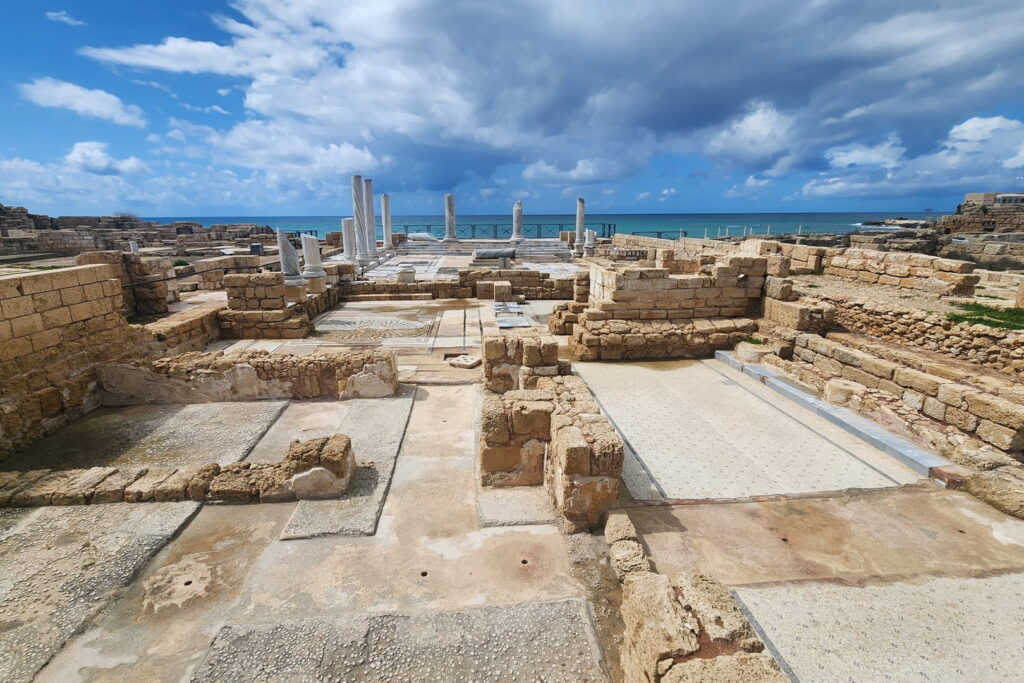
The archaeological remains at Caesarea span nearly 1,500 years of continuous habitation, creating a layered landscape where Roman foundations support medieval walls and ancient harbor installations lie partially submerged in crystal-clear Mediterranean waters.
The site’s excellent preservation allows for an immersive experience where ancient streets, public buildings, and defensive structures tell the story of daily life in one of the ancient world’s most important ports.
Roman Theater — The restored amphitheater represents one of Caesarea’s most impressive structures, originally seating approximately 4,000 spectators for dramatic performances and public gatherings. Built into a natural slope facing the Mediterranean, the theater showcases typical Roman architectural elements including a semicircular orchestra, tiered seating, and elaborate stage facilities. This location gained modern archaeological fame as the discovery site of the Pilate Stone, a limestone inscription that provides the only contemporary evidence of Pontius Pilate’s governorship in Judaea.
Herodian Harbor — The remains of Herod’s revolutionary artificial harbor demonstrate ancient engineering at its finest, with massive underwater breakwaters still visible from the shore. The harbor utilized innovative hydraulic concrete technology that allowed construction directly in marine environments, creating protected anchorage where none existed naturally. Visitors can observe the submerged foundations and appreciate the scale of this undertaking that required moving enormous stone blocks and creating artificial islands to shelter incoming vessels.
Crusader City — The medieval fortifications built by Crusader forces in the 13th century provide a sharp contrast to the earlier Roman construction, featuring thick defensive walls and a compact urban layout designed for siege warfare. King Louis IX of France ordered extensive rebuilding of these fortifications, creating the impressive walls and gates that visitors enter today. The Crusader city demonstrates how medieval builders adapted and reused Roman foundations while creating distinctly different architectural spaces suited to their military needs.
Water Aqueducts — The remarkable ancient aqueduct system that supplied Caesarea with fresh water from Mount Carmel springs extends for approximately 10 kilometers, with substantial sections still visible along the Mediterranean shore. Multiple aqueduct channels were constructed during different periods to meet the city’s growing water demands, showcasing sophisticated Roman hydraulic engineering. The visible remains demonstrate the characteristic arched construction that maintained proper water flow across varying coastal terrain, requiring precise gradient calculations and substantial investment in permanent infrastructure to support a major urban population.
Synagogue Remains — Located in the northern section of the archaeological site, the ancient synagogue foundations reveal the presence of a significant Jewish community throughout Caesarea’s history. The synagogue complex includes mosaic floors with geometric patterns and Hebrew inscriptions that provide insights into Jewish religious life in this cosmopolitan Roman city. These remains demonstrate how diverse religious communities coexisted within Caesarea’s urban fabric, with the synagogue serving the substantial Jewish population that maintained its presence from the Herodian period through Byzantine rule.
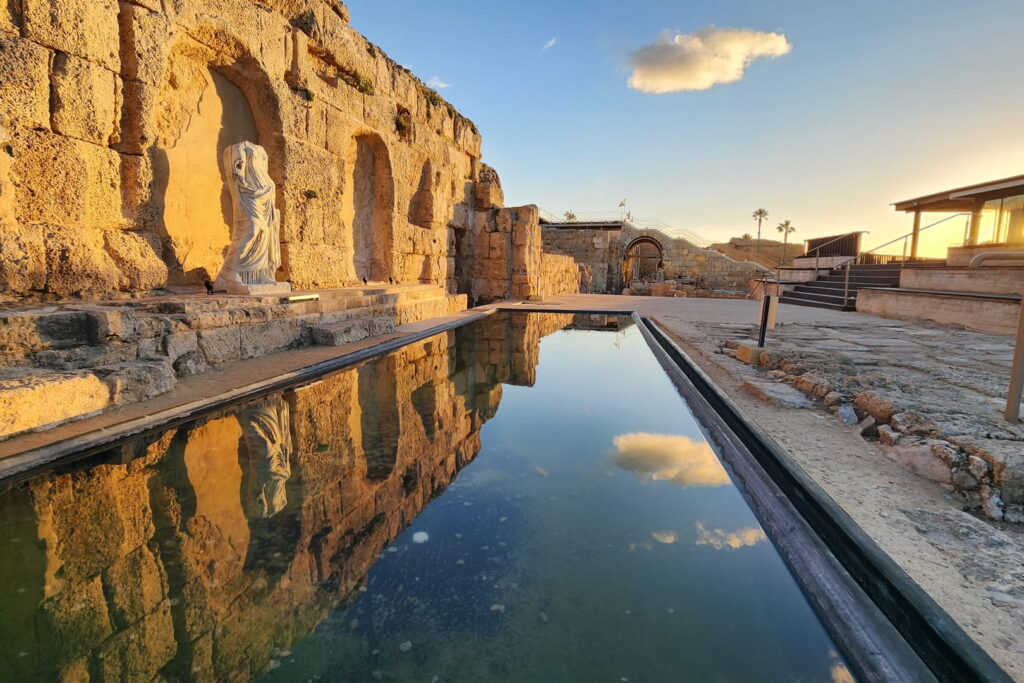
Herod’s Palace — The palace platform extends on a promontory jutting into the Mediterranean, where excavated remains include a distinctive swimming pool that once served the royal residence. The palace complex commanded spectacular views while providing private access to the sea, reflecting both the luxury and security concerns of Herodian royal architecture. Visitors can explore the foundation walls and water installations that supported this exclusive residential area, imagining the opulent lifestyle of ancient rulers who entertained Roman dignitaries and administered a diverse kingdom from this coastal headquarters.
Hippodrome — The massive chariot racing facility could accommodate over 30,000 spectators, making it larger than many modern sports stadiums and demonstrating Caesarea’s importance as a center of entertainment and public spectacle. The elongated U-shaped track follows typical Roman circus design, with a central barrier (spina) around which chariots raced in a counterclockwise direction. Archaeological work has revealed the starting gates, spectator seating areas, and support facilities that made this venue capable of hosting the elaborate games and festivals that were central to Roman urban culture.
Underwater Archaeological Park — The world’s first underwater archaeological park allows snorkelers and divers to explore submerged harbor installations, shipwrecks, and building foundations that lie beneath the Mediterranean’s clear waters. The underwater experience provides a unique perspective on ancient maritime technology and urban planning, as visitors can swim among the same structures that once guided Roman merchant ships to safety. Professional diving equipment and guided tours are available for those seeking a comprehensive exploration of these submerged archaeological treasures.
Practical Information
The official Caesarea National Park operates year-round with varying seasonal hours, typically opening at 8:00 AM and closing between 4:00 PM (winter) and 6:00 PM (summer). Adult admission includes access to all land-based archaeological areas, with separate fees for underwater park activities and special exhibitions.
The park offers audio guides in multiple languages and provides detailed maps highlighting major features and recommended walking routes.
Additional Information
How long should I plan to spend at Caesarea Maritima?
Most visitors need 3-4 hours to explore the main archaeological areas thoroughly, including the Roman theater, harbor remains, and Crusader fortifications. If you plan to participate in underwater archaeological park activities or attend special performances at the Roman theater, allow a full day. The site is extensive, so comfortable walking shoes and sun protection are essential.
Can I see the famous Pilate Stone at Caesarea?
The original Pilate Stone inscription is housed in the Israel Museum in Jerusalem for preservation. However, a replica is displayed at Caesarea near the Roman theater where the original was discovered in 1961. Information panels at the theater explain the stone’s historical significance as the only contemporary evidence of Pontius Pilate’s governorship.
What biblical events happened at Caesarea Maritima?
Caesarea features prominently in the New Testament as the place where the Apostle Paul was imprisoned for two years before his appeal to Caesar. The city was also where Cornelius the Centurion became the first Gentile convert to Christianity, and where Philip the Evangelist lived and ministered. These events established Caesarea as a crucial location in early Christian history.
Is the underwater archaeological park suitable for non-divers?
Yes, the underwater park offers snorkeling opportunities for beginners as well as advanced diving experiences. Equipment rental and guided tours are available on-site, with shallow water areas accessible to those comfortable swimming and using basic snorkeling gear. The clear Mediterranean waters provide excellent visibility for viewing submerged harbor structures.
What makes Caesarea’s ancient harbor so historically significant?
Herod’s harbor was revolutionary because it used underwater concrete technology to create artificial breakwaters in open sea conditions. This engineering breakthrough allowed construction of a major port where natural protection didn’t exist, influencing harbor design throughout the Roman Empire. The concrete formula included volcanic ash that actually strengthened when exposed to seawater.
Nearby Sites
- Apollonia National Park: Ancient coastal city featuring Roman villa ruins, Byzantine churches, and a Crusader fortress overlooking the Mediterranean Sea.
- Sidna Ali Mosque: Historic mosque located on a cliff overlooking the sea, built to honor Ali ibn Alim, a nephew of Saladin, and featuring traditional Ottoman architecture.
- Dor Beach and Tel Dor: Ancient Canaanite port city with beautiful beaches and archaeological remains spanning 3,000 years.
- Zichron Ya’akov: Historic wine-making town founded by Baron Edmond de Rothschild with charming pedestrian streets and local wineries.
Keep reading
Part of our Central Israel Guide →