The Sydna Ali Mosque stands near Herzliya, about 15 kilometers north of Tel Aviv, honoring Ali Ibn Alim, a Muslim warrior from the Crusades. This historic site combines Crusader-era architecture with Islamic religious significance, creating a unique cultural landmark along Israel's Mediterranean coast that reflects the region's diverse heritage.
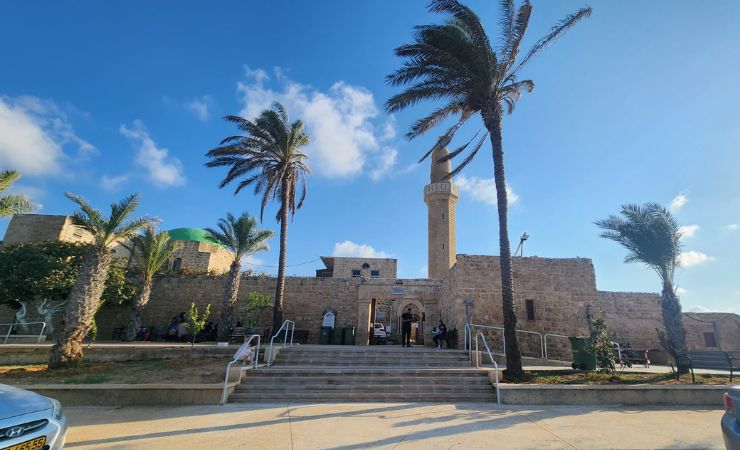
The Sydna Ali Mosque is a centuries-old coastal shrine that fuses Islamic architecture, Crusader-era history, and local legend. Perched on a limestone cliff above the Mediterranean, it was built to honor Ali Ibn Alim, a Muslim warrior venerated as a saint, whose tomb remains inside the complex to this day.
Location
The mosque sits just outside Herzliya, roughly 15 kilometers north of Tel Aviv, on a low limestone ridge that drops sharply to the Mediterranean shore. The elevation is modest, only about 20 meters above sea level, but enough to give the building an elevated, outward-facing presence visible from the beach below.
Historical Context
The Sydna Ali Mosque’s origins date to the 13th century, when it was built to honor Ali Ibn Alim, a Muslim warrior who, according to tradition, died in battle against the Crusaders near the ancient city of Apollonia. Ali Ibn Alim was believed to be a descendant of the Prophet Muhammad, and his grave quickly became a focus of local veneration. The site sits directly above the ruins of Apollonia, a city with roots stretching back to the Phoenician period that later served as a Roman, Byzantine, and Crusader stronghold. That layering of civilizations beneath the mosque’s foundations gives the location an unusual depth, even by Israeli coastal standards.
In 1481, during the Mamluk period, the mosque was substantially expanded and rebuilt. The Mamluks, who controlled much of the Levant after driving out the Crusaders in the late 13th century, actively sponsored religious and funerary architecture along the coast as an assertion of Islamic authority. The mosque’s whitewashed walls, square minaret, and vaulted prayer hall reflect the restrained Mamluk building style typical of that era.
During the Ottoman period, the mosque became the focal point of an annual festival tied to the watermelon harvest, a gathering that drew pilgrims and merchants from across the region. The surrounding village of Al-Haram grew up around the shrine and depended on it as a community anchor. When the 1948 Arab-Israeli War broke out, the village was depopulated, and the mosque stood essentially abandoned for several decades. The Israeli government eventually classified the building as a protected heritage site. A Muslim religious association undertook a significant restoration in the 1990s, repairing the minaret, replastering the walls, and reopening the tomb chamber to visitors. The mosque has been in active, if modest, use since then.
The Legend of Ali Ibn Alim
One of the most enduring legends connected to the Sydna Ali Mosque involves a young girl and a broken milk vase. One evening, as Ali walked along the seashore, he heard a child crying. Sitting on the sand beneath a cliff was a young girl, visibly distraught. When Ali asked her why she was crying, she explained that she had been sent to fetch milk for her family but had dropped the vase, spilling its contents into the sand. Milk was a precious commodity for her poor family, and the loss was serious. Ali comforted the girl, knelt down, and prayed. The broken vase reassembled itself before her eyes, and Ali then reached into the wet sand and squeezed milk from the grains, filling the vase completely.
The story takes a stranger turn after Ali’s death. He was buried near his home according to custom, but his family found the body outside the grave the following morning. They reburied him, and the earth rejected him again. This happened several times. According to the legend, Ali appeared in a dream to his friend Fouad, a local tea shop owner, and explained that the earth refused to hold him because he had once drawn milk from it, an act that disrupted its natural order and created a debt the soil would not forgive.
Ali instructed Fouad that he must rest above ground rather than in it. Following those instructions, Ali’s family and friends built a small mausoleum over the spot. It is in this above-ground tomb, beneath a black stone said to have once marked his house, that Ali remains to this day, venerated as a local saint by Muslim pilgrims who visit the mosque.
Inside Sydna Ali Mosque
The mosque complex is compact but layered with detail. Visitors entering from the courtyard move through a sequence of spaces that shift from open-air garden to shaded arcade to the hushed interior of the prayer hall. The building’s current form reflects the 15th-century Mamluk reconstruction, with later Ottoman and 20th-century repairs visible in the patchwork of stonework on the exterior walls.
Visitors will find several key features inside the complex:
- Main Prayer Hall: The mosque’s main prayer space retains its original Mamluk vaulting and a simple mihrab, the niche indicating the direction of Mecca. The hall is still used for daily prayers and feels genuinely active rather than museumified.
- Tomb of Ali Ibn Alim: The above-ground maqam sits in a chamber adjacent to the prayer hall.
- Garden Courtyard: The courtyard surrounding the mosque is planted with fig trees, oleander, and other Mediterranean species.
- Coastal Views: The cliff-edge position gives unobstructed views north and south along the Israeli coast. On a clear day you can see the high-rises of Herzliya to the south and the faint outline of the Carmel ridge to the north.
Additional Information
What is the Sydna Ali Mosque and why is it historically significant?
The Sydna Ali Mosque is a medieval Islamic shrine on Israel’s Mediterranean coast, roughly 15 kilometers north of Tel Aviv. Built in the 13th century to honor Ali Ibn Alim, a Muslim warrior believed to be a descendant of the Prophet Muhammad, it was substantially rebuilt by the Mamluks in 1481.
Is the Sydna Ali Mosque open to non-Muslim visitors?
Yes, non-Muslim visitors are generally welcome in the courtyard, garden, and outer areas of the complex. Access to the prayer hall depends on whether prayers are in progress. Friday midday prayers draw the largest gatherings, so a weekday morning visit tends to be the most relaxed option.
Who was Ali Ibn Alim, and why is he buried above ground?
Ali Ibn Alim was a Muslim warrior who, according to tradition, fought and died near Apollonia during the Crusader period in the 13th century. He is venerated locally as a saint. According to the legend attached to his burial, the earth repeatedly rejected his body because he had once miraculously drawn milk from the sand, an act the ground refused to forgive. His followers therefore built an above-ground mausoleum, known as a maqam, where his remains rest to this day beneath a green-draped cenotaph.
What is the admission fee for the Sydna Ali Mosque?
Entry to the Sydna Ali Mosque is free of charge. The site is maintained by a private Muslim religious association rather than the Israel Nature and Parks Authority, so there is no ticket booth or set fee structure. A small donation is appreciated but not required.
Nearby Sites
- Apollonia National Park: Located nearby, Apollonia boasts ancient Roman and Crusader ruins, sitting dramatically on cliffs overlooking the sea.
- Sidna Ali Beach: Just a short walk from the mosque, this beautiful stretch of sandy beach is ideal for swimming and relaxing by the sea.
- Jaffa: Only a short drive south, this historic port city is rich in religious and cultural history. Home to Simon the Tanner’s home and St. Peter’s Church.
- Caesarea: About 30 minutes to the north, this ancient Roman city offers well-preserved ruins, including an amphitheater and aqueduct.
Keep reading
Part of our Shephelah & Central Israel Guide →