Apollonia National Park preserves the ruins of an ancient coastal city active from Phoenician times through the Crusader period. Located on Mediterranean cliffs north of Herzliya, the site features a Crusader fortress, Roman villa remains, and Byzantine church ruins. The Mamluks conquered and destroyed the city in 1265, ending centuries of occupation.
Apollonia National Park sits on sandstone cliffs 40 meters above the Mediterranean, about 15 kilometers north of Tel Aviv, preserving the ruins of Arsuf, a coastal city occupied from Phoenician times through the Crusader period. The Mamluks conquered and destroyed it in 1265 CE, and what they left behind is one of Israel’s most layered archaeological sites.
Where exactly is Apollonia National Park?
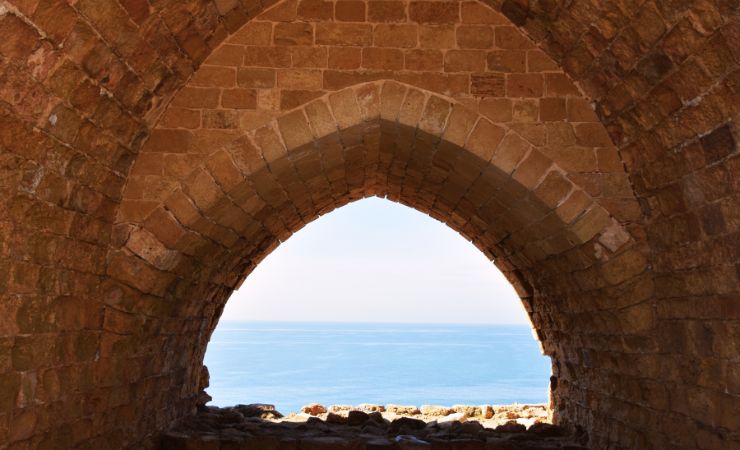
The park occupies a clifftop position on the Mediterranean coast, approximately 15 kilometers north of Tel Aviv and 3 kilometers south of Netanya. Standing at the edge of the ruins, you can see the coastline stretch from Jaffa all the way to Mount Carmel. Access is straightforward via coastal Highway 2, with clear signage to the entrance on the western side of the highway.
Historical Context of Apollonia (Arsuf)
The Phoenicians founded the settlement in the 6th or 5th century BCE, naming it Ashuf after Reshef, the Canaanite god of war and plague. It controlled vital trade routes between Egypt and the northern Levant. When Seleucid Greek influence arrived, the city was renamed Apollonia, linking the local deity Reshef with the Greek god Apollo.
Under Roman rule from the 1st century BCE onward, Apollonia grew into a prosperous commercial port. Workshops processed murex shells to produce the famous Tyrian purple dye, and the city expanded with bathhouses and public buildings. During the Byzantine period (4th to 7th centuries CE), the city, then called Sozusa, reached its peak, covering roughly 70 acres with a population estimated at 10,000 to 15,000 residents.
The Muslim conquest in 640 CE brought renewed strategic importance under the name Arsuf. The city defended the coastal route to Jerusalem and served as a staging point for trade and military campaigns. The most dramatic chapter, however, came during the Crusader period, when the city changed hands repeatedly between 1101 and 1265 CE.
What happened at the Battle of Arsuf?
The Battle of Arsuf on September 7, 1191, marked a pivotal moment in the Third Crusade and established Richard I of England’s reputation as one of medieval Europe’s greatest military commanders. This confrontation between Richard the Lionheart and Saladin’s forces demonstrated the strategic importance of Apollonia’s coastal position in controlling the route to Jerusalem.
Background
Following the successful siege of Acre in July 1191, Richard I commanded approximately 20,000 Crusader troops, including French knights, English infantry, and Hospitaller cavalry. His strategic objective was to secure the coastal route southward to establish a base at Jaffa before attempting an inland march to Jerusalem. Saladin, commanding a similar-sized force of Ayyubid cavalry, Kurdish warriors, and Mamluk soldiers, employed harassment tactics to prevent the Crusader advance and force a decisive battle on terms favorable to his mobile forces.
The march from Acre had taken two weeks, with Saladin’s forces conducting daily raids on the Crusader column. Richard’s army maintained strict formation, with the Knights Templar leading the vanguard, followed by Angevin and Poitevin forces, then the supply train protected by crossbowmen and infantry. The Knights Hospitaller formed the rear guard, bearing the brunt of constant Muslim attacks.
Richard’s Strategy Won the Battle
Richard employed a defensive formation that maximized his army’s strengths while negating Saladin’s advantages in cavalry mobility. The Crusader army marched parallel to the Mediterranean shore, with their right flank protected by Richard’s fleet providing supplies and communication. This coastal route prevented Saladin from launching flanking attacks and forced him to assault the disciplined Crusader formation head-on.
The English king demonstrated exceptional tactical discipline by restraining his heavy cavalry from premature charges despite intense provocation. For hours, Saladin’s mounted archers peppered the Crusader lines with arrows while launching feinted attacks designed to break their formation. Richard’s soldiers maintained their protective shields and crossbow volleys while waiting for the decisive moment when Saladin’s forces would be committed and vulnerable.
When Muslim forces finally pressed their attack too close to the Crusader lines, Richard unleashed his carefully coordinated cavalry charge. The combined impact of Hospitaller knights from the rear and Templar cavalry from the front caught Saladin’s army in a devastating pincer movement. The disciplined charge shattered the Ayyubid formation and forced them to retreat toward the hills inland from Arsuf.
Aftermath
The Battle of Arsuf delivered a crucial psychological victory for the Crusaders while demonstrating that Saladin’s forces were not invincible. Richard’s tactical brilliance preserved his army’s strength for future campaigns while securing the coastal route essential for maintaining supply lines from Europe. Although the victory did not immediately lead to Jerusalem’s recapture, it established Crusader control over the vital ports and strengthened their negotiating position in subsequent diplomatic efforts. The battle’s success also enhanced Richard’s legendary status and proved that disciplined European heavy cavalry could triumph over Muslim light cavalry when properly deployed and commanded.
What can you see inside Apollonia National Park?
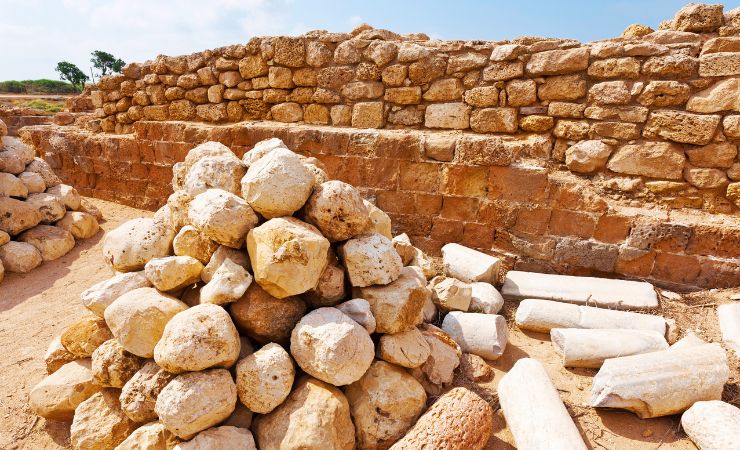
Crusader Castle — The Knights Hospitaller built this fortress between 1241 and 1265 CE, and its massive donjon measures 38 meters square, constructed from local kurkar sandstone blocks weighing several tons each. Stone projectiles from mangonels are still embedded in the walls, and a dramatic breach in the eastern wall shows exactly where Mamluk undermining brought the defenses down in 1265. Tel Aviv University excavations revealed that the Hospitallers built on earlier Byzantine foundations, incorporating Roman materials throughout.
Roman Villa Complex — In the southern sector of the park, excavations uncovered a 2nd-to-3rd century CE villa with mosaic floors displaying geometric patterns and marine motifs, you can walk alongside them today. Hypocaust heating channels run beneath the floors, and fragments of imported marble columns suggest the owner was a wealthy merchant or Roman administrator. The villa’s industrial wing held stone vats for murex shell processing, and chemical residue confirms Tyrian purple dye production on site.
Phoenician and Persian Layers — Stratigraphic digs expose the site’s earliest occupation from the 6th century BCE, including inscribed pottery shards, bronze figurines of Reshef, and stone anchors that confirm early maritime commerce. Persian-period finds (539 to 332 BCE) include distinctive egg-shaped storage jars and silver coins bearing the inscription “Arsuf,” making the chronology unusually legible for visitors willing to read the interpretive panels.
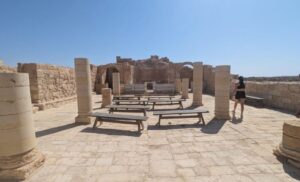
Byzantine Basilica — The foundations of a three-nave basilica measuring 45 meters in length mark Apollonia’s golden age under the name Sozusa. Lead seals bearing official Byzantine titles found here indicate the city functioned as a regional administrative center controlling coastal trade between Gaza and Caesarea. The sheer footprint of the structure communicates the city’s ambition during this period more clearly than any label can.
Crusader Town and Market Street — Beyond the castle walls, Crusader engineers laid out a planned town with a market street lined by shops, residential quarters, and metalworking workshops. Artifacts here reflect a genuinely multicultural population: Frankish, Armenian, Greek, and Arab communities all left material traces. Coin hoards containing Crusader bezants, Islamic dinars, and Byzantine solidi found at the site reveal the complex monetary economy that sustained Arsuf across its Crusader decades.
Multilayered Fortifications — Apollonia’s defensive system is one of the most complete examples of medieval military architecture in the Levant. Three concentric lines of fortification surround the site, including an outer wall stretching 800 meters with 14 rectangular towers and a moat carved 15 meters into bedrock. Inner citadel walls reach 4 meters thick, engineered to resist counterweight trebuchets. Sally ports allowed defenders to launch surprise raids on besieging forces, a detail that makes the 1265 Mamluk siege all the more remarkable.
Reconstructed Siege Engines — A working replica ballista stands at the site, giving visitors a physical sense of the firepower both sides brought to Apollonia’s final siege. Standing next to it, the scale of the castle walls looks different than it does from the walking trail alone.
Practical Information
Opening Hours — The park is open Sunday through Thursday and Saturday from 8:00 am to 5:00 pm (last entry 4:00 pm), and Friday from 8:00 am to 4:00 pm (last entry 3:00 pm). Hours extend by one hour during summer months (April through September). The park is closed on Yom Kippur.
Admission — Adult entry costs around 28 NIS; children under 5 enter free. Israel Nature and Parks Authority annual pass holders enter at no additional charge. Check the Israel Nature and Parks Authority website for current pricing before your visit.
How Long to Allow — A self-guided walk through the main areas takes 2 to 3 hours. Reading every interpretive panel or joining a guided tour adds another hour.
Additional Information
What is Apollonia National Park known for?
Apollonia National Park preserves the ruins of Arsuf, a coastal city occupied from the 6th century BCE through 1265 CE. It is best known for its Crusader fortress built by the Knights Hospitaller, Roman mosaic floors, Byzantine basilica foundations, and its role in the 1191 Battle of Arsuf during the Third Crusade.
Where was Arsuf?
Arsuf stood on Mediterranean cliffs roughly 15 kilometers north of Tel Aviv and 3 kilometers south of Netanya. The ruins are preserved today inside Apollonia National Park, accessible from coastal Highway 2 on Israel’s Sharon coast.
What happened at the Battle of Arsuf in 1191?
On September 7, 1191, Richard I of England defeated Saladin’s Ayyubid forces near Arsuf during the Third Crusade. Richard’s coordinated cavalry charge shattered Saladin’s formation, secured the coastal route to Jaffa, and established Richard’s reputation as a leading medieval military commander.
Who destroyed Apollonia, and when?
Mamluk Sultan Baibars conquered and destroyed Apollonia in 1265 CE, ending centuries of continuous occupation. The rapid abandonment after the siege preserved organic materials, pottery, and metalwork that archaeologists continue to study today.
Who is the largest national park in the world?
Northeast Greenland National Park is the largest national park in the world, covering about 972,000 square kilometers. Apollonia National Park is a compact coastal site in Israel, significant for its archaeological depth rather than its size.
How long does a visit to Apollonia National Park take?
A self-guided visit takes 2 to 3 hours. Visitors who join a guided tour or read every interpretive panel should allow 3 to 4 hours. Summer visits may coincide with active Tel Aviv University excavation seasons, adding extra interest.
Nearby Sites
Sydna Ali Mosque: The Sydna Ali Mosque is a historical and religious landmark that was built in the 15th century. This mosque commemorates Ali Ibn Alim, a revered Muslim warrior believed to have fallen during a battle against the Crusaders.
Caesarea: A grand port city built by Herod the Great. You will be able to explore the Roman amphitheater, aqueducts, and the underwater archaeological park.
Tel Aviv Port: Known locally as “Namal Tel Aviv,” the Tel Aviv Port is a bustling waterfront area in Israel’s vibrant city that offers a mix of shopping, dining, and entertainment options.
Keep reading
Part of our Central Israel Guide →