Habima Square is a major public plaza in central Tel Aviv, home to the Habima National Theatre (Israel's national theatre), the Charles Bronfman Auditorium (home of the Israel Philharmonic Orchestra), and the Eyal Ofer Pavilion for Contemporary Art. Its buildings form part of Tel Aviv's UNESCO White City heritage site.
Habima Square is a major public plaza in central Tel Aviv, home to three of Israel’s most significant cultural institutions and part of the city’s UNESCO White City World Heritage Site, inscribed in 2003. Bring your coffee, find a bench by the Sunken Garden in the afternoon, and let the square come to life around you, that is when families fill the paths, the reflecting pool catches the light, and the place reveals what it actually is.
What Is the History Behind Habima Square?
The square’s origins trace to 1925, when British urban planner Patrick Geddes drew up Tel Aviv’s first master plan and designated this precise location as the city’s cultural core. Geddes envisioned a modern Acropolis, a cluster of arts institutions anchoring civic life, while the nearby Dizengoff Square would serve commerce. If can confidently be said that nine decades later, plan has been followed with striking fidelity.
The theatre that names the square has older roots. The Habima Theatre was founded in 1912 as an amateur troupe by Nahum Lazarevich Tsemakh in Bialystok, then part of the Russian Empire. Because its productions were performed entirely in Hebrew and drew on Jewish folk tradition, Russian authorities banned it. From 1918, the troupe worked under the Moscow Art Theatre, gaining professional training and artistic credibility before the decision was made to relocate to Mandatory Palestine. The company settled permanently in Tel Aviv in 1931.
The cornerstone of the Habima Theatre building was laid in 1935 and completed in 1945. In 1958, Prime Minister David Ben-Gurion’s government formally declared Habima to be Israel’s national theatre. The broader arts complex includes the Helena Rubinstein Pavilion (opened in 1959), and the Culture Palace, Heichal HaTarbut, was inaugurated as the permanent home of the Israel Philharmonic Orchestra in 1957.
Between 2005 and 2013, internationally recognized Israeli sculptor Dani Karavan redesigned the public plaza to mark Tel Aviv’s centenary.
In recent decades the square has also become a register of Israeli public life and mass protests again the government.
What Can You See Inside Habima Square?
Habima National Theatre — Designed by Oscar Kaufmann with its cornerstone laid in 1935 and the building completed in 1945, the theatre was fully renovated and reopened in 2012. The complex holds four performance halls: the Rovina Hall (930 seats), the Meskin Hall (320 seats), the Bertonov Hall (220 seats), and the Blanche Rapaport Hall (170 seats). Many productions offer simultaneous English subtitles, making performances accessible to international visitors. The restored facade is a textbook example of the White City style, horizontal banding, ribbon windows, and an unadorned white exterior.
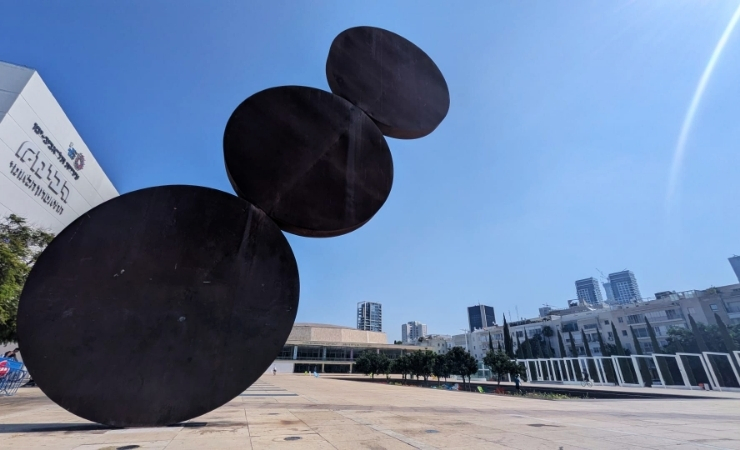
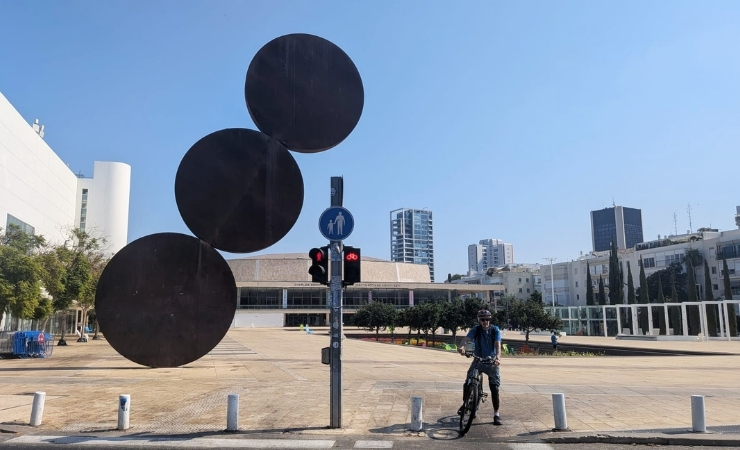
Three Circles Sculpture — The visual landmark of the square is the Three Circles sculpture by Israeli artist Menashe Kadishman, created between 1967 and 1976. Three giant steel discs are balanced one atop another at an angle, a minimalist structure that achieves a striking sense of precarious weight. During the period when Israel held hostages in Gaza, the three-circle structure was painted yellow as part of the public protest calling for their return, a vivid transformation of public art into civic expression.
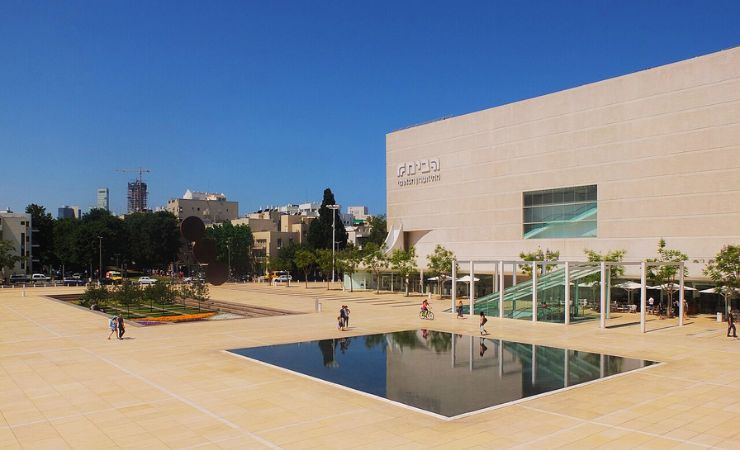
Charles Bronfman Auditorium — Inaugurated in 1957 as the Fredric R. Mann Auditorium and The auditorium was extensively renovated before reopening in 2013, this is the largest concert hall in Tel Aviv and the permanent home of the Israel Philharmonic Orchestra. Its presence on the square explains the plaza’s official alternative name, Kikar HaTizmoret, meaning the Orchestra Plaza.
Eyal Ofer Pavilion for Contemporary Art — Established in 1952 as the Helena Rubinstein Pavilion and subsequently renamed, this pavilion operates as an annex of the Tel Aviv Museum of Art. It mounts rotating exhibitions of Israeli and international contemporary work throughout the year.
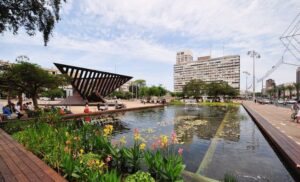
Sunken Garden and Reflecting Pool — A sunken garden descends below street level and creates a quiet enclosure within the surrounding urban activity. The garden is at the same location where Danny Karavan’s father, Avraham Karavan who was the city’s official landscape designer maintained the municipal nursery in the 1950s. Sandboxes incorporated into the design reference the original sand dunes on which early Tel Aviv was built. Sit here in the afternoon and the square fills with families, people catching up over coffee, and the kind of unhurried city life that makes this one of Tel Aviv’s genuinely pleasant stops.
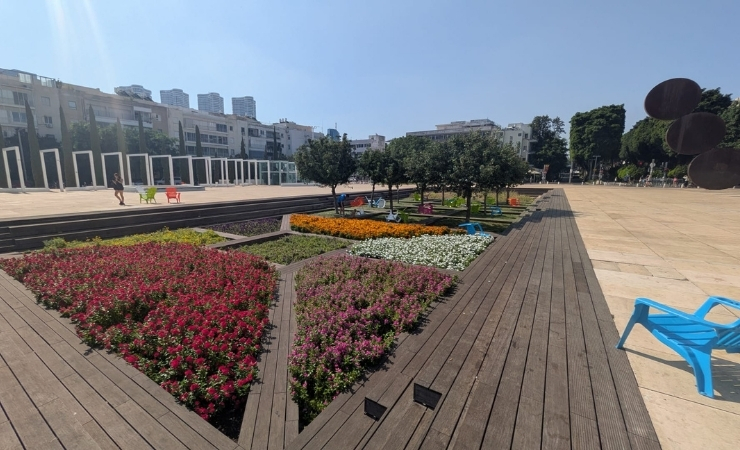
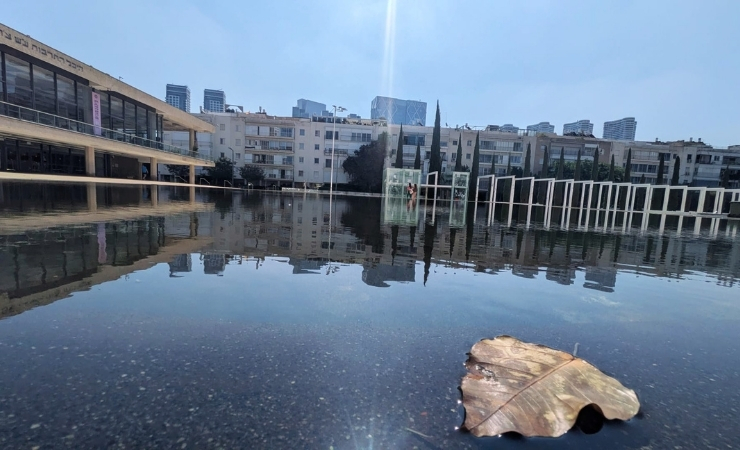
Dani Karavan’s Steel Arches — A series of white steel arches lines the western edge of the square, forming a visual corridor that connects the plaza to Rothschild Boulevard to the southwest. Characteristic of Karavan’s environmental sculpture practice, the arches are geometric, site-specific, and meant to be experienced as part of the broader landscape. Check out the beautiful and clean geometric shadows they cast across the paving in the morning if you are there.
Gan Yaakov — Tucked alongside the square, this two-level park is shaded by ancient sycamore trees . Its organic informality offers a quiet counterpoint to the geometric precision of Karavan’s plaza. The dense canopy provides genuine relief on a hot Tel Aviv afternoon. Go there to experience the contrast between the garden’s naturalistic character and the surrounding modernist architecture.
What Should You Know Before You Visit?
The square is exposed, with limited shade across much of the open plaza, do not underestimate the Mediterranean sun, especially between 10 a.m. and 3 p.m. The afternoon and evening are the best times to visit, when the energy shifts and the square becomes a genuine public living room rather than a transit point between buildings.
Just across the road from the square, Tony Vespa’s pizza at 140 Rothschild blvd. is worth a stop. You pay by the size of the slice, and the quality is outstanding, a simple, reliable meal before or after a performance or gallery visit.
The Habima National Theatre website at habima.co.il/en lists current productions and ticket availability, with English-language navigation. The Eyal Ofer Pavilion operates as part of the Tel Aviv Museum of Art, and its exhibitions calendar is listed there.
Additional Information
Where is Habima Square located in Tel Aviv?
Habima Square sits in central Tel Aviv at the junction of several major cultural arteries, with Rothschild Boulevard extending to its southwest and Dizengoff Street nearby to the north. The nearest cross streets and bus routes make it straightforward to reach from most parts of the city on foot or by public transit.
Who designed the public plaza at Habima Square?
Israeli sculptor Dani Karavan (1930 to 2021) redesigned the plaza between 2005 and 2013, commissioned to mark Tel Aviv’s centenary. Karavan won the Israel Prize for sculpture in 1977. His father, Avraham Karavan, had previously served as the city’s official landscape designer and worked the very ground where the plaza now stands.
Is Habima Square accessible for visitors with mobility needs?
The plaza surface is largely flat and paved, making it navigable for wheelchair users and those with limited mobility. Both the Habima National Theatre and the Charles Bronfman Auditorium underwent significant renovations that included accessibility improvements. It is advisable to contact each venue directly to confirm specific accessibility provisions before your visit.
Can international visitors attend performances at the Habima National Theatre?
Yes. Many Habima National Theatre productions offer simultaneous English subtitles via a personal receiver system available at the box office. The theatre’s four halls range from 170 to 930 seats, so productions vary considerably in scale and intimacy. Booking in advance through the theatre’s English-language website is recommended.
Nearby Sites
- Rothschild Boulevard: Extends southwest from Habima Square and is one of the most architecturally significant streets in Tel Aviv, lined with some of the finest examples of Bauhaus and International Style buildings in the White City.
- Dizengoff Square: Sits roughly ten minutes north of Habima and was designated in the original Geddes Plan as the commercial counterpart to Habima’s cultural cluster. The square is home to the Fire and Water Fountain, a kinetic sculpture by Yaakov Agam, and is surrounded by well-preserved Bauhaus architecture.
- Sarona: A restored Templer colony turned located a short walk to the southeast, comprising some thirty-odd nineteenth-century stone buildings that once housed a German Protestant agricultural settlement. Today the compound functions as a mix of restaurants, boutiques, and a dedicated market hall.
- Tel Aviv Museum of Art, just a few minutes’ walk from the square. Has permanent collection that spans Impressionism, modern art, and a substantial holding of Israeli work.
Keep reading
Part of our Tel Aviv & Jaffa Guide →