The Suspended Orange Tree Jaffa is a living sculpture by Israeli artist Ran Morin, completed in 1993. A full-grown orange tree grows from a large earthenware vessel suspended one metre above the ground by steel cables in Old Jaffa's Artists' Quarter. It bears real oranges from November to March and is free to visit.
The Suspended Orange Tree Jaffa is a living environmental sculpture by Israeli artist Ran Morin, completed in November 1993 and located at 2 HaTsorfim Street in Old Jaffa’s Artists’ Quarter. A full-grown orange tree grows from a large earthenware vessel suspended roughly one metre above a cobblestone alley by steel cables. The tree bears real fruit every season.
Overview
The Suspended Orange Tree Jaffa — officially titled Oranger Suspendu (French for ‘Suspended Orange Tree’) — is one of Old Jaffa’s most visited public artworks, drawing hundreds of thousands of visitors to the narrow cobblestone lanes of the Artists’ Quarter each year. The French title reflects artist Ran Morin’s international orientation and signals the work’s dual identity: a rooted local landmark and a universal philosophical statement.
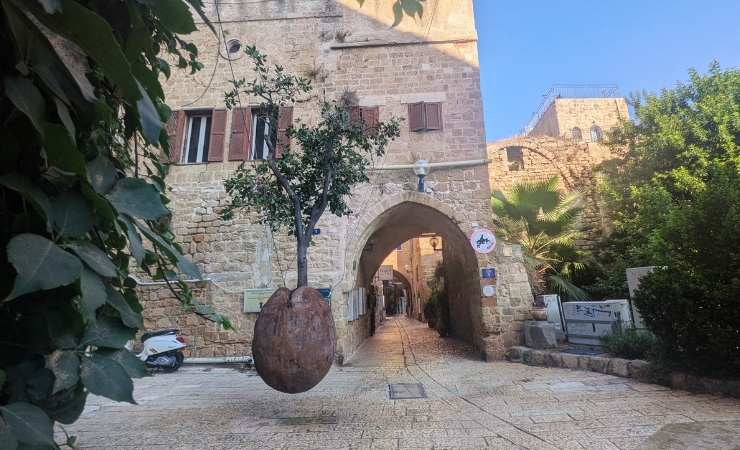
The sculpture stands approximately 5 metres high in total. An orange tree grows from a large terracotta-style vessel — shaped to evoke both a traditional Middle Eastern pitcher and an oversized seed — which hangs suspended about one metre above the ground by steel cables anchored into the stone walls of the flanking buildings. A concealed drip irrigation system keeps the tree alive, and the tree genuinely bears oranges during the November-to-March harvesting season. The City of Tel Aviv-Jaffa officially designated the work a permanent public sculpture in January 1994, two months after its completion.
The work was created by Ran Morin, born in Jerusalem in 1958, who began integrating full-sized living trees into sculptural works in the early 1980s and is now based in New York. Morin calls the Jaffa piece his ‘baby’, describing it as something that ‘came as a flash, representing the end of a whole process.’ The official documentation of the work frames it around the French philosophical pairing of Enracinement–Déracinement — rootedness versus uprootedness — a tension the sculpture makes physically visible.
Historical Background: The Jaffa Orange
The Jaffa orange is known botanically as the Shamouti variety. Arab farmers developed the Shamouti as a natural mutation of the Baladi orange in mid-19th century Palestine, near the port city of Jaffa. The scale of the trade that followed was remarkable: exports grew from approximately 200,000 oranges in 1845 to 38 million oranges by 1870, the same year a German Templer colony first applied the ‘Jaffa’ brand label to exported crates. The full history of the variety is documented on the Jaffa orange Wikipedia page. By the 20th century, the orange had become so closely identified with the region that Tel Aviv-Yafo earned the informal nickname ‘the Big Orange.’ The groves that once surrounded Jaffa have long since disappeared under urban development — a disappearance central to Morin’s artistic intent.
Ran Morin was commissioned to create the work for this setting. He described the piece as referencing ‘the last Jaffa Orange’, the concept of Genius Loci (the spirit of a place), and a lineage of lost landscapes. A local folk legend adds a more grounded layer to the origin story: according to tradition, a local resident had planted an orange tree on municipal land; when an official arrived to cut it down for violating local ordinances, someone raised it off the ground instead — an act of preservation by elevation that the sculpture literalises.
The Jaffa installation’s success immediately generated international interest. Within two years of completion, Morin had created an Acacia Pendulum in Eilat (1995) and an Acer Pendulum in London’s Regent’s Park (1994), as inquiries arrived from institutions around the world seeking similar commissions.
Inside Suspended Orange Tree Jaffa: What to See
Approaching the sculpture along the cobblestone lanes of the Artists’ Quarter, most visitors encounter the Suspended Orange Tree before they fully expect it. The alley narrows, the ancient stone walls close in, and then, hanging in the gap between two buildings, shadowing the paving stones below, is a living tree in mid-air.
What follows are the specific elements that reward close attention.
The Living Orange Tree in Suspension — The tree itself is a full-grown orange (Citrus sinensis), specifically referencing the Shamouti (Jaffa) variety. Its trunk erupts from a crack near the top of the vessel below, as though splitting the clay apart through sheer upward pressure. The canopy spreads naturally above, unconfined. Between November and March, the tree carries real small, round, oranges that are vivid against the pale stone of the surrounding buildings. A concealed drip irrigation system, invisible from ground level, has sustained the tree since 1993, making this one of the longer-lived living artworks in public space anywhere in the region.
The Earthenware Vessel — The large pot from which the tree grows is a sculptural work in its own right. Shaped to suggest simultaneously a womb, a seed, and a traditional Middle Eastern water jug, the vessel is constructed from a steel armature coated in ground stone and pigments, giving it the texture and warmth of terracotta. Its cracked where the tree’s trunk forces through. This crack is an intentional element, symbolising natural life breaking through human-made containment.
The Steel Cable Suspension System — Four steel cables anchor the vessel to the stone walls of the flanking buildings, holding the entire assembly, pot, soil, root system, and tree, suspended in the gap between structures. The cables are visible and unadorned, an engineering statement as much as an aesthetic one.
HaTsorfim Street Cobblestone Setting — The narrow cobblestone alley, the restored Ottoman and Crusader-era stonework of the flanking buildings, and the zodiac-named lanes radiating outward all form the visual and historical context against which the hanging tree reads as both ancient and entirely contemporary.
The Surrounding Artists’ Quarter — Immediately around the Suspended Orange Tree, the alleys of Old Jaffa’s Artists’ Quarter contain galleries, artists’ workshops, and studios that have occupied the restored buildings since the municipality’s 1960s renewal project.
Practical Information for Visiting
The Suspended Orange Tree Jaffa is a permanent outdoor public sculpture accessible at all hours, every day of the year, at no charge. The address is 2 HaTsorfim Street (also referred to as Mazal Ari Street), Old Jaffa, Tel Aviv-Yafo. The piazza has been closed to private vehicles since 1995; the nearest parking is along the Jaffa waterfront, a five-minute walk downhill. The fruit-bearing season runs from November through March — visiting during these months gives the best chance of seeing the tree carrying oranges.
Additional Information
- Suspended Orange Tree Jaffa — Official Website — Official site
- Ran Morin – Wikipedia — Biographical details of Ran Morin (born 1958), and his other major works (Olive Columns, Ramat Rachel).
- Jaffa orange – Wikipedia — Historical background of the Jaffa (Shamouti) orange providing the cultural context for Morin’s sculpture.
Frequently Asked Questions
What exactly is the Suspended Orange Tree in Jaffa?
The Suspended Orange Tree Jaffa is a living environmental sculpture created by Israeli artist Ran Morin, completed in November 1993. A full-grown orange tree grows out of a large earthenware vessel suspended approximately one metre above a cobblestone alley by steel cables anchored to the walls of flanking stone buildings. The entire installation stands roughly 5 metres high.
Who created the Suspended Orange Tree and what does it mean?
The sculpture was created by Ran Morin, an Israeli environmental sculptor born in Jerusalem in 1958, who began integrating full-sized living trees into artworks in the early 1980s and is now based in New York. The work’s central theme is what Morin frames as Enracinement–Déracinement — rootedness versus uprootedness.
Nearby Sites
- St. Peter’s Church in Jaffa: A Franciscan church built in 1654 on the site where, according to tradition, the Apostle Peter stayed with Simon the Tanner — a five-minute walk from the Artists’ Quarter.
- St. Nicholas Armenian Church in Jaffa: A historic Armenian church in the heart of old Jaffa, representing centuries of Armenian presence in the port city.
- Ilana Goor Museum: An 18th-century caravanserai turned museum holding over 500 works by sculptor Ilana Goor, located within walking distance of the Suspended Orange Tree in the Artists’ Quarter.
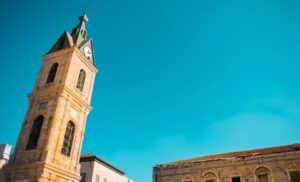
- Jaffa Clock Tower: An Ottoman-era landmark built in 1906 to mark the 25th anniversary of Sultan Abdul Hamid II’s reign, standing at the northern entrance to Old Jaffa near the main square.
- Jaffa Port (Namal Yafo): One of the oldest working ports in the world, now a mixed-use seafront area with restaurants, weekend markets, and boat trips, less than ten minutes’ walk from the sculpture.
Keep reading
Part of our Tel Aviv & Jaffa Guide →