Rabin Square is Tel Aviv's main public city square, covering approximately 4 acres in the center of the city. Formerly called Kings of Israel Square, it was renamed in 1995 after Prime Minister Yitzhak Rabin was assassinated there. It holds an assassination memorial, a Holocaust monument by Yigal Tumarkin, and Tel Aviv City Hall.
Rabin Square (Hebrew: כיכר רבין, Kikar Rabin), originally named Kikar Malkhey Yisrael (Kings of Israel Square) the plaza was redesignated Rabin Square in November 1995 following the assassination of Prime Minister Yitzhak Rabin at the site. It is the country’s premier venue for civic gatherings, political protests, and national commemorations. The square sits on the northern edge of central Tel Aviv, anchored on its northern side by the imposing Brutalist facade of Tel Aviv City Hall.
Historical Background
Rabin Square has served as Tel Aviv’s civic heart since the mid-1960s, but the land itself carries a longer history. During the British Mandate period in the early twentieth century, the area was covered with orchards. As the city expanded rapidly in the late 1940s, those orchards disappeared, and an irrigation pool on the site was repurposed as Tel Aviv’s first municipal swimming pool. That pool was demolished when construction of City Hall began, and the square was designed alongside the building in 1964 by architects Yaski and Alexandroni.
From its earliest years, the square functioned as Israel’s default gathering point for mass public events. Until the early 1990s, Yom Ha’atzmaut — Israel’s Independence Day — was marked here with open-air exhibitions of IDF field units, including armor and heavy artillery. In 1982, the square demonstrated its capacity for civic dissent when over 400,000 people gathered to protest the Lebanon War, one of the largest demonstrations in Israeli history.
The defining moment came on the evening of November 4, 1995. A peace rally held under the slogan “Yes to Peace, No to Violence,” attended by more than 100,000 people, filled the square in support of the Oslo Accords. At 21:30, as Prime Minister Yitzhak Rabin descended the steps of City Hall following the rally, he was shot by Yigal Amir, an Israeli law student and far-right ultranationalist. Rabin died of his wounds shortly afterward at Ichilov Hospital. The assassination sent shockwaves through Israeli society and beyond.
In the days that followed, thousands of young Israelis came to the square spontaneously, lighting candles and covering the City Hall wall with handwritten messages of grief. This generation became known in Hebrew as the “Candle Youth” — Dor Haneirot — a phrase that entered the cultural vocabulary of modern Israel. The square was renamed Kikar Rabin within weeks, and a permanent memorial was established at the precise spot where he fell. The annual Yitzhak Rabin Memorial, held on the weekend closest to November 4, now draws an average of 100,000 visitors each year, making it one of the largest recurring events in Tel Aviv.
One detail from that night has become an enduring symbol. In Rabin’s pocket at the time of the assassination was a blood-stained sheet of paper containing the lyrics to “Shir LaShalom” — the Song for Peace — sung by the crowd at the rally just moments before he was shot. The paper is now on display at the Rabin Center in Tel Aviv and reproduced widely in Israeli classrooms and commemorations.
Inside Rabin Square Tel Aviv: What to See
Rabin Square rewards visitors who take time to move through it deliberately rather than simply crossing it on the way to somewhere else. The northern end is dominated by the weight of City Hall and the assassination memorial below it. The southern end offers the sculptural gravity of the Holocaust monument and the quieter pleasures of the ecological pool. Between them, the open plaza itself — busy with cyclists, dog walkers, schoolchildren on field trips, and office workers eating lunch — gives an honest picture of daily Tel Aviv life.
Each element of the square carries its own distinct character, and the contrast between them is part of what makes the space meaningful. A morning visit allows you to read the engraved speech on the City Hall steps in relative quiet. An evening visit transforms the building’s facade into a canvas of colored light. The full circuit of the square, including time at each memorial, takes approximately 45 to 60 minutes.
Rabin Assassination Memorial — Located at the northeast corner of the square, directly below Tel Aviv City Hall, this sunken memorial marks the precise spot where Prime Minister Rabin was shot on November 4, 1995. The memorial incorporates broken basalt rocks chosen to symbolize the rupture caused in Israeli society by the killing — a country cracked open by violence from within. Preserved sections of the original graffiti and handwritten condolence messages left on the City Hall wall in the days following the assassination have been incorporated into the site, giving it a raw, unpolished quality that sets it apart from more formal national monuments. Visiting this corner on a quiet weekday afternoon, it is not unusual to find Israelis standing in silence, some of whom were present at the rally in 1995.
Engraved Final Speech on the City Hall Steps — At the top of the staircase leading to the Tel Aviv City Hall entrance, Rabin’s final speech — delivered from this very spot minutes before his assassination — is engraved in stone in three languages: Hebrew, Arabic, and English. The choice of all three languages was deliberate, reflecting the peace-oriented message of the Oslo process he had championed. Reading the words while standing on the same steps where he stood gives the inscription an immediacy that a museum display cannot replicate. The speech is brief, and visitors are encouraged to read it in full before descending to the memorial below.
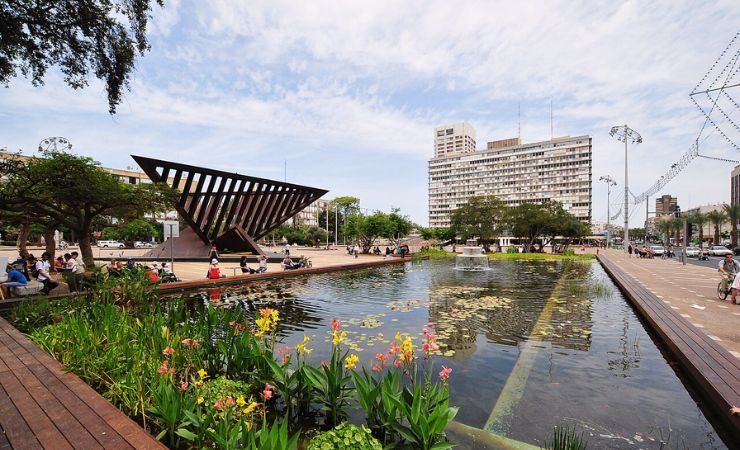
“Lashoa Velagvora” Holocaust Memorial — Standing at the southern end of the square, this striking sculpture was created by Israel Prize–winning artist Yigal Tumarkin in 1975. Its title translates as “Monument to the Holocaust and Revival.” The work takes the form of an inverted pyramid constructed from rusty iron and glass, and when viewed from certain angles or from above, it resolves into the shape of a Star of David. Tumarkin described the piece as mapping the journey from darkness and oppression toward renewal — a trajectory embedded in the physical form itself, with the inverted weight suggesting both collapse and defiant resistance. The choice of corroded iron gives the surface a texture that reads as aged, scarred, and deliberately unbeautiful.
Ecological Pool and Reflecting Garden — Added during a renovation in 2010, this ornamental pool sits adjacent to the Tumarkin monument at the square’s southern end. The pool contains koi fish, lotus flowers, papyrus plants, and a small fountain, with interpretive signage explaining the ecological relationships within the system. It functions as a practical pause point — locals frequently bring takeaway coffee from the Ibn Gabirol cafés and sit at the pool’s edge — and provides a meditative counterweight to the heavier memorials nearby. Children are reliably drawn to the koi.
Tel Aviv City Hall — The building that defines the northern edge of Rabin Square was designed in the Brutalist style by architect Menachem Cohen and completed in the mid-1960s. Its facade contains 720 windows, a feature that becomes visually dramatic when the building is illuminated at night with LED light displays for national holidays, international solidarity events, and civic occasions. The building has been lit in the colors of the French tricolor, the Ukrainian flag, and the rainbow flag of LGBTQ Pride, among others — each illumination generating its own news cycle. As an example of mid-century Brutalist civic architecture, it is also of genuine interest to architecture enthusiasts. Tel Aviv City Hall remains a functioning municipal building, and its steps serve as the symbolic threshold between the city’s government and its public square.
Ibn Gabirol Street Promenade — Flanking the eastern side of the square, Ibn Gabirol Street is one of central Tel Aviv’s main social boulevards. The stretch adjacent to Rabin Square is lined with cafés, bars, restaurants, and boutiques operating at most hours of the day. It offers an easy transition from the reflective atmosphere of the memorials to the ordinary rhythms of a modern Israeli city, and most visitors find themselves stopping here before or after walking the square. The promenade is at its most animated on Friday afternoons, when the pre-Shabbat energy of the city is palpable.
Practical Information
Rabin Square is an open public space with no admission charge and no opening hours, it is accessible at all times.
Additional Information
- Rabin Square – Wikipedia — Overview of the square’s history, design, memorials, and renaming following the 1995 assassination
- Assassination of Yitzhak Rabin – Britannica — Authoritative account of the November 4, 1995 assassination at Kings of Israel Square, including political context and aftermath
- Thousands attend Rabin memorial rally, 25 years after assassination – Times of Israel — News coverage of the annual commemoration events at the square and the legacy of the ‘Generation of Candles’
- Tel Aviv City Hall – Wikipedia — History and architectural details of the Brutalist City Hall building that defines the northern edge of Rabin Square
Where exactly is Rabin Square located in Tel Aviv?
Rabin Square sits on Ibn Gabirol Street in central Tel Aviv, directly in front of Tel Aviv City Hall. The square is bordered by Ibn Gabirol Street to the east. The square is roughly 2 kilometers north of Tel Aviv’s main beachfront hotels. It is also within easy reach of the Dizengoff Center shopping district and the Yarkon Park area to the north.
What is the Rabin assassination memorial, and what does it look like?
The Rabin assassination memorial is a sunken monument at the northeast corner of the square, marking the precise spot where Prime Minister Yitzhak Rabin was shot on November 4, 1995. It incorporates broken basalt rocks chosen to represent the rupture caused in Israeli society by the killing. Sections of the original handwritten condolence messages and graffiti left on the City Hall wall in the days following the assassination have been preserved as part of the memorial.
Who created the Holocaust memorial in Rabin Square, and what does it represent?
The Holocaust memorial in Rabin Square, titled “Lashoa Velagvora,” meaning “Monument to the Holocaust and Revival” was created by Yigal Tumarkin, one of Israel’s most prominent sculptors and a recipient of the Israel Prize. Completed in 1975, the work takes the form of an inverted pyramid made from corroded iron and glass. When viewed from above or certain angles, the structure forms the shape of a Star of David. Tumarkin described the piece as representing the path from darkness and persecution toward national renewal.
When does the annual Rabin Memorial rally take place, and what happens?
The annual Yitzhak Rabin Memorial rally is held on the weekend closest to November 4, the date of the 1995 assassination, each year. Speakers typically include political figures, family members, and cultural personalities, and the evening concludes with a performance of “Shir LaShalom”, the Song for Peace, the same song sung at the 1995 rally moments before Rabin was shot.
Nearby Sites
- Neve Tzedek — One of Tel Aviv’s oldest neighborhoods, sitting roughly 2 kilometers south of Rabin Square.
- Dizengoff Center — A short walk southwest of the square, this landmark 1970s shopping complex was one of the first covered malls in Israel.
- Yarkon Park — Tel Aviv’s largest urban park lies approximately 1.5 kilometers north of Rabin Square along the Yarkon River. Locals use it daily for cycling, rowing, and picnicking.
- Tel Aviv Port (Namal Tel Aviv) — A renovated working port turned leisure district, around 2 kilometers northwest of the square.
Keep reading
Part of our Tel Aviv & Jaffa Guide →