Perched on the western slope of Mount Herzl, the World Holocaust Remembrance Center commands a solemn presence across 45 acres of Jerusalem’s Mount of Remembrance. This extraordinary institution, known as Yad Vashem Jerusalem, serves as both a guardian of memory and a beacon of education, housing the world’s most comprehensive collection of Holocaust documentation and testimony.
The name itself carries profound biblical significance, drawn from the prophet Isaiah’s promise: “And to them will I give in my house and within my walls a memorial and a name (yad vashem)… that shall not be cut off.” In Hebrew, yad means “hand” or “monument” and shem means “name,” together forming “a memorial and a name” — a fitting designation for this sacred space dedicated to preserving the memory of the six million Jews murdered during the Holocaust.
Historical Background
The establishment of Yad Vashem on August 19, 1953, through the Yad Vashem Law passed by Israel’s Knesset represented one of young Israel’s earliest and most significant commitments to Holocaust remembrance and education. The Israeli Parliament, just five years after Israel’s independence, recognized the urgent need to collect, preserve, and share the testimonies and artifacts of the Holocaust before survivors’ voices were lost to time. This groundbreaking legislation established the institution’s dual mandate: to commemorate the Holocaust and educate future generations about its lessons.
The institution’s foundation was deeply influenced by key figures in Israeli society, including historian Ben-Zion Dinur, who served as Israel’s first Minister of Education, and Mordecai Shenhavi, a kibbutz member who first proposed the concept of a Holocaust memorial in 1942. Their vision extended beyond simple commemoration to encompass comprehensive research, documentation, and educational outreach on an international scale.
Located strategically on Har HaZikaron (Mount of Remembrance), the site’s positioning holds deep symbolic meaning within Jerusalem’s landscape. The choice of location reflects the Jewish principle of remembrance woven into the very fabric of the eternal city, creating a space where personal memory intersects with collective history. The mountain’s western location provides visitors with panoramic views of the Jerusalem Hills, symbolically connecting the trauma of the past with the hope of Jewish renewal in the ancient homeland.
The initial memorial structures, constructed between 1957 and 1961, began with the Hall of Remembrance, designed by architects Arieh Elhanani, Arieh Sharon, and Benjamin Idelson. This stark, tent-like structure established the austere architectural language that would characterize early Holocaust memorialization. The 1960s and 1970s witnessed the addition of the Avenue of the Righteous Among the Nations (1962) and the Children’s Memorial, originally dedicated in 1987 through the generous donation of Abraham and Edita Spiegel in memory of their two-year-old son Uziel.
Over the decades, Yad Vashem has evolved from a modest memorial into the world’s preeminent Holocaust research and education center. The institution’s mission expanded dramatically during the 1980s and 1990s beyond commemoration to encompass comprehensive documentation, research, and the training of educators worldwide. The Valley of the Communities, inaugurated in 1992, represented a revolutionary approach to Holocaust memorialization by honoring entire Jewish communities rather than focusing solely on individual victims.
The opening of the new Holocaust History Museum in March 2005, designed by renowned architect Moshe Safdie, marked a transformative moment in Holocaust education and memorial architecture. This $56 million project took fifteen years from conception to completion, incorporating cutting-edge museum technology with sensitive memorial design. The museum’s innovative triangular prism design literally pierces through the mountain, symbolizing the way Holocaust memory penetrates through layers of history and consciousness.
Today, the World Holocaust Remembrance Center houses over 169 million pages of documentation, 500,000 photographs, 132,000 survivor testimonies, and 200,000 artifacts, making it the largest repository of Holocaust materials globally. This vast collection continues to grow as researchers uncover new testimonies, photographs, and artifacts that illuminate individual stories within the broader narrative of persecution and survival. The institution’s International Institute for Holocaust Research employs dozens of scholars conducting groundbreaking research into previously unexplored aspects of Holocaust history.
Inside Yad Vashem Jerusalem: What to See
The Holocaust museum Jerusalem offers visitors a profound and carefully orchestrated journey through one of history’s darkest chapters. Each memorial and exhibition space within the complex serves a specific purpose in telling the complete story of the Holocaust while honoring individual victims and survivors. The campus design intentionally creates emotional peaks and valleys, allowing visitors moments of reflection between intense encounters with historical evidence.
Holocaust History Museum
The centerpiece of any Yad Vashem visit, this architectural masterpiece designed by Moshe Safdie presents a prism-like triangular structure that literally penetrates through the mountain. The 4,200-square-meter museum’s linear progression guides visitors chronologically through the Holocaust narrative across ten thematic galleries:
- Pre-War Jewish Life Galleries — Photographs, artifacts, and multimedia presentations documenting the rich diversity of European Jewish communities before 1933, including recreated synagogue interiors, family photographs, and religious artifacts highlighting the vibrancy of Jewish culture across Poland, Germany, Hungary, and other European countries
- Rise of Nazism Exhibition (1933-1939) — Original propaganda materials, Nuremberg Laws documentation, and personal testimonies illustrating the gradual erosion of Jewish rights, featuring actual Nazi propaganda films, boycott signs from Jewish businesses, and identity cards showing the progressive marking of Jewish citizens
- Ghettoization Displays (1939-1942) — Reconstructed ghetto environments, including original street signs from the Warsaw Ghetto, ration cards issued to Jewish residents, clandestine educational materials, and underground newspapers demonstrating cultural resistance amid persecution
- Deportation and Extermination Galleries (1942-1945) — Authentic artifacts from concentration camps, including striped prisoner uniforms, wooden clogs, suitcases bearing victims’ names, and personal belongings confiscated upon arrival at extermination camps
- Resistance and Survival Sections — Documentation of Jewish resistance movements, partisan activities, and individual acts of defiance, featuring weapons used by Warsaw Ghetto fighters, false identity papers, and testimonies from forest partisans
- Liberation and Aftermath Exhibitions (1945-1948) — Allied footage from camp liberations, photographs of displaced persons camps, documentation of war crimes trials, and early immigration certificates to Palestine showing the long path to recovery and renewal
- Interactive Learning Stations — Digital archives allowing visitors to search testimonies, explore pre-war communities through interactive maps, and access educational resources for deeper understanding
- Artifact Preservation Galleries — Climate-controlled displays featuring fragile items such as prisoner artwork, diary pages, and religious objects hidden during the war
- Video Testimony Theaters — Dedicated screening rooms featuring full-length survivor testimonies, liberator accounts, and rare historical footage
- Research and Documentation Center — Visible archives where visitors can observe ongoing preservation work and scholarly research in progress
Hall of Names
This circular memorial chamber, designed by Moshe Safdie and Dorit Harel, features two striking architectural elements that create a powerful space for individual remembrance. The 30-meter-high conical structure rises both above and below ground level, creating a dramatic vertical space for contemplation:
- Upper Cone Display — Contains 600 photographs and testimony fragments of Holocaust victims, carefully selected to represent the diversity of murdered Jewish communities, rotating continuously on mechanized displays to emphasize the vast scope of individual loss while preventing any single image from becoming routine
- Lower Reflective Pool — Mirrors the photographs above while symbolizing the unknown victims whose names remain unrecorded, creating an infinite visual effect that suggests the unmeasurable scope of loss
- Circular Repository Shelves — Houses 2.7 million Pages of Testimony submitted by survivors, family members, and researchers documenting individual Holocaust victims, with dedicated workstations where visitors can search the database and submit new testimonies
- Central Reading Area — Provides quiet spaces for visitors to read individual testimonies, with multilingual access terminals offering translations in dozens of languages
- Memorial Registration Desk — Staffed facility where families can contribute new Pages of Testimony or update existing records with additional information about victims
Children’s Memorial
Perhaps the most emotionally powerful space within the complex, this underground memorial commemorates the 1.5 million Jewish children murdered during the Holocaust. Designed by architects Moshe Safdie and Shmuel Bickels, the memorial creates an otherworldly experience of loss and remembrance:
- Infinite Reflection System — Five flickering candle flames reflected through an intricate system of mirrors create the illusion of millions of stars in complete darkness, each reflected light representing a murdered child’s soul
- Audio Memorial — Continuous recitation of children’s names, ages, and countries of origin in Hebrew, English, and Yiddish, taking approximately three months to complete the full cycle of known names before beginning again
- Darkness and Light Symbolism — Visitors navigate through complete darkness along carefully placed handrails before emerging into Jerusalem’s bright daylight, symbolizing the journey from death to remembrance
- Entrance Corridor — Features enlarged photographs of Jewish children before the war, showing their innocence and vitality before the systematic destruction that followed
- Commemorative Plaques — External markers honoring specific child victims and the families who survived to tell their stories
Avenue of the Righteous Among the Nations
This tree-lined pathway honors the over 28,000 individuals from 51 countries recognized for risking their lives to save Jews during the Holocaust. Established in 1962, this living memorial grows continuously as new cases of rescue are verified through Yad Vashem’s rigorous research process:
- Commemorative Trees — Over 2,000 carob and olive trees planted in honor of verified rescuers, each accompanied by a metal plaque bearing the rescuer’s name and country, with trees selected for their symbolic significance and ability to thrive in Jerusalem’s climate
- Memorial Plaques — Individual markers bearing the names and countries of origin of recognized Righteous Among the Nations, installed along stone retaining walls when tree-planting space became limited
- Garden of the Righteous — Dedicated space featuring the Wall of Honor with names of all recognized rescuers engraved on stone panels, organized by country and continuously updated as new recognition is granted
- National Representation Areas — Specific sections dedicated to rescuers from countries with significant representation, including Poland, Netherlands, France, and Ukraine
- Educational Stations — Interactive displays sharing detailed rescue stories, explaining the criteria for recognition, and highlighting the moral courage required to save Jewish lives
Valley of the Communities
This unique outdoor memorial creates a powerful landscape of memory through its innovative design, carved directly into the natural bedrock of Mount Herzl. Dedicated in 1992, the memorial required extensive excavation and stone carving to create its dramatic topography:
- Excavated Stone Chambers — 100 spaces carved from natural bedrock, each representing different regions of pre-war Jewish Europe, with chamber sizes roughly corresponding to the Jewish population density of each region
- Community Name Engravings — Over 5,000 Jewish communities destroyed or damaged during the Holocaust inscribed on stone walls in both Hebrew and Latin scripts, representing communities from Norway to Greece
- Geographic Organization — Chambers arranged according to the geographic distribution of European Jewish communities, allowing visitors to understand regional patterns of destruction
- Central Pathway — Visitors can walk through the memorial along elevated walkways, experiencing the scale of communal destruction while maintaining overview perspective of the entire memorial landscape
- Research Documentation — Each inscribed community name represents verified historical research, with ongoing efforts to add newly discovered communities to the memorial
Hall of Remembrance
The original memorial structure at Yad Vashem maintains its austere dignity as a space for contemplation and ceremony. Completed in 1961, this tent-like structure designed by Arieh Elhanani, Arieh Sharon, and Benjamin Idelson established the architectural vocabulary for Holocaust commemoration:
- Eternal Flame — Burns continuously above a crypt containing ashes from extermination camps including Treblinka, Sobibor, and Auschwitz-Birkenau, collected immediately after liberation
- Engraved Floor Names — Names of 21 major Nazi extermination camps inscribed in Hebrew and English on dark basalt stone flooring, creating a solemn pathway toward the eternal flame
- Memorial Ceremonies — Site of official state commemorations during Holocaust Remembrance Day, hosting heads of state, diplomatic delegations, and survivor gatherings
- Architectural Elements — Rough-hewn stone walls and minimalist design create an atmosphere of solemnity without overwhelming visitors with decorative elements
- Wreath Laying Area — Designated space for official commemorative ceremonies, with protocol areas for state visits and diplomatic observances
Memorial to the Deportees
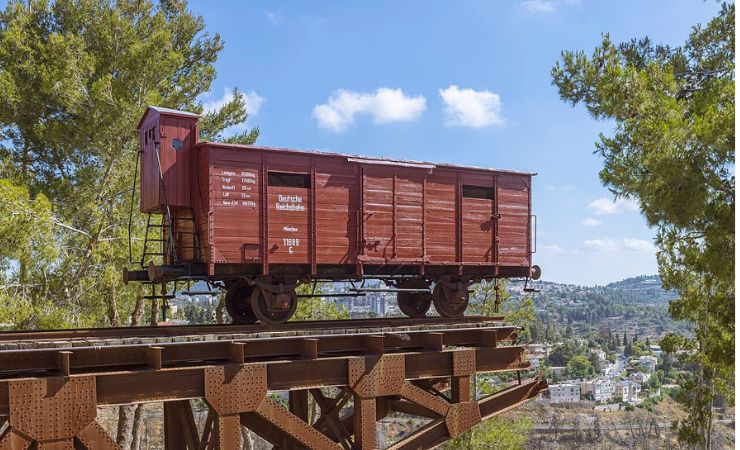
This stark memorial provides a visceral reminder of the transportation that led millions to their deaths. Installed in 1995, the memorial creates a jarring visual impact through its dramatic positioning:
- Original Cattle Car — Authentic railway car used in deportations from Europe, obtained through cooperation with European railway museums and positioned on iron tracks that end abruptly at the mountainside
- Mountainside Placement — Car appears to jut dramatically from the Mount of Remembrance, creating the illusion of a train emerging from the earth itself
- Symbolic Positioning — Overlooks the Valley of the Communities, connecting individual deportation with communal destruction in a single visual field
- Historical Context Displays — Information panels explaining the deportation process, railway system collaboration, and the logistics of mass murder
- Preserved Interior — Visitors can view the interior conditions through secured openings, understanding the dehumanizing conditions of deportation transport
Art Museum
The Art Museum houses the world’s largest collection of artwork created during and in response to the Holocaust, featuring works by both professional artists and untrained prisoners who documented their experiences through visual art:
- Concentration Camp Art — Drawings and paintings created secretly by prisoners, often using improvised materials like burnt wood for charcoal or beet juice for paint
- Ghetto Documentation — Artistic works from major ghettos including Warsaw, Łódź, and Theresienstadt, showing daily life under Nazi restrictions
- Post-War Memorial Art — Works by survivors processing their trauma through artistic expression, spanning multiple decades and artistic movements
- Contemporary Holocaust Art — Modern interpretations and responses to Holocaust themes by artists worldwide, including children and grandchildren of survivors
Synagogue and Religious Artifacts
This sacred space reconstructs elements of destroyed European synagogues while displaying rescued religious artifacts, emphasizing the spiritual dimension of Holocaust remembrance:
- Rescued Torah Scrolls — Religious manuscripts saved from destroyed synagogues, some bearing visible damage from Nazi destruction
- Synagogue Architectural Elements — Original bimah platforms, ark decorations, and religious fixtures from demolished European synagogues
- Religious Resistance Documentation — Materials showing how Jewish communities maintained religious practice under Nazi persecution
- Memorial Prayer Services — Regular religious observances for visitors seeking spiritual connection to Holocaust remembrance.
Practical Information
The World Holocaust Remembrance Center opens Sunday through Thursday from 8:30 AM to 5:00 PM, with extended hours until 8:00 PM on Thursdays during summer months. Friday hours are 8:30 AM to 2:00 PM, and the site remains closed on Saturdays and Jewish holidays. Admission is free, though advance online reservations are recommended for the Holocaust History Museum during peak visiting periods.
Located at Har Hazikaron, Mount Herzl, Jerusalem, the complex is accessible via Jerusalem Light Rail to Mount Herzl station, followed by a brief walk uphill. The official Yad Vashem website provides detailed visitor information and educational resources. Allow a minimum of three to four hours for a comprehensive visit, though many visitors find they need significantly longer to fully absorb the exhibits and memorials.
Nearby Sites
- Mount Herzl National Cemetery — Israel’s national cemetery containing the graves of Theodor Herzl, prime ministers, and fallen soldiers.
- Herzl Museum — Interactive museum dedicated to the life and vision of Zionism’s founder, Theodor Herzl.
- Jerusalem Forest — Extensive woodland area offering hiking trails and picnic areas on Jerusalem’s western hills.
- Ein Karem — Historic village known as the traditional birthplace of John the Baptist, featuring ancient churches, Meriam’s Well, and artist galleries.
- Hadassah Medical Center Ein Karem — Home to Marc Chagall’s famous stained glass windows depicting the Twelve Tribes of Israel.
Keep reading
Part of our Jewish Heritage Guide →