Ben-Gurion's Tomb National Park is a free, open-access national park near Kibbutz Sde Boker in the Negev Desert, where Israel's first Prime Minister David Ben-Gurion and his wife Paula are buried at the edge of Zin Canyon. The site is open 24/7.
Ben-Gurion’s Tomb National Park is a national park in the Negev Desert, located next to Midreshet Ben-Gurion (Ben-Gurion College) near Kibbutz Sde Boker. The park was established around the grave plot where Israel’s first Prime Minister David Ben-Gurion and his wife Paula are buried, at the edge of a cliff overlooking the canyon of Nahal Zin. Admission is free and the site is open around the clock.
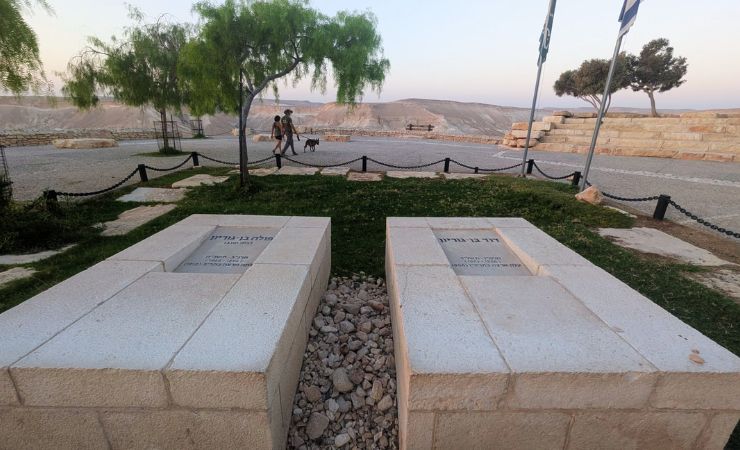
Overview
Ben-Gurion’s Tomb National Park sits at the southern boundary of the academic campus of Midreshet Ben-Gurion, approximately 84 kilometres south of Be’er Sheva in the central Negev. The Israel Nature and Parks Authority administers the site, which draws visitors from across Israel and abroad — historians, pilgrims, school groups, hikers, and tourists who combine the tomb with the nearby hiking trails of Ein Avdat National Park.
The park occupies a dramatic natural setting. A path from the parking area passes through a maintained garden of indigenous Negev flora before arriving at the cliff edge, where the two graves look out over the vast chalk-and-limestone escarpment of Zin Canyon and the Avdat Highlands. The choice of burial site was deliberate and deeply personal: Ben-Gurion had spent the final decades of his life in this landscape, walking its canyon rim each morning, and he chose to remain here permanently rather than accept a state burial at Mount Herzl in Jerusalem.
The name Ben-Gurion is Hebrew, meaning “son of a lion cub.” It was the name David Grün adopted when he became active in Zionist politics — a practice common among early Zionist leaders who Hebraised their surnames upon settling in Palestine.
Historical Background
David Ben-Gurion was born David Grün in Płońsk, Poland, in 1886. He became involved in Zionist politics as a young man and emigrated to Ottoman Palestine in 1906 — a journey that would define the rest of his life. Over the following four decades, he rose to become the dominant figure in the Zionist movement and, on May 14, 1948, he stood before a gathering in Tel Aviv and delivered Israel’s Declaration of Independence.
After serving as Israel’s first — and longest-serving — Prime Minister, Ben-Gurion made a choice that surprised many of his contemporaries. In 1953, following his first political retirement, he moved to Kibbutz Sde Boker in the Negev Desert, where he lived as an ordinary kibbutz member, working the land and tending sheep. Ben-Gurion held a firm conviction that Israel’s long-term future depended on populating and developing the Negev. His motto — rendered from the Hebrew word shmama, meaning a barren or desolate place, called for making the desert bloom. He believed that settling the Negev was among the most urgent tasks facing the young state, and he intended to lead by example.
Paula Ben-Gurion died on January 29, 1968. Ben-Gurion had already selected a burial plot south of the library building at Midreshet Sde Boker for the two of them, waiving his right to a state burial at the national cemetery on Mount Herzl. When Ben-Gurion himself died on December 1, 1973, he was buried at the site two days later, beside Paula.
In May 1974, the National Parks Authority held a public architectural competition for the design of the burial square. The brief requested a space that would accommodate pilgrimage visits while remaining, in the words of the brief itself, “modest but full of majesty.” The tombstones were ultimately designed by Israeli sculptor Ezra Orion (1934–2015), who lived and worked at Midreshet Ben-Gurion. The inscription on each grave carries only three dates: date of birth, date of death, and the year of aliyah — the year each made immigration to the Land of Israel. No titles, no offices, no list of achievements. Ben-Gurion had specified this himself. His view, as recorded in multiple accounts, was that his name alone should be sufficient.
Inside Ben-Gurion’s Tomb National Park: What to See
The park is compact but carefully composed. From the parking area, a stone path winds through a desert garden before reaching the cliff-edge grave plot — a sequence that functions almost as a processional, moving visitors gradually from the everyday world into a space of unusual stillness. The combination of austere graves, open sky, and the sheer drop of Zin Canyon below creates an atmosphere unlike any other memorial site in Israel.
Wildlife is an unexpected feature of the visit. Wild Nubian ibex — sure-footed mountain goats with long curved horns — are regularly seen grazing on the maintained green lawns around the grave site. These animals are fully protected in Israel and show little fear of visitors, making close observation common. For many visitors, an ibex grazing a few metres from the tombstones becomes one of the defining images of the visit.
Tombs of David and Paula Ben-Gurion — The two graves are the centrepiece of the park: simple, flat rectangular tombstones set side by side at the cliff edge, designed by sculptor Ezra Orion. Each stone carries only three dates — birth, death, and year of aliyah — in keeping with Ben-Gurion’s explicit instructions. There are no epithets, no titles, no record of offices held. The deliberate plainness of the inscriptions gives the graves a particular weight. Paula died on January 29, 1968; David on December 1, 1973. They have rested here together since his burial on December 3, 1973.
Panoramic Viewpoint over Nahal Zin (Zin Canyon) — The graves sit at the edge of a steep cliff that drops into one of the most dramatic desert landscapes in Israel. Nahal Zin — the Zin Canyon — was formed by reverse erosion over millions of years, cutting through chalk and limestone to expose sheer white cliff faces and a broad, winding dry riverbed below. Historically, the Zin Valley marked the southern border of the biblical Promised Land. Ben-Gurion walked the rim of this canyon every morning until his death in 1973, and the view he contemplated daily is unchanged. The Avdat Highlands extend across the horizon to the south and east.
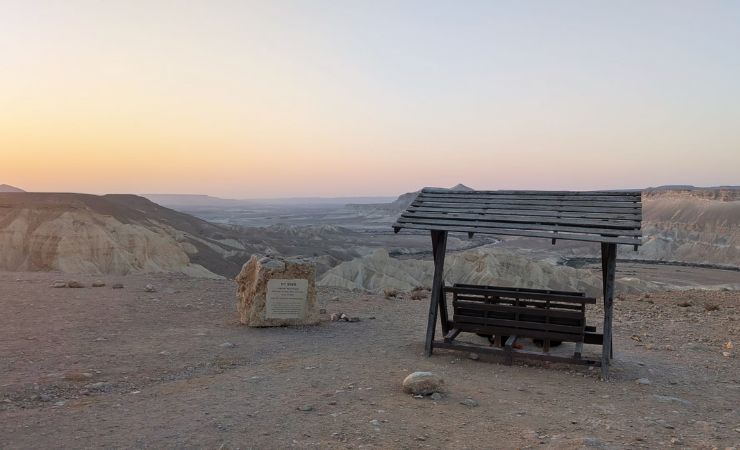
Desert Flora Garden — The path from the car park to the grave site passes through a maintained garden planted with indigenous Negev species selected to thrive in the region’s arid climate and saline soil. The contrast between the carefully tended greenery and the bare desert plateau beyond it is striking and intentional — a small demonstration of the very principle Ben-Gurion championed. Visitors who walk slowly along this path will notice flowering shrubs, grasses, and low desert trees that have adapted to conditions most plants cannot survive.
Cliff-Edge Promenade and Scenic Trails — A natural promenade runs along the canyon rim near the tomb, offering unobstructed views of the Tzin Valley in both directions. The area connects to the trail network of Ein Avdat National Park, which begins close to the lower parking area. Visitors who wish to extend their time in the landscape can descend into the canyon itself via the Ein Avdat trails, which pass freshwater pools and ancient cave monasteries carved into the cliff face.
Visiting Ben-Gurion’s Tomb National Park: Practical Information
Ben-Gurion’s Tomb National Park is open 24 hours a day, seven days a week, with no admission charge. The site is managed by the Israel Nature and Parks Authority; full visitor details are available on the official INPA park page. The park is located adjacent to Midreshet Ben-Gurion (Ben-Gurion College), near Kibbutz Sde Boker, approximately 84 kilometres south of Be’er Sheva on Route 40. A car park is available at the site. Visitors combining the tomb with Ben-Gurion’s Hut should note the two sites are 4 kilometres apart — the hut is at Kibbutz Sde Boker, north of the college campus, and has its own separate parking area and opening hours through the Ben-Gurion Heritage Institute. Those planning to hike into Zin Canyon should check current trail conditions with Ein Avdat National Park before descending, as the canyon trails involve steep sections and limited shade.
Additional Information
- Ben-Gurion’s Tomb National Park – Israel Nature and Parks Authority — Official INPA page for the national park — location, description, and visitor information
- David Ben-Gurion – Britannica — Authoritative biographical entry on David Ben-Gurion, his role as Israel’s first prime minister, and his legacy as Father of the Nation
- Ben-Gurion Tomb National Park – Wikipedia — History of the park’s establishment, architectural competition, tombstone design, and burial chronology
- Ben-Gurion’s Hut – Wikipedia — Details on the Desert Home museum, its preservation per Ben-Gurion’s will, and its operation by the Ben-Gurion Heritage Institute
Is Ben-Gurion’s Tomb National Park free to visit?
Yes, admission to Ben-Gurion’s Tomb National Park is free of charge, and the site is open 24 hours a day, every day of the year. There are no ticketing booths or entry gates. The car park adjacent to the site is also free. Ben-Gurion’s Hut at Kibbutz Sde Boker.
Why is Ben-Gurion buried in the Negev rather than at Mount Herzl in Jerusalem?
Ben-Gurion actively chose the Negev burial site and waived his right to a state burial at Mount Herzl, Israel’s national cemetery in Jerusalem. His decision reflected a lifelong conviction that Israel’s future depended on populating and developing the Negev Desert. He selected the plot south of the Midreshet Sde Boker library for himself and his wife Paula years before his death, ensuring both would remain in the landscape he had championed.
What is inscribed on Ben-Gurion’s tombstone?
The tombstone carries only three dates: Ben-Gurion’s date of birth (1886), his date of death (December 1, 1973), and the year he made aliyah — his immigration to the Land of Israel in 1906. No titles, no offices, and no description of his achievements appear on the stone. The same three-date format appears on Paula Ben-Gurion’s stone beside him. Both tombstones were designed by Israeli sculptor Ezra Orion (1934–2015), who lived and worked at Midreshet Ben-Gurion.
Can visitors see wildlife at the tomb park?
Wild Nubian ibex — large mountain goats with distinctive curved horns — are commonly seen roaming and grazing on the maintained green lawns within the park, often within a few metres of the tombstones. These animals are a protected species in Israel and are accustomed to human presence, allowing for close observation without disturbance.
How does Ben-Gurion’s Tomb National Park differ from Ben-Gurion’s Hut?
The two sites are related but distinct. Ben-Gurion’s Tomb National Park is the outdoor memorial at the cliff edge of Nahal Zin, where David and Paula Ben-Gurion are buried — it is free, always open, and requires no booking. Ben-Gurion’s Hut is the preserved wooden home at Kibbutz Sde Boker, approximately 4 kilometres north, where the couple lived from 1953 until Ben-Gurion’s death in 1973. The Hut is an indoor museum operated by the Ben-Gurion Heritage Institute.
What else is there to do near the tomb park?
Ein Avdat National Park begins close to the lower parking area near the tomb and offers marked hiking trails into Zin Canyon, passing freshwater springs, Byzantine-era cave monasteries, and sheer limestone cliffs formed over millions of years. The trails range from a short accessible loop to a longer descent requiring a second exit point at Ein Akev. The Avdat archaeological site — a UNESCO World Heritage Nabataean city — is located approximately 10 kilometres south on Route 40.
Nearby Sites
- Shivta National Park — A well-preserved Nabataean and Byzantine town in the western Negev, located roughly 40 kilometres southwest of Sde Boker.
- Avdat National Park — A UNESCO-listed Nabataean city. Avdat was a major stopping point on the ancient Incense Route and later flourished under Byzantine rule.
- Ben-Gurion’s Hut — The modest wooden home at Kibbutz Sde Boker, roughly 4 kilometres north of the tomb, where David and Paula Ben-Gurion lived from 1953 until his death in 1973.
- Ein Avdat National Park — A canyon reserve that begins just below the tomb park, offering marked trails through Nahal Zin along cliff faces of white chalk and limestone.
Keep reading
Part of our Negev & Southern Israel Guide →