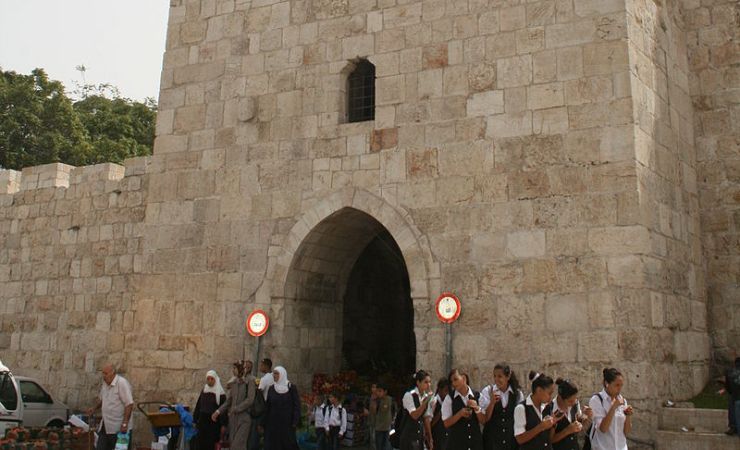
Herod's Gate, also called Flower Gate, is one of eight gates in Jerusalem's Old City walls, located on the northern side between Damascus Gate and Lions' Gate. Despite its name, the gate has no historical connection to King Herod. It provides access to the Muslim Quarter and connects to the Palestinian neighborhoods of eastern Jerusalem.
One of the eight gates of the old city walls, Herod’s Gate, also known as the Flower Gate Jerusalem, connects the Muslim Quarter to the modern Palestinian neighborhood beyond. This northern entrance features distinctive Ottoman architecture and carries both historical weight and cultural significance that extends far beyond its modest appearance.
Location
Herod’s Gate sits on the northern wall of Jerusalem’s Old City, positioned approximately 315 meters east of the more prominent Damascus Gate. The gate provides direct access from the Muslim Quarter to the Bab az-Zahra neighborhood, where Palestinian families have lived for generations.
Herod's Gate is known by Other Names
The gate carries multiple names that reflect different cultural and religious traditions. In Arabic, locals know it as “Bab az-Zahra” (Gate of Flowers), while Hebrew speakers call it “Sha’ar HaPrakhim,” both translating to “Flowers Gate” or “Flower Gate Jerusalem.” The English name “Herod’s Gate” derives from a 16th-century Christian tradition that mistakenly identified a nearby Mamluk-era building as the palace of Herod Antipas, the ruler who questioned Jesus before the crucifixion.
The floral designation comes from the carved stone rosette that adorns the gate tower, a decorative element typical of Ottoman-era architecture. In Islamic tradition, the flower symbolism carries deeper meaning related to paradise and spiritual awakening. Medieval Arab geographers also referred to the area as “Bab al-Sahira,” connecting it to Islamic eschatological beliefs about the Day of Judgment, when the righteous will gather in this vicinity.
Evolving Architecture
Ottoman Sultan Suleiman the Magnificent commissioned the current gate as part of his comprehensive reconstruction of Jerusalem’s walls. The original opening measured barely wide enough for a single person to pass through, serving primarily as a postern gate for local residents rather than commercial traffic. Unlike the grand Damascus Gate with its elaborate triple-arched entrance, Herod’s Gate featured a simple L-shaped passage designed for security rather than ceremony.
The gate underwent significant modification during the Ottoman administrative reforms of 1875. As Jerusalem’s population expanded beyond the Old City walls and new neighborhoods developed to the north, Ottoman authorities widened the passage to accommodate increased pedestrian and cart traffic. The expansion included straightening the original bent entrance and adding stone benches along the interior walls.
The Jerusalem Foundation’s 1986 restoration project transformed the area surrounding the gate. The foundation converted a deteriorated parking area into an elegant stone-paved plaza featuring indigenous plants and stone seating areas. The project, completed in time for the 20th anniversary of Jerusalem’s reunification in 1987, included improved lighting and accessibility features that make the gate more welcoming to contemporary visitors while preserving its historical character.



Historical Significance of Herod's Gate
The area around Herod’s Gate witnessed one of medieval history’s most consequential battles when Crusader forces under Duke Godfrey of Bouillon breached Jerusalem’s northern wall on July 15, 1099. According to contemporary chronicles, Crusader siege towers approached this section of the wall after a five-week siege, ultimately overwhelming the Fatimid defenders and opening the city to European conquest.
Archaeological excavations near the gate have revealed layers of destruction and rebuilding that reflect Jerusalem’s turbulent medieval period. The Israel Antiquities Authority uncovered Crusader-period fortifications, Ayyubid repairs from Saladin’s time, and Mamluk modifications that preceded the Ottoman reconstruction. These findings provide physical evidence of the strategic importance this northern approach held for successive rulers of Jerusalem.
During the British Mandate period (1917-1948), the gate served as a checkpoint between the Old City and the expanding Arab neighborhoods to the north. Following the 1967 Six-Day War, when Israel gained control of East Jerusalem, the gate became a symbol of the city’s complex demographic and political realities, remaining a primary access point for Palestinian residents of the Muslim Quarter.
Practical Information
Herod’s Gate remains open 24 hours daily for pedestrian access, with no admission fee required. The gate connects directly to the Muslim Quarter’s narrow stone streets, where traditional markets and residential areas create an authentic atmosphere of daily life.
Additional Information
Why is the Flower Gate Jerusalem called both Herod’s Gate and Bab az-Zahra?
The gate has different names in different languages and traditions. Arabic speakers call it “Bab az-Zahra” (Gate of Flowers), while the English name “Herod’s Gate” comes from a 16th-century Christian tradition that mistakenly identified a nearby building as Herod Antipas’s palace. Both the Arabic and Hebrew names (Sha’ar HaPrakhim) refer to the stone rosette carved into the gate tower.
Can visitors access the Old City through the Flower Gate Jerusalem at any time?
Yes, Herod’s Gate remains open 24 hours daily for pedestrian access with no admission fees. The gate provides direct entry to the Muslim Quarter, making it convenient for visitors staying in hotels north of the Old City or those coming from sites like the Garden Tomb.
What historical events occurred near the Flower Gate Jerusalem?
The most significant historical event was the Crusader breach of Jerusalem’s walls in 1099, when forces under Godfrey of Bouillon attacked this section of the northern fortifications. Archaeological excavations have revealed layers of destruction and rebuilding from various periods, including Crusader, Ayyubid, and Mamluk modifications.
How far is the Flower Gate Jerusalem from other major Old City gates?
Herod’s Gate sits approximately 315 meters east of Damascus Gate along the northern wall. It’s the closest gate to the Garden Tomb and provides easy walking access to the Rockefeller Archaeological Museum. The location makes it ideal for visitors exploring the northern approach to Jerusalem’s Old City.
Sites Nearby
- Rockefeller Archeological Museum: Dive into a world of ancient artifacts and relics, showcasing the rich tapestry of civilizations that once graced the region.
Damascus Gate: Located at the North of the Old City, this gateway stands as a testament to Jerusalem’s architectural prowess.
Garden Tomb: You will love this tranquil oasis in the heart of the city. This site is believed by some to be the burial place of Jesus.
- Zedekiah’s Cave: This vast limestone quarry beneath the Old City offers a unique exploration experience for the adventurous at heart. Are you ready for it?
Keep reading
Part of our Jerusalem Travel Guide →