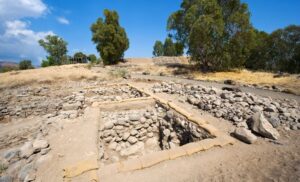
The Ein Gedi Synagogue reveals a thriving Jewish community from over 1,500 years ago along the Dead Sea's western shore. This ancient site showcases elaborate mosaic floors, Hebrew and Aramaic inscriptions, and connections to Ein Gedi's famous balsam perfume industry, which brought wealth to the settlement during Byzantine times.
Along the western shore of the Dead Sea, the remnants of an ancient synagogue known as the Ein Gedi Synagogue offer a window into a vibrant Jewish community from more than 1,500 years ago. The site combines religious architecture, extraordinary mosaic art, and the economic legacy of a rare and coveted perfume industry into one of the most compelling archaeological stops on the Dead Sea coast.
What is the Location of Ein Gedi’s Synagogue?
Ein Gedi sits on the western shore of the Dead Sea, approximately 80 kilometers southeast of Jerusalem. The site lies within Ein Gedi National Park, just off Route 90, the main highway running along the Dead Sea.
Biblical context
Ein Gedi appears multiple times in the Hebrew Bible.
David sought refuge here from King Saul, hiding in the caves near the freshwater oasis (1 Samuel 24:1-2). The area is also referred to as Hazazon-tamar in 2 Chronicles 20:2, where it is mentioned in connection with the Moabites and Ammonites.
The Song of Songs compares the beloved to “a cluster of henna blossoms in the vineyards of Ein Gedi” (1:14), reflecting the region’s ancient reputation for lush, fragrant vegetation in an otherwise arid landscape. That reputation was well earned: the combination of freshwater springs and the intense heat of the Dead Sea basin created growing conditions found almost nowhere else in the ancient world, which is precisely why the balsam plant thrived here and nowhere else in Judea.
Ein Gedi Synagogue Overview
The Ein Gedi synagogue was constructed during the late Roman period, around the 3rd century CE, and served as the spiritual and communal center for the Jewish inhabitants of the settlement. The building followed the broadhouse plan common to synagogues of that era, with its entrance on the south side facing Jerusalem. It remained in active use for approximately 300 years, throughout the Byzantine period, before its destruction in the early 6th century CE.
The synagogue, along with the surrounding settlement, was destroyed by fire in the early 6th century CE. The exact cause remains a subject of scholarly debate, with theories ranging from an accidental conflagration to sectarian violence or military conflict during the turbulent years of Byzantine rule. Excavations led by archaeologist Dan Barag in the 1970s, followed by further work documented by Biblical Archaeology Society researchers, revealed that the fire was intense enough to char a Torah scroll left in the ark, preserve the mosaic floor under debris, and bake a hoard of bronze coins in place. Following the destruction, the site was abandoned, marking the end of a centuries-long Jewish community at Ein Gedi.
The Community and the Afarsimon Perfume
The Jewish community of Ein Gedi was renowned for cultivating the balsam plant, known in Hebrew as “afarsimon.” This shrub produced a resinous sap that was processed into one of the most expensive commodities in the ancient Mediterranean world, valued by weight against silver and sought after by Roman emperors, physicians, and priests alike. The Roman writer Pliny the Elder described it as the most prized product of Judea, and the historian Josephus noted that Cleopatra once lobbied Mark Antony for control of the Ein Gedi groves. The production of balsam held cultural and religious importance as well: the balm was used in sacred rituals, including the anointing oil of the Temple, and as a luxury trade item across the Roman and Byzantine empires. The significance of this industry is underscored by a mosaic inscription found in the synagogue that includes a curse upon anyone who would reveal the “secret of the town,” widely interpreted as a protective measure to guard the proprietary methods of balsam cultivation and extraction. The balsam plant itself became extinct sometime after the Arab conquest of the 7th century CE, and modern botanists have not been able to identify it with complete certainty from ancient descriptions alone.
What Can Be Found at the Ein Gedi Synagogue
Unique Mosaic Floor
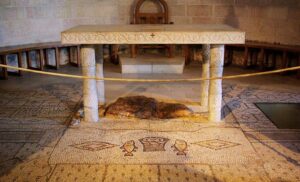
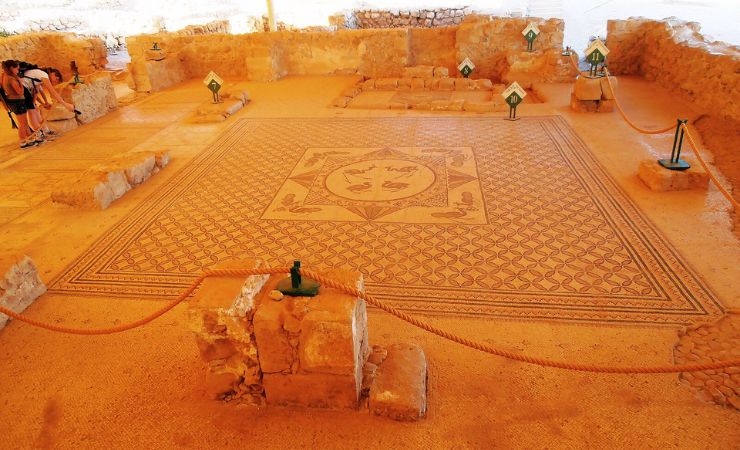
The synagogue’s mosaic floor is one of the best-preserved examples of ancient synagogue art in Israel. Unlike the figurative mosaics at Beit Alpha or Tzippori, which depict zodiac wheels with human figures and scenes from the Hebrew Bible, the Ein Gedi mosaic is entirely geometric, suggesting that this particular community adhered to a stricter interpretation of the prohibition against figural imagery. The floor covers the full length of the prayer hall and remains largely intact despite the fire that destroyed the building above it.
Design and Layout
- Geometric Patterns: The central area of the prayer hall features a rectangular mosaic carpet divided into three square panels, each adorned with alternating black and white tesserae. This design creates a visually striking effect, with reddish stones interspersed, particularly in the northern panel’s border.
- Aniconic Motifs: Unlike other contemporary synagogues that incorporated zodiac motifs or biblical scenes, the Ein Gedi mosaic is devoid of figurative art. This reflects a community preference for non-figurative decoration, possibly influenced by local interpretations of the Second Commandment’s prohibition against graven images.
Inscriptions
The mosaic includes several inscriptions in Aramaic and Hebrew, offering direct evidence of the community’s religious priorities, social structure, and economic anxieties:
- Genealogical List: One inscription lists biblical patriarchs from Adam to Japheth, emphasizing the community’s connection to its ancestral heritage and grounding the synagogue within the sweep of Jewish sacred history.
- Zodiac and Months: Another inscription enumerates the zodiac signs alongside the corresponding Hebrew months, reflecting a synchronization of Jewish and regional calendrical systems that was common in late antique Jewish communities.
- Donor Recognition: A dedicatory inscription honors community members who contributed to the synagogue’s maintenance, highlighting the value placed on communal support and piety.
- Community Conduct and Curse: A particularly striking inscription warns against behaviors such as causing disputes, slander, theft, and revealing the “secret of the town.” The latter is believed to refer to the proprietary methods of balsam production, which underpinned the settlement’s prosperity. The inscription invokes divine retribution upon violators, underscoring the community’s commitment to ethical conduct and the protection of trade knowledge.
- Aramaic Inscriptions: Additional inscriptions list biblical figures, zodiac signs, and months, reinforcing the layers of communal identity encoded into the floor that worshippers walked across every week.
“Cathedra of Moses” (Cathedra de Moshe)
This carved stone seat, positioned prominently within the synagogue’s prayer hall, is believed to have served as the place of honor for the community’s chief rabbi or Torah reader during public readings. Stone seats of this type, referred to in Matthew 23:2 as the “seat of Moses,” have been found at several ancient synagogue sites across ancient Israel, but the Ein Gedi example is among the better-preserved specimens.
Objects Found at the Site at the Site
Excavations uncovered a bronze seven-branched menorah, a decorated bronze goblet, and a hoard of bronze coins, all found in the destruction layer from the 6th-century fire. The coin hoard indicates that the community had accumulated meaningful wealth, likely connected to the balsam trade. Most significantly, a charred scroll was recovered from the ark. Using multispectral imaging technology, researchers later identified it as containing text from the Book of Leviticus, making it one of the oldest Torah scroll fragments ever found in a synagogue context. The scroll is now analyzed and preserved at the Israel Antiquities Authority.
Practical Information
The Ein Gedi Synagogue ruins are located within Ein Gedi National Park, managed by the Israel Nature and Parks Authority. The site is open Sunday through Thursday from 8:00 AM to 5:00 PM, Friday from 8:00 AM to 4:00 PM, and is closed on Saturday (Shabbat).
Parking is free at the national park lot off Route 90. The path to the synagogue ruins is mostly flat and paved, making it accessible for visitors with limited mobility, though some uneven ground exists around the excavated areas. No specific dress code is required.
Additional Information
What is the Ein Gedi Synagogue and why is it significant?
The Ein Gedi Synagogue is an ancient Jewish house of worship dating to approximately the 3rd century CE, active through the early 6th century CE. It is significant for its remarkably preserved mosaic floor, its multilingual inscriptions, and its direct connection to the balsam perfume industry that made the Ein Gedi community one of the wealthiest in Byzantine-era Judea. The charred Leviticus scroll found in its ark is among the oldest Torah fragments ever recovered from a synagogue.
What does the “secret of the town” inscription in the Ein Gedi Synagogue mean?
The inscription is a curse embedded in the synagogue’s mosaic floor, warning community members against revealing the “secret of the town” on pain of divine punishment. Most scholars interpret this as a reference to the closely guarded methods of cultivating and processing the balsam plant, which produced the highly prized afarsimon perfume. Protecting that knowledge was essential to maintaining the community’s economic advantage in the ancient trade network.
When was the Ein Gedi Synagogue discovered and excavated?
The site was first excavated in the early 1970s under the direction of archaeologist Dan Barag, with subsequent work carried out by the Israel Antiquities Authority. The excavations revealed the full extent of the mosaic floor, the stone cathedra, the bronze artifacts, and the charred scroll. Scholarly analysis of the inscriptions and mosaic continued into the 2020s, with detailed publications by Hebrew University researchers documenting the findings.
Can you visit the Ein Gedi Synagogue today?
Yes, the synagogue ruins are accessible to visitors within Ein Gedi National Park, off Route 90 on the western Dead Sea shore. The mosaic floor and structural remains are visible on site. The park is open most days of the week, with reduced hours on Fridays and closure on Saturdays. Standard national park admission applies.
Nearby Sites
- Ein Gedi Nature Reserve: A haven of waterfalls, wildlife, and hiking trails amidst the desert landscape.
- Masada National Park: The ancient fortress atop a plateau, known for its historical significance and panoramic views.
- Qumran National Park: The site where the Dead Sea Scrolls were discovered, offering insights into ancient Jewish life.
- Qasr al-Yahud is believed to be where John the Baptist baptized Jesus.
- Lot’s Wife Pillar is a striking natural rock formation near the Dead Sea, traditionally linked to the biblical story of Lot’s wife, who turned into a pillar of salt for looking back at Sodom
Keep reading
Part of our Jordan Valley & Dead Sea Guide →