Corazim is an ancient Jewish village located in the Upper Galilee, approximately 3.5 kilometers north of Capernaum and the Sea of Galilee. Jesus reproached Corazim in the Gospels for rejecting his teachings despite witnessing his miracles. Today, visitors can explore impressive ruins including a 4th-century black basalt synagogue and residential structures from the Talmudic period.
Corazim (Korazim or Chorazin) holds profound significance for both historians and Christian pilgrims, its ancient stones preserving one of the most haunting pronouncements in the New Testament. Here Jesus delivered a stern rebuke to the city’s inhabitants for their persistent lack of faith despite witnessing his miracles firsthand.
Location
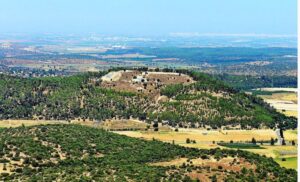
Corazim sits on a basalt plateau 3.2 kilometers (2 miles) north of Capernaum and 250 meters above sea level, commanding sweeping views of the northern shores of the Sea of Galilee. The ancient city forms the third point of the “Evangelical Triangle” alongside Capernaum and Bethsaida, three cities where Jesus conducted much of his Galilean ministry. The site lies within the boundaries of Corazim National Park.
Biblical context
Corazim appears in the New Testament as one of three Galilean cities that experienced Jesus’ miraculous works yet failed to respond with repentance and faith. According to Matthew 11:21 and Luke 10:13, Jesus pronounced a stern woe upon Corazim alongside Bethsaida and Capernaum. The specific Christian sites in Israel condemnation suggests that multiple miracles occurred within the city, though the Gospels do not detail these particular works.
The biblical passage from Matthew 11:21 delivers this judgment:
Woe to you, Chorazin! Woe to you, Bethsaida! For if the mighty deeds done in your midst had been done in Tyre and Sidon, they would long ago have repented in sackcloth and ashes
Archaeological evidence reveals that Corazim suffered destruction in the late Roman period, likely during the 4th century CE earthquake documented by the church historian Eusebius in his Ecclesiastical History. Early Christian writers, particularly Jerome in his commentaries, viewed this destruction as fulfillment of Jesus’ prophetic warning. The timing aligns remarkably with the period when Christianity became the dominant religion in the Roman Empire, lending additional weight to early Christian interpretations of divine judgment upon the unrepentant city.



Corazim during the Byzantine period
Following its initial destruction, Corazim experienced a remarkable revival during the Byzantine period (4th-7th centuries CE), becoming a prosperous Jewish settlement that contradicted its earlier spiritual condemnation. The reconstructed town gained reputation throughout the region for producing exceptional wheat, specifically mentioned in the Babylonian Talmud (Menahot 85a) as grain of the highest quality. Talmudic sources record that Rabbi Joseph ben Isaac Bekhor Shor, a notable 12th century biblical commentator, claimed ancestry from this renewed Corazim, indicating the town’s continued significance in scholarship circles.
The town’s second period of prosperity lasted until the 8th century, when the Islamic conquest brought economic upheaval and demographic changes that gradually eroded its Jewish population. Archaeological evidence suggests that a final earthquake, possibly in the 8th century, delivered the ultimate blow to Corazim’s urban infrastructure.
Rabbinic literature provides intriguing commentary on Corazim’s fate. The Babylonian Talmud (Eruvin 54b) suggests divine displeasure with the town’s manipulation of eruv laws, while the Jerusalem Talmud attributes its downfall to the absence of Torah scholars among its residents, reflecting broader rabbinic concerns about communities that prioritized material prosperity over spiritual learning.
Archeological Findings
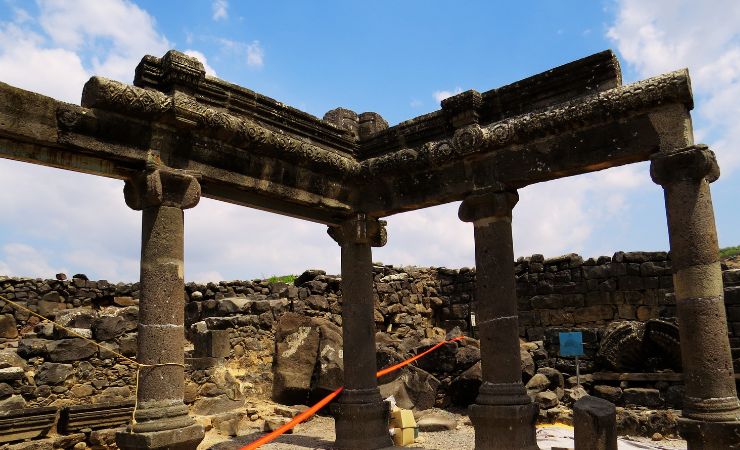
- The Synagogue: The centerpiece of Corazim’s archaeological remains is a magnificent 4th-5th century CE synagogue, measuring 24 × 17 meters (79 × 56 feet). American biblical scholar Edward Robinson first identified the site in 1838, though systematic excavation began under German archaeologists H. Kohl and C. Watzinger between 1905-1907. The synagogue follows the classic Galilean basilica plan with its elaborately decorated southern façade facing Jerusalem. Interior columns created three aisles, while external steps descended from an impressive entrance terrace. The structure employed local black basalt stone, creating a striking architectural statement visible across the surrounding countryside.
- Sculpted Ornaments: The synagogue housed an extraordinary collection of decorative relief carvings that reflected the cosmopolitan culture of late Roman Palestine. Artistic elements include detailed depictions of grape harvesting scenes, Roman soldiers, lions, eagles, and remarkably, mythological figures such as Hercules battling the Nemean lion, a Medusa head, and a centaur. These discoveries demonstrate the sophisticated artistic sensibilities and cultural openness of Corazim’s Jewish community during the Byzantine period.
- The Moses Seat: Among the most significant finds is an ornate basalt chair bearing a three-line Aramaic inscription honoring Judah ben Ishmael, who funded the synagogue’s construction including its colonnade and entrance steps. This “Seat of Moses” (cathedra of Moses) likely corresponds to the teaching chair referenced in Matthew 23:2, providing tangible connection between archaeological evidence and Gospel accounts of synagogue practices.
- Residential Structures and Olive Press: Excavations uncovered several residential blocks containing well-preserved domestic architecture, including a large olive press installation that demonstrates the agricultural basis of Corazim’s economy. Stone doorways, window frames, and storage facilities reveal details about daily life in this prosperous Byzantine-era Jewish town, complementing the religious and public architecture of the synagogue complex.
Practical Information
Opening Hours: April-September: 8:00 AM – 5:00 PM; October-March: 8:00 AM – 4:00 PM. Friday hours end one hour earlier. Closed on Yom Kippur and during severe weather conditions.
Admission: Adults: ₪24 (approximately $8 USD); Students: ₪20 (approximately $6.50 USD); Children under 5: Free. Group discounts available for 20+ visitors with advance booking.
Additional Information
https://en.parks.org.il/reserve-park/korazim-national-park/
Why did Jesus curse Corazim?
Jesus pronounced woe upon Corazim because its inhabitants witnessed his miracles yet failed to repent and believe. According to Matthew 11:21 and Luke 10:13, the city received multiple miraculous works but remained spiritually unresponsive. Jesus declared that even the pagan cities of Tyre and Sidon would have shown greater faith if they had witnessed such divine power.
What archaeological evidence exists for Corazim in Jesus’ time?
While the visible synagogue ruins date to the 4th-5th centuries CE, excavations have revealed earlier foundations and pottery fragments from the 1st century CE Roman period. These earlier remains confirm settlement during Jesus’ lifetime, though the specific buildings he would have known lie buried beneath later Byzantine construction. The town’s strategic location and agricultural prosperity during this period align with its biblical prominence.
How does Corazim relate to Capernaum and Bethsaida?
Corazim forms the third point of the “Evangelical Triangle” with Capernaum and Bethsaida, three cities where Jesus conducted significant ministry in Galilee. All three received the same prophetic condemnation for unbelief despite witnessing Christ’s miraculous works. The sites lie within walking distance of each other around the northern shores of the Sea of Galilee, making them easily accessible during Jesus’ Galilean campaigns.
What can visitors see at Corazim today?
The main attraction is the remarkably preserved 4th-5th century synagogue with its ornate basalt carvings, decorative friezes, and the famous “Seat of Moses” chair with its Aramaic inscription. Visitors can also explore residential ruins, an ancient olive press, and enjoy panoramic views of the Sea of Galilee from the elevated site. The visitor center provides historical context and archaeological explanations.
Is Corazim mentioned in Jewish texts besides the New Testament?
Yes, the Babylonian Talmud (Menahot 85a) praises Corazim for producing exceptional wheat, while other Talmudic passages (Eruvin 54b) suggest the town faced divine judgment for legal manipulations. The Jerusalem Talmud attributes its destruction to lack of Torah scholars. These sources indicate Corazim remained significant in Jewish memory long after the biblical period, particularly during its Byzantine revival.
Nearby Sites
- Capernaum: Known as the “Town of Jesus,” Capernaum is a must-visit site for its ancient synagogue and the House of Peter.
- Bethsaida: Another city in the Evangelical Triangle, Bethsaida is believed to be the birthplace of several apostles and a site of Jesus’ miracles.
- Mount of Beatitudes: This serene location is traditionally believed to be where Jesus delivered the Sermon on the Mount. The Church of Beatitudes is located on the mount.
- Tabgha: Known for the Church of the Multiplication, Tabgha is believed to be the site of Jesus’ miracle of feeding the 5,000.
- Domus Galilaeae: Situated in the tranquil hills of northern Israel, provides a peaceful haven where individuals can engage in prayer and introspection.
Keep reading
Part of our Galilee & Northern Israel Guide →