Capernaum served as Jesus' primary base of operations during his Galilean ministry after leaving Nazareth. Located on the northwestern shore of the Sea of Galilee, this fishing village became known as "his own town" where Jesus performed numerous miracles, taught in the synagogue, and called several disciples including Peter, Andrew, James, and John.
Capernaum commanded a strategic position on the northwestern shore of the Sea of Galilee where Jesus established his primary base for ministry. The fishing town appears more frequently than any other location in the Gospels, earning it the designation as the center of Jesus’ Galilee operations. Archaeological evidence reveals a thriving community with a 1st-century synagogue, residential quarters, and infrastructure that supported the religious and social activities described in the New Testament. The name derives from the Hebrew “Kfar Nahum,” meaning “Nahum’s Village,” though scholars continue to debate whether this refers to the biblical prophet Nahum or another individual entirely.
Location
Capernaum sits on the northwestern shore of the Sea of Galilee, approximately 2.5 kilometers northeast of where the Jordan River exits the lake. The ancient town occupied a prime location along the Via Maris, the major trade route connecting Egypt to Damascus. This positioning made Capernaum a natural customs collection point and contributed to its economic importance during the Roman period. Visitors arrive at the site as the final stop of the 4-day Jesus Trail pilgrimage route, which traces the footsteps of Jesus through the Galilee region.
Biblical Context
Capernaum appears in all four Gospels as the geographic center of Jesus’ Capernaum Jesus ministry. After religious leaders drove him from Nazareth (Luke 4:28-30), Jesus chose this prosperous fishing town as his new headquarters. The Gospels record that Matthew the tax collector worked here, collecting duties on goods traveling the Via Maris trade route. The proximity to Bethsaida provided access to the fishing families of Simon Peter, Andrew, James, and John, who became his first disciples.
The accounts describe Capernaum as the setting for more miracles and teachings than any other location in Jesus’ ministry. He healed the centurion’s servant, Simon Peter’s mother-in-law, and a paralytic lowered through a roof to reach him. The synagogue held particular significance as the venue for his revolutionary teachings about the Bread of Life (John 6:35-59). Despite these miraculous demonstrations, the townspeople’s persistent unbelief prompted Jesus’ harsh rebuke, prophesying the city’s eventual destruction (Matthew 11:23-24).
Jesus’ Base of Ministry
After the rejection at Nazareth, Jesus established Capernaum as his operational headquarters around 30 CE. Matthew 4:13 records that “he left Nazareth and went to live in Capernaum,” indicating a permanent relocation rather than temporary visits. The choice proved strategic, placing him at the intersection of major trade routes where diverse populations gathered. Archaeological evidence suggests the town’s population reached approximately 1,500 residents, providing a substantial audience for his teachings while maintaining manageable community dynamics.
Calling of the Disciples
Capernaum’s fishing industry provided Jesus with his core group of followers. The Gospels detail how he called Peter and Andrew from their nets along the shoreline (Matthew 4:18-20), then recruited James and John from their family fishing operation (Mark 1:19-20). Matthew’s calling occurred at the customs house, where the tax collector abandoned his lucrative post to follow Jesus (Matthew 9:9). These recruitment events established patterns for Christian discipleship that emphasize leaving worldly occupations for spiritual purposes.
Miracles Performed by Jesus in Capernaum
- Healing the Centurion’s Son: A Roman centurion approached Jesus with unprecedented faith in his healing authority. The officer’s declaration, “Lord, I do not deserve to have you come under my roof. But just say the word, and my servant will be healed” (Matthew 8:8), demonstrated remarkable trust from an unexpected source. Jesus granted the healing from a distance, praising the centurion’s faith as greater than any he had found in Israel.
- Healing of Simon Peter’s Mother-in-law: In Peter’s household, Jesus encountered the fisherman’s mother-in-law suffering from fever. The Gospel of Matthew reports: “He touched her hand, and the fever left her, and she got up and began to serve him” (Matthew 8:15). This intimate healing within a disciple’s family demonstrated the personal care Jesus extended to those closest to his followers.
- Healing the Paralytic: Friends carried a paralyzed man to a house where Jesus taught, but crowds blocked their access. Undeterred, they climbed onto the roof, removed tiles, and lowered their friend on a mat directly in front of Jesus. “When Jesus saw their faith, he said to the paralyzed man, ‘Son, your sins are forgiven’” (Mark 2:5). The healing that followed validated Jesus’ authority to forgive sins.
- Casting Out an Unclean Spirit: During synagogue worship, a demon-possessed man disrupted the service with supernatural recognition of Jesus’ identity. Jesus commanded sternly: “Be quiet! Come out of him!” The Gospel of Mark describes the dramatic result: “The impure spirit shook the man violently and came out of him with a shriek” (Mark 1:25-26).
- Healing the Nobleman’s Son: A royal official traveled from Capernaum to Cana, pleading for Jesus to heal his dying son. Without making the journey himself, Jesus declared, “Your son will live.” John’s Gospel records the father’s discovery: “Then the father realized that this was the exact time at which Jesus had said to him, ‘Your son will live.’ So he and his whole household believed” (John 4:53).
- Walking on Water: After feeding five thousand people, Jesus dismissed the crowds and sent his disciples across the Sea of Galilee by boat. During the night, he approached their vessel by walking on the water’s surface. “But he said to them, ‘It is I; don’t be afraid.’ Then they were willing to take him into the boat, and immediately the boat reached the shore where they were heading” (John 6:20-21).
- Raising Jairus’s Daughter and Healing a Woman: Jairus, a synagogue leader, requested Jesus’ help for his dying daughter. En route to the house, a woman with chronic bleeding touched Jesus’ garment and received instant healing. Despite news of the girl’s death, Jesus continued to Jairus’s home where he restored the child to life. His words to the woman were: “Daughter, your faith has healed you. Go in peace and be freed from your suffering” (Mark 5:34), and to the girl: “Little girl, I say to you, get up!” (Mark 5:41).
Teachings at the Synagogue
The Capernaum synagogue hosted Jesus’ most challenging theological discourse about eternal life. In John 6:35-59, he declared himself “the bread of life” and spoke of giving his flesh and blood for spiritual nourishment. This teaching proved so difficult that many disciples abandoned him (John 6:66). The synagogue’s role as both a venue for revolutionary teaching and community rejection illustrates the complex reception Jesus received in his adopted hometown.
Denunciation of Capernaum
Despite witnessing unprecedented miraculous activity, Capernaum’s residents largely rejected Jesus’ message. This persistent unbelief prompted one of his sternest condemnations: “And you, Capernaum, will you be lifted to the heavens? No, you will go down to Hades” (Luke 10:15). The prophecy proved accurate, as the town gradually declined after the Byzantine period and was eventually abandoned, leaving only archaeological ruins.
The Miraculous Catch of Fish
Jesus’ first recorded miracle in Capernaum involved Simon Peter’s fishing boat. After teaching crowds from the vessel, Jesus instructed Peter to cast nets in deep water despite the fisherman’s protests about an unsuccessful night of fishing. The resulting catch was so enormous that it required assistance from another boat and nearly sank both vessels. This demonstration convinced Peter to leave his fishing career and follow Jesus as a disciple.
The Archeology of Capernaum
Archaeological investigations at Capernaum reveal layers of continuous occupation from the 2nd century BCE through the 8th century CE. Franciscan archaeologists, working systematically since the early 20th century, have uncovered two synagogue levels, residential quarters, and a venerated Christian site identified as Peter’s house. The excavations demonstrate how this site evolved from a modest fishing village into a significant religious center. These discoveries provide concrete evidence for the biblical accounts while illuminating daily life in 1st-century Galilee.
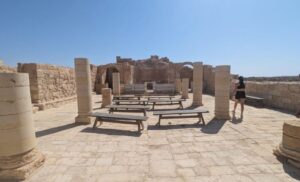
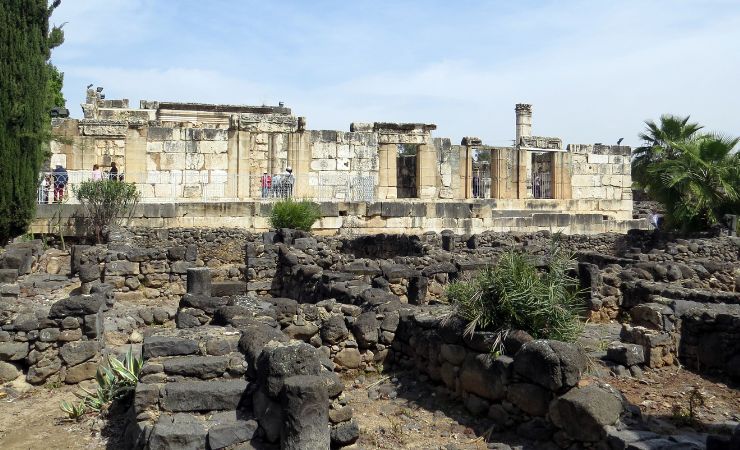
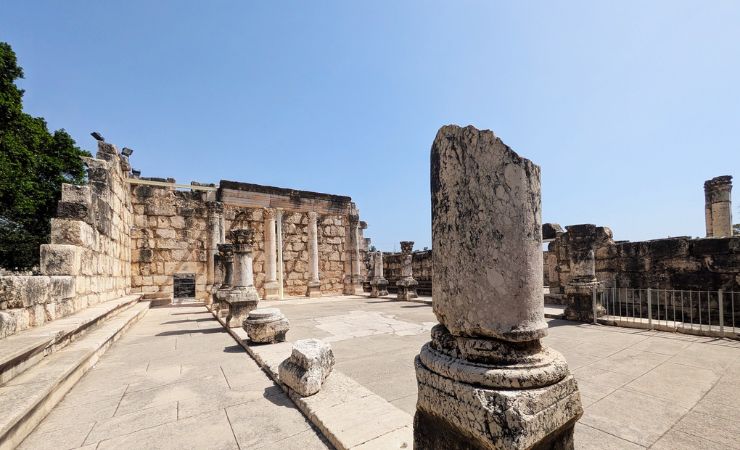
The Synagogue: The impressive limestone synagogue dominates Capernaum’s archaeological landscape with its white stone contrasting sharply against the surrounding black basalt buildings. Dating to the 4th or 5th century CE, this elaborate structure measures approximately 20 by 25 meters with richly decorated architectural elements. Carved stone reliefs include depictions of the Ark of the Covenant, seven-branched menorahs, and geometric patterns reflecting Jewish artistic traditions. Beneath this later synagogue lie the foundations of an earlier building constructed from local basalt stone, including a cobbled pavement radiocarbon-dated to the 1st century CE. This earlier structure almost certainly represents the synagogue where Jesus taught and performed miracles according to Gospel accounts. While most remains lie beneath protective concrete, visitors can observe portions of the original entrance and basalt columns that mark the building’s footprint.
House of Saint Peter: A modest basalt stone dwelling underwent remarkable transformations over four centuries, evolving from a private residence into a Christian pilgrimage destination. Archaeological analysis reveals that by the mid-1st century CE, this house’s main room received special treatment with plastered walls and floors, suggesting use as a community gathering space or house church (domus ecclesiae). Ancient graffiti and inscriptions in Greek, Latin, and Aramaic reference Jesus and Peter, providing early evidence of Christian veneration. The 5th-century construction of an octagonal church around the house confirms its significance to Byzantine pilgrims. This octagonal design was specifically reserved for sites considered holy, allowing worshipers to circumambulate the sacred center. The building’s evolution from Jesus’ time through the Byzantine period offers a unique archaeological record of early Christianity’s development.
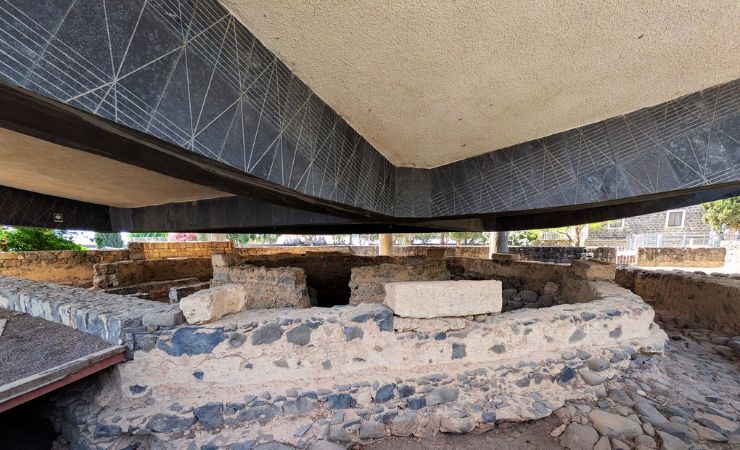
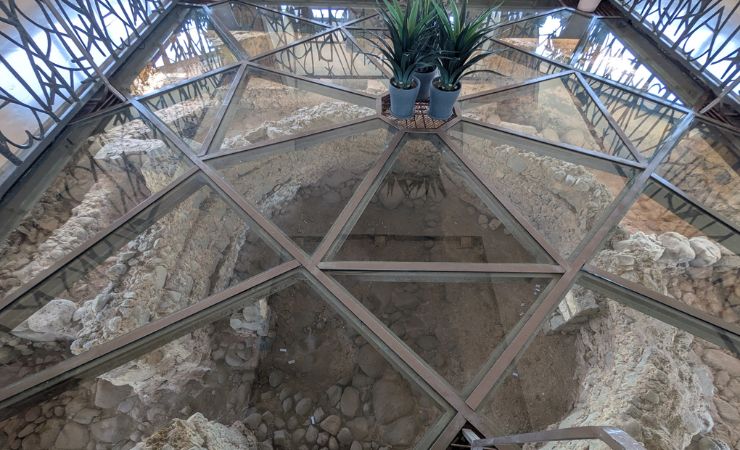
Ruins of the Roman and Byzantine Village: Excavations reveal an extensive residential quarter with narrow cobblestone streets, multi-room houses, and courtyards typical of ancient Galilean settlements. A well-preserved Roman road runs north-south through the site, constructed with fitted basalt stones and measuring approximately 4 meters wide. This road connected Capernaum to the Via Maris trade route and Damascus, facilitating the commercial traffic that made customs collection profitable for tax collectors like Matthew. House foundations show evidence of multiple building phases, with repairs and additions spanning centuries of continuous occupation. Stone vessels for ritual purity, ceramic oil lamps, and cooking pots provide insights into daily life and religious observances of the Jewish community that thrived here during Jesus’ ministry.
Ritual Baths and Olive Press: Archaeological teams have uncovered several mikvaot (ritual baths) cut into bedrock throughout the residential areas, confirming Capernaum’s identity as an observant Jewish community. These stepped pools feature the precise engineering required for ritual purification according to halakhic law. A large olive press installation includes circular stone basins, pressing stones, and collection channels that processed olives into oil for cooking, lighting, and trade. The press’s substantial size suggests commercial production beyond local consumption, indicating Capernaum’s role in regional agricultural commerce.
Fishermen’s Tools: Capernaum’s economy centered on Sea of Galilee fishing, evidenced by numerous fishing weights, bronze hooks, and needle-like implements for net repair found throughout the site. Lead sinkers bear manufacturing marks suggesting standardized production for commercial fishing operations. The famous 1st-century boat discovered nearby (known as the “Jesus Boat”) provides additional context for understanding the vessels used by Peter and his partners. Fish bones found in cooking areas indicate both local consumption and processing for export, with garum (fermented fish sauce) production contributing to the town’s prosperity.
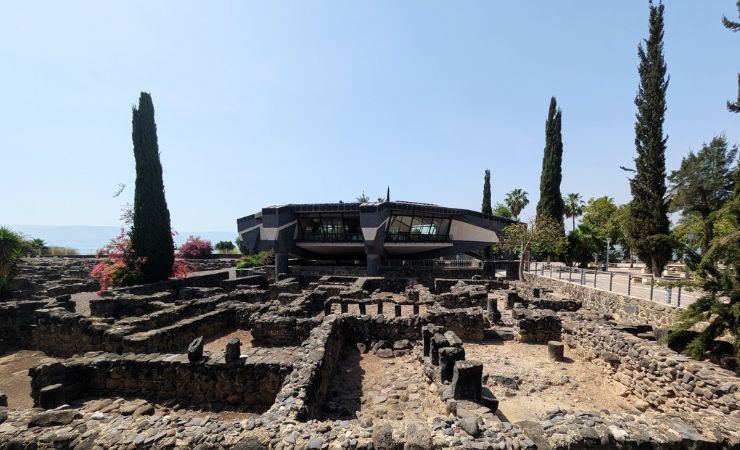
The Modern Franciscan Church (Memorial Church)
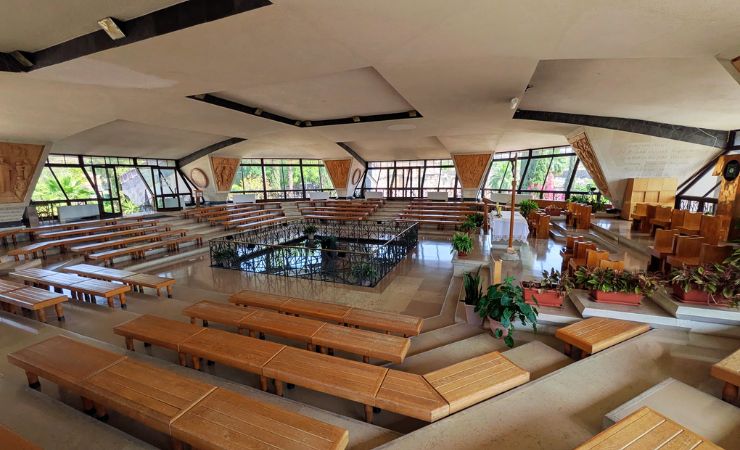
The contemporary Memorial Church, completed in 1990 by architect Ildo Avetta, hovers dramatically above the traditional site of St. Peter’s house on eight concrete pillars. This innovative design preserves the archaeological remains below while creating a sacred space for worship and reflection. The church’s octagonal plan echoes its Byzantine predecessor, maintaining architectural continuity across fifteen centuries. A circular glass floor in the center provides direct views into the excavated ruins, allowing visitors to observe the ancient rooms where early Christians gathered. Natural lighting illuminates both the modern sanctuary and the archaeological site below.
Practical Information
Hours: Open daily April-September 8:00 AM-6:00 PM, October-March 8:00 AM-5:00 PM. Site closes 30 minutes before sunset on Fridays and Jewish holidays.
Admission: Adult tickets cost 10 NIS (approximately $3 USD). Children under 12 enter free with adult supervision. Groups of 15+ qualify for reduced rates with advance booking.
Parking: Free parking available adjacent to the entrance. Buses can accommodate drop-off near the site entrance. Limited shade available in parking area.
Dress Code: Modest clothing required for church and synagogue areas. Shoulders and knees must be covered. Head coverings recommended but not mandatory.
Additional Information
Capernaum – Wikipedia
- 2nd Century BC (Hasmonean Period): Capernaum is established as a fishing village on the northern shore of the Sea of Galilee. Several other fishing villages also emerge around the lake during this time.
- Early Roman Period (1st Century AD): Capernaum grows larger. A synagogue is built in the center of the village.
- During Jesus’ Early Ministry (1st Century AD): Capernaum serves as Jesus’ primary base. He resides in the town, teaches in the synagogue, calls his first disciples from their fishing activities, and performs numerous miracles.
- During Jesus’ Ministry (1st Century AD): Jesus teaches about the bread of life in the Capernaum synagogue. During Jesus’ Ministry , Jesus denounces Capernaum due to the lack of repentance and belief among its inhabitants despite witnessing his miracles.
- Mid-1st Century AD: One specific house in Capernaum, believed to be the home of Saint Peter, begins to be venerated as a religious gathering place. Its main room is plastered, and domestic ceramics are replaced with lamps and storage jars.
- Latter Half of the 1st Century AD: The main room of the house believed to be Peter’s is reworked and plastered, suggesting it was used as a communal gathering place or house church (domus ecclesiae).
- Through the Early 4th Century: The group of private houses around the courtyard known as the sacra insula (which includes the house believed to be Peter’s) remains in use.
- Early to Mid-4th Century AD: The first-century synagogue in Capernaum is replaced by the grand white-stone synagogue.
- 4th Century AD: The sacra insula (including Peter’s house) is transformed. A thick-walled enclosure is built around the entire compound. The specific room believed to be Peter’s house is altered and expanded with a central archway, reinforced walls, pavement, and plastering.
- 5th Century AD: An octagon church is built over the location of St Peter’s house. The village of Capernaum reaches its peak size of about 60 Dunams (6 Hectares) with a population of approximately 1,500.
- Late 19th Century: Exploration of biblical places in the Holy Land begins, often driven by a desire to find demonstrable evidence of biblical accuracy. Charles Wilson and Charles Warren arrive in Jerusalem with support from the Palestine Exploration Fund, aiming to remove difficulties in understanding the sacred text through archaeology.
- Early 20th Century onwards: Archaeological excavations are conducted at Capernaum, revealing the ruins of the synagogue, houses (including the “House of Peter”), and other structures.
- 1990: A modern memorial structure is built over the “House of Peter” site in Capernaum.
Where exactly was Jesus’ home in Capernaum?
Archaeological evidence points to a specific basalt stone house that underwent significant modifications in the 1st century CE, transforming from a private residence into a community gathering place. This house, now beneath the modern Memorial Church, contains ancient Christian graffiti and inscriptions referencing Jesus and Peter. While definitive proof remains elusive, the archaeological and historical evidence strongly suggests this was indeed Peter’s house, which served as Jesus’ primary residence during his Galilee ministry.
What miracles did Jesus perform specifically in Capernaum?
The Gospels record seven major miracles in Capernaum: healing the centurion’s servant from a distance, curing Peter’s mother-in-law of fever, healing a paralytic lowered through a roof, casting out an unclean spirit in the synagogue, healing a royal official’s son, walking on the Sea of Galilee, and raising Jairus’s daughter while healing a woman with bleeding. These miracles demonstrate Jesus’ authority over sickness, nature, death, and spiritual forces, establishing Capernaum as the primary venue for his supernatural demonstrations.
Can visitors see the actual synagogue where Jesus taught?
The impressive white limestone synagogue visible at Capernaum dates to the 4th-5th centuries CE, built over the foundations of an earlier 1st-century basalt structure. Visitors can observe portions of this earlier synagogue, including basalt columns and the entrance area, which represent the actual building where Jesus taught and performed miracles. The later limestone synagogue was constructed directly above, preserving the sacred location while creating a grander worship space for the growing Christian and Jewish communities.
How do archaeologists know this is the biblical Capernaum?
Multiple lines of evidence confirm Capernaum’s identification: the site’s location matches Gospel descriptions on the northwestern shore of the Sea of Galilee, 1st-century archaeological remains align with biblical accounts of a thriving fishing village, and continuous Christian veneration of specific locations (particularly Peter’s house) provides historical continuity. Ancient sources, including early Christian pilgrims and historical documents, consistently identify this location as biblical Capernaum, supported by place-name continuity and geographical references.
What was daily life like in Capernaum during Jesus’ time?
Capernaum functioned as a prosperous fishing community with approximately 1,500 residents engaged in processing and trading fish from the Sea of Galilee. Archaeological evidence reveals stone houses built around courtyards, ritual baths indicating observant Jewish practice, an olive oil production facility, and extensive fishing equipment. The town’s position on the Via Maris trade route brought merchants and travelers, creating the diverse audience that heard Jesus’ teachings and witnessed his miracles.
What happened to Capernaum after Jesus’ ministry ended?
Capernaum continued as a significant Christian pilgrimage destination through the Byzantine period, reaching its peak size in the 5th century with the construction of an octagonal church over Peter’s house and a grand limestone synagogue. However, the town gradually declined following the Arab conquest in the 7th century and was eventually abandoned. Jesus’ prophecy of judgment against the city for its unbelief found fulfillment in its complete desolation, leaving only archaeological ruins to mark this once-important biblical site.
How long should visitors plan to spend at Capernaum?
Most visitors spend 1-2 hours exploring Capernaum’s archaeological sites, including the synagogue ruins, Peter’s house beneath the Memorial Church, and the ancient village remains. Guided tours typically last 45 minutes and provide valuable historical context, while self-guided visits allow more time for reflection and photography. The site works well in combination with nearby biblical locations like the Mount of Beatitudes, Tabgha, and Bethsaida for a comprehensive Galilee experience.
Nearby Sites
- Bethsaida: Another city in the Evangelical Triangle, Bethsaida is believed to be the birthplace of several apostles and a site of Jesus’ miracles.
- Mount of Beatitudes: This serene location is traditionally believed to be where Jesus delivered the Sermon on the Mount. The Church of Beatitudes is located on the mount.
- Tabgha: Known for the Church of the Multiplication, Tabgha is believed to be the site of Jesus’ miracle of feeding the 5,000.
- The Jesus Boat: The “Jesus Boat” is a 1st-century AD fishing boat discovered in the Sea of Galilee, discovered and preserved in the 1980s.
- Magdala: Magdala is an ancient Jewish town renowned as the home of Mary Magdalene. Its archaeological sites, including a well-preserved 1st-century synagogue.
Keep reading
Part of our Christian Pilgrimage Guide →