Kursi is the site where Jesus performed the "Miracle of the Swine," casting demons into a herd of pigs that rushed into the Sea of Galilee. Located on the eastern shore, this significant New Testament location features Byzantine church ruins and serves as an important pilgrimage destination for Christian visitors exploring Jesus' Galilean ministry.
Kursi commands a unique position in biblical history as the site where Jesus performed the remarkable “Miracle of the Swine.” This extraordinary event, documented in the New Testament, transforms Kursi into an essential destination for Christian pilgrims, history enthusiasts, and spiritual seekers. The site’s name derives from “chair” in Semitic languages, referencing the distinctive shape of the broad valley that cradles this ancient location on the eastern shore of the Sea of Galilee.
Location
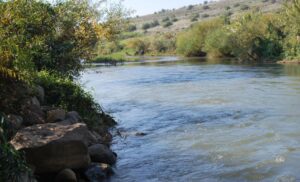
Kursi sits prominently on the eastern shore of the Sea of Galilee, positioned strategically along the banks of Nahal Samakh, a seasonal stream that descends from the Golan Heights.
Biblical context of Kursi
The Kursi Miracle of Swine holds profound significance in the New Testament, specifically recorded in the Gospel of Mark (5:1-20), Matthew (8:28-34), and Luke (8:26-39). According to these accounts, Jesus crossed the Sea of Galilee and encountered a man possessed by a legion of demons. The possessed man lived among the tombs, displaying superhuman strength that enabled him to break chains and shackles.
When Jesus commanded the demons to leave the man, they begged to be allowed to enter a nearby herd of about 2,000 swine. Jesus granted their request, and the entire herd immediately rushed down the steep embankment into the sea and drowned.
The miracle’s location in the “country of the Gadarenes” or “Gerasenes” corresponds to the eastern shore of the Sea of Galilee, where Kursi provides the only suitable geography matching the biblical description.


Kursi's archeological history
A Site Revered by Early Christians
Early Christian writers and pilgrims recognized Kursi as the authentic location of the Kursi Miracle of Swine from the 4th century onward. St. Sabas, the renowned founder of the Mar Saba monastery in the Judean Desert, personally prayed at this sacred site in 491 CE, cementing its status among early Christian holy places. Medieval pilgrims’ accounts consistently identify this eastern shore location as the site where Jesus performed the dramatic exorcism, establishing a continuous tradition of Christian veneration spanning over 1,500 years.
Rediscovery of Kursi
Archaeological fortune struck Kursi in March 1970 when a bulldozer constructing the new road to the recently captured Golan Heights accidentally unearthed fragments of Byzantine pottery and carved stone architectural elements. The recent archaeological research team, led by archaeologists Dan Urman and Vassilios Tzaferis, immediately recognized the significance of these finds. Subsequent emergency excavations revealed not only an extensive monastery complex but also the remains of an ancient fishing harbor, complete with a sophisticated breakwater system and stone-lined pools designed for storing live fish awaiting transport to markets around the Sea of Galilee.
Unveiling the Monastic Life
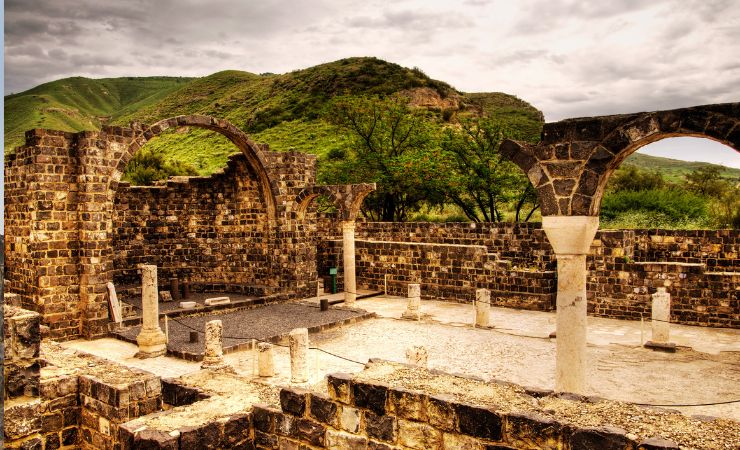
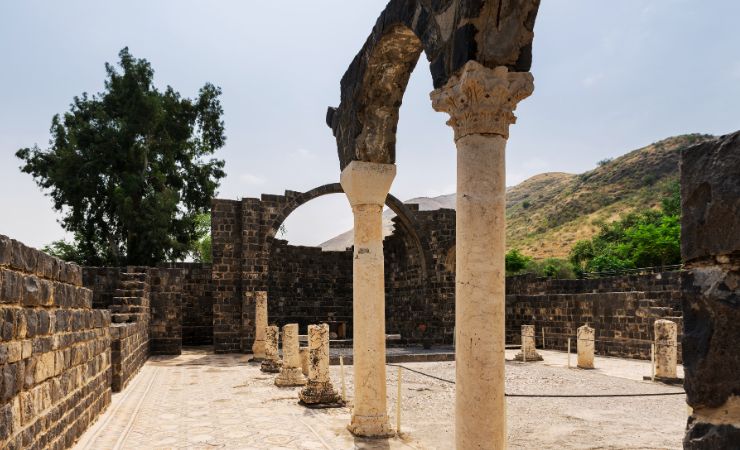
The 5th-century monastery at Kursi emerged as one of the largest and most elaborate Byzantine monastic complexes discovered in Israel. Massive stone walls, standing up to 3 meters high in places, surrounded the entire complex, punctuated by a defensive watchtower overlooking the Sea of Galilee. The central church measured 25 by 15 meters, featuring a traditional basilica plan with a nave separated from two side aisles by rows of imported marble columns. A special chapel in the southern aisle contained a stone-lined crypt where archaeologists discovered the carefully arranged skeletons of 30 monks, each buried with simple wooden crosses.
Archaeological evidence reveals the monastery’s economic self-sufficiency through a sophisticated oil press installation, indicating that olive oil production provided substantial income for the monastic community. The complex included extensive living quarters for monks, a well-appointed guesthouse for pilgrims, and a complete bathhouse complex featuring hot and cold rooms in the Roman tradition. A stone-paved road connected the monastery directly to the harbor facilities, where pilgrims arrived by boat from Capernaum and Tiberias.
The church’s magnificent mosaic floors originally depicted an elaborate menagerie including roosters, geese, doves, cormorants, various fish species, and abundant fruits representing the Garden of Eden. However, when the monastery was abandoned during the early 8th century Arab conquest, iconoclasts systematically obliterated all animal and human representations to comply with Islamic prohibitions, leaving only geometric patterns visible.
A Chapel with a View
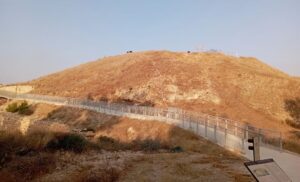
Archaeological dating indicates that the hilltop chapel behind the main monastery predates the larger complex by at least a century. Its mosaic floor includes prominent Christian crosses, which were officially prohibited on church floors after 427 CE by imperial decree of Theodosius II. This chapel features a stone bench positioned to provide direct sightlines to the memorial boulder marking the traditional site of the miracle and commanding panoramic views across the entire Sea of Galilee toward the western shore villages of Jesus’ ministry.
Practical Information
- The Kursi archaeological site operates as a national park managed by the Israel Nature and Parks Authority. Current admission fees are 16 NIS (approximately $5 USD) for adults and 7 NIS (approximately $2 USD) for children and seniors. The site opens daily from 8:00 AM to 5:00 PM (until 4:00 PM during winter months). F
Archeological finding
- Byzantine Monastery Complex: Excavations revealed one of Israel’s largest and best-preserved Byzantine monasteries, including a main church, monks’ cells, refectory, scriptorium, and extensive service buildings surrounded by defensive walls.
- Intricate Mosaic Floors: The monastery’s church displays remarkable mosaic artistry featuring geometric patterns, vine scrolls, and originally included detailed depictions of animals, birds, and biblical symbols before iconoclastic destruction.
- Aramaic Memorial Inscription: A carved stone inscription in Aramaic identifies the site as the “monastery of the holy martyr,” providing direct textual evidence of early Christian worship and the site’s connection to biblical events.
- Greek Marble Commemorative Plaque: Archaeologists discovered a formal marble plaque bearing a Greek inscription that explicitly identifies this location with the Gospel account of Jesus’ miracle, demonstrating continuous Christian tradition.
- Ancient Harbor Installations: Underwater archaeology revealed sophisticated harbor works including stone breakwaters, mooring rings, and fish storage facilities that supported both monastic life and pilgrimage activities.
- Pottery and Coins: Thousands of pottery shards and Byzantine coins provide precise dating evidence, confirming the monastery’s operation.
Additional Information
Where exactly did the Kursi Miracle of Swine take place?
The Kursi Miracle of Swine occurred on the eastern shore of the Sea of Galilee, at the site now known as Kursi National Park. This location provides the only geography on the Sea of Galilee that matches the biblical description of steep cliffs leading directly to the water. Archaeological evidence and continuous Christian tradition since the 4th century confirm this as the authentic site where Jesus cast demons from a possessed man into a herd of swine.
What biblical accounts describe the Kursi swine miracle?
The miracle appears in three Gospel accounts: Mark 5:1-20, Matthew 8:28-34, and Luke 8:26-39. Each Gospel provides slightly different details, with Mark and Luke describing one possessed man while Matthew mentions two. All accounts agree on the essential elements: Jesus casting out demons called “Legion,” the demons entering approximately 2,000 swine, and the entire herd rushing down the steep embankment into the sea where they drowned.
Can visitors see remains of the Byzantine monastery at Kursi?
Yes, visitors can explore extensive ruins of the 5th-century Byzantine monastery, including the main church with its mosaic floors, monks’ living quarters, and defensive walls. The site also features a hilltop chapel predating the main monastery and ancient harbor installations.
How much does it cost to visit Kursi and what are the opening hours?
Admission to Kursi National Park costs 16 NIS (approximately $5 USD) for adults and 7 NIS (approximately $2 USD) for children and seniors. The site opens daily from 8:00 AM to 5:00 PM during summer months and until 4:00 PM in winter.
Why was Kursi important to early Christians and pilgrims?
Early Christians recognized Kursi as a sacred site because it preserved the exact location where Jesus demonstrated his divine authority over evil spirits. Notable figures like St. Sabas prayed here in 491 CE, and the massive monastery complex built in the 5th century accommodated thousands of pilgrims annually. The site represented tangible proof of Jesus’ miraculous power and served as a major pilgrimage destination for over 300 years.
Nearby sites
- Church of Beatitudes: This church on a hilltop site is traditionally believed to be where Jesus delivered the Sermon on the Mount, offering panoramic views of the Sea of Galilee.
- Corazim: An ancient village, it was one of the cities condemned by Jesus for its lack of faith
- Capernaum: Known as Jesus’ “own city”, it’s home to a modern church built over St. Peter’s house and an ancient synagogue.
- Bethsaida: An ancient city on the north shore of the Sea of Galilee, mentioned several times in the New Testament.
Keep reading
Part of our Christian Pilgrimage Guide →