The Jaffa Clock Tower stands in the heart of old Jaffa, built in 1906 to commemorate the 25th anniversary of Ottoman Sultan Abdul Hamid II's reign. This distinctive limestone structure marks the entrance to the old city and serves as a prominent landmark where seven streets converge, symbolizing Jaffa's transition from Ottoman rule to modern times.
The Jaffa Clock Tower is one of the most recognizable landmarks in the ancient port city of Jaffa, offering a vivid reminder of the Ottoman Empire’s reach and the city’s passage into modernity. Erected in 1903 to mark the 25th anniversary of Sultan Abdul Hamid II’s reign, the tower reflects a distinct architectural style that blends
Location
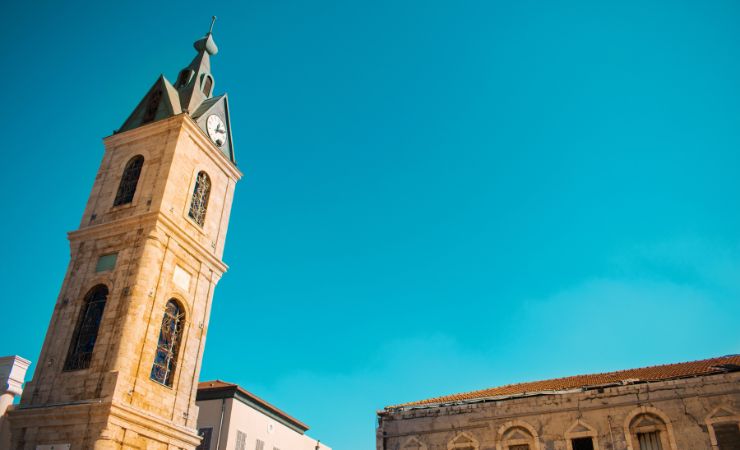
The 28-meter-high Jaffa Clock Tower stands at the northern end of Yefet Street, anchoring the open plaza known as Clock Square. The square sits at the intersection of Jaffa’s main commercial and civic arteries, making the tower immediately visible to anyone arriving from the direction of Tel Aviv on Yefet Street.
Background to Building the Clock Tower
The Jaffa Clock Tower was one of roughly a dozen clock towers erected across the Ottoman Empire to mark the 25th anniversary of Sultan Abdul Hamid II’s accession to the throne in 1876. The sultan, who ruled from Constantinople, used these public monuments as instruments of modernization and imperial visibility, placing prominent timepieces in commercial centers from Beirut to Baghdad. Each tower was meant to signal that the empire’s cities kept pace with the clocks of Europe, a pointed political message at a time of intense rivalry with Western powers.
In Jaffa, however, the project did not flow automatically from imperial decree. Local administrators had to organize funding independently, and the community itself carried a significant share of the financial burden. Contributions came from municipal tax revenues and private donors drawn from Jaffa’s mixed population of Muslims, Christians, and Jews. Among the most prominent contributors was Yosef Moial, a Jewish businessman and community leader whose fundraising role reflects the cooperative civic culture that defined Jaffa at the turn of the century. The city was then one of the busiest ports on the eastern Mediterranean coast, handling citrus exports and pilgrim traffic alike, and its residents had both the means and the motivation to invest in a structure that would mark their city’s standing.
The decision to place the tower at the head of Jaffa’s main market square was deliberate. Clock Square functioned as the city’s commercial and administrative hub, and a clock tower positioned there served the practical needs of merchants, government officials, and the general public at a moment when personal watches were still a luxury. The tower’s construction thus answered both the sultan’s symbolic aims and the city’s everyday life.
The Jaffa Clock Tower's Architechture
The initiation of the Jaffa Clock Tower’s construction was marked on September 1, 1900, with a ceremonial laying of the first cornerstone. Positioned strategically at the epicenter of Jaffa’s main market square, the clock tower emerged in close proximity to significant landmarks including the Mahmoudia Mosque, the Kishla — Jaffa’s central police station and jail — and the notable Saraya House. Following the completion of its second level in 1901, construction efforts proceeded to the third floor the subsequent year, culminating in 1903 with the tower’s completion and the installation of two clocks. A notable feature of the second floor included the engraving of the Torah and Sultan Abdul Hamid II’s seal, adding a layer of historical and cultural significance to the structure.
The tower is characterized by its three-story structure, which is crowned with a distinctive multi-gabled roof, setting it apart from other clock towers built during the same era. The use of limestone in its construction is consistent with the materials commonly used in the region, providing a sense of continuity with the historical and environmental context of Jaffa. This choice of material not only contributed to the tower’s aesthetic appeal but also ensured its durability over the years.
In the early 1960s, the Jaffa Clock Tower underwent significant restoration. Decorative bars were installed in addition to colorful mosaic windows. These mosaics, designed by Arie Koren, depict various scenes from Jaffa’s history, adding a layer of narrative and visual interest to the tower. This restoration project not only preserved the tower’s structural integrity but also enhanced its role as a historical monument, allowing it to convey the rich history of Jaffa to visitors and locals alike. The Clock itself was restored twice: in the 1980s and then again in 2021.
Additional Information
What architectural style is the Jaffa Clock Tower?
The Jaffa Clock Tower belongs to the late Ottoman eclectic style, a late 19th-century idiom that borrowed neo-Gothic and neo-Romanesque forms from European architecture and applied them to local building traditions. The result is a three-story limestone tower with arched windows, shallow pilasters, and a multi-gabled roof that distinguishes it from the more austere clock towers built elsewhere in the empire during the same period.
When was the Jaffa Clock Tower built, and why?
Construction began on September 1, 1900, and the tower was completed and dedicated in 1903. It was built to commemorate the 25th anniversary of Sultan Abdul Hamid II’s accession to the Ottoman throne, part of a broader imperial program that placed clock towers in major cities across the empire as symbols of modernization and centralized authority.
What material was used to build the Jaffa Clock Tower?
The tower is built from kurkar, a local sandstone-limestone common along the Jaffa coastline. The material weathers to a warm honey tone and connects the tower visually to the historic buildings surrounding Clock Square. Kurkar was the standard building material in Jaffa throughout the Ottoman period and appears in many of the city’s older structures.
What are the mosaic windows on the Jaffa Clock Tower?
The six stained-glass mosaic windows were added during the 1965 restoration and were designed by Israeli artist Arie Koren. They depict significant moments from Jaffa’s history, including scenes of the ancient harbor, Napoleon’s 1799 siege of the city, and the early waves of Jewish immigration to Palestine in the late 19th century. The mosaics are positioned on the second and third floors.
Is the Jaffa Clock Tower accessible for visitors with mobility limitations?
Clock Square is a flat, paved public plaza with no steps or barriers at street level, making it fully accessible for wheelchair users and visitors with limited mobility. Because the tower itself cannot be entered, there are no interior accessibility concerns.
Nearby Sites
- Al-Mahmoudiya Mosque: The largest mosque in Jaffa, notable for its use of ancient columns and its beautiful fountain.
- St. Peter’s Church: The Church commemorates Saint Peter’s visionary acceptance of gentiles into Christianity, showcasing New Spanish Baroque architecture.
- Simon the Tanner’s House: This house is linked to Peter’s pivotal vision, symbolizing the expansion of the early Christian Church to include all faiths
- Jaffa Flea Market (Shuk HaPishpishim): Located just south of the Clock Square, this bustling market is a treasure trove of antiques, traditional crafts, and vibrant eateries, blending the old with the new.
Keep reading
Part of our Tel Aviv & Jaffa Guide →