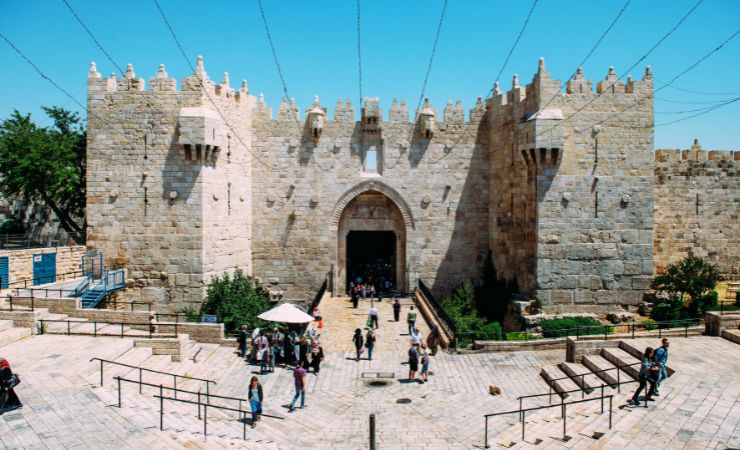
Damascus Gate serves as one of the eight gates and main entrances to Jerusalem's Old City. Known as "Sha'ar Shkhem" in Hebrew and "Bāb al-ʿĀmūd" in Arabic, it stands as a significant historical landmark and major access point, connecting the Old City to East Jerusalem's bustling commercial districts and Palestinian neighborhoods.
Introduction
The Damascus Gate, known as “Sha’ar Shkhem” in Hebrew and “Bāb al-ʿĀmūd” in Arabic, ranks among the most impressive and historically significant entrances to Jerusalem’s Old City. The gate serves as one of the eight gates in the Old City of Jerusalem and functions as the primary access point to the Muslim Quarter from the north. Built in 1537 CE during the Ottoman period under Sultan Suleiman the Magnificent, this magnificent structure combines military architecture with decorative Islamic design elements.
Location
The Damascus Gate occupies the northwestern wall of Jerusalem’s Old City. The gate faces the neighborhood of East Jerusalem and opens directly onto Sultan Suleiman Street, connecting to Highway 1 that leads northward to Ramallah and ultimately to the ancient city of Damascus in Syria, from which the gate derives its name.
Damascus Gate: A Deeper Dive into History and Archaeology
A location that symbolizes its importance
Damascus Gate Jerusalem occupies a position of immense strategic significance that has made it a crucial entry point for millennia. The gate connects Jerusalem to the ancient Damascus Road, the primary trade route linking the Levantine coast with inland Syria and Mesopotamia. This highway carried merchants, pilgrims, and armies between major Mediterranean ports and the centers of empire in Damascus, Aleppo, and Baghdad. The gate’s placement on higher ground provides natural defensive advantages while facilitating control of north-south movement through the region. Archaeological evidence suggests continuous occupation and fortification of this site since at least the Second Temple period, making it one of the most historically layered locations in Jerusalem.
Aelia Capitolina Period
Extensive recent archaeological research excavations beneath the current Damascus Gate have revealed the impressive remains of a Roman triumphal arch dating to Emperor Hadrian’s visit to Jerusalem in 129/130 CE. This earlier gate formed part of the northern entrance to Aelia Capitolina, the Roman colony established on the ruins of Jerusalem following its destruction in 70 CE. The Roman gate featured three arched openings, typical of imperial triumphal architecture.
The gate initially functioned as a free-standing monument because Jerusalem’s walls had been demolished during the First Jewish-Roman War. Roman engineers positioned the gate at the intersection of the Cardo Maximus, the city’s main north-south thoroughfare, with the northern approach road. For nearly two centuries, the Tenth Legion (Legio X Fretensis) maintained a garrison in the city, enforcing imperial prohibition against Jewish residence in Aelia Capitolina. Only in the late 3rd or early 4th century did Roman authorities construct new defensive walls that incorporated the gate into the city’s fortification system.
Two other triumphal gates from the time of Emperor Hadrian are the Ecce Homo Arch, and the triumphal arch located at the Alexander Nevsky Church in the Old City.
The gate earned the designation “Gate of the Column” from a commemorative column erected in the square behind it. This column, topped with a statue of Emperor Hadrian, proclaimed Roman victory over the Jewish rebels and served as a focal point for imperial ceremonies. Fragments of the column’s inscribed base, discovered during 20th-century excavations, confirm its dedication to Hadrian and provide evidence of the square’s use for public gatherings. The urban plan of Aelia Capitolina followed standard Roman colonial design, with the Cardo Maximus extending southward from the gate toward the forum area near the present-day Cardo Maximus archaeological site.
Byzantine and Early Islamic Periods
During the Byzantine era (324-638 CE), the gate continued to serve as Jerusalem’s primary northern entrance, though modifications reflected the city’s transformation into a pilgrimage destination. Byzantine engineers reinforced the gate’s defensive capabilities while maintaining its ceremonial function for Christian processions entering the holy city. The Madaba Map, a 6th-century mosaic floor discovered in Jordan, depicts Jerusalem with prominent northern and southern gates connected by a colonnade-lined street, confirming the gate’s continued prominence.
Following the Arab conquest in 638 CE, the new Muslim rulers retained the gate’s basic structure while adapting it to Islamic architectural preferences. Early Islamic modifications included the addition of pointed arch elements and geometric decorative patterns that would later influence the Ottoman reconstruction. The gate’s Arabic name, “Bāb al-ʿĀmūd” (Gate of the Column), preserved the memory of Hadrian’s commemorative pillar even after the column itself had disappeared.
Crusaders Period
The Crusader occupation of Jerusalem (1099-1187 CE) brought significant modifications to the Damascus Gate’s structure and function. Crusader engineers, prioritizing defensive capabilities over ceremonial access, constructed a series of chambers and storage rooms against the gate’s outer facade. These additions effectively blocked the original Roman entrances, forcing travelers to use narrow internal passages that could be more easily defended during sieges.
Archaeological evidence indicates that the Crusaders installed heavy wooden doors reinforced with iron bands and equipped the gate with murder holes in the vaulted ceiling above the passage. These defensive modifications proved effective during Saladin’s siege of Jerusalem in 1187, though the city ultimately fell to Muslim forces. Following the Muslim reconquest, the gate’s defensive features were maintained but the restrictive internal passages were partially widened to improve commercial access.
Ottoman Period
The current Damascus Gate represents the architectural vision of Mimar Sinan, the Ottoman Empire’s chief architect, who designed the structure as part of Sultan Suleiman the Magnificent’s comprehensive renovation of Jerusalem’s defenses between 1535-1541 CE. Sinan’s design brilliantly incorporated elements from the underlying Roman ruins while creating a distinctly Ottoman architectural statement that emphasized both defensive strength and imperial grandeur.
The gate’s construction required the careful dismantling of medieval additions and the integration of surviving Roman stonework into the new design. Ottoman builders employed the distinctive ablaq technique, alternating courses of light and dark stone that create horizontal stripes across the facade. The central arch rises to a height of 8 meters and spans 4.5 meters at its widest point, topped by an intricate muqarnas vault featuring stalactite-like carved stone elements typical of Islamic architecture.
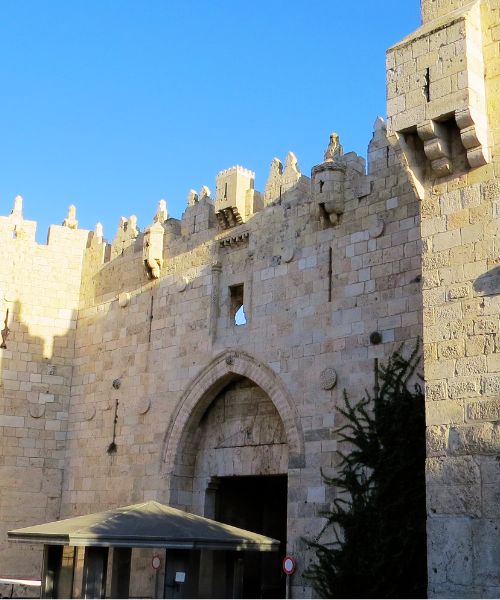
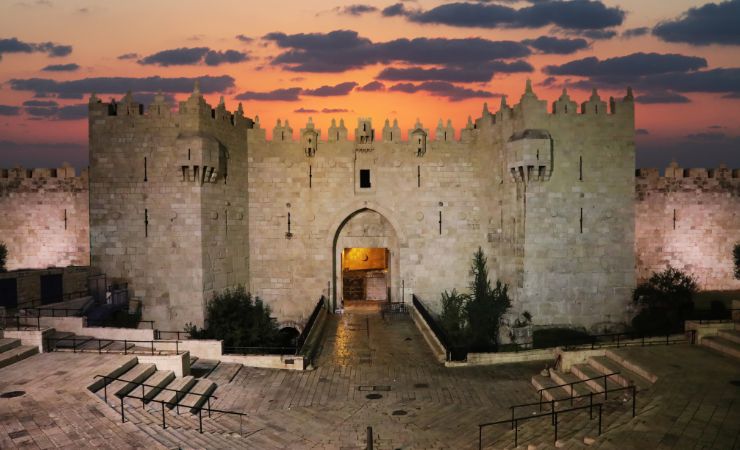
Above the gate, a marble inscription in Ottoman Turkish and Arabic commemorates Suleiman’s building project with the date 945 AH (1537 CE). The inscription reads: “In the name of God the Merciful, the Compassionate. The order was given by our Lord Sultan Suleiman in the year 945.” Twin crenellated towers flanking the gate rise 15 meters above ground level, equipped with machicolations that allowed defenders to drop projectiles on attackers below.
The gate’s internal passage executes a sharp 90-degree turn to the west, a defensive feature that prevented attackers from charging straight through while creating a killing ground where defenders could concentrate fire. This L-shaped passage stretches 12 meters in length and features cross-vaulted ceilings supported by pointed arches. Side chambers within the passage originally served as guardrooms and customs inspection points where Ottoman officials could examine merchandise and collect taxes from merchants entering the city.
Israeli Period
Following the 1967 Six-Day War, Israeli authorities initiated a comprehensive preservation and restoration program for Damascus Gate Jerusalem under the direction of architects Peter Bugod and Eunice Figueiredo in partnership with the Jerusalem Foundation. The project unfolded in three distinct phases designed to address both practical urban needs and archaeological preservation requirements.
The first phase (1981) transformed the gate’s external plaza into an amphitheater-style gathering space that accommodated the area’s role as a social and commercial hub. The redesign included improved vehicle access for deliveries to Old City merchants, designated parking areas for tour buses, and enhanced pedestrian circulation patterns. Stone seating arranged in terraced levels provides rest areas for visitors while maintaining clear sightlines to the gate’s Ottoman facade.
Phase two (1982) focused on modernizing infrastructure within the gate’s commercial area, including complete reconstruction of shop roofs using traditional Jerusalem stone, installation of contemporary electrical and plumbing systems, and laying of period-appropriate stone paving throughout the passage. The project also included restoration of original Ottoman-era storefronts and the creation of standardized shop signs that complement the historical architecture.
The final phase (1985) represented the most archaeologically significant component of the restoration. Excavations conducted beneath the Ottoman structure revealed substantial remains of the Roman gate, including intact sections of Hadrian’s triumphal arch, a complete guardroom with original floor mosaics, and a stone staircase that once provided access to the Roman wall’s rampart walk. These discoveries were preserved in situ and incorporated into an underground archaeological garden that allows visitors to experience Jerusalem’s layered history firsthand. The garden features climate-controlled display cases protecting delicate artifacts, informational panels in multiple languages, and carefully planned lighting that highlights architectural details while protecting ancient stone surfaces.
The Current Visitor Experience
Damascus Gate Jerusalem presents visitors with a dramatically different approach compared to other Old City entrances such as the Jaffa Gate. Rather than ascending steps to reach the entrance, visitors descend approximately 3 meters from street level to the gate’s threshold, a design feature that reflects the area’s natural topography and the accumulation of debris over centuries.
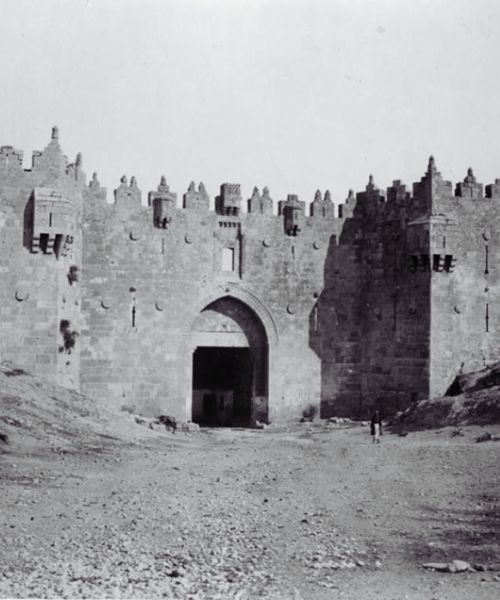
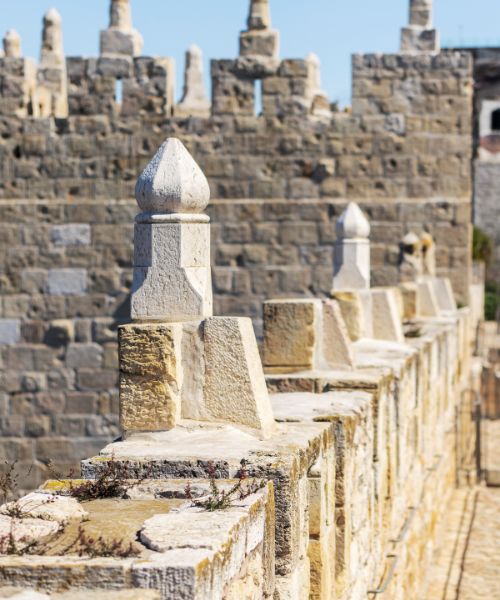
The gate’s twin towers, each standing 15 meters high and crowned with traditional crenellations, feature distinctive machicolations that project outward from the upper levels. These defensive apertures, while no longer serving their original military purpose, create dramatic shadows across the gate’s facade throughout the day. The restored northern tower, reconstructed in 2011 following damage during the Six-Day War, incorporates original Ottoman stonework with carefully matched replacement blocks. Historical photographs from the British Mandate period guided the restoration of architectural details including the arrow slits and battlements.
The gate provides direct access to the bustling Arab bazaar (souk) that extends deep into the Muslim Quarter, where merchants sell everything from traditional embroidery and ceramics to aromatic spices and fresh-baked bread. The main thoroughfare beyond the gate, known as Al-Wad Street, follows the approximate path of the ancient Roman Cardo Maximus and leads southward toward the Western Wall and Temple Mount area.
The underground archaeological garden beneath the gate operates with restricted access, typically opening for guided tours on specific days of the week. Visitors can explore the Roman guardroom with its intact floor mosaics depicting geometric patterns typical of the 2nd century CE, examine the massive foundation stones of Hadrian’s triumphal arch, and walk along sections of the original Roman roadway.
Practical Information
Damascus Gate remains open 24 hours daily for pedestrian traffic, with no admission fee required to pass through the main gate.
Additional Information
Damascus Gate – Wikipedia
Architectural and Chronological Aspects of the Ancient Damascus Gate Area
The Damascus Gate Section – Israel Antiquities Authority
Jerusalem Foundation – The Damascus Gate
Can you see the Roman ruins under Damascus Gate?
Yes, the Roman archaeological remains are accessible through a dedicated underground museum that operates Tuesday through Thursday from 9:00 AM to 3:00 PM. Visitors can explore Hadrian’s original triumphal arch, Roman guardrooms with intact mosaics, and sections of the ancient roadway. The site requires advance booking for groups and involves navigating stone steps.
What shops and markets are near Damascus Gate Jerusalem?
Damascus Gate provides direct access to the Muslim Quarter’s extensive bazaar system, featuring traditional Palestinian handicrafts, spices, textiles, and religious artifacts. The main souk extends along Al-Wad Street toward the Temple Mount, with dozens of family-owned shops selling everything from hand-embroidered clothing to local sweets and aromatic coffee.
Is Damascus Gate wheelchair accessible?
The main gate area at street level is wheelchair accessible, with ramped access from Sultan Suleiman Street to the gate’s plaza. However, the underground archaeological site requires visitors to navigate stone steps and narrow passages, making it unsuitable for wheelchairs or those with mobility limitations. The Old City streets beyond the gate feature uneven stone paving that may present challenges.
What security measures exist at Damascus Gate?
Israeli security personnel conduct periodic bag checks and metal detector screenings at Damascus Gate, particularly during heightened security periods or major religious holidays. Visitors should carry valid identification and allow extra time during busy periods. The area is monitored by security cameras, and both uniformed and plainclothes officers patrol the vicinity regularly.
How do you get to Damascus Gate by public transportation?
Damascus Gate is served by Jerusalem’s bus lines 3, 9, and 26, which stop at the Sultan Suleiman Street station approximately 100 meters from the gate. The Jerusalem Light Rail’s City Hall station is about a 10-minute walk away via Jaffa Road and Sultan Suleiman Street. Taxis and ride-sharing services can drop passengers directly at the gate’s plaza.
What is the historical significance of Damascus Gate’s Arabic name?
The Arabic name “Bāb al-ʿĀmūd” (Gate of the Column) preserves the memory of a Roman commemorative column that stood in the square behind Hadrian’s original gate. This column, topped with a statue of Emperor Hadrian, symbolized Roman victory over the Jewish rebels and served as a focal point for imperial ceremonies. Though the column disappeared centuries ago, the name survived through continuous Arabic-speaking residence in Jerusalem.
Nearby Sites
- The Garden Tomb: A rock-cut tomb in Jerusalem which many Christians believe to be the site of the burial and resurrection of Jesus Christ.
- Herod’s Gate: Also known as Flower Gate, it leads into the Muslim Quarter of the Old City, and its name is derived from a rosette carved into the gate’s facade.
- The Roman Cardo: The main street in the Byzantine era of Jerusalem, it was the economic heart of the city and is now a significant archaeological site.
- King Hezekiah’s Tomb: Traditionally believed to be the burial place of the biblical King Hezekiah, it is an ancient Jewish funerary monument located outside the Old City of Jerusalem.
Keep reading
Part of our Jerusalem Travel Guide →