Beit Alpha Synagogue is a sixth-century archaeological site in northern Israel, renowned for its exceptionally preserved mosaic floor. Located at the foot of Mount Gilboa, the synagogue features three striking panels depicting the Binding of Isaac, a zodiac wheel with Helios, and religious symbols including a menorah and ark.
Beit Alpha Synagogue stands as one of Israel’s most remarkable archaeological treasures, a 6th-century house of worship that drew Jewish farmers and merchants from across the Harod Valley. Built at the foot of Mount Gilboa in a small Byzantine village, this ancient synagogue survived earthquakes, conquests, and centuries of abandonment to emerge as a masterpiece of ancient Jewish art.
Location of the Beit Alpha Synagogue
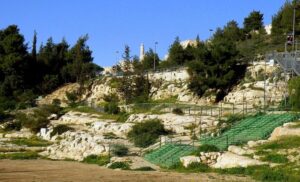
The Beit Alpha Synagogue National Park occupies a strategic position in the fertile Harod Valley, situated between Kibbutz Beit Alpha and Kibbutz Hefzi-Bah in northern Israel. The ancient site sits along the historic Roman road that connected Scythopolis (modern Beit She’an) with the military camp at Megiddo and the coastal port of Caesarea Maritima.
The History of the Synagogue
The Beit Alpha Synagogue emerged during a period of remarkable Jewish cultural flowering in the Byzantine period. The village itself was established as a Roman agricultural settlement, positioned along the vital commercial route linking the Decapolis city of Scythopolis with the Roman legionary fortress at Megiddo. The community prospered from grain cultivation and trade, supporting a population large enough to commission and maintain an elaborate house of worship.
Construction began at the end of the 5th century, with the building’s stone foundations and walls completed during the reign of Emperor Anastasius I. The magnificent mosaic floor was commissioned and laid between 518-527 CE, during the reign of Byzantine Emperor Justin I, as recorded in a Greek inscription that credits two master craftsmen, Marianos and his son Hanina, who also created mosaics for synagogues in nearby Beit She’an. Archaeological excavations revealed a hoard of early 4th-century Byzantine coins hidden in a genizah (ritual storage space) beneath the synagogue’s apse, suggesting the community safeguarded valuable items during periods of political uncertainty.
The Beit Alpha Synagogue continued to serve its community even after the Muslim conquest of the region in 638 CE, demonstrating the continuity of Jewish life under early Islamic rule. This period of stability ended abruptly in 749 CE, when a catastrophic earthquake leveled the synagogue along with numerous other structures throughout the Jordan Valley. The destruction was so complete that the irrigation systems failed, transforming the fertile valley into marshland.



The Mosaic Floor: Three Panels, Many Layers
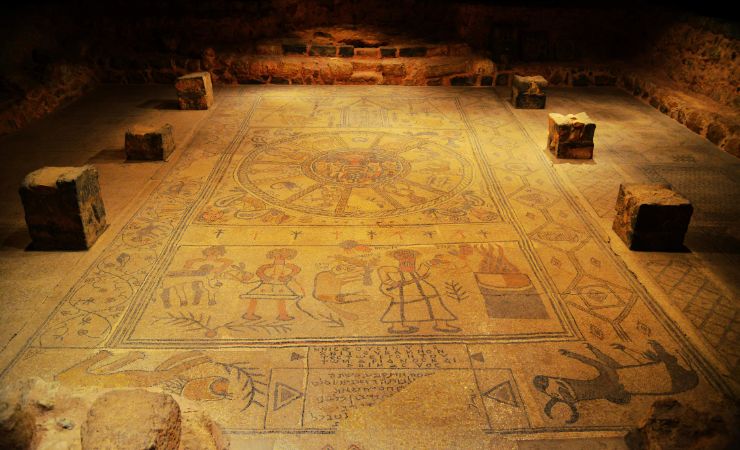
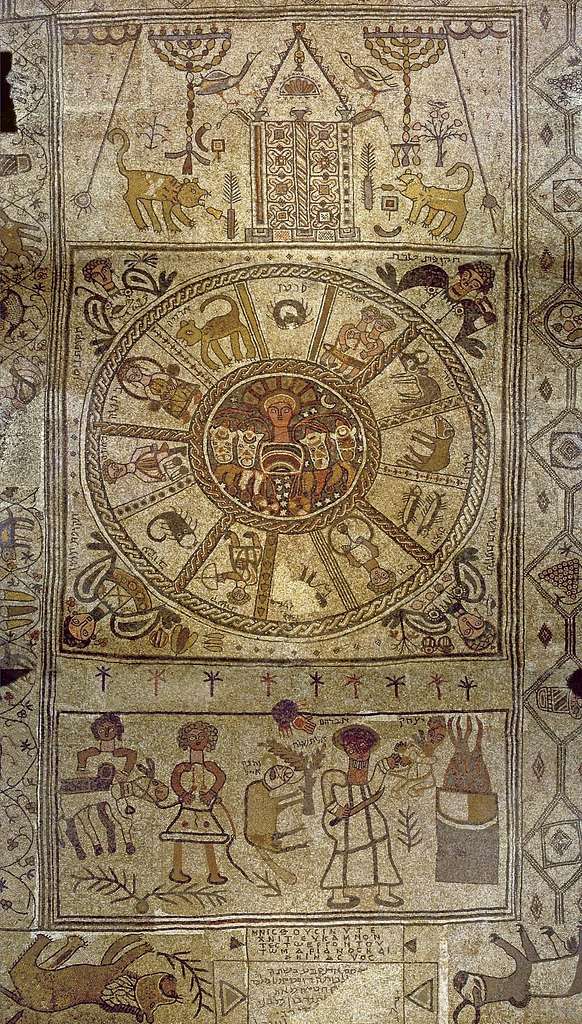
The most striking feature of Beit Alpha is its well-preserved mosaic floor, made by two artists named Marianos and Hanina. It’s made up of three large panels running down the center of the synagogue, surrounded by patterns and small images of animals, plants, and daily life.
The Binding of Isaac (Northern Panel)
The northern panel depicts the Akedah, the binding of Isaac from Genesis 22, rendered with remarkable emotional intensity and theological sophistication.
Abraham dominates the left side of the composition, his bearded figure dressed in a striped tunic, raising a knife above his son who lies bound upon a stone altar.
Isaac appears as a young man rather than a child, emphasizing his willingness to participate in God’s test.
A divine hand extends from the upper right corner, accompanied by the Hebrew inscription “al tishlach” (do not stretch out your hand), capturing the moment of divine intervention.
A ram caught in a thicket appears in the upper left, its horns entangled in stylized branches, ready to serve as the substitute sacrifice.
Two servants wait beside a loaded donkey at the bottom of the panel, faithful to Abraham’s instruction that they remain behind while he and Isaac worship.
Hebrew labels identify each figure, while direct quotations from the Torah emphasize the panel’s function as both artistic decoration and religious instruction for a community that valued textual learning alongside visual beauty.
The Zodiac Wheel (Central Panel)
The central panel presents perhaps the most enigmatic element of the entire mosaic: a complete zodiac wheel dominated by Helios, the Greek sun god, driving his quadriga (four-horse chariot) across the heavens. The twelve zodiac signs appear in their traditional sequence, each labeled in Hebrew rather than Greek or Latin, suggesting the community’s desire to integrate cosmological imagery within their Jewish cultural framework. Four female figures occupy the corners, personifying the seasons and carrying agricultural symbols that connected cosmic cycles with the practical rhythms of farming life in the Harod Valley.
Why is this in a synagogue? Scholars have suggested a few reasons:
It may have served as a visual calendar, helping people keep track of festivals.
It could reflect how Jewish communities adopted common artistic themes of the time without focusing on their original meanings.
Some believe it’s connected to God’s promise to Abraham that his descendants would be “as numerous as the stars.”
The Torah Shrine (Southern Panel)
The southern panel occupies the most sacred area of the synagogue, positioned directly in front of where the Torah ark once stood. This panel functions as a visual echo of the physical ark, depicting a stylized Torah shrine beneath a peaked roof supported by columns.
The shrine’s double doors stand partially open, revealing interior details while maintaining the mystery of the sacred contents. Ornate birds, possibly peacocks symbolizing immortality or ostriches representing divine protection, flank the structure as guardians of sacred knowledge.
- The composition includes a rich array of Jewish ritual objects that would have been familiar to every member of the congregation. Two seven-branched menorahs stand prominently on either side of the ark, while a shofar, lulav, etrog, and incense shovel represent the cycle of Jewish holidays and daily worship.
An eternal flame hangs suspended above the shrine, casting symbolic light over the entire scene.
Two lions crouch at the base of the composition, serving as powerful guardians of the Torah while evoking the tribal symbol of Judah.
Decorative curtains frame the entire panel, creating the impression that worshippers are witnessing a sacred drama unfolding behind a temple veil.
Significance and Interpretations
The Beit Alpha Synagogue mosaic fundamentally challenges traditional assumptions about ancient Jewish attitudes toward figurative art. For centuries, scholars believed that post-biblical Judaism strictly avoided human and animal representations in religious contexts, following interpretations of the Second Commandment that prohibited graven images. The discovery of Beit Alpha, along with similar synagogue mosaics at Hammat Tiberias and Sepphoris, revealed that many Jewish communities in late antiquity embraced elaborate figural art as a means of religious expression and communal identity.
The synagogue’s decorative program reflects a sophisticated theological worldview that integrated biblical narrative, cosmic symbolism, and ritual practice into a unified artistic statement. The community that commissioned this work possessed both the financial resources and cultural confidence to blend Jewish tradition with Hellenistic artistic conventions, creating something distinctively their own. The Hebrew inscriptions throughout the mosaic demonstrate that this was not simple cultural assimilation but rather a deliberate adaptation of Mediterranean artistic vocabulary to serve Jewish religious purposes.
The coexistence of Jewish and pagan elements within the same sacred space continues to generate scholarly debate. While some researchers view the zodiac as purely decorative borrowing stripped of religious significance, others argue for more complex interpretations. The arrangement of the three panels creates a theological progression from earthly obedience (the Akedah) through cosmic order (the zodiac) to divine presence (the Torah shrine), suggesting that the pagan symbols served to illustrate Jewish concepts about God’s sovereignty over creation.
Practical Information
Hours: April-September: 8:00 AM – 5:00 PM daily; October-March: 8:00 AM – 4:00 PM daily. The site closes one hour earlier on Fridays and holidays.
Admission: Adults: 14 NIS (approximately $4 USD); Students/Seniors: 12 NIS ($3.50 USD); Children under 5: Free. Israel National Parks Annual Pass accepted.
Getting There: Located on Route 669 between Kibbutz Beit Alpha and Kibbutz Hefzi-Bah. Free parking available on-site. The site is wheelchair accessible via paved paths.
Facilities: Visitor center with multimedia presentation, restrooms, drinking fountains, and shaded seating areas. A protective pavilion covers the mosaic floor to prevent weather damage.
Additional Information
1st century AD (approx.): The Roman/Byzantine agricultural village of Beit-Alpha is established.
Early 4th century AD: A hoard of Byzantine coins is hidden in a Genizah (ritual archive place) under the apse of the Beit Alpha synagogue.
4th century AD: The Peutinger map, based on a Roman map, marks the village of Beit-Alpha.
End of 5th century AD: The Beit Alpha synagogue structure is built.
Beginning of 6th century AD (518-527 AD): During the reign of Byzantine Emperor Justin I, the magnificent mosaic floor of the Beit Alpha synagogue is commissioned and laid. The artists, Marianos and his son Hanina, are also known mosaic craftsmen from Beit She’an.
749 AD: The Beit Alpha synagogue, still functioning under Muslim control, is destroyed in a massive earthquake that levels many towns and cities in the region. The area subsequently turns into a large swamp due to unrepaired water channels and irrigation.
1866-1877: The site, appearing as “Kh. Beit Ilfa,” is examined during the PEF survey by Wilson, Conder, and Kitchener, who describe foundations of buildings and walls, including well-dressed stones and ancient sarcophagi.
1878: The PEF survey map shows “Kh. Beit Ilfa” near ancient roads.
1922: Two Kibbutz settlements are established around the ruins of the Roman village: Kibbutz Beit-Alpha (named after the ruins) to the east, and Kibbutz Hefzi-bah (named after Jerusalem) to the west.
1928: Kibbutz Hefziba members accidentally discover the extensive mosaic floors of the Beit Alpha synagogue during irrigation construction for a new dining hall.
Early 1929: Archaeological excavations of the Beit Alpha synagogue begin under the auspices of the Hebrew University of Jerusalem, led by Eleazar Sukenik.
Early 1930: A structure is built over the synagogue with British Mandate government funding to protect the mosaic.
October 1960: A new building is inaugurated over the mosaic, with surrounding lawns, restrooms, and a cafeteria.
1962: A secondary round of excavations, sponsored by the Israel Antiquities Authority, further explores residential structures around the synagogue.
October 1965: A section of the mosaic depicting a shofar goes missing.
What makes the Beit Alpha Synagogue mosaic floor unique?
The Beit Alpha Synagogue features one of the most complete and well-preserved ancient synagogue mosaics in Israel, created by master craftsmen Marianos and Hanina in the 6th century. Its unique three-panel design combines biblical narrative (the Binding of Isaac), astronomical imagery (zodiac wheel with Helios), and Jewish ritual symbols (Torah shrine), representing a remarkable fusion of Jewish tradition and Hellenistic artistic culture.
How old is the Beit Alpha Synagogue and when was it discovered?
The Beit Alpha Synagogue was built in the late 5th century CE, with its mosaic floor completed between 518-527 CE during the Byzantine period. The ancient synagogue was accidentally rediscovered in 1928 by members of Kibbutz Hefziba while constructing irrigation channels. Formal archaeological excavations began in 1929 under the direction of Eleazar Sukenik from the Hebrew University of Jerusalem.
Why does a Jewish synagogue contain pagan symbols like the zodiac and Helios?
The presence of zodiac signs and the Greek sun god Helios in the Beit Alpha Synagogue reflects the cultural integration of Jewish communities in late antiquity. Scholars debate whether these symbols served as religious calendars, decorative elements stripped of pagan meaning, or theological metaphors illustrating God’s cosmic sovereignty. Recent research suggests the zodiac may represent God’s promise to Abraham about descendants “as numerous as the stars.”
What destroyed the original Beit Alpha Synagogue?
The Beit Alpha Synagogue was destroyed by a catastrophic earthquake that struck the Jordan Valley in 749 CE. This same earthquake devastated numerous settlements throughout the region and caused the collapse of irrigation systems, turning the fertile Harod Valley into marshland. The synagogue had continued functioning under early Muslim rule before this natural disaster ended its nearly 250-year period of active use.
Nearby Sites
- Beit She’an National Park (~10 min east): A sprawling Roman‑Byzantine city with a theater, baths, and colonnaded streets.
- Tel Megiddo (~30 km northwest): Archaeological layers from Bronze Age to Crusader—legendary Armageddon scenery.
- Kochav HaYarden (Belvoir Fortress) (~20 km north): A Crusader-era hilltop castle with sweeping views of the Jordan Valley.
- Mount Gilboa: A favorite for scenic hikes and panoramic viewpoints over Jezreel and Jordan Valleys.
Keep reading
Part of our Jewish Heritage Guide →