Kochav HaYarden, also called Belvoir Fortress, is a well-preserved Crusader castle perched 500 meters above the Jordan Valley. Built by the Knights Hospitaller in the 1160s-1180s, it features a unique concentric double-wall design and offers spectacular panoramic views of the valley, Golan Heights, and surrounding landscapes.
Kochav HaYarden, Hebrew for “Star of the Jordan,” is also known by its Arabic name Kawkab al-Hawa, meaning “Star of the Wind.” Both names reflect the hilltop site’s commanding presence above the Jordan Valley. The fortress built here by the Knights Hospitaller, known to history as Belvoir Fortress Israel, ranks among the best-preserved Crusader military sites anywhere in the Middle East.
Location
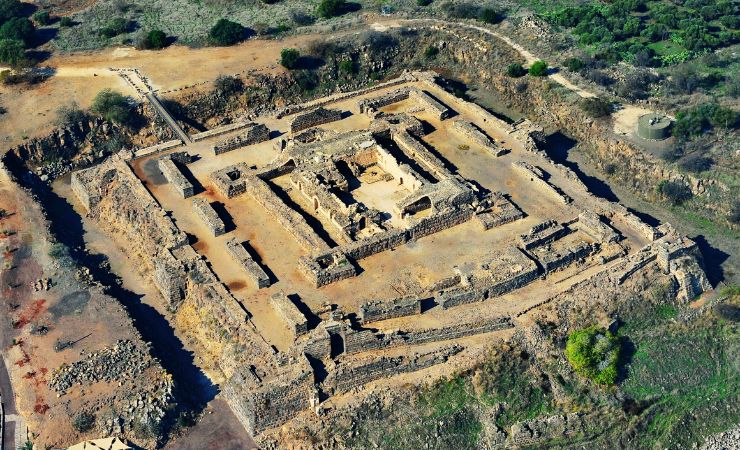
Kochav HaYarden sits on a basalt spur at the eastern edge of the Issachar Plateau in northern Israel, where Lower Galilee drops sharply toward the Jordan Rift Valley. The fortress rises roughly 500 meters (1,640 ft) above the Jordan River Valley floor, giving its garrison a clear view stretching from the Sea of Galilee in the north to the hills of Gilead across the river.
A Strategic Stronghold in the Jordan Valley
Belvoir Fortress Israel faced its first serious test in 1180, when Saladin’s forces attacked and were driven off. In the summer of 1182, a full field battle known as the Battle of Forbelet was fought on the plain below the castle between Saladin’s army and the forces of the leprous King Baldwin IV of Jerusalem. The engagement ended in a tactical draw, with Baldwin managing to withdraw his forces intact, and Belvoir remained in Hospitaller hands.
Everything changed on July 4, 1187, when Saladin annihilated the main Crusader army at the Battle of Hattin, near the Sea of Galilee. Within weeks, fortress after fortress surrendered as the Kingdom of Jerusalem collapsed. Belvoir was one of only three major Crusader strongholds that refused to capitulate, the others being Tyre and the castle of Safed.
Muslim forces arrived at Belvoir’s gates in July 1187. Finding that a direct assault was futile against the concentric walls and the dry moat, they settled into a formal siege. The Hospitaller garrison did not simply wait them out. Knights launched repeated sorties through the postern gates, harassing supply lines and inflicting casualties. In December 1187, one such raid destroyed an entire Muslim unit camped outside the walls.
Saladin himself arrived in March 1188, determined to end the siege personally. His presence raised morale among the besiegers but did not break the defenders. The siege was actually lifted temporarily in May 1188, a remarkable demonstration of what a well-supplied garrison in a well-designed fortress could achieve against one of the most capable commanders of the medieval world.
By the end of 1188, Saladin’s forces returned with renewed energy. Winter fighting was miserable for both sides, and casualties mounted. Eventually, Muslim sapper units succeeded in tunneling beneath part of the eastern outer wall, collapsing a tower section and forcing their way into the outer corridor. Even then, the Hospitallers continued fighting from the inner keep.
With no realistic prospect of relief and their position inside the keep now untenable, the garrison opened negotiations. Saladin, who had followed the siege for months and witnessed the defenders’ extraordinary resilience firsthand, granted generous terms. The Hospitallers were permitted to leave with their personal belongings and march north to Tyre under safe conduct. Belvoir formally surrendered on January 5, 1189, after an 18-month siege that had cost both sides dearly.
Practical Information
Kochav HaYarden National Park is managed by the Israel Nature and Parks Authority. The site is open Sunday through Thursday and Saturday from 8:00 a.m. to 5:00 p.m. (last entry at 4:00 p.m.), and on Fridays and holiday eves from 8:00 a.m. to 4:00 p.m. (last entry at 3:00 p.m.).
No dress code applies, though the site involves uneven stone surfaces and open ramps, so closed-toe shoes are strongly recommended.
Additional Information
Belvoir, study of the interior castle
Belvoir Castle (Israel)
Belvoir fortress – BibleWalks 500+ sites
- Roman and Byzantine Periods: A Jewish village named Kochava exists near the site of future Belvoir Castle.
- 1168: Velos, a French nobleman, sells the site to the Order of the Knights Hospitaller for 1,400 gold Bezants. Gilbert of Assailly, the Grand Master of the Knights Hospitaller, begins construction of Belvoir Castle.
- 1180-1183: Muslim forces attempt to take Belvoir Fortress but are unable to capture it. During the summer of 1182, the Battle of Forbelet is fought near Belvoir Castle between the forces of King Baldwin IV of Jerusalem and Saladin, ending in a tactical draw.
- July 4, 1187: Saladin’s forces achieve a decisive victory over the Crusaders at the Battle of Hattin. The Galilee falls to the Ayyubid forces. Belvoir Castle is among the three fortresses that hold out.
- July 1187: Muslim forces arrive at the gates of Belvoir Castle and lay siege after failing to capture it immediately. The besieged Knights initially rely on the fortifications but soon begin launching raids and attacks on the Muslim forces.
- December 1187: The besieged Knights from Belvoir destroy a complete Muslim unit, highlighting their resistance.
- March 1188: Saladin himself arrives at Belvoir to command the siege after his forces are unable to overcome the besieged Knights. He views the capture of Belvoir as a way to break the morale of the Crusaders besieged in Tyre. Despite Saladin’s presence, the siege on Belvoir is lifted.
- End of 1188: Saladin’s forces return to Belvoir and renew the siege. The difficult winter and the Crusaders’ continued resistance inflict heavy casualties on the besieging forces.
- Early January 1189: Muslim sapper units manage to breach the eastern outer wall of the fortress and push towards the inner walls.
- January 5, 1189: After a brief battle and realizing their hope is lost, the Crusaders offer terms of surrender. Impressed by the defenders’ bravery, Saladin allows them to leave with their possessions and relocate to Tyre. Belvoir Castle is transferred to Muslim control after a siege lasting a year and a half.
- 1191: The Galilee is recaptured by the Crusaders. Belvoir remains under Muslim control.
- 1217-1218: Muslim rulers have the fortifications of Belvoir dismantled (slighted), fearing its recapture by the Crusaders.
- 1219: The Ayyubid ruler in Damascus has Belvoir Castle slighted.
- 1228: Belvoir Castle is demolished.
- 1240: Belvoir is ceded back to the Franks (Crusaders) through an agreement.
- 1243-1263: Belvoir is under the control of the Hospitallers again, following a deal between Richard Earl of Cornwall and the Governor of Egypt. The fortress is not repaired due to lack of funds.
- After 1263: Belvoir returns to Muslim control.
- 18th Century: The ruins of Belvoir are resettled and become the Arab village of Kawkab al-Hawa.
- 1963: Archaeological excavations begin at Belvoir (Tamari and Tsuri). Arab buildings on the site are demolished by Israeli authorities.
- 1963-1968: Michael Ben Dov conducts archaeological excavations at Belvoir. The fortifications are revealed, and restoration work is completed. The site is opened to visitors.
- 1994-1996: Yigal Tumarkin creates a sculpture garden at Belvoir National Park.
Where exactly is Belvoir Fortress Israel located?
Belvoir Fortress, known in Hebrew as Kochav HaYarden, sits on the eastern edge of the Issachar Plateau in the Lower Galilee region of northern Israel. It is approximately 20 kilometers north of Beit She’an, reached via Route 717.
How long does a visit to Belvoir Fortress take?
Most visitors spend between 1-1.5 hours at the site. That is enough time to walk through the outer courtyard, explore the inner keep, descend into the dry moat, and take in the panoramic views over the Jordan Valley.
Who built Belvoir Fortress, and when?
The fortress was built by the Knights Hospitaller, a Catholic military order, beginning in 1168 after they purchased the hilltop site from a French nobleman named Velos. Construction was ordered by Grand Master Gilbert of Assailly. The Hospitallers built Belvoir as one of the most sophisticated concentric castles in the Holy Land, designed to control the Jordan Valley crossing from Transjordan into the Kingdom of Jerusalem.
What happened to Belvoir after Saladin captured it?
After the Hospitaller garrison surrendered on January 5, 1189, Saladin held the fortress as a strategic asset. Between 1217 and 1219, Ayyubid rulers ordered the fortifications systematically demolished (a process called slighting) to prevent the castle from being used again by returning Crusaders. By 1228, most of the superstructure had been brought down. The site was briefly returned to Crusader control in the 1240s but was never repaired or garrisoned again.
What can you see inside Belvoir Fortress today?
Visitors can explore the vaulted outer halls that once served as stables and storage, the inner keep with its central cistern and stone-built kitchen, three original cooking stoves built into the kitchen walls, a Nine-Men’s Morris game board carved into a stone surface, and the dry moat reached by descending staircases. The sculpture garden created by Yigal Tumarkin between 1994 and 1996 is also spread across the grounds. On clear days, the views from the ramparts extend east to the hills of Jordan and north toward Mount Tabor.
Nearby Sites
Beit She’an National Park: Awell-preserved Roman and Byzantine ruins, including a theater, bathhouses, and colonnaded streets.
- Mount Gilboa: A scenic ridge with hiking trails and stunning views over the Jezreel and Jordan Valleys.
- The Sea of Galilee: Includes ancient synagogues, boat rides, and traditional fish meals along the shore.
- The Ancient Synagogue of Beit Alfa: Famous for its beautifully preserved 6th-century mosaic floor, including a zodiac wheel.
- Ein Harod (Ma’ayan Harod) National Park: A peaceful park built around a spring at the foot of Mount Gilboa, associated with the biblical story of Gideon.
Keep reading
Part of our Galilee & Northern Israel Guide →