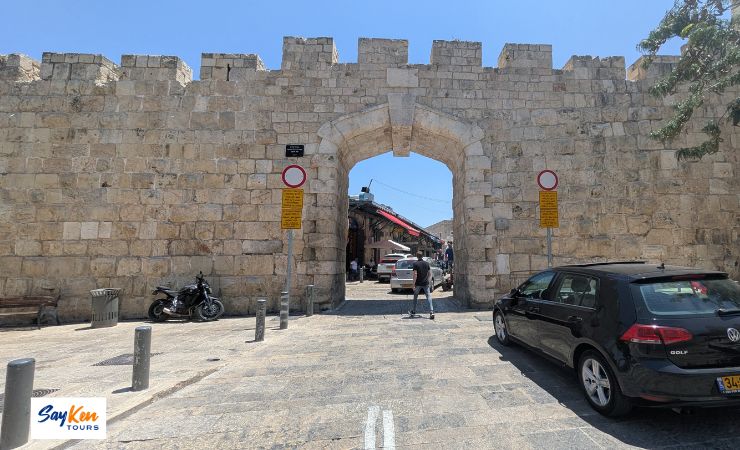
New Gate, built in 1889, is the youngest and most recent entrance to Jerusalem's Old City. Located in the northern wall between Jaffa Gate and Damascus Gate, it was constructed during Ottoman rule to provide Christian pilgrims direct access to the Christian Quarter and nearby religious sites.
New Gate is a 19th-Century addition to the Gates of the Old City of Jerusalem. It represents the youngest entrance to the Old City, constructed in 1889 during a period of significant urban expansion. This relatively modern addition to Jerusalem’s ancient walls serves the practical needs of the growing Christian Quarter while maintaining the architectural integrity of the historic fortifications.
Location of the New Gate
New Gate Jerusalem occupies a strategic position along the northwestern wall of the Old City, approximately 400 meters east of Jaffa Gate and 600 meters west of Damascus Gate. The gate provides direct access between the Christian Quarter’s northern section and the modern neighborhoods that developed during the late Ottoman period.
Historical Context
The construction of New Gate Jerusalem in 1889 marked a significant departure from centuries-old urban planning traditions. Known as “Bāb al-Jadid” in Arabic and “HaSha’ar HeChadash” in Hebrew, this gate emerged from negotiations between Ottoman authorities and European Christian institutions seeking improved access to their expanding properties north of the Old City. The French consul played a particularly influential role in advocating for the gate’s creation, reflecting the growing European presence in Jerusalem during this transformative period.
The timing of the gate’s construction coincided with Sultan Abdul Hamid II’s modernization efforts throughout the Ottoman Empire. Unlike the ancient gates that evolved organically over millennia, New Gate Jerusalem was planned and executed as a deliberate urban intervention. The project required careful consideration of the existing Mamluk and Ottoman fortifications, ensuring that the new opening would not compromise the wall’s defensive integrity.
The architectural design reflects late Ottoman engineering principles while respecting traditional Jerusalem stonework. The arched entrance features carefully dressed limestone blocks that match the surrounding wall construction. Master masons employed time-honored techniques to create the distinctive crenellated crown that caps the gate, ensuring visual continuity with the historic fortifications. The gate’s relatively modest proportions, measuring approximately 3.5 meters in width, reflect its intended function as a pedestrian passage rather than a major commercial thoroughfare.
Practical Information
New Gate Jerusalem remains open 24 hours daily for pedestrian access, with no admission fee required. The gate accommodates wheelchair users and those with mobility limitations, featuring level stone paving on both sides.
Additional Information
Why is New Gate Jerusalem called the “youngest” gate?
New Gate Jerusalem earned this designation because it was constructed in 1889, making it the most recently built of all the Old City gates. While other gates have ancient origins dating back to Roman, Byzantine, or early Islamic periods, New Gate was specifically created during the late Ottoman era to serve the expanding Christian Quarter.
What was the main reason for building New Gate Jerusalem?
The gate was built to provide direct access between the Christian Quarter and the growing European neighborhoods north of the Old City walls. French religious institutions and other Christian organizations had established significant properties outside the walls and needed convenient passage for their communities and activities.
What architectural style does New Gate Jerusalem represent?
The gate exemplifies late Ottoman architectural principles, incorporating traditional Jerusalem limestone construction with 19th-century engineering techniques. The design maintains visual harmony with the surrounding medieval walls while reflecting the modernization efforts of Sultan Abdul Hamid II’s era.
Nearby Sites
- Notre-Dame de France: This Catholic Monestary was established in the 19th century. It has an exhibition of what is believed to be Jesus’ Shrouds.
- St. Louis Hospital: St. Louis Hospital has been serving the city’s residents since the late 19th century.
Tancred’s Tower (Goliath’s Tower): This tower is named after the Crusader prince Tancred, commemorating his attempt to break through the city walls during the Crusaders’ siege on the Old City in 1099.
The Garden Tomb: Believed by some to be the burial and resurrection site of Jesus. It offers an alternative to the Church of the Holy Sepulchre.
Keep reading
Part of our Jerusalem Travel Guide →