Mary's Tomb in Jerusalem is a 1,000-year-old underground sanctuary built by Crusaders that marks the traditional burial site of the Virgin Mary. Located in the Kidron Valley at the foot of the Mount of Olives, the tomb features a dramatic stone staircase descending into a cave-like church. The site is venerated by Christians and Muslims alike and remains an active place of worship.
Mary’s Tomb Jerusalem occupies a sacred position in the Kidron Valley beneath the Mount of Olives, where the Virgin Mary’s final resting place has drawn pilgrims for over a millennium. The Crusaders built the current underground tomb structure more than 1,000 years ago as part of their magnificent Church of the Assumption, which once dominated the valley floor.
The Location of Mary's Tomb
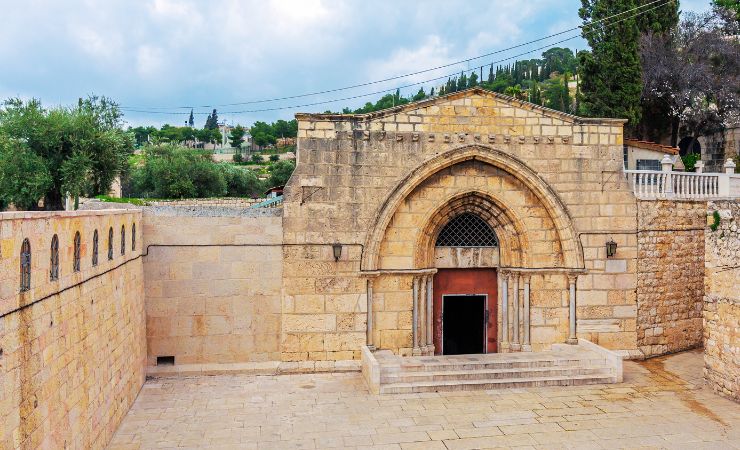
Mary’s Tomb Jerusalem sits in the Kidron Valley at the foot of the Mount of Olives, approximately 200 meters east of Lion’s Gate in the Old City walls. The tomb occupies a strategic location between the ancient Jewish cemetery on the Mount of Olives slopes and the historic Garden of Gethsemane. Visitors approach the site through a narrow entrance that leads to a steep stone staircase descending 15 meters below ground level into the Byzantine-era crypt.
Biblical Context
While Mary’s Tomb Jerusalem receives no explicit mention in canonical biblical texts, the site carries profound significance within established Christian tradition and ecclesiastical history. Eastern Orthodox, Oriental Orthodox, and Anglican Christian communities maintain strong consensus that this location marks the Virgin Mary’s final earthly resting place, mother of Jesus Christ.
The tradition draws authority from apocryphal literature, particularly the “Transitus Mariae” (The Passing of Mary), which places Mary’s burial near Gethsemane in the Kidron Valley. The narrative gained widespread acceptance by the 5th century, coinciding with the earliest documented Christian veneration at this specific location. Orthodox Christianity celebrates “The Dormition of the Mother of God” on August 15th, directly connecting Mary’s earthly departure to this Jerusalem site through centuries of liturgical practice and pilgrimage traditions.
Historical accounts from the 6th-century pilgrim Theodosius and the 8th-century monk Epiphanius provide written testimony of Christian worship at Mary’s Tomb, establishing the site’s continuous religious significance well before the Crusader period. These sources document established pilgrimage routes and religious ceremonies, indicating the tomb’s recognition as a major Christian shrine throughout the Byzantine era.
The Crusader Church: A Timeless Testament
The Crusaders constructed their magnificent Church of the Assumption (also known as the Church of Our Lady of Jehosaphat) directly above Mary’s Tomb Jerusalem during the 12th century, creating one of the most architecturally ambitious religious structures in the Holy Land. The three-story church featured elaborate Gothic elements typical of Crusader ecclesiastical architecture, with massive stone pillars supporting soaring vaulted ceilings that extended 30 meters above the sacred crypt below.
Crusader engineers and masons deliberately preserved the existing Byzantine crypt when building their superstructure, demonstrating remarkable engineering skill and religious sensitivity. The church incorporated 48 marble columns imported from Constantinople, intricate carved capitals depicting biblical scenes, and extensive mosaic work that rivaled contemporary European cathedrals. Pilgrims would enter through an ornate western portal before descending the sacred stairway to reach Mary’s actual burial chamber, creating a powerful spiritual progression from earthly grandeur to underground reverence.
Saladin’s conquest of Jerusalem in 1187 resulted in the systematic destruction of the upper church structure, though the Muslim commander specifically ordered the preservation of the underground tomb itself, recognizing Mary’s honored position within Islamic tradition as the mother of the prophet Isa (Jesus).
Franciscan friars attempted restoration during the late 14th century, but their efforts faced repeated political and financial obstacles. The decisive shift occurred in 1757 when Greek Orthodox clergy successfully claimed ownership during the Ottoman-supervised “status quo” arrangements, which allocated control of various Holy Land sites among Christian denominations. This resulted in the permanent expulsion of the Franciscans, establishing the current arrangement where Greek Orthodox and Armenian Apostolic communities share stewardship of Mary’s Tomb Jerusalem through alternating ceremonial duties and maintenance responsibilities.
Despite these changes, the Franciscans have managed to retain possession of the Grotto of Gethsemane.
Archaeological Findings
Systematic excavations at Mary’s Tomb Jerusalem have revealed multiple construction phases spanning over 1,500 years.
- Byzantine Foundation Layer: Excavations beneath the current tomb structure revealed 5th-century Byzantine foundations, including limestone block walls and mosaic fragments that predate the Crusader construction by 700 years. These early Christian remains confirm documented pilgrimage accounts from the 6th century.
- Ancient Inscriptions: Archaeologists have documented inscriptions in Greek, Latin, Armenian, and Arabic dating from the 5th to 15th centuries.
- Early Christian Iconography: The site has yielded fragments of early Christian frescoes, including a 7th-century depiction of the Virgin Mary with the Christ child, demonstrating continuous artistic tradition. Stone carvings of crosses, anchors, and fish symbols appear throughout the structure’s various construction phases.
- Crusader Church Evidence: Extensive remains of the 12th-century Church of the Assumption include carved limestone capitals featuring biblical scenes, remnants of colored glass windows, and foundation stones measuring up to 2 meters in length. These elements provide insight into Crusader architectural techniques and religious iconography specific to Marian devotion.
- Crypt Preservation Techniques: Archaeological analysis reveals sophisticated Byzantine and Crusader methods for preserving the underground tomb chamber, including advanced drainage systems, moisture control measures, and structural reinforcements that have maintained the space’s integrity across centuries of political upheaval and natural disasters.
What Can Be Seen
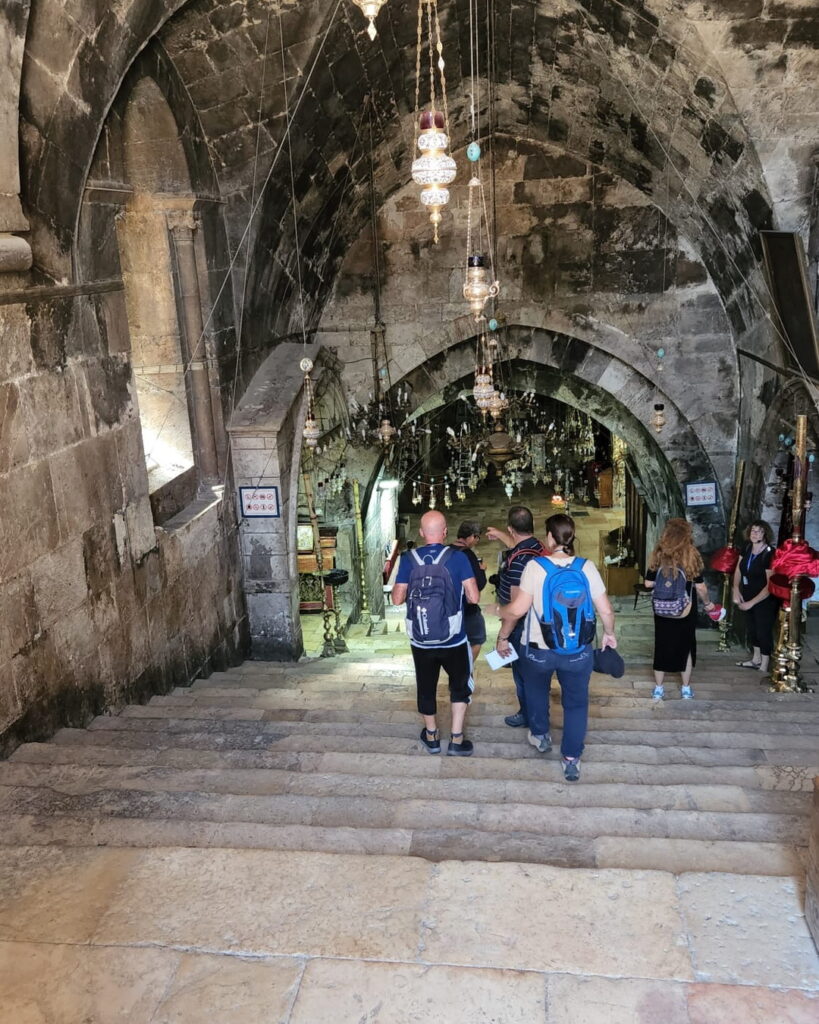
Visitors to Mary’s Tomb Jerusalem descend 47 carved stone steps to reach the underground sanctuary, experiencing a profound transition from the bustling Kidron Valley into a space of sacred silence.
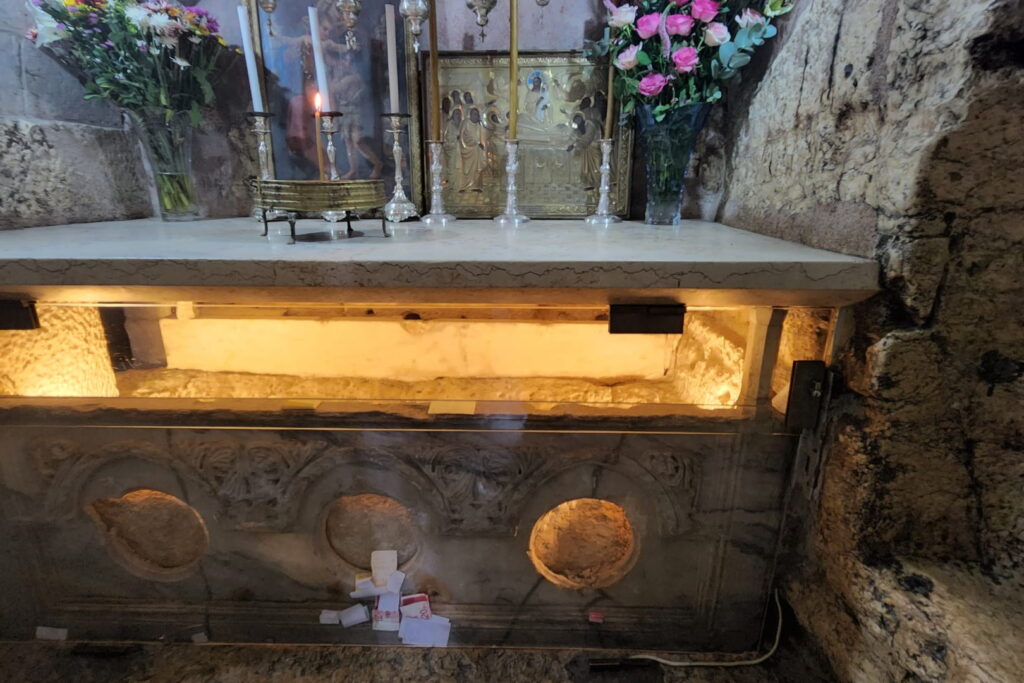
- The Sacred Tomb Chamber: The centerpiece is Mary’s actual tomb, carved from Jerusalem limestone and enclosed within a marble shrine. Orthodox iconographic paintings and hanging oil lamps create an atmosphere of reverent devotion, while the tomb itself remains accessible for pilgrims to touch and pray.
- Ancient Stone Steps: The original Crusader-era staircase features worn limestone treads that have been smoothed by millions of pilgrim footsteps over 900 years. Each step bears witness to centuries of faithful pilgrimage, with some stones showing carved crosses left by medieval visitors.
- Byzantine Crypt Architecture: The underground chamber showcases classic Byzantine construction techniques, including cross-vaulted ceilings supported by limestone columns and walls that maintain constant cool temperatures year-round. Original 6th-century stonework remains visible in the eastern sections.
- Orthodox Religious Art: Contemporary Greek Orthodox iconography covers much of the interior, including painted scenes of Mary’s Dormition and Assumption. Golden oil lamps burn continuously, maintained by the Greek Orthodox and Armenian communities according to their shared custodial arrangement.
- Historical Inscriptions: Visitors can observe carved inscriptions in multiple languages and scripts covering 15 centuries of Christian pilgrimage, providing tangible connections to generations of faithful believers who have visited this sacred site.
Practical Information
Opening Hours: Mary’s Tomb Jerusalem welcomes visitors daily from 6:00 AM to 12:00 PM and 2:30 PM to 5:00 PM. The site observes a midday closure for maintenance and Orthodox prayer services. During major Orthodox holidays, particularly the Feast of the Dormition (August 15th), hours may extend to accommodate increased pilgrimage traffic.
Admission: Entry to Mary’s Tomb is completely free of charge, though donations are welcomed to support ongoing maintenance and conservation efforts.
Accessibility: The site presents significant accessibility challenges due to its underground location. Visitors must navigate 47 stone steps to reach the tomb chamber, making it unsuitable for wheelchairs or those with severe mobility limitations. Handrails are available along the stairway, but the steps are steep and may be slippery.
Dress Code: As an active Orthodox Christian shrine, modest dress is required. Men should wear long pants and shirts with sleeves, while women must cover shoulders and knees. Head coverings are recommended for women, particularly during religious services. Shorts, tank tops, and revealing clothing will result in denied entry.
Additional Information
Where exactly is Mary’s Tomb located in Jerusalem?
Mary’s Tomb Jerusalem is located in the Kidron Valley at the foot of the Mount of Olives, approximately 200 meters east of Lion’s Gate. The tomb sits underground beneath the remains of the medieval Crusader Church of the Assumption, accessible via a 47-step stone staircase that descends 15 meters below ground level.
Which Christian denominations control Mary’s Tomb Jerusalem?
Mary’s Tomb Jerusalem operates under shared stewardship between the Greek Orthodox Church and the Armenian Apostolic Church of Jerusalem, established through the Ottoman-era “status quo” arrangements of 1757. These communities alternate their ceremonial duties and maintenance responsibilities, with specific days designated for each denomination’s liturgical activities and religious services.
How long should I plan to spend visiting Mary’s Tomb Jerusalem?
Most visitors spend 30-45 minutes at Mary’s Tomb Jerusalem, including time for prayer, reflection, and exploring the underground chamber. The descent and ascent of the stone staircase requires careful navigation, particularly for older visitors.
What are the opening hours for Mary’s Tomb?
Mary’s Tomb Jerusalem is open daily from 6:00 AM to 12:00 PM and 2:30 PM to 5:00 PM, with a midday closure for maintenance and prayer services. During major Orthodox holidays, particularly the Feast of the Dormition on August 15th, hours may extend to accommodate increased pilgrimage traffic.
Nearby Sites
- Garden of Gethsemane: Located mere minutes away, this historic garden is where Jesus prayed the night before his crucifixion.
- Church of All Nations: Also known as the Basilica of the Agony, it’s famed for its stunning mosaics and its association with the Gethsemane Garden.
- Dominus Flevit Church: Shaped like a tear drop to commemorate Jesus weeping over Jerusalem’s future destruction, it offers breath-taking panoramic views of the Old City.
- Mount of Olives: A historically significant location with numerous religious sites including Pater Noster, Dominus Flevit, and the Church of Ascension.
Keep reading
Part of our Christian Pilgrimage Guide →