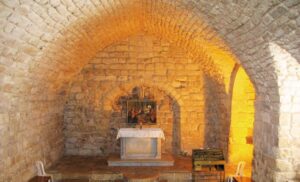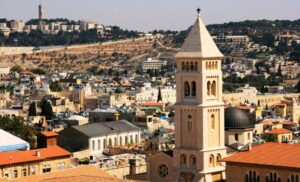
Dominus Flevit Church stands on the Mount of Olives where Jesus wept over Jerusalem's future destruction. Built between 1953 and 1955 by Italian architect Antonio Barluzzi, the teardrop-shaped church features a stunning window framing the Old City. The site contains ancient tombs and archaeological remains from the Second Temple period.
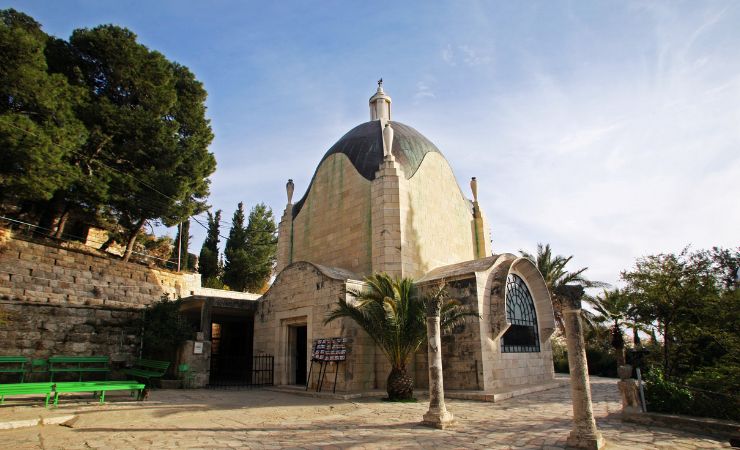
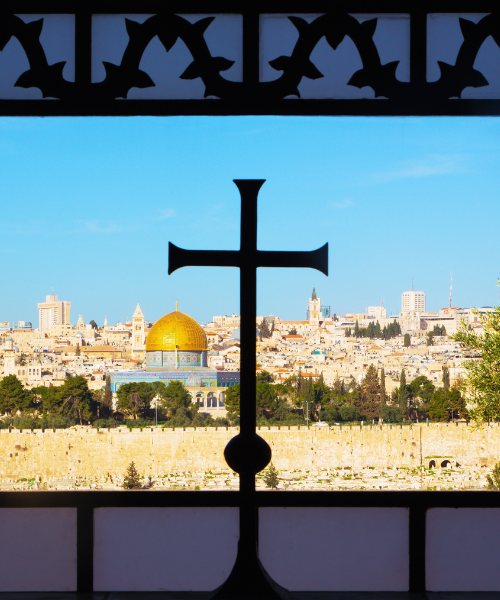
The Dominus Flevit Church commemorates one of the most poignant moments in the Gospel narrative, when Jesus wept over Jerusalem while foreseeing its destruction. This teardrop-shaped sanctuary was constructed between 1953 and 1955, under the supervision of the renowned Italian architect Antonio Barluzzi. The project was financed by the Franciscan Custody of the Holy Land, the religious order responsible for safeguarding and maintaining Catholic sites throughout the region. The church offers panoramic views of Jerusalem’s Old City, with its distinctive dome and altar window perfectly framing the Temple Mount and ancient city walls.
Where is Dominus Flevit Located?
The Dominus Flevit Church sits approximately halfway down the western slope of the Mount of Olives, east of Jerusalem’s Old City. Located at 600 meters above sea level, it stands between the Chapel of the Ascension at the summit and the Garden of Gethsemane at the base. The church is positioned near the traditional route of Jesus’ triumphal entry into Jerusalem on Palm Sunday. From this strategic location, the Pater Noster Church lies 200 meters uphill, making it convenient to visit multiple sites during a single Mount of Olives pilgrimage.
Biblical Context
The name “The Lord Wept” directly references the Gospel account where the Holy Land records Jesus weeping over Jerusalem. This profound moment occurred during Jesus’ descent from the Mount of Olives on what Christians call Palm Sunday, as crowds welcomed him with palm branches and shouts of “Hosanna.” The teardrop-shaped church commemorates this prophetic lament, where Jesus foresaw the city’s destruction that would occur forty years later in 70 AD during the Roman siege.
According to the Gospel of Luke, as Jesus approached Jerusalem and beheld the city spread before him, he was moved to tears by the knowledge of its coming fate. This weeping represented both divine sorrow and prophetic warning about the consequences of rejecting the Prince of Peace.
“And when he drew near and saw the city, he wept over it, saying, ‘Would that you, even you, had known on this day the things that make for peace! But now they are hidden from your eyes. For the days will come upon you, when your enemies will set up a barricade around you and surround you and hem you in on every side and tear you down to the ground, you and your children within you. And they will not leave one stone upon another in you because you did not know the time of your visitation.'”
Architectural Masterpiece
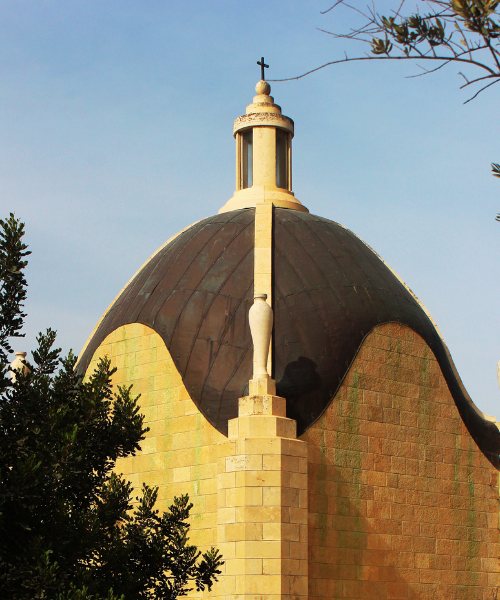
Antonio Barluzzi, known as “the architect of the Holy Land” for designing numerous churches, created the Dominus Flevit Church as one of his most emotionally evocative works. The building’s revolutionary teardrop design, unique among Christian architecture, symbolizes the tears Jesus shed over Jerusalem’s fate.
Constructed entirely of golden Jerusalem stone quarried from the surrounding hills, the church integrates seamlessly with the ancient Mount of Olives landscape. The dome’s distinctive shape creates an interior that draws the eye naturally toward the altar and its magnificent window, which perfectly frames the Old City’s skyline including the Dome of the Rock and Western Wall.
The facade features hand-carved stone reliefs depicting the Franciscan coat of arms and symbols of Christ’s passion, executed by local craftsmen using traditional techniques. Above the entrance, a Latin inscription reads “Dominus Flevit Super Illam” (The Lord Wept Over It), establishing the church’s commemorative purpose.
Inside, the sanctuary accommodates approximately 50 worshippers in an intimate setting designed for contemplation. The altar window, Barluzzi’s masterpiece, eliminates the need for traditional stained glass by using the living view of Jerusalem as its canvas. Natural light filters through smaller windows featuring subtle blue and gold stained glass, while the domed ceiling creates exceptional acoustics for prayer and liturgy.
Archeological Findings at Dominus Flevit
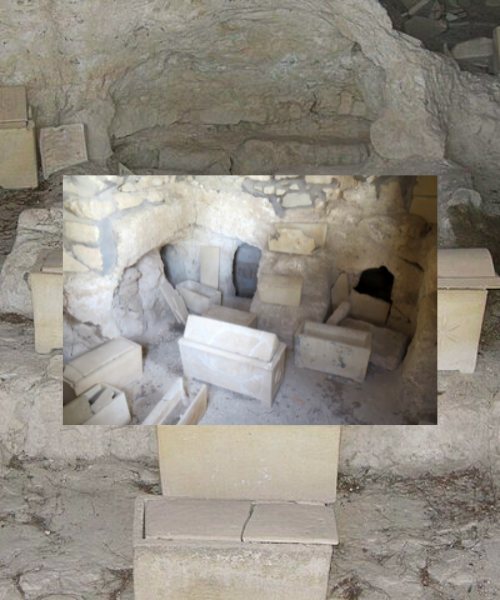
Before construction of the modern church, Father Bellarmino Bagatti and J.T. Milik conducted extensive excavations between 1953 and 1955, uncovering layers of human occupation spanning over 3,000 years. The discoveries reveal how this sacred hilltop has served as a burial ground and place of worship across multiple civilizations.
Ancient Tombs from the Canaanite Period: Beneath the site, archaeologists found burial caves from the Jebusite era (16th-14th centuries BC), complete with pottery vessels, bronze weapons, and jewelry that demonstrate ancient Jerusalem’s connections with Egypt, Cyprus, and Mesopotamia.
Jewish Burial Sites from the Second Temple Period (1st century BC-1st century AD): The most significant discoveries include over 120 Jewish tombs from Jesus’ era, featuring:
- Ossuaries (bone boxes) bearing names like Jesus, Mary, Martha, Shimon, and John inscribed in Aramaic, Hebrew, and Greek, providing authentic examples of first-century Jewish burial practices
- Beautifully decorated sarcophagi displaying menorah symbols, some showing early Judeo-Christian iconography that suggests the blending of Jewish and emerging Christian communities
Artifacts from the Roman and Byzantine Eras:
- Exquisite golden earrings, delicate glass perfume vessels, and ceramics from a wealthy necropolis that served Jerusalem’s elite families
- Silver shekels minted during the Jewish First Revolt (66-70 AD), bearing the inscription “Holy Jerusalem”
- A magnificent Herodian-period limestone sarcophagus decorated with rosettes and geometric patterns
Ruins of a 5th-Century Byzantine Church:
- A remarkably preserved mosaic floor displaying colorful depictions of fruits, flowers, fish, and intricate geometric patterns in the basilica style typical of the Byzantine period.
- A Greek inscription mentioning Simeon, described as a “friend of Christ,” who helped fund the decoration of this early Christian place of worship.
Remains of a Byzanto-Arabic Monastery: Foundations and pottery fragments from a 7th-8th century monastery church that continued the site’s Christian tradition through the early Islamic period.
First Temple Period Pottery Shards: Small ceramic fragments dating to the 8th-6th centuries BC provide glimpses into daily life during Jerusalem’s biblical monarchy period, when kings like Hezekiah and Josiah ruled from the nearby city.
Practical Information
Opening Hours: Daily 8:00 AM – 11:45 AM and 2:30 PM – 5:00 PM (April-September); 8:00 AM – 11:45 AM and 2:00 PM – 4:30 PM (October-March). The church may close during religious services.
Admission: Free entry, though donations are welcomed to support maintenance and the Franciscan mission.
Dress Code: Modest dress required – no shorts, sleeveless shirts, or short skirts. Shoulders and knees must be covered. Head coverings are appreciated but not mandatory.
Getting There: Accessible by car via the Mount of Olives road from Lions Gate, though parking is limited to a few spaces near the church. Most visitors arrive by tour bus or taxi. The site is a 10-minute uphill walk from the Garden of Gethsemane or 15 minutes downhill from the Chapel of the Ascension.
Additional Information
Biblical Era (Pre-70 AD):
- c. 16th-14th Century BC: Canaanite tombs exist in the area where the Dominus Flevit Church is now located. Archaeological findings from this period have been unearthed.
- Time of the Second Temple (Early 1st Century BC – Early 1st Century AD): Jewish tombs, including those with ossuaries, are present in the area.
- Palm Sunday (Early 1st Century AD, likely around 30-33 AD): Jesus makes his triumphal entry into Jerusalem, descending the Mount of Olives. As he approaches and sees the city, he weeps over its future destruction, prophesying the events to come. This event is the central commemoration of the Dominus Flevit (“The Lord Wept”).
- Jesus’ Ministry in Jerusalem (Early 1st Century AD): The tradition associated with the Mount of Olives includes Jesus instructing his disciples, possibly in a grotto near the summit.
- 70 AD: The Roman legions besiege Jerusalem, culminating in the destruction of the Temple and the leveling of the city, fulfilling Jesus’ prophecy.
Post-Biblical Era:
- 5th Century AD: A Byzantine church dedicated to the prophetess St. Anna is built on the site where the Dominus Flevit Church now stands. An elaborate mosaic floor from this church has been preserved.
- 634-638 AD: Sophron, the Patriarch of Jerusalem, writes about the beauty of the Mount of Olives.
- 7th-8th Century AD: A Byzanto-Arabic monastery is established in the area. Ruins of its church were later found beneath the Dominus Flevit Church.
- 16th Century: The reference point for Jesus’ weeping becomes a mosque known as el-Mansuriyyeh, located on the northern side of the Franciscan property.
- 1891: The Franciscan Custody of the Holy Land purchases a plot of land close to the ruins of the el-Mansuriyyeh mosque.
- 1953-1955: Archaeological excavations are conducted on the Franciscan property by Father Bellarmino Bagatti and J.T. Milik. These excavations uncover tombs from Canaanite Jerusalem, Jewish tombs from the time of Christ and later periods, and the remains of the Byzantine monastery.
- 1953-1955: The current Dominus Flevit Church is constructed under the supervision of Italian architect Antonio Barluzzi. The project is financed by the Franciscan Custody of the Holy Land.
- 1956: The Dominus Flevit Church is inaugurated.
What is the significance of the Dominus Flevit Church?
The Dominus Flevit Church commemorates the biblical event when Jesus wept over Jerusalem while descending the Mount of Olives on Palm Sunday. The church’s teardrop shape symbolizes Christ’s tears and his prophecy about Jerusalem’s destruction in 70 AD. The site offers visitors a place to reflect on this poignant moment and enjoy panoramic views of the Old City.
Who designed the Dominus Flevit Church and when was it built?
The church was designed by renowned Italian architect Antonio Barluzzi and constructed between 1953 and 1955. Barluzzi, known as “the architect of the Holy Land,” created the distinctive teardrop design specifically to represent Jesus’ tears over Jerusalem. The Franciscan Custody of the Holy Land financed the project.
What archaeological discoveries were made at the Dominus Flevit site?
Excavations revealed over 3,000 years of human occupation including Canaanite burial caves, 120 Jewish tombs from Jesus’ era with ossuaries bearing biblical names, a 5th-century Byzantine church with preserved mosaics, and artifacts ranging from Herodian-period sarcophagi to First Revolt silver shekels. These findings provide remarkable insight into ancient Jerusalem’s burial practices and religious development.
Can you see Jerusalem from inside the Dominus Flevit Church?
Yes, the church’s most distinctive feature is its altar window that perfectly frames the Old City of Jerusalem, including the Temple Mount and Dome of the Rock. Architect Barluzzi designed this window as the centerpiece, using the living view of the holy city as natural “stained glass” rather than traditional colored windows.
What are the visiting hours for Dominus Flevit Church?
The church is open daily 8:00 AM – 11:45 AM and 2:30 PM – 5:00 PM (April-September) or 2:00 PM – 4:30 PM (October-March). Entry is free, though the church may close briefly during religious services. Modest dress is required, with shoulders and knees covered.
How do you get to the Dominus Flevit Church?
The church is located halfway down the western slope of the Mount of Olives, accessible by car via the Mount of Olives road from Lions Gate, though parking is limited. It’s a 10-minute uphill walk from the Garden of Gethsemane or 15 minutes downhill from the Chapel of the Ascension. Most visitors arrive by tour bus or taxi.
Are there other churches designed by Antonio Barluzzi in Jerusalem?
Yes, Barluzzi designed several other significant churches in the Holy Land, including the Church of All Nations (Basilica of the Agony) in the Garden of Gethsemane, the Church of the Transfiguration on Mount Tabor, and churches at Cana and the Mount of Beatitudes. His distinctive architectural style combines modern design with traditional Holy Land materials and spiritual symbolism.
Nearby sites
-
The Garden of Gethsemane: Reflect in the footsteps of Jesus as you visit the Garden of Gethsemane, where he prayed before his arrest. Ancient olive trees and a serene atmosphere create a sacred ambiance.
-
Mary’s Tomb: Mary’s Tomb is believed to be the burial place of the Virgin Mary. Located in the Kidron Valley and footsteps away from Absalom’s Tomb, this sacred site holds significant religious importance for Christians.
-
Pater Noster (The Eleona) Church: The Eleona Church, situated on the Mount of Olives is where Jesus taught his diciples how to prey.
-
The Church of All Nations: The Basilica of the Agony is adjacent to the Garden of Gethsemane. Built by Antonio Berluzzi, this is the perfect place to contemplate Jesus’ agony and arrest.
-
Mount Zion: Mount Zion includes a few important sites such as the Last Supper Room, the traditional burial place of King David, the Dormition Abbey, and the Zion Gate.
Keep reading
Part of our Christian Pilgrimage Guide →