Ramleh War Cemetery is the largest Commonwealth burial site in Israel, established after World War I. Located in Ramla, it contains over 3,300 graves of soldiers from Britain, Australia, New Zealand, India, and other Commonwealth nations who died during the Middle Eastern campaigns. The cemetery features the impressive Jerusalem Memorial, commemorating thousands of soldiers with no known graves.
The Ramleh War Cemetery is one of six Commonwealth War Graves Commission burial sites established in Israel following World War I, and it is the largest of them all. Covering several acres on the outskirts of Ramla, the cemetery holds 5,887 burials representing soldiers from 57 nations who served under British command across two world wars. For visitors tracing Commonwealth war graves in the Middle East, Ramleh is the most significant single site in the country.
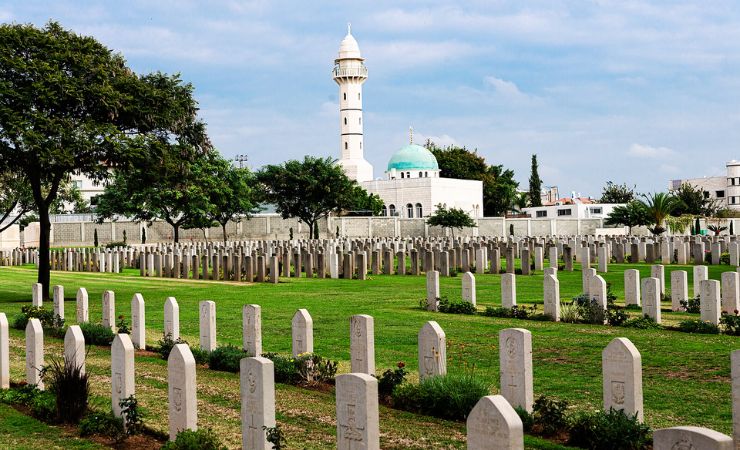
Location of the Ramleh War Cemetery
The Ramleh War Cemetery sits approximately 2 kilometers north of Ramla’s city center, on a flat plain that looks westward toward the Shephelah lowlands and eastward toward the Judean Hills.
Historical Context
The Ramleh War Cemetery came into existence during the First World War as British forces pushed north through Ottoman-held Palestine. On November 1, 1917, the 1st Australian Light Horse Brigade captured Ramleh, then known as Ramla, as part of General Allenby’s broader Southern Palestine Offensive. Starting in December of that year, Field Ambulances and later Casualty Clearing Stations were stationed in Ramleh and nearby Lydda. These medical units initiated the cemetery’s use. As the campaign extended northward, graves were also relocated to Ramleh from temporary battlefield cemeteries scattered across the region, consolidating the dead in a more permanent and maintainable site. The Commonwealth War Graves Commission, established by Royal Charter in 1917, took responsibility for the site and has maintained it ever since.
The cemetery remained active throughout the British Mandate period in Palestine, including during the Second World War, and was used until early May 1948. During World War II, it served personnel from the Ramla Royal Air Force Station as well as patients from several Commonwealth military hospitals operating in the region, including the No. 19 General Hospital at Ramla.
During the Second World War, legislation was passed making the British government responsible for the burial of all fallen soldiers of the British Empire who died between the start of World War I and the end of the Mandate in 1948. In recognition of the British Empire’s role in the defense and liberation of Palestine during the First World War, the municipality of Ramla granted the cemetery grounds to the United Kingdom in perpetuity.
The original layout of the cemetery was designed by Sir John J. Burnet, the prominent Scottish architect who also contributed to several other CWGC cemeteries in the region. In the 1950s, the site was significantly modified by Alan Stewart following the addition of World War II graves, which required a substantial reorganization of the plot sections and the construction of new stone features.



British Military Cemetery Layout
The British Military Cemetery in Ramla follows a standardized design. The graves are arranged in neat rows on maintained lawns, with red rose bushes planted along the graves. The gravestones follow a consistent structure, with differences only in the inscription, the symbol of the soldier’s military unit, religious affiliation, and the design of the upper portion of the stone, which varies by country of origin. A notable exception are the graves of French soldiers, which are marked with crosses instead of the standard design.
Next to the main section of the British Military Cemetery is a separate area where Hindu and Muslim soldiers are buried, in accordance with their religious burial customs, which did not permit burial in the main section.
Notable Graves and Memorials
The Ramleh War Cemetery contains a total of 5,887 burials. These include 3,300 Commonwealth burials from World War I, of which 964 are unidentified, and 1,168 from World War II. In addition, there are 892 graves of soldiers from other nationalities who served in both world wars, along with 525 non-war burials. In total, the cemetery commemorates 5,731 fallen soldiers from 57 nations. Among them are 30 individuals identified as Jewish.
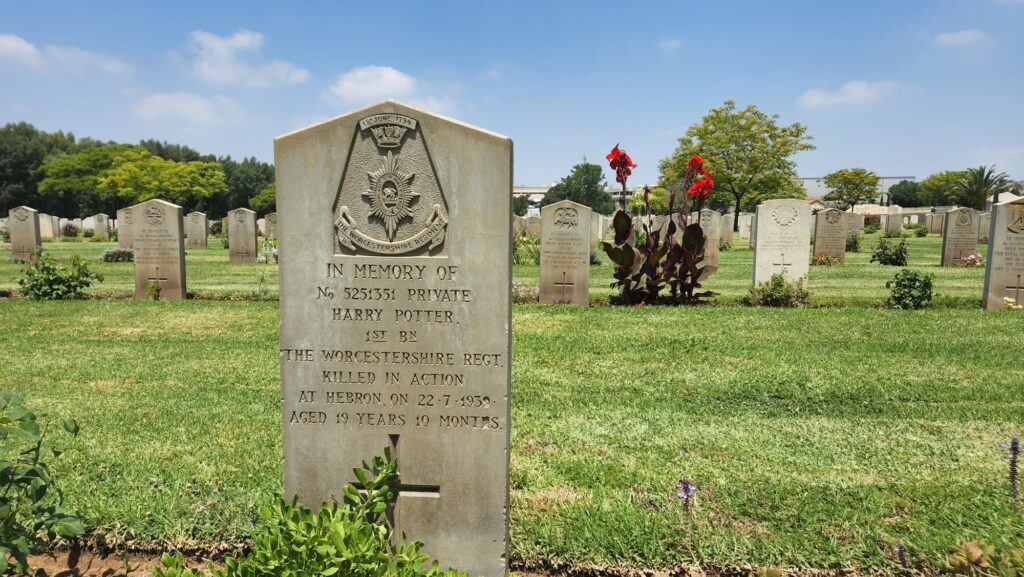
One of the most visited graves is that of Private Harry Potter, who served in the Worcestershire Regiment under the service number 5251351. He died in July 1939 while serving in British Mandatory Palestine. Records indicate he enlisted before turning 17 by lying about his age, a common practice among young men eager to serve. He worked primarily as a driver and signed his final letter home using the nickname “Crash Harry.” He was stationed mostly in the Hebron area and was killed near Hebron during the later stages of the Arab Revolt that began in 1936, roughly two years before J.K. Rowling published her first novel using a nearly identical name. His grave has become a minor pilgrimage stop for fans of the books, though the coincidence is entirely accidental.
Among the other significant burials is that of Neil Primrose, a British Liberal politician and son of Prime Minister Lord Rosebery, who served as a cavalry officer and was killed in action near Gaza in November 1917. The cemetery also holds the graves of British Army sergeants Mervyn Paice and Clifford Martin, who were abducted and hanged by the Irgun in July 1947 as a reprisal for the execution of three Irgun members by British authorities, an episode that drew international condemnation and accelerated British pressure to withdraw from the Mandate. The grave of a grandson of Baron Edmond de Rothschild, the French Jewish philanthropist whose financial support helped establish many of the early Zionist settlements in Palestine, as explored in depth in accounts of early Zionist history, is also located here.
The British Military Cemetery includes two formal memorials:
- The Ramla 1914-18 Memorial, erected in 1961, honors over 300 servicemen from the Commonwealth, Germany, and the Ottoman Empire who were originally buried in cemeteries across Israel. Their original burial sites could not be preserved, and only 74 of the individuals commemorated here are named.
- The Ramla 1939-45 Memorial commemorates 28 Jewish and non-Arab servicemen from the Second World War and six members of the Police Force who died in non-combat situations. Like the earlier memorial, it honors those whose graves elsewhere could not be maintained.
Additional Information
- November 1, 1917: Ramleh (now Ramla) is occupied by the 1st Australian Light Horse Brigade during World War I.
- December 1917 onwards: Field Ambulances and later Casualty Clearing Stations are posted at Ramla and Lydda, beginning the use of the area as a cemetery.
- November 11, 1917 (and surrounding Sundays): An official ceremony is held annually at the Ramleh War Cemetery on the Sunday closest to this date, commemorating the end of World War I.
- May 6, 1927: The Ramleh War Cemetery is unveiled.
- World War II (1939-1945): The Ramleh War Cemetery is used by the Ramla Royal Air Force Station and various Commonwealth hospitals. The British government is made responsible for burying fallen soldiers of the British Empire from WWI until the end of the British Mandatory Period.
- 1947: British sergeants Mervyn Paice and Clifford Martin are hanged by the Irgun and subsequently buried at Ramleh War Cemetery.
- 1948: The British Mandate in Palestine ends. The Ramleh War Cemetery is in use until the start of May 1948 for British burials.
- 1950s: The Ramleh War Cemetery is extensively remodelled by Alan Stewart following the addition of 1939-45 war graves.
- 1961: The Ramleh 1914-18 Memorial is erected within Ramleh War Cemetery to commemorate over 300 Commonwealth, German, and Turkish servicemen buried in inaccessible cemeteries elsewhere in Israel.
- The Ramleh 1939-45 Memorial is erected within Ramleh War Cemetery to commemorate 28 Jewish and non-Arab servicemen and six non-war casualties of the Palestine Police Force buried in inaccessible cemeteries elsewhere in Israel.
How do I find a specific grave at the Ramleh War Cemetery?
The Commonwealth War Graves Commission maintains a free online search tool at cwgc.org where you can enter a name and locate the exact plot, row, and grave number. A printed cemetery register is also available at the entrance to the site, organized alphabetically, and a site plan shows the layout of each plot section.
Who is buried at the Ramleh War Cemetery?
The cemetery holds 5,887 burials representing soldiers from 57 nations who served under British command during World War I and World War II, as well as 525 non-war burials from the Mandate period. Among the nationalities represented are British, Australian, New Zealand, Indian, South African, French, and Egyptian soldiers, along with a smaller number of German and Ottoman prisoners of war whose graves were consolidated here from sites that could no longer be maintained.
What is the significance of Private Harry Potter’s grave at Ramleh?
Private Harry Potter of the Worcestershire Regiment died near Hebron in July 1939 during the final phase of the Arab Revolt, before J.K. Rowling created her fictional character of the same name. The coincidence has turned his grave into one of the most visited in the cemetery, attracting tourists who leave small tokens, though the connection between the two names is entirely accidental.
Is the Ramleh War Cemetery accessible for visitors with mobility limitations?
The cemetery grounds are largely flat and on well-maintained grass and paved paths, making most of the site navigable for visitors using wheelchairs or walking aids. The entrance gate is level with the street. Visitors with specific accessibility needs are advised to contact the CWGC in advance for guidance.
When is the annual remembrance ceremony held at the Ramleh War Cemetery?
An official commemoration ceremony takes place each year on the Sunday closest to November 11, marking the armistice that ended World War I. The event is typically organized by the British Embassy in Israel and attended by diplomatic representatives, military personnel, and members of the public. Visitors are welcome to attend.
Nearby Sites
- The White Tower (Ramla): A 14th-century Mamluk minaret offering panoramic views of the city.
- Pool of Arches: An underground 8th-century water reservoir where you can paddle boats through ancient stone arches.
- Great Mosque of Ramla (Al-Omari Mosque): Originally built as a Crusader church, later converted into a mosque with striking Gothic architecture.
- Lod Mosaic Center: Home to one of the most stunning Roman mosaics ever found in Israel, dating back to the 3rd century.
- Church of St. George (Lod): A significant Christian site believed to house the tomb of St. George, revered in multiple faiths.
Keep reading
Part of our Shephelah & Central Israel Guide →