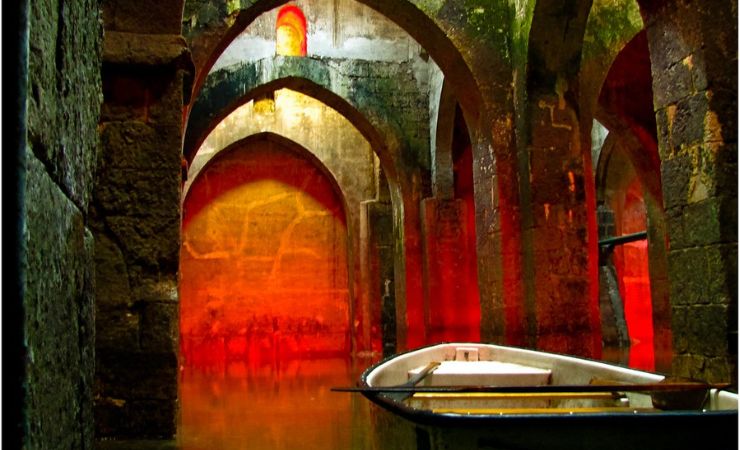
Ramla's Pool of Arches is an 8th-century underground water reservoir built during the early Islamic period. Located beneath street level in central Ramla, this vaulted cistern still holds water today and visitors can row small boats through its arched chambers, experiencing infrastructure that has functioned for over 1,200 years.
Below the streets of Ramla, the Pool of the Arches offers visitors a rare glimpse into medieval Islamic engineering. This 1,200-year-old underground reservoir still holds water and welcomes visitors who can row through its ancient stone chambers, illuminated by natural light filtering through its original ceiling openings.
Credit: https://www.flickr.com/photos/37873897@N06/5190998713
Location
The Pool of the Arches is located at Ha-Hagana Street 12 in central Ramla, approximately 20 kilometers southeast of Tel Aviv and 35 kilometers northwest of Jerusalem. The site sits below street level, accessed through a discrete entrance that reveals the underground marvel beneath.



History of the Pool of Arches
Constructed in 789 CE during the reign of the Abbasid Caliph Harun al-Rashid, the Pool of the Arches was designed as a covered water reservoir to serve the residents of Ramla. An inscription in Arabic at the entrance confirms its completion date, making it one of the few structures in recent archaeological research that can be precisely dated to the Abbasid period. The pool was part of an intricate water supply system, receiving water via an aqueduct from springs near Tel Gezer. Despite numerous earthquakes over the centuries, the pool’s robust construction has ensured its preservation.
Ramla itself was founded by the Umayyad Caliph Sulayman ibn Abd al-Malik around 715 CE as the first planned Islamic city. The Pool of the Arches represents the sophisticated urban infrastructure that early Islamic rulers developed to support their new administrative centers. The engineering techniques employed in its construction demonstrate the advanced hydraulic knowledge that Islamic builders brought from Damascus and Baghdad to the eastern Mediterranean.
During the Crusader period (1099-1291), the pool continued to function as Ramla’s primary water source. The Crusaders maintained the existing infrastructure rather than replacing it, recognizing the superior engineering of the Islamic-era system. Later Ottoman records from the 16th century document ongoing maintenance of the pool, indicating its continuous use for over seven centuries.
What Can Be Found at the Site
- Underground Reservoir: A subterranean water storage facility covering over 400 square meters and built into a large excavated pit. The walls aren’t quite symmetrical—the northern wall stretches about 24 meters, while the southern side measures 20.5 meters. The ceiling was originally made up of six vaulted sections, five of which remain intact.
Supporting these vaults are 15 stone columns and 16 pilasters arranged in a symmetrical cross shape. Between each pair of columns rises a pointed arch, and above each arch, small pointed windows were built into the wall to let in light. The water reaches depths of up to one meter, and the pool’s total capacity is approximately 5,700 cubic meters.
Columns and arches were built from carefully cut stone blocks using precise masonry techniques.
Walls and ceiling vaults used smaller stones and measure about one meter thick throughout.
The entrance to the pool is located in the northeast corner. A stone staircase, now reinforced with metal steps for safety, leads down to the water level. Structurally, the staircase rests on a flat arch at the top and a half-arch at the bottom, details that demonstrate the sophistication of early Islamic architecture.
Architectural Features:
Systematic Pointed Arches: The pool features three rows of five stone columns each, supporting pointed arches throughout the structure. This represents one of the earliest systematic uses of pointed arches in Israel, predating their widespread adoption in Gothic architecture by several centuries.
Original Arabic Inscription: An ancient Arabic inscription on the entrance wall commemorates the pool’s construction. The inscription reads: “In the name of Allah and with Allah’s blessing, the agent of the Emir of the faithful ordered construction, may Allah lengthen his days, in the month of Haja in the year one hundred and seventy two.” This translates to May 789 CE, during the reign of Caliph Harun al-Rashid.
Water Drawing System: Originally, the ceiling had 24 square openings used to draw water from above. Each opening had a carved stone base with a round hole in the center, likely for securing ropes or pulleys. Only 12 of these openings survive, likely due to earlier restoration work during the British Mandate period.
Hydraulic Engineering: The pool connects to an the archaeology of Israel sophisticated aqueduct system that channeled water from springs near Tel Gezer, demonstrating the advanced hydraulic knowledge of 8th-century Islamic engineers.
Visitor Experience: The Pool of the Arches is open to the public and offers rowboat rentals, allowing guests to navigate the tranquil waters beneath the ancient stone arches. The experience provides a unique perspective on medieval Islamic architecture while enjoying the cool, dimly lit atmosphere of this underground marvel.
Practical Information
Opening Hours: Sunday through Thursday 8:00 AM to 4:00 PM, Friday 8:00 AM to 1:00 PM. Closed on Saturdays and Jewish holidays. Last entry is 30 minutes before closing.
Admission: Adults 15 NIS (approximately $4.50), Children under 12 and seniors over 65 pay 8 NIS (approximately $2.40). Rowboat rental costs an additional 20 NIS (approximately $6) for 30 minutes.
Accessibility: The site has limited accessibility due to the stone staircase leading to the water level. Visitors with mobility challenges should contact the site in advance to discuss accommodations.
Additional Information
Can you swim in the Pool of the Arches?
No, swimming is not permitted in the Pool of the Arches. Visitors can rent rowboats to navigate the waters and appreciate the architecture from within the pool. The water depth reaches only about one meter, and the site is preserved as a historical monument rather than a recreational swimming facility.
How long does it take to visit the Pool of the Arches?
A typical visit to the Pool of the Arches takes 30-45 minutes to one hour. Photography enthusiasts may want to allow additional time to capture the unique lighting and stone arches.
What is the best time of day to visit the Pool of Arches?
Mid-morning offers the best natural lighting for photography, as sunlight filters through the ceiling openings at optimal angles. The pool maintains a cool temperature year-round, making it a refreshing escape during hot Israeli summers.
Is the Pool of the Arches suitable for young children?
The site is suitable for children over 8 years old who can safely navigate the stone staircase. Parents should supervise children closely near the water. The rowboat experience is particularly enjoyable for families, though children must be accompanied by adults in the boats.
How old are the Pool of Arches compared to other Islamic sites in Israel?
Dating to 789 CE, the Pool of the Arches is among the oldest precisely dated Islamic structures in Israel. It predates most Crusader architecture by 300 years and represents early Abbasid period construction techniques that influenced later developments throughout the region.
Nearby Sites
- The White Tower: A historic minaret offering panoramic views of Ramla and its surroundings.
- Franciscan Church of St. Nicodemus and St. Joseph of Arimathea: A church with historical significance, believed to be associated with these biblical figures.
- Great Mosque of Ramla: Originally a Crusader cathedral, this mosque is a testament to the city’s diverse religious history.
- Ramla British War Cemetery: A well-kept Commonwealth cemetery where soldiers from both World Wars are buried.
Keep reading
Part of our Shephelah & Central Israel Guide →