The Grotto of Gethsemane, also called the Grotto of the Betrayal, is where Jesus prayed and was arrested before his crucifixion. Located among ancient olive trees at the Mount of Olives' base, this cave has served as a Christian pilgrimage site since the 4th century, marking where Christ confronted his fate.
At the Grotto of Gethsemane, also known as the Grotto of the Betrayal, Jesus Christ confronted his deepest fears and made peace with his fate among the ancient olive trees. This subterranean cave at the foot of the Mount of Olives has drawn Christian pilgrims since the 4th century, marking what many believe to be the actual location where Judas betrayed Jesus with a kiss.
Location
The Grotto of Gethsemane sits at the base of the Mount of Olives in Jerusalem’s Kidron Valley, directly adjacent to the famous Garden of Gethsemane and just meters away from the Tomb of Virgin Mary. Visitors can access the grotto through a narrow entrance along the path connecting Jerusalem’s Old City to the Mount of Olives. The cave lies approximately 500 meters northeast of the Temple Mount.
Biblical Context
The Grotto of Gethsemane connects to one of Christianity’s most pivotal moments. According to the New Testament, Jesus regularly visited this olive grove with his disciples for prayer and teaching. On the night before his crucifixion, the gospels record that Jesus experienced profound spiritual anguish here, sweating drops of blood as he prayed for strength to face his imminent sacrifice. While the Garden of Gethsemane above likely witnessed his agony in prayer, Christian tradition holds that the actual betrayal by Judas Iscariot occurred within this cave, where the disciples had taken shelter.
An angel from heaven appeared to him and strengthened him. And being in anguish, he prayed more earnestly, and his sweat was like drops of blood falling to the ground.
Luke 22:43-44
This moment of profound prayer and spiritual preparation was interrupted when Judas arrived with temple guards and Roman soldiers. The kiss of betrayal, delivered to identify Jesus in the darkness, marked the beginning of the Passion narrative that would culminate in the crucifixion just hours later.



The History of the Grotto of Gethsemane
Archaeological evidence suggests this natural limestone cave served agricultural purposes for centuries before the time of Christ. Local farmers used the grotto as storage space for grain, olive oil, and pressed olives. The cave’s consistent cool temperature and natural protection from the elements made it ideal for preserving agricultural products from the extensive olive groves covering the Mount of Olives.
Early Christian pilgrims in the 4th century initially identified a stone to the left of the Jerusalem-Mount of Olives pathway as the betrayal site. However, by the 6th century, Christian tradition had shifted to recognize this cave as the actual location where Judas betrayed Jesus. During the Byzantine period, some Eastern Christian communities even considered the grotto a cenacle, a place where the Last Supper might have occurred.
The site’s identification evolved over subsequent centuries. In 1333, German Dominican monk Wilhelm von Boldensele visited the cave and proclaimed it the location of Christ’s agony, leading to its popular designation as the Grotto of the Agony. This interpretation persisted until theological scholarship distinguished between the site of Jesus’s prayer (the Garden above) and the location of his arrest (the cave below).
Franciscan friars gained custody of the Grotto of Gethsemane in the 17th century after negotiations with Ottoman authorities. They had previously lost control of the nearby Tomb of the Virgin Mary but successfully established permanent guardianship over this cave. 1955 severely damaged the grotto’s interior, destroying centuries of accumulated pilgrimage artifacts and damaging the cave’s natural structure. Franciscan architects sealed the original entrance and constructed a new, elevated opening designed to prevent future water damage. Despite extensive renovations completed in 1957, the grotto retains its essential character and atmospheric qualities that connect modern pilgrims to the events of two millennia ago.
Grotto of Gethsemane Artifacts
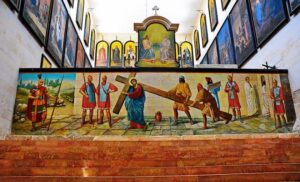
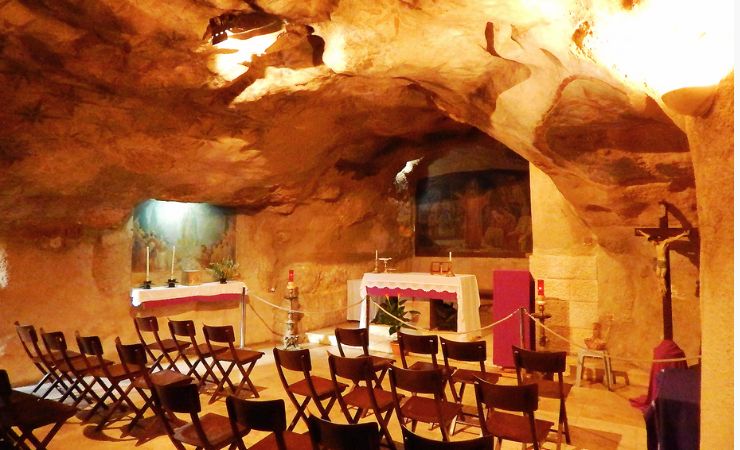
- The Three Altars: The grotto contains three ornate altars adorned with religious murals painted by Franciscan artists. The main altar features an artistic depiction of Jesus in prayer while his apostles sleep nearby. The two side altars display paintings commemorating the Virgin Mary’s Assumption and the moment of Judas’s treacherous kiss. Below the central altar, bronze statues portray two sleeping disciples, capturing the biblical account of their exhaustion during Christ’s hour of greatest need.
- Ancient Olive Press: To the right of one altar, visitors can observe a hole carved into the cave wall at the precise height needed to support a wooden beam. This beam formed part of an ancient olive press system. When weighted at one end, the beam would crush olives stacked in woven baskets, extracting precious oil that sustained the local economy for centuries.
- Starlit Ceiling: The cave’s ceiling features an artistic representation of stars, symbolizing the nighttime setting when Jesus prayed under the open sky. These painted stars create an atmospheric reminder of the cosmic significance Christian theology attributes to the events that unfolded here.
- Natural Rock Formations: The limestone walls preserve their natural character, maintaining the same geological features that provided shelter during the 1st century. Pilgrims often touch these ancient surfaces, seeking a tangible connection to the events of the Passion narrative.
Practical Information
- Opening Hours: The Grotto of Gethsemane opens daily from 8:00 AM to 12:00 PM and 2:30 PM to 6:00 PM during summer months (April through September). Winter hours (October through March) are 8:00 AM to 12:00 PM and 2:30 PM to 5:00 PM. The site closes on Sundays for Mass celebrations.
- Admission: Entry is free, though donations are welcomed to support site maintenance and Franciscan ministry. Voluntary contributions can be made at the entrance or inside the grotto.
- Accessibility: The cave entrance requires descending stone steps and may present challenges for visitors with mobility limitations. The interior passages are narrow and uneven, making wheelchair access difficult.
- Dress Code: Modest attire is required, covering shoulders and knees. Religious significance of the site calls for respectful clothing choices.
Sources and Additional Reading
See the Holyland – Gethsemane
Showcaves – Grotto of Gethsemane
Additional Information
What is the difference between the Grotto of Gethsemane and the Garden of Gethsemane?
The Garden of Gethsemane, located above ground, is traditionally where Jesus prayed in agony before his arrest. The Grotto of Gethsemane is the underground cave where Christian tradition holds that Judas betrayed Jesus with a kiss. Both sites are within meters of each other at the foot of the Mount of Olives, but they commemorate different moments in the Passion narrative.
Can you visit the Grotto of Ge
thsemane for free?
Yes, admission to the Grotto of Gethsemane is completely free. The Franciscan order maintains the site through donations and does not charge entrance fees. Visitors are welcome to contribute voluntary donations to support ongoing preservation and religious services.
Is the Grotto of Gethsemane mentioned in the Bible?
While the Bible mentions Jesus praying in Gethsemane and being arrested there, it doesn’t specifically reference a cave or grotto. Christian tradition and archaeological evidence suggest this cave served as shelter for the disciples and the likely location of the betrayal scene described in the gospels.
What other biblical sites are near the Grotto of Gethsemane?
The immediate area contains several significant Christian sites including the Garden of Gethsemane, the Church of All Nations built over the Rock of Agony, the Tomb of the Virgin Mary, and the Church of Mary Magdalene. The Mount of Olives also features the traditional site of Jesus’s Ascension and provides panoramic views of Jerusalem’s Old City.
Nearby Sites
- Church of All Nations: Built over the “Rock of the Agony,” this church is a significant landmark that commemorates Jesus’s prayer in the garden before his arrest.
- Tomb of the Virgin Mary: This site is revered by the Eastern Orthodox Church and the Armenian Church as the burial place of the Virgin Mary.
- The Tomb of the Kidron Valley: The Kidron Valley is dotted with ancient tombs and burial monuments such as the Tomb of Absalom, Zechariah, and Tomb of Benei Hezir.
- Church of Mary Magdalene: A beautiful Russian Orthodox church situated next to an orchard, offering a different perspective on the biblical narrative.
Keep reading
Part of our Christian Pilgrimage Guide →