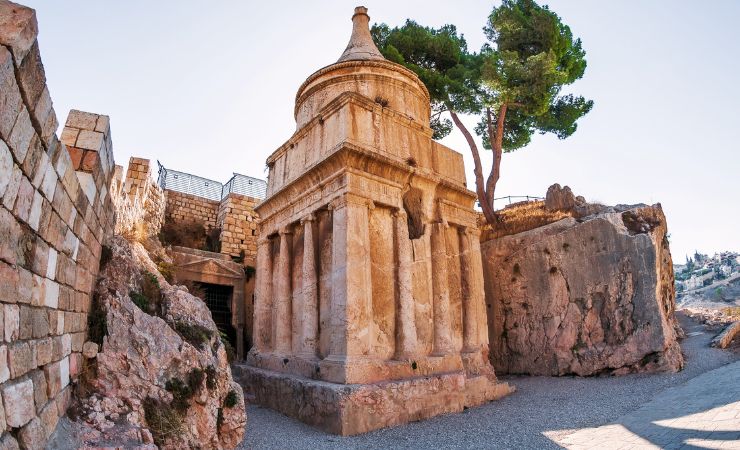
The Tomb of Absalom is a 2,000-year-old rock-cut monument with a distinctive conical roof in Jerusalem's Kidron Valley. Despite its name, it dates to the Second Temple period and has no connection to King David's rebellious son Absalom, who lived 900 years earlier. For centuries, Jews threw stones at it as a symbolic curse against disobedient children.
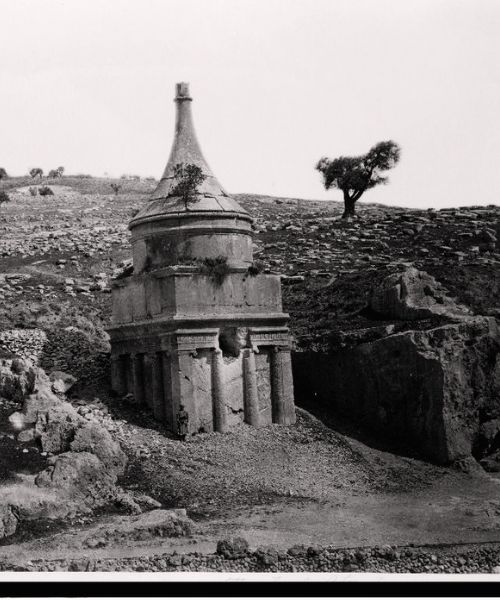
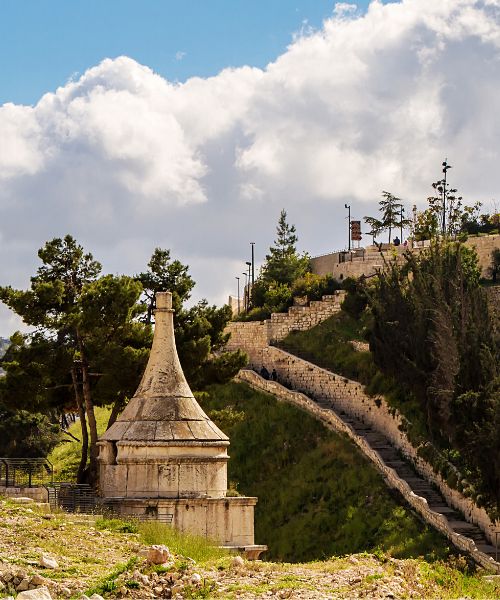
The Tomb of Absalom rises 20 meters from the rocky floor of Jerusalem’s Kidron Valley, its concave conical roof cutting sharply against the limestone hillside. Carved from the living bedrock of the Mount of Olives and topped with precision-cut masonry, this 1st-century CE monument has accumulated two millennia of legend, and pilgrimage.
For centuries, Jewish pilgrims and residents cursed this monument and pelted it with stones, expressing their anger at Absalom’s betrayal of his father. The practice became so ingrained in Jerusalem tradition that piles of stones accumulated around its base, creating a physical manifestation of communal condemnation that lasted well into the modern era.
Where Is the Tomb of Absalom?
The Tomb of Absalom stands in the Kidron Valley, which the Bible calls the Valley of Jehoshaphat. The valley forms a natural boundary between the Old City of Jerusalem and the Mount of Olives, running southeast from the city walls toward the Judean Desert and the Dead Sea.
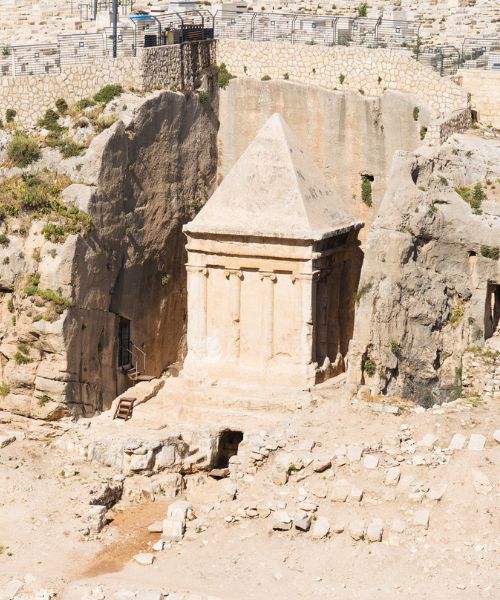
The monument occupies the valley’s narrowest point, where the steep limestone slopes of the Mount of Olives and the Temple Mount nearly converge. The Tomb of Zechariah and the Tomb of Benei Hezir stand just meters away, making this one of the most concentrated ancient necropolises in the world.
Who Was Absalom, and What Did He Do?
Absalom was the third son of King David, who reigned around 1000 BCE. The Hebrew Bible describes him as the most physically striking man in Israel, known especially for his hair, so thick it weighed five pounds when cut each year.
His story, told in detail across 2 Samuel chapters 15 to 18, is one of the Bible’s most dramatic family conflicts. After murdering his half-brother Amnon to avenge the rape of his sister Tamar, Absalom spent three years in exile. He returned to Jerusalem and spent four more years systematically turning the people against his father, eventually forcing David to flee the capital.
The rebellion ended at the Battle of the Wood of Ephraim. Fleeing on a mule, Absalom’s famous hair caught in the branches of an oak tree. He hung there, helpless, until David’s general Joab pierced him with three javelins. The very feature that defined him became the instrument of his death.
Before he died, Absalom had erected a memorial to himself in the King’s Valley, traditionally identified with the Kidron Valley, because he had no surviving sons to carry his name:
Now Absalom in his lifetime had taken and set up for himself the pillar that is in the King’s Valley, for he said, ‘I have no son to keep my name in remembrance.’ He called the pillar after his own name, and it is called Absalom’s monument to this day.
Does the Tomb Actually Date to Absalom's Time?
No. Archaeological evidence dates the Tomb of Absalom to the 1st century CE, placing its construction roughly 900 years after Absalom lived. The monument belongs to the Second Temple period, when Jerusalem flourished under Roman rule and Hellenistic architectural styles shaped the city’s most ambitious building projects.
The biblical verse from 2 Samuel 18:18 gave ancient visitors a ready explanation for the impressive pillar they found in the Kidron Valley, and the identification stuck. The Copper Scroll, one of the Dead Sea Scrolls dated to 68 CE, references a monument in Jerusalem’s vicinity. Flavius Josephus also mentions Absalom’s monument in his Antiquities of the Jews, written around 93 to 94 CE, cementing the tradition in the historical record.
Some modern archaeologists suggest the tomb may have belonged to Herod Agrippa I, the last Herodian ruler of Judea and grandson of Herod the Great. The construction date, the architectural sophistication, and the prominent location would all suit a ruler of his stature, but definitive proof has not emerged.
What Did David Do When Absalom Died?
David’s grief at the news of Absalom’s death is one of the most raw emotional moments in the Hebrew Bible. Despite the rebellion, David had ordered his commanders to deal gently with his son. When word reached him, he went to the chamber over the city gate and wept: “O my son Absalom, my son, my son Absalom! Would I had died instead of you, O Absalom, my son, my son!” (2 Samuel 18:33). His mourning was so overwhelming that Joab rebuked him for shaming the soldiers who had saved his life.
Inside the Tomb of Absalom: What Can You See?
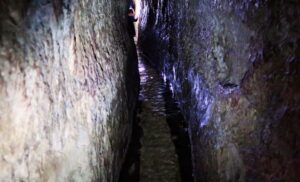
The Monolithic Lower Section — The base of the monument is carved entirely from the living bedrock of the Kidron Valley, measuring roughly 6 meters square and 6.4 meters high. Three sides are separated from the surrounding rock face by narrow excavated passageways you can walk through, where the cold, rough stone walls press close and the chisel marks of 1st-century craftsmen are still visible at eye level.
Ionic Columns and Classical Friezes — Each facade of the lower section features pairs of Ionic half-columns flanked by corner quarter-columns and pilasters, topped by a Doric frieze of alternating triglyphs and metopes. An Egyptian cornice crowns the whole composition, a single structure that layers Greek, Roman, and Egyptian decorative traditions, reflecting the cosmopolitan cultural exchange that defined Jerusalem under Roman rule following Alexander the Great’s earlier conquests.
The Conical Roof — Above the Egyptian cornice, a square masonry base supports a circular drum decorated with rope-like molding, which carries the monument’s most recognizable feature: a conical roof with concave sides. This classical tholos form closely resembles contemporary Nabatean monuments at Petra, about 250 kilometers to the south, pointing to active architectural exchange between the two cultures.
The Interior Burial Chamber — A small arched entrance on the south side of the upper section opens onto an internal staircase that descends into a burial chamber measuring 2.4 meters square, cut from solid bedrock. The chamber holds arcosolium graves on two walls and a smaller burial niche, designed for multiple interments in the Second Temple tradition. When archaeologists first examined the chamber, it was completely empty, no bones, no artifacts, no inscription identifying its original occupant.
The Drainage System — Cut into the rock surrounding the monument, a careful system of channels directs rainwater away from the structure’s base. Standing beside it after a winter rain, you can hear the water running through grooves that have performed the same job for nearly 2,000 years, a practical detail that explains in part why the monument has survived so intact above ground.
The Byzantine Inscriptions — In 2003, archaeologists discovered two inscriptions carved into the monument’s walls, both dating to the Byzantine era of the 4th century CE. The first, written in Greek, reads: “This is the tomb of Zachariah, the martyr, the holy priest, the father of John”, identifying the site with Zechariah, father of John the Baptist, said to have been murdered in the Temple by Herod’s order. The second reads: “This is the tomb of Simeon who was a very just man and a very devoted elder and (who was) waiting for the consolation of the people”, language that precisely matches Luke 2:25 as it appears in the Codex Sinaiticus, a 4th-century manuscript of the Christian Bible, referring to Simeon who blessed the infant Jesus at the Temple. Together, the inscriptions show how Byzantine Christian monks and pilgrims reimagined ancient Jewish burial sites as New Testament shrines.
Why Did Jews Throw Stones at the Tomb of Absalom?
For centuries, Jewish pilgrims and Jerusalem residents hurled stones at the monument as a public curse against rebellious children. Absalom’s betrayal of his father David was treated as the definitive act of filial treachery, and the tradition turned the tomb into a living moral lesson. Piles of stones accumulated around the base over generations, a physical record of communal condemnation that continued well into the modern era.
The practice faded during the 20th century, and in more recent decades the monument has been cleaned and studied rather than pelted. The shift from cursed landmark to archaeological treasure captures how dramatically Jerusalem’s relationship with its own past can change within a few generations.
How Do You Get to the Tomb of Absalom?
The Tomb of Absalom is accessible 24 hours a day, seven days a week, with no admission fee. It stands in the public area of the Kidron Valley, reachable via the main valley road. Parking along the narrow valley floor is limited; the nearest reliable options are the Lion’s Gate area or the Mount of Olives parking facilities, both requiring a 10 to 15 minute walk down into the valley. The main path to the monument is partially wheelchair accessible, though the final approach to the tomb’s base involves some irregular stone surfaces.
Additional Information
Tomb of Absalom in Wikipedia
Tomb of Absalom In Madain Project
The “Tomb of Absalom”: The Earliest Judeo-Christian Place of Pilgrimage in Jerusalem.
Where is Absalom buried?
According to 2 Samuel 18:18, Absalom erected a pillar for himself in the King’s Valley, traditionally identified with the Kidron Valley in Jerusalem. The monument known as the Tomb of Absalom stands there today, though it dates to the 1st century CE, about 900 years after Absalom lived, and was likely built for someone else.
Who is Absalom in the Bible and what did he do?
Absalom was King David’s third son, renowned for his remarkable hair. He killed his half-brother Amnon, spent three years in exile, then led a full rebellion that drove David from Jerusalem. He died when his hair caught in an oak tree during battle and Joab pierced him with javelins. His story runs through 2 Samuel 15 to 18.
Is Absalom’s monument still standing?
Yes. The Tomb of Absalom stands intact in Jerusalem’s Kidron Valley, accessible free of charge around the clock. The 20-meter monument is one of the best-preserved Second Temple period structures in Israel, combining rock-cut and masonry construction with Ionic columns, a Doric frieze, and a distinctive conical roof.
Did David cry when Absalom died?
Yes. Despite the rebellion, David had ordered his commanders to spare Absalom. On hearing of his son’s death, David went to the city gate and wept: “O my son Absalom, my son, my son Absalom! Would I had died instead of you.” His grief was so consuming that general Joab rebuked him for it (2 Samuel 18:33).
What do the Byzantine inscriptions at the Tomb of Absalom say?
Discovered in 2003, two Greek inscriptions identify the tomb with New Testament figures. One names it the tomb of Zechariah, father of John the Baptist. The other commemorates Simeon, who blessed the infant Jesus at the Temple, using wording that matches Luke 2:25 in the 4th-century Codex Sinaiticus manuscript.
Are there ancient Egyptian texts connected to the Tomb of Absalom?
No Egyptian texts reference the Tomb of Absalom directly. However, the monument’s upper cornice uses Egyptian architectural styling, reflecting the cosmopolitan influences, Greek, Roman, Egyptian, and Nabatean, that shaped Jerusalem’s monumental architecture during the 1st century CE Second Temple period.
Nearby Sites
- Bnei Hazir Tomb: This tomb, carved into the rocks, was built for the Hezir priestly family, mentioned in the Dead Sea Scrolls as the priests in charge of Yom Kippur ceremonies during the Second Temple period.
- Tomb of the Prophet Zechariah: This is another significant monument located in the Kidron Valley. It is traditionally associated with the prophet Zechariah.
Church of All Nations: Also known as the Basilica of the Agony. This is a Catholic church that enshrines a section of bedrock where Jesus is said to have prayed before his arrest.
Mary’s Tomb: This is a Christian tomb in the Kidron Valley that was believed in the 6th century to be the burial place of Mary, the mother of Jesus.
Lion’s Gate: This is one of the seven open Gates in Jerusalem’s Old City Walls. This gate is located in the eastern wall and leads directly to the Via Dolorosa.
Keep reading
Part of our Jerusalem Travel Guide →