The Wedding Church at Cana marks the site where Jesus performed his first miracle, turning water into wine at a wedding feast. Located in the Galilean village of Kafr Kanna, the modern Catholic church contains ancient stone jars commemorating this biblical event that began Jesus's public ministry.
The Wedding Church at Cana marks the location where Jesus performed his first recorded miracle, transforming water into wine during a wedding feast as described in the Gospel of John. Built on foundations that have housed churches since the Byzantine period, this Franciscan church draws pilgrims from around the world who come to commemorate Christ’s inaugural public miracle.
Location
The Wedding Church at Cana stands in Kafr Kanna, an Israeli village in the Lower Galilee region of northern Israel. Located 7 kilometers northeast of Nazareth, the village sits at an elevation of 180 meters above sea level along the ancient trade route between Nazareth and the Sea of Galilee. The church lies at the modern village center on Casa Nova Street, easily accessible by car or tour bus from major Galilean sites.
Biblical Context
The Wedding at Cana appears exclusively in the Gospel of John, chapter 2, where it initiates Jesus’ public ministry through his first recorded miracle. The evangelist John presents this event as the first of seven “signs” that reveal Jesus’ divine nature and mission.
The narrative unfolds at a wedding feast where Jesus attended with his mother Mary and his newly called disciples. When the wine ran short, a social catastrophe in first-century Jewish culture where hospitality demanded abundance, Mary approached her son about the crisis. Wedding celebrations typically lasted seven days, and running out of wine would bring lasting shame to the host family. Despite Jesus’ initial response about his “hour” not yet having come, he responded to his mother’s faith and intervened.
Jesus instructed servants to fill six stone water jars, each holding 20 to 30 gallons and normally used for Jewish purification rituals. The Gospel records that Jesus transformed this water into wine of exceptional quality, superior to what had been served earlier. The steward of the feast, unaware of the miracle, complimented the bridegroom on saving the finest wine for last, contrary to usual custom.
John concludes this account by noting that this first sign revealed Jesus’ glory and led his disciples to believe in him. The miracle establishes themes central to John’s Gospel, including Jesus as the source of spiritual abundance and the transformation of old covenant practices into new covenant reality.
Jesus said to the servants, ‘Fill the jars with water’; so they filled them to the brim. Then he told them, ‘Now draw some out and take it to the master of the banquet.’
They did so, and the master of the banquet tasted the water that had been turned into wine.
This miracle carries profound theological significance beyond the immediate transformation of elements. The water used for Jewish ritual purification symbolizes the old covenant, while the abundant, superior wine represents the new covenant of grace through Christ. The timing at a wedding celebration emphasizes Jesus’ affirmation of marriage as a sacred institution and joyful human celebration.
The Wedding at Cana demonstrates Jesus’ care for ordinary human needs and social customs while revealing his divine power. By performing this miracle at the request of his mother, Jesus honors familial bonds and responds to genuine need. The disciples’ resulting faith marks the beginning of their deeper understanding of Jesus’ true identity and mission, setting the stage for the ministry that would follow throughout Galilee and beyond.
Is Kafr Cana the True Cana of the Bible?
Scholars debate the precise location of the biblical Cana, with three primary candidates emerging from archaeological research. While Kafr Kanna maintains the strongest traditional claim through continuous Christian veneration and linguistic preservation of the ancient name, alternative theories deserve consideration.
Khirbet Qana, located 13 kilometers north of Nazareth on a hilltop site, gained scholarly attention after excavations by Douglas Edwards from the University of Puget Sound. This site yielded evidence of a first-century Jewish settlement, including ritual baths, stone vessels, and a cave complex that Edwards suggests may have been associated with early Christian veneration of the wedding miracle. Crusader-era pilgrimage accounts describe visiting Cana at a location matching Khirbet Qana’s elevated position rather than the valley location of modern Kafr Kanna.
A third possibility emerged from salvage excavations conducted in 2004 on the western hill of Kafr Kanna. Archaeologists uncovered substantial remains of a first-century Jewish village, including houses, pottery, and stone vessels typical of the period. These findings suggest that ancient Cana may have encompassed a larger area than the modern village center, potentially including both the traditional church site and the western hill settlement.
The linguistic evidence favors Kafr Kanna, where the Arabic name preserves the Aramaic “Qana” found in early Christian sources. The continuous Christian presence at this location since at least the sixth century, documented by pilgrimage accounts and church remains, supports the traditional identification despite ongoing scholarly discussion about the exact boundaries of the ancient settlement.
Architecture of the Wedding Church at Cana
The current Wedding Church at Cana, completed in 1905, incorporates foundations from earlier Byzantine and Crusader churches that occupied this site for over a millennium. Franciscan architects designed the structure to accommodate both liturgical functions and archaeological preservation, creating a unique dual-level church that serves contemporary worshippers while protecting ancient remains.
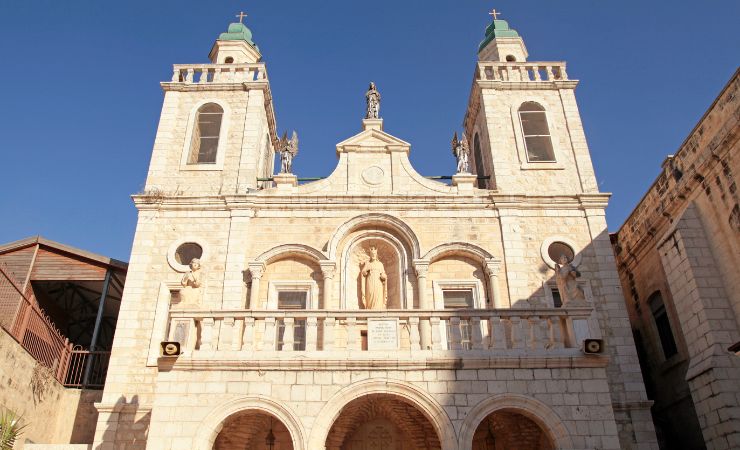
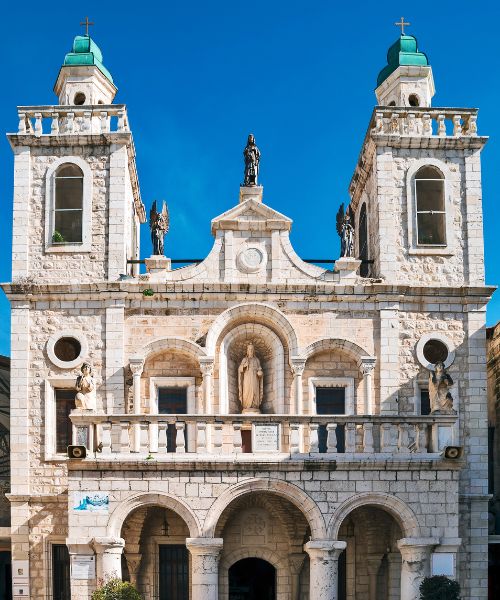
The exterior facade, constructed from local Galilee limestone, features a symmetrical design inspired by European church architecture. The white stone construction deliberately echoes the cathedral of Salzburg, hometown of Father Aegidius Geissler, the church’s founding priest. Twin bell towers frame the main entrance, while arched windows and decorative stonework reflect both Franciscan simplicity and the grandeur appropriate for commemorating Christ’s first miracle.
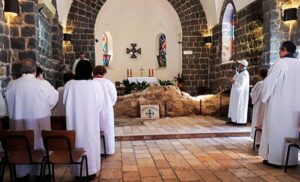
The upper church serves as the primary worship space, featuring a nave with wooden pews, stained glass windows depicting the wedding miracle, and a marble altar. The interior incorporates archaeological artifacts discovered beneath the church, including portions of a fifth-century synagogue floor with an Aramaic inscription thanking benefactors. These ancient mosaic fragments, displayed behind protective glass, provide tangible connections to the Jewish community that inhabited Cana during the centuries following Christ’s ministry.
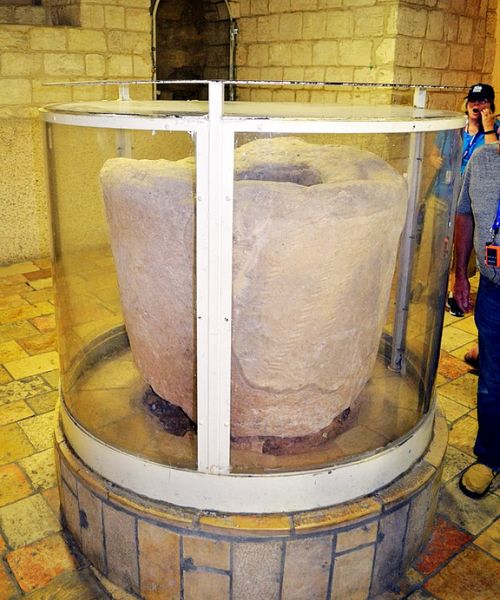
The lower crypt functions as both archaeological museum and devotional space. Here visitors encounter stone vessels similar to those described in John’s Gospel, excavated from first-century contexts in the surrounding area. A reconstructed wine press demonstrates ancient viticulture techniques, while display cases contain pottery sherds, oil lamps, and coins spanning from the Roman period through the Byzantine era. The crypt’s most treasured artifact is a large stone jar, traditionally identified as one of the six vessels used in the miracle, though dating techniques place its manufacture in the early centuries of the Christian era rather than the first century.
Architecture of the Wedding Church at Cana
Visitors to the Wedding Church at Cana can explore both the active place of worship and its archaeological treasures through a self-guided tour that typically takes 30 to 45 minutes.
- Stone Water Jars: The crypt displays large stone vessels similar to those described in John’s Gospel, with capacities ranging from 15 to 25 gallons. These jars, carved from local limestone, demonstrate the craftsmanship required for ritual purification vessels in first-century Jewish households.
- Ancient Synagogue Remains: Mosaic fragments from a fifth-century synagogue include an Aramaic inscription honoring the synagogue’s benefactors. The geometric patterns and Jewish symbols provide insight into the continuous Jewish presence in Cana following the destruction of the Second Temple.
- Roman and Byzantine Pottery: Display cases contain oil lamps, cooking vessels, and storage jars excavated from beneath the church and surrounding areas. These artifacts illustrate daily life in ancient Cana across several centuries.
- Wedding Iconography: Modern stained glass windows in the upper church depict scenes from the wedding miracle, while painted murals show Jesus blessing the stone jars and servants drawing wine for the feast master.
- Ritual Bath (Mikveh): Excavated remains of a first-century Jewish ritual bath confirm the village’s observance of purity laws, supporting the Gospel account of stone jars used for ceremonial washing.
- Wine Production Artifacts: Ancient wine presses and fermentation jars demonstrate that viticulture was practiced in the Cana area during the Roman period, providing context for the wedding miracle’s setting.
Additional Information
1817: Mirza Hussein Ali, later known as Bahá’u’lláh, is born into a noble family in the Iranian province of Nur.
1844: The Báb announces his mission. (The Templars in Palestine expect the return of Christ in this year.) Bahá’u’lláh becomes a follower of the Báb.
August 1852: Bahá’u’lláh, while confined in an underground dungeon, relates receiving the announcement of his divine calling.
1853: Bahá’u’lláh’s property is confiscated, and he and his family are expelled from their native land to Baghdad.
1853 – 1863: Bahá’u’lláh resides in Baghdad for ten years, including two spent wandering alone in the mountains of Kurdistan.
Prior to 1863: Before complying with an order from the the Sultan of Turkey to move to Istanbul, Bahá’u’lláh announces his divine mission to the followers of the Báb, most of whom accept his claim and become Bahá’ís.
1868: The Turkish Sultan banishes Bahá’u’lláh to ‘Akko, then a remote outpost of the Ottoman Empire, used for political prisoners.
Between 1868 and 1877: Bahá’u’lláh spends nine years of confinement, first in the citadel and then within the walls of the Old City of ‘Akko. During this period, while still confined, he formulates the fundamental laws and principles of the Bahá’í religion in the “Most Holy Book” (Kitáb-i-Aqdas).
1877 onwards (last twelve years of his life): Bahá’u’lláh is allowed to move about freely and live in the countryside north of ‘Akko, spending his last twelve years in relative comfort in the mansion that stands in the centre of the Bahá’í Gardens in ‘Akko.
1890: Bahá’u’lláh determines the location for the resting place of the Báb in Haifa.
29 May 1892: Bahá’u’lláh passes away at the age of 75. His remains are buried in a small building next to the mansion in ‘Akko, known as the “Shrine of Bahá’u’lláh”.
1900 – 1909: The simple ashlar masonry mausoleum for the Báb is built on Mount Carmel in Haifa, including a cistern for water collection.
1909: The first gardens are planted around the Báb’s mausoleum in Haifa. The bones of the Báb are brought to the Holy Land and buried in the simple stone structure on Mount Carmel.
1922 – 1957: As much land as possible is purchased around the Shrine of the Báb in Haifa to expand and protect the property for future development. Several formal gardens with a blend of Eastern and Western styles are designed and installed around the Haifa site, including nine small terraced gardens.
1929: Shoghi Effendi renovates Bahá’u’lláh’s house in Bahji, Akko.
1948 – 1953: Shoghi Effendi directs the development of the golden-domed superstructure around the Shrine of the Báb in Haifa.
1987: Canadian architect-engineer Fariborz Sahba is commissioned to design and construct 18 terraced gardens above and below the Shrine of the Báb in Haifa.
1990s: The city of Haifa decides to renovate the “German Colony”. The Bahá’í establishment requests the municipality to shift a street in the German Colony by 10 degrees to align with the axis between the Shrine of the Báb and the Shrine of Bahá’u’lláh. A compromise is reached where the street is lined with roundabouts, invisibly shifting slightly at each roundabout to create a final tilt of less than one degree that, if extended, would point to the Shrine of Bahá’u’lláh.
2000: UNESCO recognizes the “outstanding universal value” of the Bahá’í Gardens in Haifa and ‘Akko and adds them to the list of World Heritage sites.
2001: The extensive landscaping begun in 1987 for the terraced gardens of the Shrine of the Báb is completed.
2008 (July): The Bahá’í Gardens in Haifa and ‘Akko are inscribed on the UNESCO World Heritage List, specifically on July 8, 2008.
Where exactly is the Wedding Church at Cana located?
The Wedding Church at Cana is located in Kafr Kanna, a village 7 kilometers northeast of Nazareth in northern Israel’s Galilee region. The church stands at the village center on Casa Nova Street and is easily accessible by car or tour bus from major Galilean sites.
What archaeological evidence exists at the Wedding Church Cana?
The church preserves significant archaeological remains including stone water jars similar to those described in John’s Gospel, fragments of a fifth-century synagogue with Aramaic inscriptions, and Roman-period pottery. The lower crypt displays these artifacts alongside a first-century Jewish ritual bath that confirms the village’s religious practices during Jesus’ time.
How long should visitors plan to spend at Wedding Church Cana?
Most visitors spend 30 to 45 minutes exploring both the upper church and lower crypt archaeological museum. Groups participating in guided tours or attending special ceremonies may spend up to an hour at the site. The self-guided experience allows flexibility for personal prayer and reflection time.
Is the Wedding Church at Cana the actual site where Jesus performed his first miracle?
While scholars debate the precise location of biblical Cana, Kafr Kanna maintains the strongest traditional claim through continuous Christian veneration since at least the sixth century. Archaeological evidence supports a first-century Jewish settlement at this location, and the Arabic name preserves the ancient Aramaic “Qana” found in early Christian sources.
What other biblical sites are near the Wedding Church Cana?
The Wedding Church at Cana is strategically located for visiting other significant Galilean sites. Nazareth, Jesus’ childhood home with the Basilica of the Annunciation, is 7 kilometers away. Mount Tabor, traditional site of the Transfiguration, is 15 kilometers southeast, while the Sea of Galilee and Capernaum are approximately 30 kilometers to the east.
Nearby Sites
- Nazareth: Known as the childhood home of Jesus, Nazareth is a city replete with religious landmarks, including the Basilica of the Annunciation and the Church of St. Joseph.
- Mount Tabor: Identified by many as the site of the Transfiguration of Jesus, Mount Tabor offers stunning views and is home to the Church of the Transfiguration.
- Capernaum: Once a fishing village, Capernaum is now an archaeological site with ruins of ancient synagogues and the House of Peter.
- Sea of Galilee: Also known as Lake Tiberias, the Sea of Galilee is a significant biblical site where Jesus is said to have walked on water and performed other miracles.
Keep reading
Part of our Christian Pilgrimage Guide →