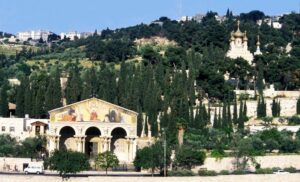
The Via Dolorosa is a sacred processional route in Jerusalem's Old City marking the path Jesus walked to his crucifixion. The 0.6-kilometer route follows 14 Stations of the Cross, beginning near the Lion's Gate and ending at the Church of the Holy Sepulchre, where the final five stations are located inside the basilica.
The Via Dolorosa, which translates to “Path of Pain” or “Way of Suffering,” is a revered route in the Old City of Jerusalem, believed to be the path that Jesus took on his way to his crucifixion. This path is marked by 14 stations, each commemorating a specific event from Jesus’ final journey, starting from his condemnation by Pontius Pilate to his burial in the tomb. The route stretches approximately 600 meters through the narrow cobblestone streets of Jerusalem’s Old City, beginning near the Lions’ Gate and ending at the Church of the Holy Sepulchre.
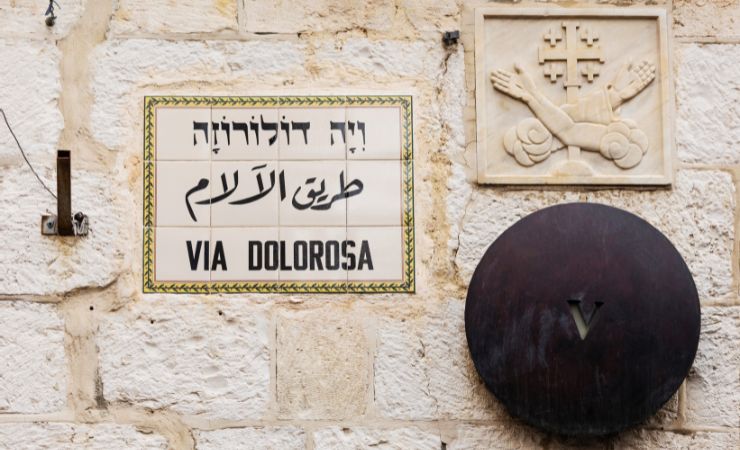
The Origins of the Via Dolorosa
Archaeological evidence suggests that the current Via Dolorosa route follows part of the ancient Roman Cardo Maximus, though the exact path Jesus walked remains a subject of scholarly debate. Historical sources trace the birth of the term “Via Dolorosa” to the 13th century, when medieval Christian pilgrims began formalizing the route through Jerusalem’s streets. In a document titled “L’estat de la citez de Iherusalem,” the street leading to the Temple is referred to as the “Sorrowful Gate” (in Old French: “Portes Doulereuses”). This is believed to be the gate through which Jesus Christ proceeded to Mount Calvary for his crucifixion.
The same document mentions other significant locations, such as the Monastery said to be the place where Jesus rested during his journey to crucifixion and the prison where he was held the night of his capture in Gethsemane. Another account from 1286 by Fra Ricoldo da Monte Croce in his “Itinerario” describes the path Jesus took, mentioning specific places like the house of Herod, the house of Pilate, and the location where Jesus spoke to the women of Jerusalem.
The current 14 stations were not universally agreed upon until the 18th century. During the Ottoman period, Franciscan friars worked to preserve and maintain the sites, establishing the devotional practice that continues today. Modern pilgrims from around the world follow this path year-round, making the Via Dolorosa one of Christianity’s most walked pilgrimage routes.
Station 1: Jesus is Condemned to Death
The first station of the Via Dolorosa marks the beginning of Jesus Christ’s final journey, a path filled with sorrow and suffering, leading to His crucifixion.
Location
The first station is situated near the Lions’ Gate on the eastern side of Jerusalem’s Old City, in the Muslim quarter. It is traditionally associated with the Church of the Flagellation, where it is believed that Jesus was scourged by Roman soldiers and crowned with thorns before His condemnation. The Franciscan church, built in 1929 by architect Antonio Barluzzi, stands on the site of the ancient Antonia Fortress, where Roman governors traditionally held court.
Biblical Context
The event of Jesus’ condemnation is recorded in the New Testament, specifically in John 19:16: “Finally Pilate handed him over to them to be crucified.” This verse signifies the moment when Pontius Pilate, the Roman governor of Judaea, succumbed to the pressure of the crowd demanding Jesus’ crucifixion, despite finding no fault in Him. The Gospels describe how Pilate attempted to release Jesus but ultimately yielded to political pressure from the Jewish leadership and the crowd’s demands.
Spiritual significance
The first station represents the beginning of Jesus’ Passion, His ultimate act of love and sacrifice for humanity. This station invites believers to reflect on the injustice of Jesus’ condemnation and the courage with which He accepted His fate. The site challenges visitors to confront moments of injustice and suffering with faith and resilience, while remembering that even in condemnation, Jesus remained silent in His dignity.
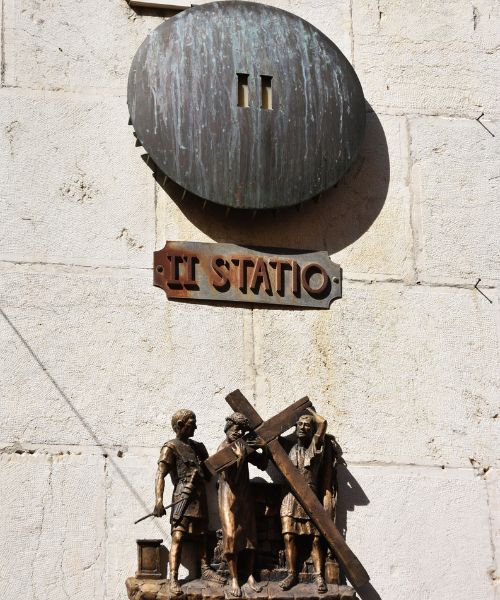
Station 2: Jesus Carries His Cross
At the second station of the Via Dolorosa, Jesus receives the heavy wooden cross that He will carry through the streets of Jerusalem, symbolizing humanity’s sins that Jesus takes upon Himself.
Location
The second station is located near the Monastery of the Flagellation, marked by the Church of the Condemnation, which commemorates the moment when Jesus was handed His cross. The church displays beautiful stained glass windows depicting the Passion narrative, and visitors can see ancient stone pavement believed to be part of the Roman courtyard where Jesus stood trial.
Biblical Context
The event of Jesus carrying His cross is described in John 19:17: “And He, bearing His cross, went out to a place called the Place of a Skull, which is called in Hebrew, Golgotha.” This verse signifies the moment when Jesus, after being condemned by Pontius Pilate, was handed the cross on which He would be crucified. Roman custom required condemned prisoners to carry their own cross or crossbeam to the execution site.
Spiritual significance
The second station represents the moment when Jesus willingly accepted the cross, embracing the weight of humanity’s sins. Archaeological evidence suggests that Roman crosses weighed between 75-125 pounds, making Jesus’s acceptance of this burden even more significant. The station invites believers to reflect on the magnitude of Jesus’ sacrifice and challenges visitors to carry their own crosses in life with faith and courage.
Station 3: Jesus Falls for the First Time
The third station of the Via Dolorosa marks Jesus’s first collapse under the weight of the cross, highlighting His human vulnerability amidst divine mission.
Location
The third station is situated on the Via Dolorosa, near the junction with the busy market street, Souq Khan al-Zeit. A small chapel owned by the Armenian Catholic Patriarchate commemorates this significant event. The chapel features a relief sculpture above the door depicting Jesus falling beneath the cross, while Polish soldiers from World War II carved their own memorial nearby.
Biblical context
While the Gospels do not provide specific accounts of Jesus falling during His journey to Calvary, Christian tradition has long held that Jesus fell three times under the cross’s weight. These moments are commemorated in the Stations of the Cross devotional practice, allowing believers to meditate on Christ’s Passion. The tradition emerged during medieval times when pilgrims sought to create a more complete narrative of Jesus’s suffering.
Spiritual Significance
The third station underscores Jesus’ complete humanity alongside His divinity. Despite being the Son of God, Jesus experienced exhaustion, pain, and physical limitations like any human being. His fall symbolizes the overwhelming weight of humanity’s sins and demonstrates His willingness to endure such agony for salvation. This station challenges believers to find strength in perseverance during their own moments of weakness and struggle.
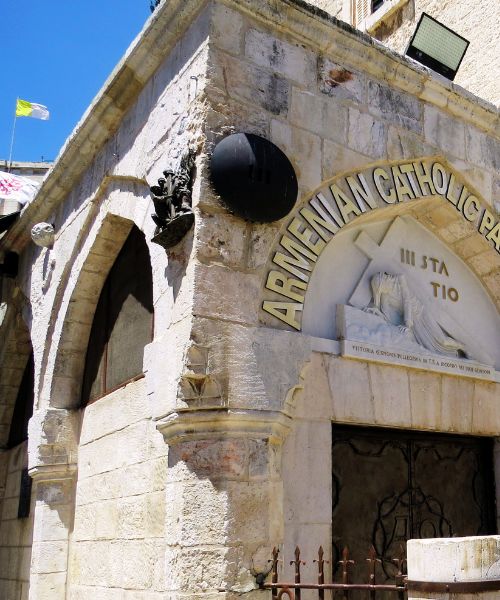
Station 4: Jesus Meets His Mother
Amidst the pain and suffering of the Via Dolorosa, the fourth station represents a moment of profound tenderness when Jesus encounters His mother, Mary, who witnesses her son’s agony.
Location
The fourth station is located by the Church of Our Lady of the Spasm (also called Our Lady of the Sorrows), which commemorates this touching encounter. Inside the church, a Byzantine mosaic displays two feet pointing northwest, believed to mark the spot where Mary stood as she gazed upon her suffering son. The Armenian Catholic Church maintains this site, which also houses ancient mosaics dating to the 6th century.
Biblical context
While the Gospels do not provide a direct account of this specific encounter along the Via Dolorosa, John 19:25-27 describes Mary standing by the cross during the crucifixion. Christian tradition has long venerated the moment of their meeting on the path, recognizing it as an extension of Simeon’s prophecy to Mary: “a sword will pierce your own soul too” (Luke 2:35). This encounter captures the heartbreak of a mother witnessing her son’s suffering.
Spiritual significance
The meeting between Jesus and Mary powerfully demonstrates familial love and mutual strength during adversity. This station invites reflection on Mary’s courage in following her son despite the danger and pain, and on Jesus’s love for His mother even in His darkest hour. The site serves as a reminder of the importance of family bonds and the strength found in love during life’s most challenging moments.
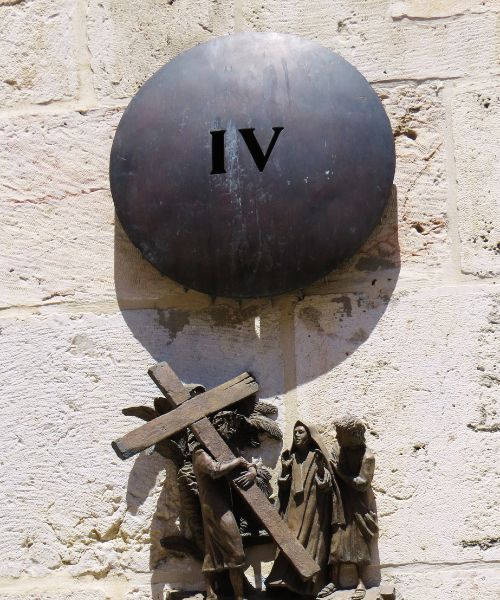
Station 5: Simon of Cyrene Helps Jesus Carry the Cross
The fifth station of the Via Dolorosa highlights an unexpected moment of compassion when Simon of Cyrene, a passerby from North Africa, is compelled to assist Jesus by carrying the cross.
Location
The fifth station is marked by a plaque on the Via Dolorosa that commemorates this act of reluctant service. The location is near the traditional site where the Via Dolorosa turns westward toward Calvary. Archaeological excavations in this area have uncovered first-century paving stones that may have been part of the ancient street system Jesus and Simon walked upon.
Biblical Context
The Gospels of Matthew, Mark, and Luke recount Simon’s involvement in carrying Jesus’s cross. Matthew 27:32 states, “As they were going out, they met a man from Cyrene, named Simon, and they forced him to carry the cross.” Simon was likely in Jerusalem for Passover, as Cyrene (in modern Libya) had a large Jewish population. Roman soldiers possessed the legal authority to compel civilians into service, which they exercised with Simon.
Spiritual Significance
Simon’s story demonstrates how ordinary people can be called into extraordinary service for God, even unwillingly. Though initially compelled by Roman soldiers rather than volunteering, Simon’s act became eternally significant in Christian tradition. Mark 15:21 mentions that Simon was “the father of Alexander and Rufus,” suggesting his family became known to the early Christian community. This station emphasizes the importance of helping others carry their burdens, even when we don’t initially choose to do so.
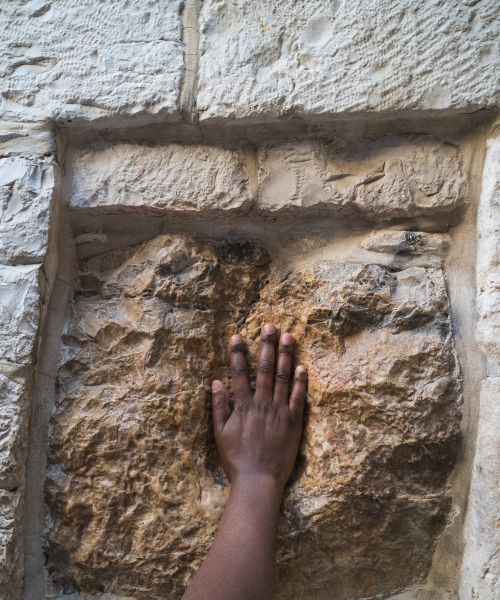
Station 6: Veronica Wipes the Face of Jesus
The sixth station commemorates one of the most beloved traditions of the Via Dolorosa: the compassionate act of a woman who wiped Jesus’s bloodied face with her cloth.
Location
Station six is located along the western section of Via Dolorosa, just west of Al Wad Street. A brown wooden door on the southern side marks the entrance to the Greek Catholic Chapel of the Holy Face, distinguished by a carved relief on the wall depicting the legendary encounter. The chapel houses traditional artwork showing Veronica’s veil bearing the imprint of Christ’s face.
Biblical Context
While not explicitly mentioned in the canonical Gospels, the account of Veronica wiping Jesus’s face has been cherished in Christian tradition for centuries. According to legend, as Jesus trudged along carrying His cross, a woman stepped forward from the crowd and tenderly wiped His face with her veil. Miraculously, an imprint of His holy countenance remained on the cloth. The name “Veronica” is believed to derive from the Latin “Vera Icon,” meaning “True Image,” emphasizing the authenticity of this divine imprint.
Early Christian writers and medieval pilgrims recorded versions of this story, and by the 14th century, it had become firmly established in Christian devotional practice. The act represents human compassion reaching out to divine suffering, Christian sites in Israel showcasing the Christian belief that sacred encounters can occur in the midst of ordinary acts of kindness.
Spiritual Significance
This station reminds believers that even small acts of kindness during others’ suffering can become eternally significant. Veronica’s courage to step forward despite the hostile crowd demonstrates how love can overcome fear. Her simple act of compassion has inspired countless Christians to recognize Jesus in the suffering faces of others and to respond with mercy and care.
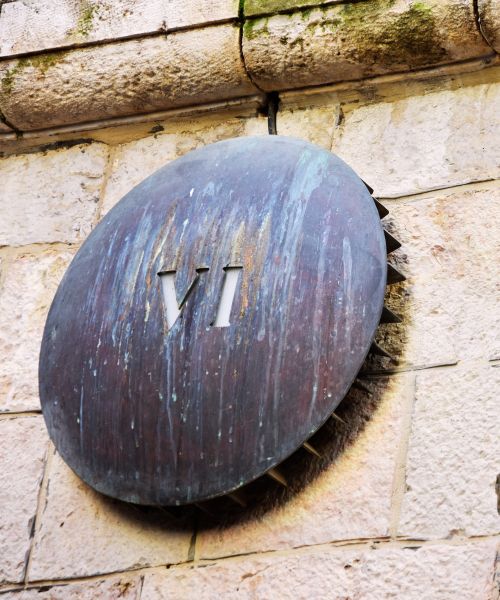
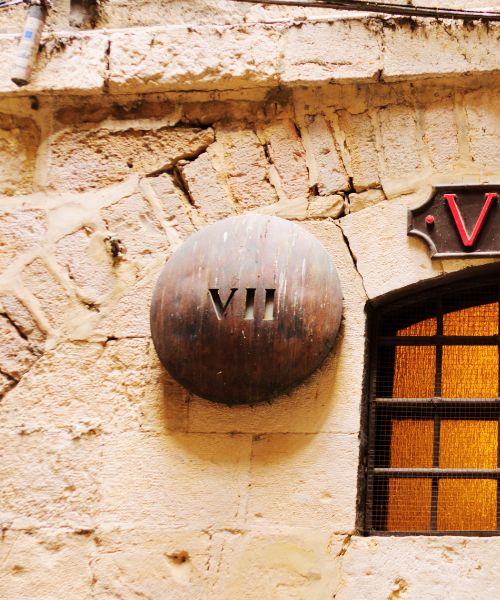
Station 7: Jesus Falls for the Second Time
At the seventh station, Jesus, increasingly weakened from torture and the cross’s weight, stumbles and falls for the second time on His journey to Calvary.
Location
The seventh station is positioned at the corner of Via Dolorosa Street and Khan es-Zeit Street. A small Franciscan chapel built at this intersection houses a Roman column (tetrapyle) from the ancient Cardo Maximus, dating to Emperor Hadrian’s reconstruction of Jerusalem in 135 CE. This location marks the historical junction between the main cardo and the decumanus of Roman Aelia Capitolina, making it archaeologically significant beyond its Christian importance.
Biblical Context
Jesus’s second fall is not explicitly mentioned in the canonical Gospels, but Christian tradition has embraced it as representing humanity’s repeated struggles with sin and weakness. The presence of the ancient Roman column serves as a powerful reminder that Jesus’s suffering occurred within the context of Roman imperial power and urban infrastructure that still partially survives today.
Spiritual Significance
The seventh station invites pilgrims to reflect on their own repeated failures and the human tendency to stumble despite good intentions. Jesus’s ability to rise after each fall demonstrates divine perseverance and offers hope to believers who struggle with recurring challenges. The ancient Roman column positioned near this site reminds visitors that God’s redemptive work occurs within human history and political realities, not apart from them.
Station 8: Jesus Speaks to the Women of Jerusalem
The eighth station marks one of the most poignant moments in Jesus’s Passion, when He pauses amid His own suffering to address the mourning women of Jerusalem with words of prophetic warning.
Location
Station eight is located on Aqabat Al Khanqah Street, just uphill from Souq Khan Al Zeit Street. The station is marked with a stone bearing a Latin cross embedded in the left wall, highlighted by a red sign. This area would have been part of the residential quarter of first-century Jerusalem, where local women might naturally have gathered to witness the grim procession.
Biblical Context
Luke 23:27-28 records this encounter: “A large number of people followed him, including women who mourned and wailed for him. Jesus turned and said to them, ‘Daughters of Jerusalem, do not weep for me; weep for yourselves and for your children.’” His words contained both compassion and prophecy, referencing the coming destruction of Jerusalem in 70 CE. The women’s public mourning demonstrated their recognition of injustice, even as Jesus redirected their attention to future sufferings their city would endure.
Spiritual Significance
This station reveals Jesus’s remarkable capacity for concern about others even during His darkest hour. Despite carrying the cross and approaching crucifixion, He took time to address the women’s grief and warn them of coming hardships. The encounter demonstrates how genuine spiritual leadership involves caring for others’ welfare even while personally suffering, and challenges believers to maintain perspective on larger suffering beyond their immediate circumstances.
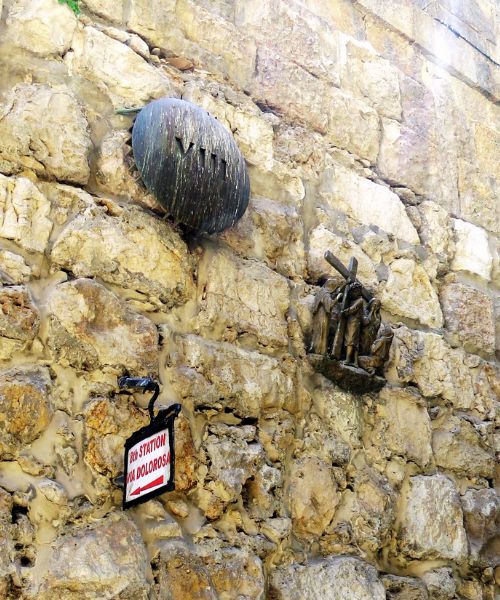
Station 9: Jesus Falls for the Third Time
As Jesus approached Calvary, the cumulative physical and emotional toll became overwhelming. The ninth station marks His third and final fall before reaching the crucifixion site.
Location
The ninth station is identified by Roman letters and a cross carved into a column set into the wall. This location houses a small Coptic Orthodox Church dedicated to Saint Helena, representing the Egyptian Christian community in Jerusalem. The Coptic presence here dates back centuries, reflecting the international character of Christian pilgrimage to the Holy Land.
Biblical Context
While the Gospels do not detail each of Jesus’s falls, the tradition of three falls has become deeply embedded in Christian devotional practice. The third fall, occurring so close to Calvary, emphasizes the extreme physical deterioration Jesus experienced. Medical analysis suggests that severe scourging, blood loss, and the cross’s weight would have made walking increasingly difficult, making multiple falls historically plausible.
Spiritual Significance
Jesus’s third fall demonstrates that even divine love incarnate experienced the limits of human endurance. The proximity to Calvary makes this fall particularly poignant, as it occurred just before the final act of salvation. This station reminds believers that God understands human weakness intimately and that even in our darkest moments of collapse, divine grace remains present and redemptive.
Station 10: Jesus is Stripped of His Garments
The tenth station marks one of the most humiliating moments of Jesus’s Passion: the removal of His clothing before crucifixion, stripping away His final earthly possessions and dignity.
Location
Station ten is located inside the Church of the Holy Sepulchre in the Chapel of the Franks, a small room dedicated to this solemn moment. The chapel’s name reflects medieval Crusader influence, though the site’s veneration predates their arrival. Ancient tradition places this event on Calvary itself, making the Church of the Holy Sepulchre the appropriate location.
Biblical Context
John 19:23-24 provides detailed description of this event: “When the soldiers crucified Jesus, they took his clothes, dividing them into four shares, one for each of them, with the undergarment remaining. This garment was seamless, woven in one piece from top to bottom. ‘Let’s not tear it,’ they said to one another. ‘Let’s decide by lot who will get it.’ This happened that the scripture might be fulfilled that said, ‘They divided my clothes among them and cast lots for my garment.’” The seamless garment may indicate Jesus’s family had some means, as such clothing was valuable.
Spiritual Significance
Stripping Jesus of His garments represented the ultimate humiliation and vulnerability. In ancient culture, public nakedness was deeply shameful, making this act particularly cruel. Yet Christian tradition sees profound meaning in Jesus’s nakedness: He entered the world with nothing and left with nothing, demonstrating complete identification with human poverty and suffering. This station challenges believers to examine their attachment to material possessions and to find true richness in spiritual rather than earthly wealth.
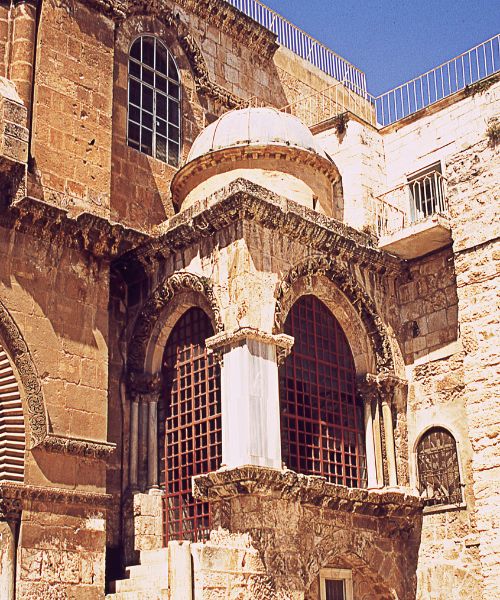
Station 11: Jesus is Nailed to the Cross
Station eleven commemorates the moment of ultimate physical suffering when Jesus was nailed to the cross, the culmination of His earthly Passion.
Location
Station 11 is situated in the Church of the Holy Sepulchre at the Franciscan altar on Calvary. This altar, built in the 20th century by architect Antonio Barluzzi, is positioned directly over the traditional site of Jesus’s crucifixion. The altar’s mosaic ceiling depicts Jesus being nailed to the cross, while visitors can see through glass the actual rock of Calvary beneath the altar.
Biblical Context
John 19:18-19 records: “There they crucified him, and with him two others—one on each side and Jesus in the middle. Pilate had a notice prepared and fastened to the cross. It read: JESUS OF NAZARETH, THE KING OF THE JEWS.” Archaeological evidence suggests Roman crucifixion involved nailing victims’ wrists and feet to wooden crosses, causing excruciating pain while ensuring slow death through asphyxiation and blood loss.
Spiritual Significance
The nailing to the cross represents the physical climax of Jesus’s sacrifice for humanity. Each nail driven into His flesh symbolized the weight of human sin and the price required for redemption. This station invites deep meditation on the extent of divine love willing to endure such torture for human salvation. The physical reality of crucifixion underscores that Christian faith is grounded in historical suffering, not merely spiritual concepts.
Station 12: Jesus Dies on the Cross
Station twelve marks the sacred spot where, according to Christian belief, Jesus breathed His last breath and completed His earthly mission of salvation through ultimate sacrifice.
Location
The twelfth station is located within the Church of the Holy Sepulchre, adjacent to station eleven. The Greek Orthodox Church administers this altar, which is positioned directly above the traditional site where Jesus’s cross stood on Calvary (Golgotha). The altar features ornate iconography depicting Christ’s death, while pilgrims can touch the actual rock of Calvary through a hole beneath the altar.
Biblical Context
John 19:28-30 provides Jesus’s final moments: “Later, knowing that everything had now been finished, and so that Scripture would be fulfilled, Jesus said, ‘I am thirsty.’ A jar of wine vinegar was there, so they soaked a sponge in it, put the sponge on a stalk of the hyssop plant, and lifted it to Jesus’s lips. When he had received the drink, Jesus said, ‘It is finished.’ With that, he bowed his head and gave up his spirit.” His declaration “It is finished” (Greek: tetelestai) was an accounting term meaning “paid in full,” signifying the completion of humanity’s redemption.
Spiritual Significance
Station twelve represents the heart of Christian faith: the moment when divine love conquered sin and death through ultimate sacrifice. Jesus’s final words demonstrate His conscious completion of His mission rather than mere defeat. For believers, this station embodies the promise of redemption and the victory of love over evil, making it the most sacred site in Christianity and the culmination of the Via Dolorosa pilgrimage.
Station 13: Jesus is Taken Down from the Cross
Station thirteen commemorates the tender moment when Jesus’s lifeless body was removed from the cross and placed in the arms of those who loved Him.
Location
Station 13 is situated within the Church of the Holy Sepulchre and is marked with a wooden statue of Mary with a sword piercing her heart, symbolizing her profound grief. This statue was donated by Queen Maria I of Portugal in 1778 and represents the fulfillment of Simeon’s prophecy about a sword piercing Mary’s soul. The station is positioned near the Stone of Anointing, where tradition holds that Jesus’s body was prepared for burial.
Biblical Context
The Gospels record that after Jesus died, a Roman soldier pierced His side with a spear to confirm death, causing blood and water to flow (John 19:34). Joseph of Arimathea, a wealthy member of the Sanhedrin and secret disciple, requested Jesus’s body from Pilate. Nicodemus, who had previously visited Jesus at night, brought a mixture of myrrh and aloes weighing about seventy-five pounds. Together they took down Jesus’s body and prepared it for burial according to Jewish customs.
Spiritual Significance
This station emphasizes the transition from public execution to private mourning, as Jesus’s followers finally could approach His body with love and respect. The removal from the cross represents the end of His physical suffering and the beginning of hope for resurrection. The presence of both declared followers like Joseph and secret disciples like Nicodemus demonstrates how Jesus’s death prompted courage even among those who had previously been afraid to publicly support Him.
Station 14: Jesus is Laid in the Tomb
The final station of the Via Dolorosa marks the solemn moment when Jesus’s body was laid to rest in the tomb, completing His earthly journey and setting the stage for resurrection.
Location
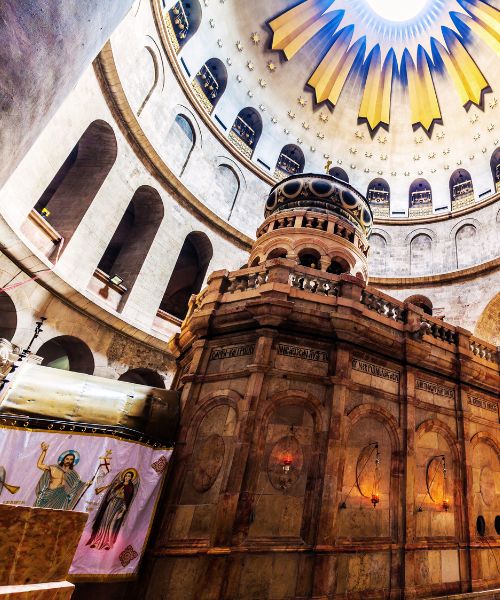
Station fourteen is located at the Edicule within the Church of the Holy Sepulchre, a small marble structure housing the remains of the tomb where Jesus was buried. The current Edicule was renovated in 2016-2017, revealing the original limestone burial bed for the first time in centuries. The tomb consists of two chambers: the Chapel of the Angel and the burial chamber itself, which can accommodate only a few visitors at a time.
Biblical Context
Matthew 27:57-60 describes the burial: “As evening approached, there came a rich man from Arimathea, named Joseph, who had himself become a disciple of Jesus. Going to Pilate, he asked for Jesus’s body, and Pilate ordered that it be given to him. Joseph took the body, wrapped it in a clean linen cloth, and placed it in his own new tomb that he had cut out of the rock. He rolled a big stone in front of the entrance to the tomb and went away.” This burial fulfilled Isaiah’s prophecy that the Messiah would be buried with the rich.
Spiritual Significance
Station fourteen represents both ending and beginning: the conclusion of Jesus’s earthly suffering and the anticipation of resurrection victory over death. The tomb’s emptiness (as Christian tradition holds it became on Easter morning) symbolizes hope triumphing over despair and life conquering death. For pilgrims, this final station completes the Via Dolorosa journey while pointing toward the joy of resurrection, reminding believers that apparent endings in God’s plan often mark new beginnings.
Practical Information
The Via Dolorosa is accessible 24 hours daily, as it consists of public streets in Jerusalem’s Old City. However, individual churches and chapels along the route have specific opening hours.
Entry to most sites along the Via Dolorosa is free, though donations are appreciated.
Modest dress is required at all religious sites: long pants for men, covered shoulders and knees for women, with head coverings recommended for churches. Comfortable walking shoes are essential for navigating cobblestone streets and uneven terrain. The route involves some uphill walking and stairs, making accessibility challenging for wheelchairs or mobility aids.
Additional Information
Via Dolorosa – the way of grief – BibleWalks 500+ sites
Origins of the Via Dolorosa
The Via Dolorosa – Jerusalem in 3 minutes
Via Dolorosa App
Vatican: Station 1, Station 2, Station 3, Station 4, Station 5, Station 6, Station 7, Station 8, Station 9, Station 10, Station 11, Station 12, Station 13, Station 14
How long does it take to walk the complete Via Dolorosa Jerusalem route?
Walking the entire Via Dolorosa typically takes 30-60 minutes, depending on crowd levels and time spent at each station. The route covers approximately 600 meters through Jerusalem’s Old City streets. During busy pilgrimage seasons or Friday afternoon processions, allow additional time for crowds and longer stops at each station.
Is the current Via Dolorosa the exact path Jesus walked to his crucifixion?
Archaeological evidence suggests the current Via Dolorosa follows part of the ancient Roman street system, though scholars debate whether it represents Jesus’s precise route. The path has evolved over centuries based on Christian tradition, medieval pilgrimage practices, and available historical evidence. While the exact route remains uncertain, the spiritual significance of the journey persists for believers.
Can I visit the Via Dolorosa stations independently or do I need a guided tour?
You can absolutely walk the Via Dolorosa independently, as the stations are clearly marked along public streets in the Old City. Many pilgrims prefer self-guided visits for personal reflection. However, guided tours provide valuable historical context, biblical background, and help navigate the sometimes confusing Old City streets. Free maps are available at the Franciscan Information Office near Station 1.
Which Via Dolorosa stations are located inside the Church of the Holy Sepulchre?
The final five stations (10-14) are located within the Church of the Holy Sepulchre. Station 10 (Jesus stripped of garments) is in the Chapel of the Franks, Stations 11-12 (crucifixion and death) are on Calvary, Station 13 (taken down from cross) is near the Stone of Anointing, and Station 14 (burial) is at the Edicule tomb. These indoor stations offer more detailed artwork and longer meditation opportunities.
Sources and Additional Reading
Nearby Sites
Lion’s Gate: The Lion’s Gate, also known as St. Stephen’s Gate, is one of the seven open gates in Jerusalem’s Old City walls. It’s named after the pair of lion symbols carved into the gate’s façade.
The Tomb of the Virgin Mary: The Tomb of the Virgin Mary is a sacred Christian burial site dedicated to Mary, the mother of Jesus.
St. Anne’s Church Jerusalem: St. Anne’s Church is a beautifully preserved Roman Catholic church, close to the Lion’s Gate. It’s believed to stand over the birthplace of the Virgin Mary.
- Ecce Homo Arch: The Ecce Homo Arch is part of a triumphal gateway built by the Romans in the 2nd century CE. It was believed to be the place where Pontius Pilate presented Jesus to the crowds with the words “Ecce Homo,” which means “Behold the Man” in Latin.
Keep reading
Part of our Christian Pilgrimage Guide →