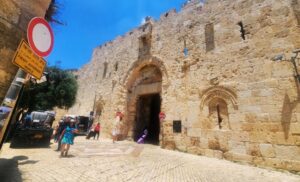
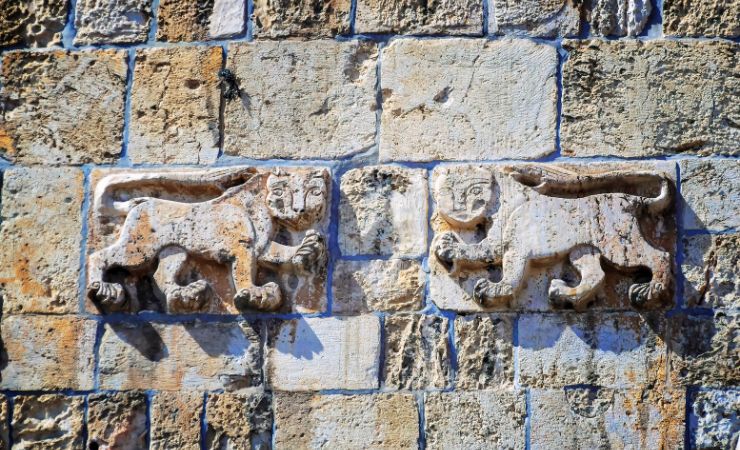
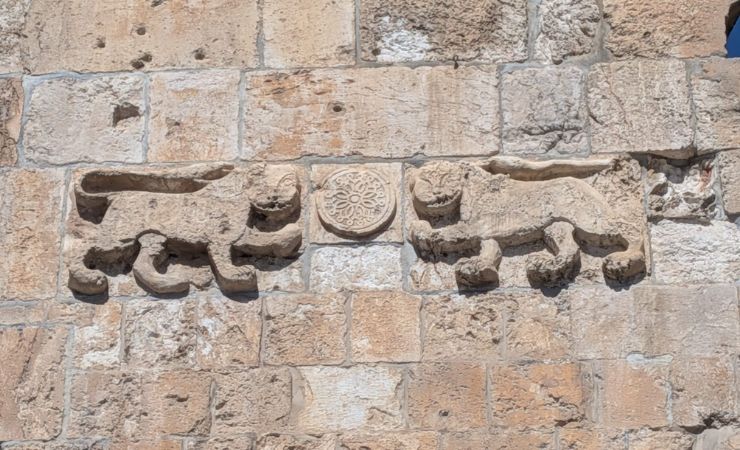
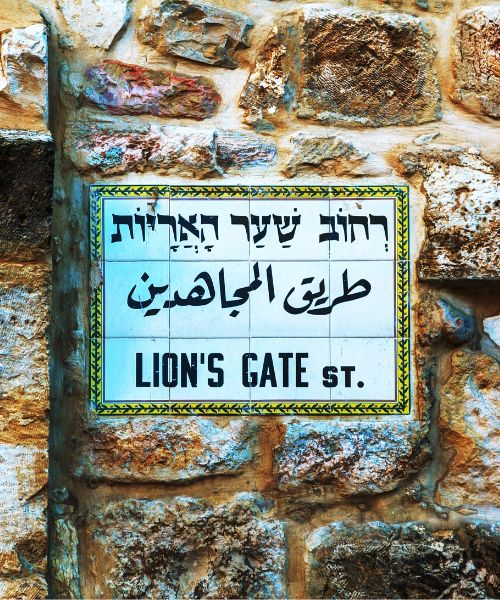
Lion's Gate is one of eight gates in Jerusalem's Old City walls, located on the eastern side facing the Mount of Olives. Built by Suleiman the Magnificent in 1538-1539, it marks the traditional starting point of the Via Dolorosa. The gate features four stone lions carved into its facade, symbolizing the Mamluk Sultan Baybars.
Lion’s Gate Jerusalem serves as one of the most historically significant entrances to Jerusalem’s Old City, marking the traditional beginning of the Via Dolorosa. Built by Ottoman Sultan Suleiman the Magnificent in 1538-1539, this ancient gateway has welcomed countless Christian pilgrims who come to walk the path believed to trace Jesus’s final journey.
Location
Lion’s Gate Jerusalem occupies the northeastern wall of the Old City, approximately 200 meters southeast of Herod’s Gate. The entrance provides direct access to the Muslim Quarter and sits at the foot of the Mount of Olives, making it the natural starting point for pilgrims descending from the mountain’s sacred sites. Its proximity to significant Dominus Flevit, the Church of Ascention, the Virgins Mary’s Tomb, and Pater Noster churches creates a natural pilgrimage route. The gate also lies adjacent to the Islamic cemetery where Muslim faithful have chosen burial near the Temple Mount, believing this location will provide spiritual advantage on the Day of Judgment.
Historical Context
Lion’s Gate Jerusalem ranks among the seven functioning gates that pierce the Ottoman-era walls surrounding Jerusalem’s Old City. The gate carries multiple names that reflect its deep religious and cultural significance across different communities and historical periods.
The Arabic name “Bab Sitna Mariam” (Gate of Our Lady Mary) derives from its proximity to the Tomb of the Virgin Mary, located just outside the gate in the Kidron Valley. Franciscan traditions place this underground church as Mary’s burial site, making the gate a natural entry point for Christian pilgrims. The Christian designation “Stephen’s Gate” honors the first Christian martyr, Saint Stephen, who according to tradition was stoned to death near this location around 34 CE, as recorded in Acts 7:54-60.
The current name emerged during Sultan Suleiman the Magnificent’s reign (1520-1566), when he commissioned the reconstruction of Jerusalem’s defensive walls between 1535-1541. Ottoman court records from 1538 document the gate’s construction, completed in 1539 as part of this massive fortification project. Archaeological evidence suggests the lion reliefs adorning the gate were salvaged from an earlier Mamluk structure, possibly associated with Sultan Baibars (1260-1277), whose heraldic symbol featured a lion or panther.
Local legend attributes the lions to a prophetic dream experienced by Suleiman, where lions threatened him for failing to protect Jerusalem adequately. While historically unverified, this story explains the prominence given to the Mamluk lion carvings in the gate’s Ottoman design.
For contemporary Christian pilgrims, Lion’s Gate Jerusalem serves as the traditional starting point for the Via Dolorosa. Palm Sunday processions begin at the Mount of Olives, with thousands of participants carrying palm branches as they descend through this ancient entrance, recreating Jesus’s triumphal entry into Jerusalem.
The gate gained modern historical significance during the Six-Day War of June 1967, when Israeli paratroopers breached the Old City through this entrance on June 7th. This moment ended 19 years of Jordanian control over the Old City and restored Jewish access to the Western Wall and Temple Mount. Colonel Mordechai Gur’s famous radio transmission, “The Temple Mount is in our hands,” was broadcast shortly after his forces passed through Lion’s Gate.
The Muslim cemetery adjacent to the gate reflects Islamic eschatological beliefs about the Day of Judgment. According to Islamic tradition, the resurrection of the dead will commence from the Temple Mount area, leading many Muslims to seek burial in this vicinity for spiritual proximity to this anticipated event.
Architecture of the Lion's Gate
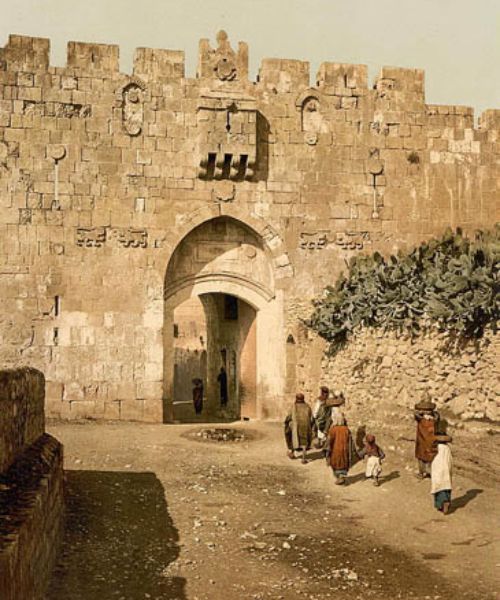
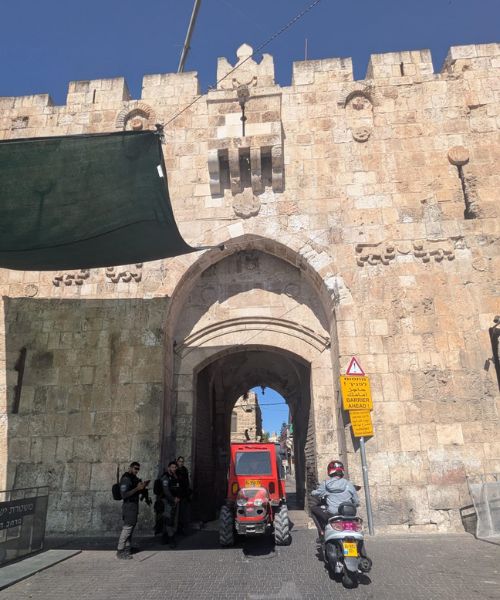
Lion’s Gate exemplifies Ottoman military architecture adapted for both defense and ceremonial purposes. The gate’s design incorporates several distinctive elements that reflect both practical security needs and symbolic messaging.
Lion Relief Carvings: Four lion relief sculptures dominate the gate’s facade, arranged in pairs on either side of the entrance. Each carving measures approximately 60 centimeters in height and depicts lions in profile with detailed manes and muscular bodies. Archaeological analysis confirms these reliefs originated from a 13th-century Mamluk structure, most likely associated with Sultan Baibars’s building projects. The Ayyubid and Mamluk periods frequently employed feline heraldic symbols, and these particular carvings display the craftsmanship typical of that era’s stone masonry.
Ottoman Architectural Elements: Above the lion carvings, intricate stone lattework and geometric patterns characteristic of Ottoman decorative arts frame the entrance. A commemorative inscription in Ottoman Turkish, carved into a marble plaque above the arch reads: “There is no god but Allah, and Muhammad is His messenger. Our lord Sultan Suleiman ordered the construction of this wall, he hopes for reward from Allah the generous. (Date) 947.”
Defensive Features and Mashikoli Terrace: The gate incorporates a machicolation (mashikoli in Arabic), a projecting stone platform above the entrance from which defenders could drop projectiles or pour boiling liquids on attackers. This terrace extends approximately two meters from the wall face and features murder holes in its floor. The architectural design allowed guards to survey approaches from multiple angles while remaining protected behind stone battlements.
Construction Materials and Techniques: Ottoman builders employed locally quarried Jerusalem limestone, the same golden-hued stone used throughout the Old City. The gate stands approximately 4.5 meters wide and rises 6 meters to the top of its pointed arch. Iron-reinforced wooden doors, replaced multiple times throughout history, originally secured the entrance. Modern restoration has preserved the original stone framework while installing contemporary gates that maintain 24-hour access for residents and pilgrims.
Practical Information
Lion’s Gate Jerusalem remains open 24 hours daily for pedestrian access. The gate provides step-free access, making it wheelchair accessible, though the cobblestone streets immediately inside can be challenging for mobility devices.
Additional Information
Nearby Sites
- Via Dolorosa: The path believed to be taken by Jesus during his final hours.
- Mount of Olives: A significant religious site with panoramic views of the Old City.
- Tomb of the Virgin Mary: A Christian tomb believed to be the burial place of Mary, mother of Jesus.
- Church of All Nations: Also known as the Basilica of the Agony, it’s a Roman Catholic church located at the foot of the Mount of Olives.
Keep reading
Part of our Jerusalem Travel Guide →