The Pater Noster Church stands on the Mount of Olives, built by Helena, mother of Constantine the Great, in the fourth century AD. It marks the traditional site where Jesus taught his disciples the Lord's Prayer. The church features the prayer displayed in over 140 languages on ceramic tiles throughout its walls and courtyards.
Introduction
The Pater Noster Church stands among the most significant Christian pilgrimage sites on Jerusalem’s Mount of Olives. Built over the ruins of a 4th-century Byzantine church commissioned by Helena, mother of Emperor Constantine, this sacred sanctuary commemorates the traditional location where Jesus taught his disciples the Lord’s Prayer. The church displays the prayer in over 140 languages on ceramic tiles, creating a remarkable testament to universal Christian faith. Visitors can explore the ancient cave where early Christians believed Jesus imparted his teachings, along with remnants of Helena’s original church that helped establish the Holy Land’s Christian pilgrimage tradition.
Location
The Pater Noster Church occupies a strategic position on the upper slopes of the Mount of Olives, approximately 800 meters east of the Old City walls. The church sits at an elevation of about 820 meters above sea level, offering panoramic views across Jerusalem to the Temple Mount and Judean Hills. The church location places it within walking distance of other significant Christian sites including the Chapel of the Ascension (200 meters north) and the Church of All Nations at the base of the mount.
Biblical Context
The Pater Noster Church commemorates the biblical tradition that Jesus taught his disciples the Lord’s Prayer on the Mount of Olives. According to Luke 11:1-4 and Matthew 6:9-13, when the disciples requested instruction on prayer, Jesus responded with what became Christianity’s most fundamental prayer. The Mount of Olives served as Jesus’s regular teaching location during his final week in Jerusalem, as recorded in the Gospels where he would retreat there each evening after teaching in the Temple courts. Early tradition, dating to the late 2nd century, specifically identified this elevated site with the prayer instruction, establishing a devotional tradition that spans nearly 1,700 years. The location’s significance extends beyond the Lord’s Prayer, as Gospel accounts describe Jesus teaching about the destruction of the Temple and his second coming while seated on these slopes overlooking Jerusalem.
This, then, is how you should pray:
‘Our Father in heaven, hallowed be your name, your kingdom come, your will be done, on earth as it is in heaven.
Give us today our daily bread. And forgive us our debts, as we also have forgiven our debtors. And lead us not into temptation, but deliver us from the evil one.’”
A Glimpse into the History of Pater Noster
The current church rises from the foundations of one of the oldest ecclesiastical structures in the Holy Land, representing an unbroken chain of Christian devotion spanning seventeen centuries.
The Byzantine Era: Helena’s Sacred Legacy
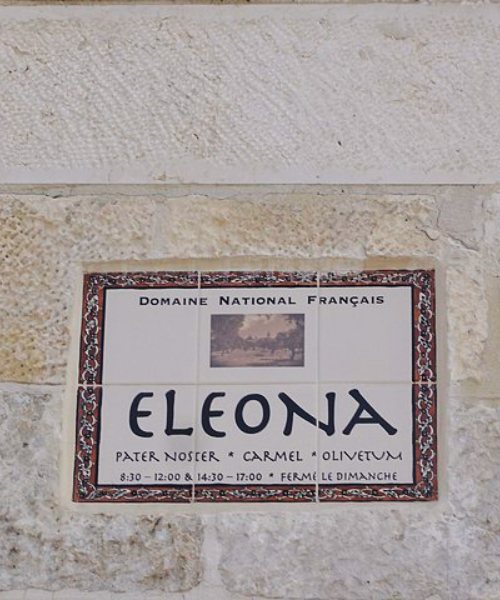
Constantine’s mother Helena arrived in around 326 CE during her groundbreaking pilgrimage that would establish Christianity’s physical presence throughout the Holy Land. Her construction of the Church of Eleona (from the Greek “eleon,” meaning olive grove) represented one of Christianity’s earliest major building projects in Jerusalem, predating even the Church of the Holy Sepulcher. The original Pater Noster Church featured three naves separated by marble columns imported from Constantinople, with the central nave measuring 18 meters in length and flanked by aisles each 6 meters wide. Helena’s architects incorporated the natural cave beneath the structure, recognizing its significance to local Christian tradition. The church complex included residential quarters for clergy, a scriptorium for copying religious texts, and pilgrimage facilities that could accommodate hundreds of visitors during major Christian festivals.
The Dark Ages: Silence and Ruin
The Persian invasion of 614 CE devastated Jerusalem’s Christian infrastructure under Khosrow II, with the Church of Eleona suffering extensive fire damage that destroyed its wooden roof and interior furnishings. When Muslim forces captured the city in 638 CE under Caliph Omar ibn al-Khattab, the damaged church was abandoned rather than rebuilt, unlike other Christian sites that received protection under early Islamic rule. For nearly 500 years, the site remained largely forgotten except for occasional visits by Christian pilgrims who left written accounts describing ruined walls and scattered marble fragments. Byzantine chronicler John of Damascus, writing in the 8th century, lamented that “the place where our Lord taught the sacred prayer has fallen to ivy and thorns.” The olive grove gradually reclaimed the sacred space, with ancient trees taking root among the fallen stones, their gnarled trunks growing around column fragments that remain visible to this day.
The Crusader Period: Rekindling the Flame
The Crusader conquest of Jerusalem in 1099 renewed Christian interest in the Mount of Olives sites under the leadership of Godfrey of Bouillon. Canon Regulars established a small oratory in 1106 among Helena’s ruins, followed by a more substantial church completed in 1152 with funding from Bishop Svend of Viborg in Denmark, whose donation of 500 silver marks covered construction costs. The Crusader church featured thick stone walls in Romanesque style with rounded arches and a distinctive bell tower that served as a landmark for pilgrims approaching from the Jordan Valley. Crusader documents record that the site became exclusively associated with the Lord’s Prayer tradition during this period, diverging from Helena’s original dual focus on the Ascension and prayer instruction. The Crusader church measured 25 by 12 meters and could accommodate 200 worshippers during peak pilgrimage seasons. Saladin’s forces heavily damaged the structure during the 1187 siege, when catapults positioned on nearby hills bombarded Christian installations across the Mount of Olives. The church was finally abandoned after the fall of Acre in 1291, ending nearly two centuries of Crusader presence.
The Modern Era: Renewal and Rebirth
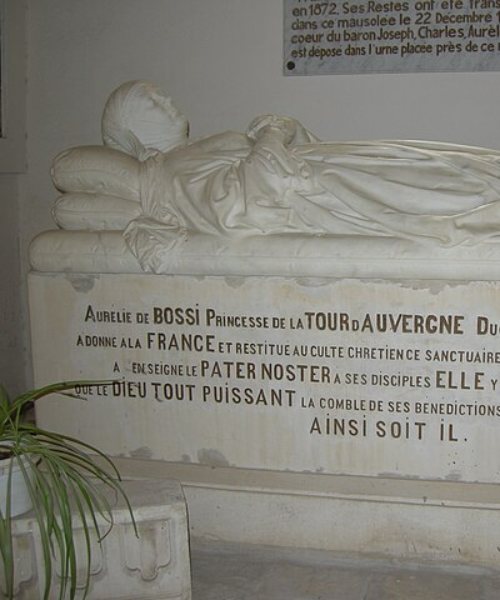
The remarkable resurrection of the Pater Noster Church began with Princess Aurelia Bossi de la Tour d’Auvergne, known as “Orly de Bois,” who purchased the site in 1868 with inherited wealth from her father’s banking fortune. Born to French nobility in 1832, she devoted her substantial inheritance to reconstructing the church within a Carmelite monastery she established called the Sanctuary of the Eleona. Her vision encompassed not merely restoration but transformation into a center for international Christian unity. Construction began in 1915 under the supervision of Italian architect Antonio Barluzzi, renowned for his work on other Holy Land churches, but World War I material shortages and the Ottoman Empire’s restrictions on Christian construction left the project incomplete, which explains the church’s unfinished appearance with exposed stone walls and missing roof sections.
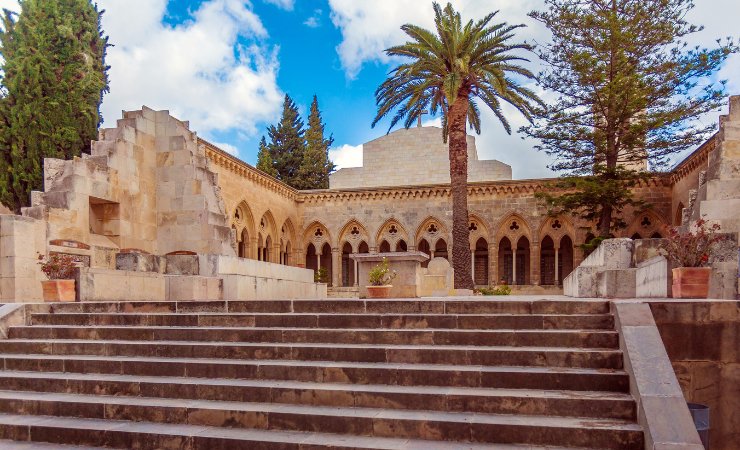
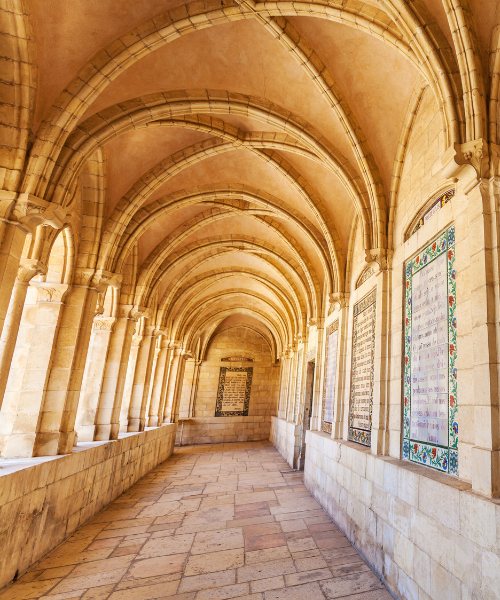
The architecture blends neo-Byzantine elements with modern construction techniques, utilizing reinforced concrete hidden within traditional limestone masonry. The building’s most striking feature is its central cloister, modeled after the Campo Santo in Pisa, Italy, measuring 30 by 25 meters with covered walkways supported by 36 columns. The cloister’s covered walkways contain ceramic plaques displaying the Lord’s Prayer in 143 languages, created by artisans from around the world between 1920 and 1960. Each plaque measures approximately 50 by 40 centimeters and uses traditional ceramic techniques specific to its cultural origin, from Japanese raku firing to Moroccan zellij tilework.
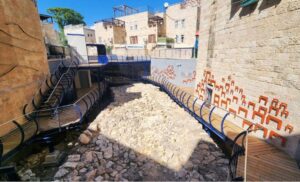
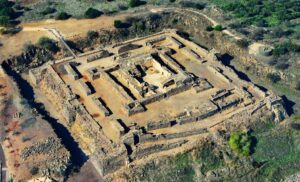
The church preserves substantial portions of Helena’s original Byzantine foundations, visible in the eastern section where 4th-century column bases and mosaic fragments remain exposed. Archaeological excavations conducted by French archaeologist Louis-Hugues Vincent revealed the complete floor plan of Helena’s church and confirmed the location of the sacred cave, now accessible through a modern staircase with wrought-iron railings crafted by local Jerusalem metalworkers. The excavations also uncovered a Byzantine-era baptismal font and fragments of religious frescoes that decorated the original church walls.
Princess Aurelia died in 1904 before seeing her vision completed, but her devotion earned her burial in the church crypt beneath a simple marble tombstone inscribed in French and Latin with the words “She sought the face of Christ.” The Carmelite nuns who maintain the site continue her mission of preserving this intersection of biblical tradition, Byzantine heritage, and modern Christian pilgrimage, welcoming over 100,000 visitors annually from every continent.
Archeological Finding at the Pater Noster Church
Systematic archaeological investigations at the Pater Noster Church have revealed remarkable continuity of Christian worship spanning 1,700 years, with findings that illuminate both the site’s biblical significance and its architectural evolution through multiple historical periods.
- Byzantine Church Remains: Excavations between 1920-1925 by French archaeologist Louis-Hugues Vincent uncovered Helena’s complete 4th-century church foundation, measuring 30 by 15 meters with walls constructed from precisely cut limestone blocks. The original church featured a central nave flanked by two aisles, separated by rows of twelve marble columns with Corinthian capitals imported from Constantinople quarries. Seven intact column bases remain visible in the site courtyard, each measuring 1.2 meters in diameter and bearing distinctive Byzantine craftsmanship including carved acanthus leaves and Christian symbols. The church floor contained elaborate mosaic work using tesserae (small ceramic and stone pieces) in geometric and Christian symbolic patterns, with fragments depicting fish, vines, and Greek letters still visible beneath protective glass panels. Archaeologists discovered that Helena’s church incorporated sophisticated drainage systems and hypocaust heating, indicating its importance and the resources devoted to its construction.
- The Lord’s Prayer Tablets: The modern cloister displays 143 ceramic plaques, each inscribed with the Lord’s Prayer in different languages and scripts representing every inhabited continent. The collection includes ancient scripts like Aramaic, Coptic, and Sanskrit alongside modern languages from Swahili to Inuktitut. Each plaque measures approximately 50 by 40 centimeters and represents traditional ceramic techniques from its cultural origin. Notable examples include Japanese calligraphy on porcelain executed by master calligrapher Koji Kinutani, Arabic script on Damascus tiles created by the Al-Andalusi workshop, and Celtic lettering on Irish pottery crafted in the Belleek tradition. The plaques were contributed by missionaries, cultural attachés, and artisan communities from around the world between 1920-1960, making this one of the most comprehensive multilingual religious displays globally. The Carmelite nuns maintain detailed records of each plaque’s origin, creator, and donation date.
- The Sacred Cave: The natural limestone cave beneath the church, measuring approximately 8 by 6 meters with a vaulted ceiling 3 meters high, contains archaeological evidence of continuous veneration since the 4th century. Byzantine-era Christian symbols carved into the cave walls include crosses measuring 15-20 centimeters, fish (ichthys) symbols, and Greek inscriptions invoking Christ’s name using traditional Byzantine lettering styles. Twelve oil lamp niches cut into the rock walls held ceramic lamps that provided lighting for early Christian pilgrims during prayer services, with carbon deposits still visible on the ceiling above each niche. Medieval Crusader graffiti overlays some Byzantine markings, including Latin inscriptions requesting prayers for deceased knights and pilgrims’ names carved in Gothic script. Modern stairs installed in 1925 provide visitor access while protecting the ancient cave environment through humidity control systems and protective barriers around the most fragile inscriptions. Archaeological analysis of pottery sherds found in the cave floor confirms continuous use from the 4th through 13th centuries.
Practical Information
Opening Hours: The church operates Monday through Saturday from 8:30 AM to 12:00 PM and 2:30 PM to 5:00 PM. Sunday hours are 2:30 PM to 5:00 PM only, as morning hours are reserved for Carmelite religious services and meditation periods. The site closes on major Christian holidays including Christmas, Easter, and Good Friday, as well as during special Carmelite observances.
Admission: Entry costs 10 NIS (approximately $3 USD) for adults, with children under 12 admitted free. Students with valid identification receive a 50% discount. Group rates are available for organized tours of 15 or more people, with advance booking required through the monastery office.
Dress Code: Modest clothing is required, with shoulders and knees covered. Head coverings are not mandatory but are appreciated during prayer times. The site provides shawls for visitors who arrive inappropriately dressed.
Accessibility: The main church level and cloister are wheelchair accessible via ramps installed in 2018. However, the sacred cave requires descending stone steps and is not accessible to mobility devices. Virtual tours and detailed photographs of the cave are available in the visitor center for those unable to access it physically.
Parking and Transportation: Free parking is available for cars and tour buses in the adjacent lot. The site is accessible via Egged Bus Lines 275 and 99, which stop along the Mount of Olives Road requiring a 300-meter uphill walk through olive groves. Taxis from central Jerusalem typically cost 40-60 NIS depending on traffic and time of day.
Additional Information
What is the Pater Noster Church and why is it significant?
The Pater Noster Church is a Christian pilgrimage site on the Mount of Olives where tradition holds that Jesus taught his disciples the Lord’s Prayer. Built over the ruins of a 4th-century Byzantine church commissioned by Helena, mother of Emperor Constantine, it represents one of Christianity’s oldest sacred sites in Jerusalem. The church displays the Lord’s Prayer in over 140 languages and preserves a sacred cave where early Christians believed Jesus imparted his teachings.
How much does it cost to visit Pater Noster Church (2026)?
Admission to the Pater Noster Church costs 10 NIS (approximately $3 USD) for adults, with children under 12 entering free.
Can I see the Lord’s Prayer in different languages at the church?
Yes, the church’s cloister features 143 ceramic plaques displaying the Lord’s Prayer in different languages and scripts from around the world. The collection includes ancient scripts like Aramaic and Coptic alongside modern languages from every continent. Each plaque represents traditional ceramic techniques from its cultural origin, creating a remarkable testament to universal Christian faith.
Is the sacred cave beneath Pater Noster Church accessible?
The sacred cave can be visited, but access requires descending stone steps, making it inaccessible to wheelchairs or mobility devices. The limestone cave measures approximately 8 by 6 meters and contains Byzantine-era Christian symbols carved into the walls. For visitors unable to access the cave, photographs and virtual tours are available in the visitor center.
What archaeological remains can visitors see at the church?
Visitors can observe substantial remains of Helena’s 4th-century Byzantine church, including seven intact marble column bases with Corinthian capitals in the courtyard. Fragments of elaborate mosaic floors are visible beneath protective glass panels. The site also preserves Crusader-era modifications and incorporates natural cave formations that have been continuously venerated since early Christian times.
How do I get to Pater Noster Church from central Jerusalem?
The church is accessible by car or taxi via the Mount of Olives Road, taking 15-20 minutes from central Jerusalem. Public buses stop along the main Mount of Olives Road, requiring a short uphill walk through olive groves to reach the church. The site sits at 820 meters above sea level, approximately 800 meters east of the Old City walls.
Nearby Sites
- Chapel of the Ascension: Just a short walk from the Pater Noster Church, the Chapel of the Ascension is believed to mark the spot where Jesus ascended into heaven. This small, round chapel is one of the oldest Christian sites on the Mount of Olives.
- Garden of Gethsemane and the Church of All Nations: Located at the foot of the Mount of Olives. It is believed to be the place where Jesus prayed and his disciples slept the night before his crucifixion. The garden is home to ancient olive trees and the Church of All Nations.
- Dominus Flevit Church: This Roman Catholic church is situated on the western slope of the Mount of Olives. Its name means “The Lord Wept” in Latin. The church is shaped like a teardrop, symbolizing the tears of Christ.
- Tomb of the Prophets: This ancient burial site is located on the western slope of the Mount of Olives and is believed to be the resting place of several Old Testament prophets.
Keep reading
Part of our Christian Pilgrimage Guide →