The Mount of Olives is a limestone ridge east of Jerusalem's Old City, standing approximately 826 meters above sea level. Named for ancient olive groves that covered its slopes, it holds profound religious significance for Judaism, Christianity, and Islam. The mountain houses the world's oldest continually used cemetery and features important biblical sites including the Garden of Gethsemane.
The Mount of Olives Jerusalem rises 818 meters above sea level, creating the most sacred mountain ridge in Judaism, Christianity, and Islam. Named after the ancient olive groves that covered its slopes for millennia, this limestone ridge still hosts olive trees believed to be over 2,000 years old. Archaeological evidence shows continuous settlement here for more than 3,000 years, with the mountain serving as a place of worship, burial, and prophecy across civilizations.
Location
The Mount of Olives Jerusalem stretches approximately 1.5 kilometers east of the Old City, separated from the Temple Mount by the ancient Kidron Valley. This strategic ridge forms part of the larger Judean Mountains chain and comprises three peaks: the northern summit crowned by the Augusta Victoria complex, the central peak housing multiple churches, and the southern elevation with the Jewish cemetery. From its slopes, visitors gain unobstructed panoramic views of Jerusalem’s Old City, including the Temple Mount’s golden Dome of the Rock, the Western Wall, and the iconic Golden Gate and Lion’s Gate.


The Mount of Olives is Significant to All the Major Monotheistic Religions
The Mount of Olives Jerusalem occupies a unique position as one of the few places on earth revered by Judaism, Christianity, and Islam. Each faith has shaped the mountain’s landscape with distinctive monuments, burial grounds, and places of worship that reflect centuries of pilgrimage and devotion.
Judaism
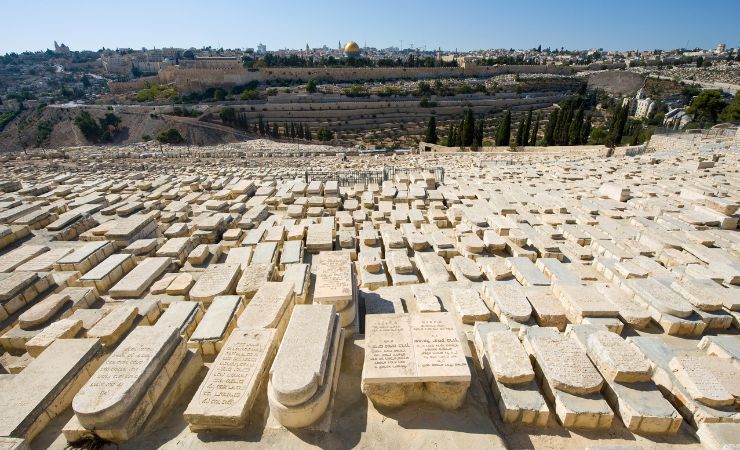
The Mount of Olives holds the distinction of being Judaism’s oldest and most sacred cemetery, with burials dating back over 3,000 years to the First Temple period. The Talmud specifically identifies this location as where the resurrection of the dead will begin during the messianic age, making burial here a profound act of faith. Ancient Jewish history records show that priests and Levites were regularly buried on these slopes during the Second Temple period. The prophet Zechariah’s vision of the end times explicitly mentions the Mount of Olives splitting in two, with the Messiah’s feet touching this very ground. Each year on Tisha B’Av, the fast commemorating the Temple’s destruction, thousands gather here to mourn while gazing across the Kidron Valley toward the Temple Mount. The cemetery now contains over 150,000 graves, including those of prominent rabbis, scholars, and Jewish leaders spanning centuries.
Christianity
The Mount of Olives Jerusalem contains more sites directly associated with Jesus’ life than any other location outside Jerusalem’s Old City. Archaeological investigations have confirmed the area’s significance during the Second Temple period, when Jesus frequently visited these slopes. The Olivet Discourse, Jesus’ longest prophetic teaching recorded in the Gospels, was delivered from this mountaintop with the Temple visible below. Following his triumphal entry into Jerusalem from Bethany via the Mount of Olives, Jesus spent his final week regularly teaching here. The Garden of Gethsemane, where Jesus prayed before his arrest, contains olive trees that scientific dating suggests could be 900 years old, potentially descended from trees that witnessed these events. Early sources document that the first Christian church on the mount was built by Empress Helena in 326 CE, establishing a tradition of pilgrimage that continues today. The belief that Jesus ascended to heaven from this location has made it central to Christian eschatology and worship.
Islam
The Mount of Olives and adjacent Temple Mount feature prominently in Islamic eschatology, particularly regarding the Day of Judgment. Islamic tradition teaches that on the final day, a bridge called As-Sirat will span from the Mount of Olives to the Temple Mount, serving as the path souls must cross to reach paradise. This bridge, described as thinner than a hair and sharper than a sword, will separate the righteous from the wicked based on their earthly deeds. The righteous will cross swiftly at different speeds according to their merit, while the sinful will struggle and potentially fall. Many Islamic scholars also recognize the mount’s significance in relation to Jerusalem’s status as Al-Quds, the third holiest city in Islam after Mecca and Medina. The proximity to Al-Aqsa Mosque and the Dome of the Rock enhances the mount’s importance in Islamic theology and pilgrimage.
Notable Sites and Monuments on the Mount of Olives
- Chapel of the Ascension: Built originally as a 4th-century Christian octagonal church by Empress Helena, this chapel underwent transformation into a mosque during the Saladin period in 1187. The interior stone preserves what tradition identifies as Christ’s final footprint before his ascension. Both Christians and Muslims continue to venerate this site, maintaining an unusual interfaith arrangement.
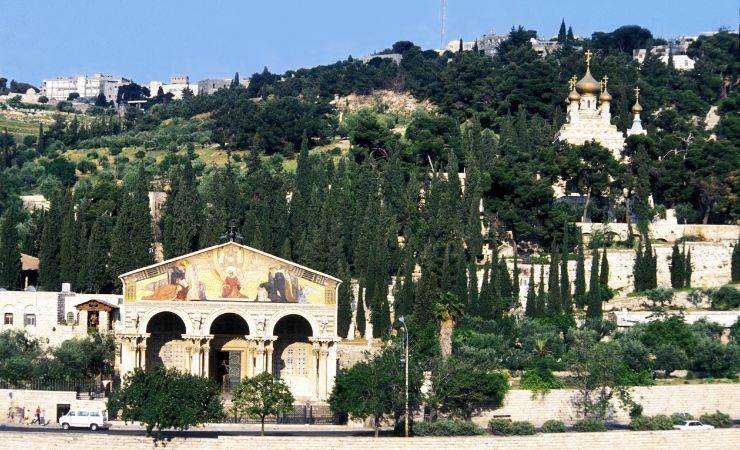
- Church of All Nations (Basilica of the Agony): Architect Antonio Barluzzi designed this striking basilica in 1924, built over Byzantine and Crusader predecessors. The church preserves a prominent limestone rock where tradition places Jesus’ agonizing prayer before his arrest. Twelve national flags represent the countries that funded construction, giving the church its popular name. The interior maintains deliberately dim lighting to evoke the atmosphere of Christ’s nighttime vigil.
- Dominus Flevit (The Lord Wept): This modern chapel’s distinctive teardrop design by Antonio Barluzzi commemorates Luke 19:41, where Jesus wept over Jerusalem’s future destruction. The altar window perfectly frames the Dome of the Rock and Old City across the valley. Archaeological excavations here uncovered a 1st-century Jewish cemetery, with ossuaries now displayed in the chapel museum. The site offers some of Jerusalem’s most photographed views, particularly at sunset.
- Pater Noster (The Church of the Lord’s Prayer): Standing on foundations of Empress Helena’s 4th-century Eleona Basilica, this Carmelite convent preserves the traditional site where Jesus taught the Lord’s Prayer. The cloister walls display the prayer in over 140 languages, including ancient scripts and modern translations. Recent archaeological research has confirmed Byzantine-period construction beneath the current structure. The unfinished basilica, begun in 1920, was intended to be Jerusalem’s largest church.
- Garden of Gethsemane: This ancient olive grove contains eight gnarled trees that DNA analysis confirms as genetically identical, likely offshoots from a single ancient parent tree. The garden occupies approximately 1,200 square meters at the foot of the Mount of Olives, maintained by Franciscan friars since 1681. Scientific studies suggest the existing trees are at least 900 years old. The Grotto of Gethsemane nearby preserves the traditional site of Jesus’ betrayal by Judas. Access is free, but respectful behavior is required in this contemplative space.
- Jewish Cemetery: Covering the mount’s western and southern slopes across 300 acres, this cemetery contains over 150,000 graves spanning 3,000 years of Jewish history. Notable burials include medieval commentator Rabbi Ovadiah of Bertinoro, 20th-century Chief Rabbi Abraham Isaac Kook, and former Israeli Prime Minister Menachem Begin. The cemetery suffered damage during Jordanian rule (1948-1967) when many headstones were used for construction, but restoration efforts continue. Sections are organized by geographic origin and religious community, creating a physical map of Jewish diaspora history.
- Augusta Victoria Hospital: This imposing German Lutheran complex, completed in 1910, originally served as a hospice for German pilgrims and was named after Kaiser Wilhelm II’s wife. The 57-meter tower offers panoramic views across Jerusalem when accessible. During World War I, it housed Turkish and German military headquarters. The complex now operates as a Palestinian hospital specializing in cancer treatment and kidney dialysis, serving East Jerusalem residents.
- Church of Mary Magdalene: Tsar Alexander III commissioned this Russian Orthodox church in 1888 to honor his mother, Empress Maria Alexandrovna. The seven golden onion domes create one of Jerusalem’s most recognizable skylines. The church houses the remains of Grand Duchess Elizabeth Feodorovna, murdered during the Russian Revolution and later canonized. Interior frescoes and iconostasis represent masterpieces of Russian religious art.
Additional Information
How do I get to the Mount of Olives from Jerusalem Old City?
The most common route involves exiting through Lion’s Gate and walking east across the Kidron Valley, a 10-15 minute uphill climb. Alternatively, take bus lines 275 or 99 from the Central Bus Station to various stops along the mount. Taxis and ride-sharing services are also available from any location in Jerusalem.
What is the best time to visit Mount of Olives Jerusalem?
Early morning (7-9 AM) and late afternoon (3-5 PM) offer the best lighting for photography and cooler temperatures for walking. Sunset provides spectacular views of the Old City’s golden stones. Avoid midday visits during summer months when temperatures can exceed 30°C (86°F) with little shade available.
Can I drive to the Mount of Olives Jerusalem?
Yes, several roads provide vehicle access to different parts of the mount. Parking is available near major sites like Augusta Victoria Hospital and the Seven Arches Hotel viewpoint. However, spaces are limited, especially on weekends and holidays when both pilgrims and local visitors arrive.
Can I see the Temple Mount from Mount of Olives Jerusalem?
The Mount of Olives provides the most spectacular and accessible views of the Temple Mount, with the golden Dome of the Rock and silver-domed Al-Aqsa Mosque clearly visible across the Kidron Valley. The viewpoint near the Seven Arches Hotel offers the most photographed panorama, especially stunning during sunrise and sunset hours.
Nearby Sites
The Tombs of the Kidron Valley: The Kidron Valley is filled with old tombs carved into the rocks. These include the Tomb of Absalom, and the Tomb of Benei Hezir.
The Virgin Mary’s Tomb: Once below a Crusader’s church, this grotto is believed to be Mary’s final resting place.
The Gates of the Old City: Jerusalem’s Old City has these ancient gates, each with its own tale. The gate in the east are the Lion’s Gate and the Golden Gate.
Temple Mount Sifting Project: This project involves sifting through dirt from the Temple Mount. It is possible to join for a few hours.