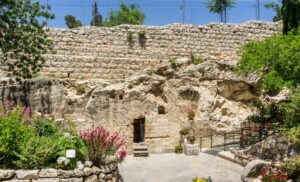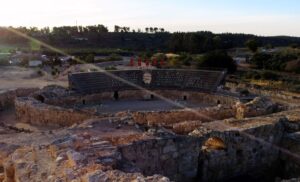
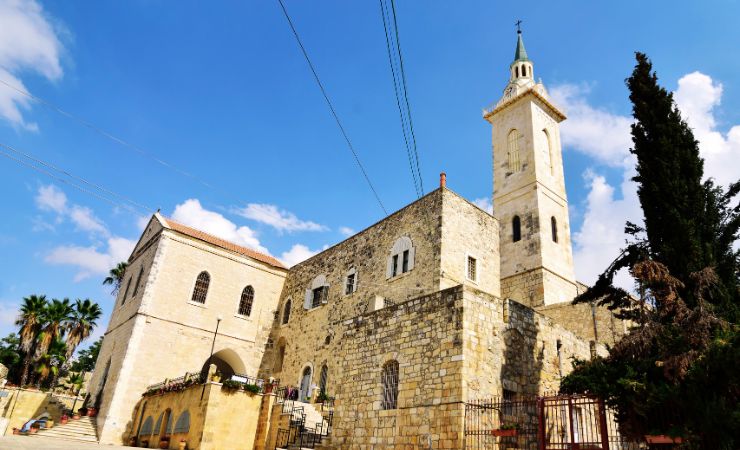
The Church of St. John Ba Harim in Ein Karem marks the traditional birthplace of John the Baptist. This Franciscan church, built over earlier Byzantine and Crusader structures, features a grotto beneath the sanctuary where John is believed to have been born. The church showcases beautiful artwork including floor mosaics and azulejo tiles depicting John's life story.
Location
The Church of St. John Ba Harim sits in Ein Karem, a historic village now part of southwestern Jerusalem. The church occupies a prominent position on Ma’ayan Street, approximately 8 kilometers (5 miles) west of Jerusalem’s Old City.
Biblical context
John the Baptist emerges in the New Testament as the forerunner to Jesus Christ, born to Zechariah, a priest of the division of Abijah, and Elizabeth, who was related to Mary, the mother of Jesus. The Gospel of Luke records that Elizabeth was barren and both parents were advanced in years when the angel Gabriel appeared to Zechariah while he was serving in the Temple in Jerusalem. According to the Franciscan sanctuaries in the Holy Land narrative, Gabriel prophesied that their son would “make ready a people prepared for the Lord” and would be filled with the Holy Spirit even from his mother’s womb.
But the angel said to him: ‘Do not be afraid, Zechariah; your prayer has been heard. Your wife Elizabeth will bear you a son, and you are to call him John. He will be a joy and delight to you, and many will rejoice because of his birth, for he will be great in the sight of the Lord
Luke 1:13-15
John’s ministry focused on preparing the way for Jesus through preaching repentance and baptizing believers in the Jordan River. He proclaimed himself the voice crying in the wilderness, as prophesied in Isaiah, calling people to make straight the paths of the Lord. The tradition placing John’s birth in Ein Karem connects this prophetic calling with the Judean wilderness that begins just east of the village, where John would later retreat for his ascetic preparation. The Church of St. John Ba Harim stands above the cave that Christian tradition has identified as John’s birthplace since the 6th century CE, when early pilgrimage accounts first recorded this association with evidence supporting continuous veneration of the site.


The History of St. John Ba Harim
Archaeological evidence reveals that Ein Karem has been continuously inhabited for over 6,000 years, with its earliest settlements dating to the Neolithic period around 4000 BCE. During the Roman period, the village flourished as a Jewish settlement, and pottery sherds and coin finds from this era support the biblical account of Zechariah and Elizabeth residing here during the first century CE. The association between Ein Karem and John the Baptist’s birthplace emerges in the 6th century with Theodosius the Cenobiarch, who traveled the Holy Land in 530 CE and recorded the location of Saint Elizabeth’s home in his itinerary.
The Church of St. John Ba Harim reflects centuries of architectural evolution under the Holy Land custodianship. The current structure incorporates elements from the 11th-century Crusader church, which itself was built upon earlier Byzantine foundations dating to the 5th or 6th century. Archaeological investigations beneath the church have revealed a complex stratigraphy including Roman-period domestic structures, Byzantine chapels with mosaic floors, and evidence of continuous religious use throughout the medieval period.
Franciscan custodian Father Thomas of Novara acquired the abandoned Crusader site in the late 17th century, purchasing it from Ottoman authorities after the area had been used as stables and storage facilities for centuries. The Franciscans faced numerous challenges, including forced abandonment during periods of local unrest and the need for extensive reconstruction.
The major restoration campaign occurred between 1857 and 1900, funded primarily by Queen Isabella II of Spain and later by the Spanish royal family. This patronage explains the distinctive Spanish architectural elements visible throughout the church, including the azulejo tiles, ornate ironwork, and royal coat of arms that adorn the interior. Spanish architects and artists directed the renovation, creating the harmonious blend of Gothic, Spanish Colonial, and local limestone craftsmanship that characterizes the building.
During World War II, a British artillery unit stationed near the church inadvertently damaged the structure during training exercises in 1941. The subsequent Franciscan excavations, directed by Father Bellarmino Bagatti, uncovered significant archaeological remains including first-century Jewish ritual baths (mikvaot), wine presses, burial chambers with kokhim-style loculi, and small Byzantine chapels with intact mosaic pavements. The discovery of mikvaot particularly supports the tradition of priestly residence here, as ritual purity requirements would have necessitated such installations for families of the Temple priesthood like Zechariah.
Inside the Church of St. John Ba Harim
The interior of the Church of St. John Ba Harim showcases the distinctive Spanish influence that defines its character. Queen Isabella II’s patronage in the 19th century brought Sevillian artisans to Jerusalem, who created the blue and white azulejo ceramic tiles that line the lower walls and the intricate wrought-iron screens that separate the nave from side chapels. The Spanish royal coat of arms, prominently displayed above the main entrance, features the quartered arms of Castile, León, Aragón, and Navarre, commemorating the monarchy’s continued support for this sacred site.
Benedictus Tablets: The church courtyard contains forty-one stone plaques inscribed with Zechariah’s canticle of praise, known as the Benedictus, translated into thirty-one different languages including Hebrew, Arabic, Latin, and various European and Asian scripts. These tablets were installed during the 1960s renovation and represent one of the most comprehensive multilingual biblical displays in the Holy Land. Each tablet measures 60 by 40 centimeters and was carved from local Jerusalem limestone by Franciscan artisans.
The Grotto of Birth: The most sacred feature within the Church of St. John Ba Harim lies beneath the left aisle, where a natural limestone cave has been venerated as John the Baptist’s birthplace since the 6th century. Visitors descend seven stone steps into the grotto, where a 14-pointed silver star embedded in marble marks the traditional spot of the birth. The cave measures approximately 4 by 6 meters and retains its natural rock walls, which show evidence of first-century habitation including niches for oil lamps and storage alcoves. Above the entrance arch, the Latin inscription “Benedictus Dominus Deus Israel” (Blessed be the Lord God of Israel) introduces Zechariah’s prayer of thanksgiving from Luke 1:68. A 17th-century painting above the opening depicts John baptizing Jesus in the Jordan River, with the Holy Spirit descending as a dove, painted by Spanish artist José de Ribera.
Mosaic Pavement: The church features an exceptional 12th-century Crusader mosaic beneath the central cupola. The geometric pattern incorporates Byzantine-style crosses, palm fronds symbolizing victory over death, and vine scrolls representing Christ as the true vine. Archaeological analysis has revealed that this mosaic was constructed over earlier Byzantine floor mosaics, with fragments of 6th-century tessellated pavements visible in several areas where the Crusader work has been damaged.
Main Altar and Statuary: The high altar, dedicated to Saint John the Baptist, features a polychrome wooden statue of the Virgin Mary wearing a deep blue mantle embroidered with gold thread, crafted by 19th-century Spanish sculptor Manuel Vilar. Flanking the central figure stand marble statues of Zechariah in priestly vestments holding a thurible (incense burner) and Elizabeth with an expression of maternal joy, both carved by Italian sculptor Giuseppe Obici in 1885. The altar itself incorporates stone elements from the original Crusader structure, including capitals with acanthus leaf carving typical of 12th-century Jerusalem masonry.
El Greco Attribution: Behind an ornate wrought-iron screen in the right apse hangs a painting traditionally attributed to Domenikos Theotokopoulos (El Greco), though modern scholarship questions this attribution. The work depicts the Visitation scene with Mary and Elizabeth embracing while Zechariah observes from behind. The painting’s elongated figures and distinctive color palette, featuring deep blues and golden highlights, reflect El Greco’s mature style from his Toledo period. Whether authentic or by a skilled follower, the painting represents one of the finest Renaissance artworks in Jerusalem’s history.
Practical Information
The Church of St. John Ba Harim is open daily from 8:00 AM to 12:00 PM and 2:30 PM to 6:00 PM (closes at 5:00 PM November through March). Entry is free of charge, though donations are welcomed for maintenance and restoration work. Visitors should dress modestly, covering shoulders and knees, and men should remove hats inside the church.
The site is partially accessible to visitors with mobility limitations, though the grotto requires descending several steps and may not be suitable for wheelchairs. Parking is available on adjacent streets, though spaces can be limited during peak pilgrimage seasons.
Additional Information
1817: Mirza Hussein Ali, later known as Bahá’u’lláh, is born into a noble family in the Iranian province of Nur.
1844: The Báb announces his mission. (The Templars in Palestine expect the return of Christ in this year.) Bahá’u’lláh becomes a follower of the Báb.
August 1852: Bahá’u’lláh, while confined in an underground dungeon, relates receiving the announcement of his divine calling.
1853: Bahá’u’lláh’s property is confiscated, and he and his family are expelled from their native land to Baghdad.
1853 – 1863: Bahá’u’lláh resides in Baghdad for ten years, including two spent wandering alone in the mountains of Kurdistan.
Prior to 1863: Before complying with an order from the the Sultan of Turkey to move to Istanbul, Bahá’u’lláh announces his divine mission to the followers of the Báb, most of whom accept his claim and become Bahá’ís.
1868: The Turkish Sultan banishes Bahá’u’lláh to ‘Akko, then a remote outpost of the Ottoman Empire, used for political prisoners.
Between 1868 and 1877: Bahá’u’lláh spends nine years of confinement, first in the citadel and then within the walls of the Old City of ‘Akko. During this period, while still confined, he formulates the fundamental laws and principles of the Bahá’í religion in the “Most Holy Book” (Kitáb-i-Aqdas).
1877 onwards (last twelve years of his life): Bahá’u’lláh is allowed to move about freely and live in the countryside north of ‘Akko, spending his last twelve years in relative comfort in the mansion that stands in the centre of the Bahá’í Gardens in ‘Akko.
1890: Bahá’u’lláh determines the location for the resting place of the Báb in Haifa.
29 May 1892: Bahá’u’lláh passes away at the age of 75. His remains are buried in a small building next to the mansion in ‘Akko, known as the “Shrine of Bahá’u’lláh”.
1900 – 1909: The simple ashlar masonry mausoleum for the Báb is built on Mount Carmel in Haifa, including a cistern for water collection.
1909: The first gardens are planted around the Báb’s mausoleum in Haifa. The bones of the Báb are brought to the Holy Land and buried in the simple stone structure on Mount Carmel.
1922 – 1957: As much land as possible is purchased around the Shrine of the Báb in Haifa to expand and protect the property for future development. Several formal gardens with a blend of Eastern and Western styles are designed and installed around the Haifa site, including nine small terraced gardens.
1929: Shoghi Effendi renovates Bahá’u’lláh’s house in Bahji, Akko.
1948 – 1953: Shoghi Effendi directs the development of the golden-domed superstructure around the Shrine of the Báb in Haifa.
1987: Canadian architect-engineer Fariborz Sahba is commissioned to design and construct 18 terraced gardens above and below the Shrine of the Báb in Haifa.
1990s: The city of Haifa decides to renovate the “German Colony”. The Bahá’í establishment requests the municipality to shift a street in the German Colony by 10 degrees to align with the axis between the Shrine of the Báb and the Shrine of Bahá’u’lláh. A compromise is reached where the street is lined with roundabouts, invisibly shifting slightly at each roundabout to create a final tilt of less than one degree that, if extended, would point to the Shrine of Bahá’u’lláh.
2000: UNESCO recognizes the “outstanding universal value” of the Bahá’í Gardens in Haifa and ‘Akko and adds them to the list of World Heritage sites.
2001: The extensive landscaping begun in 1987 for the terraced gardens of the Shrine of the Báb is completed.
2008 (July): The Bahá’í Gardens in Haifa and ‘Akko are inscribed on the UNESCO World Heritage List, specifically on July 8, 2008.
What is the difference between Church of St. John Ba Harim and the Church of the Visitation?
The Church of St. John Ba Harim marks the traditional birthplace of John the Baptist and houses the sacred grotto where he was born, while the Church of the Visitation commemorates Mary’s visit to Elizabeth during their pregnancies. Both churches are located in Ein Karem, about 400 meters apart, and are often visited together as part of a pilgrimage tour. The Church of the Visitation focuses on the meeting between the two women and features the Magnificat prayer, while St. John Ba Harim centers on John’s birth and displays the Benedictus prayer.
Can you visit the birth grotto inside Church of St. John Ba Harim?
Yes, visitors can descend into the birth grotto located beneath the left aisle of the church. The natural limestone cave requires walking down seven stone steps and may not be accessible to visitors with mobility limitations. A 14-pointed silver star embedded in marble marks the exact spot where tradition holds John the Baptist was born. The grotto is open during regular church hours and no additional fee is required.
What is the significance of the Spanish influence in Church of St. John Ba Harim?
The Spanish influence reflects the patronage of Queen Isabella II and the Spanish royal family, who funded major renovations between 1857 and 1900. Spanish architects and artisans created the distinctive azulejo ceramic tiles, wrought-iron screens, and other decorative elements that characterize the church interior. The Spanish royal coat of arms is prominently displayed above the main entrance, and the church continues to receive support from Spain.
Where can you see the Benedictus prayer at Church of St. John Ba Harim?
The Benedictus prayer, Zechariah’s canticle of praise from Luke 1:68-79, is displayed on forty-one stone tablets throughout the church courtyard in thirty-one different languages. Each limestone tablet measures 60 by 40 centimeters and was hand-carved by Franciscan artisans during the 1960s renovation. The original Latin text “Benedictus Dominus Deus Israel” also appears carved above the entrance to the birth grotto.
What archaeological discoveries have been made at Church of St. John Ba Harim?
Franciscan excavations between 1942 and 1947 revealed significant first-century remains including Jewish ritual baths (mikvaot), wine presses, burial chambers, and Byzantine chapel foundations with intact mosaic floors. The discovery of mikvaot particularly supports the tradition of priestly residence, as ritual purity requirements would have been essential for Temple priesthood families like Zechariah. These findings provide archaeological context for the biblical account of John’s birth in this location.
Nearby Sites
Mary’s Well: A significant site believed to be where Mary drank water during her visit to Elizabeth.
Church of the Visitation: Located a short distance from St. John Ba Harim, this church commemorates Mary’s visit to Elizabeth.
- Abu Gosh Crusader Church: Also known as the Church of St. Mary of the Resurrection, this church in Abu Gosh dates back to the Crusader period and is renowned for its well-preserved frescoes.
- Abu Gosh Benedictine Monastery: This monastery is dedicated to the Ark of the Covenant, believed by some to have been housed in Abu Gosh for a time.
Keep reading
Part of our Christian Pilgrimage Guide →