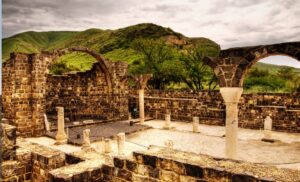
The Church of the Visitation in Ein Karem commemorates Mary's visit to her cousin Elizabeth, as recounted in the Gospel of Luke. Built by the Franciscans in 1955 on Byzantine and Crusader ruins, the two-story church features stunning mosaics and frescoes depicting the Magnificat and the meeting of the two expectant mothers.
The Church of the Visitation in Ein Karem, 8 kilometers west of Jerusalem, marks the site where the Gospel of Luke records Mary visiting her cousin Elizabeth. This, in my opinion, is one the best churches to visit in the holy land, compact in size with so many stories at arm’s length.
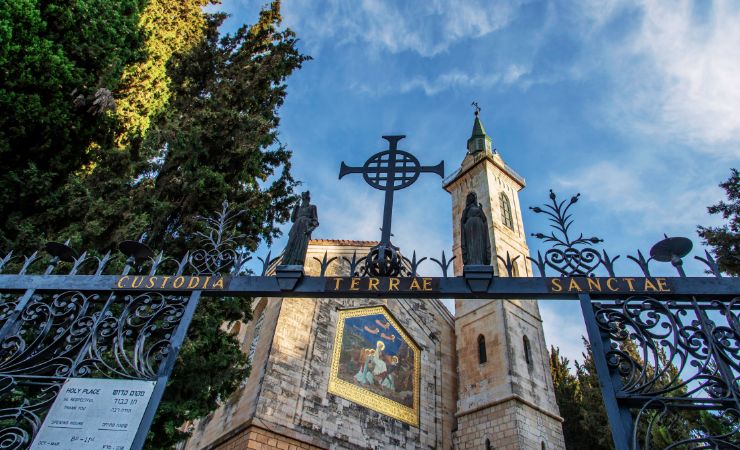
Where Is the Church of the Visitation?
The church sits on a hillside in Ein Karem at 750 meters above sea level, within the terraced slopes of the Judean Mountains. The hilltop position is not incidental. The cobbled slope up to the church is a genuine climb, but it is worth stopping as many times as you need, especially once you reach the top and look out at the Ein Karem reservoir. That view of the reservoir from the top is stunning.
Luke 1:39 places the Visitation in “the hill country of Judea,” and Ein Karem’s elevation and location within the tribal territory of Judah match that description. Archaeological surveys confirm continuous settlement here since the Bronze Age, making this one of the most geographically consistent candidates for the biblical site.
The Biblical Story: Why Mary Traveled to Ein Karem
The event the church commemorates took place during the reign of Herod the Great, who ruled Judea from 37 to 4 BCE under Roman authority. After the angel Gabriel told Mary she would conceive through divine intervention, she also learned that her elderly relative Elizabeth had miraculously conceived. The Gospel of Luke records that Mary “arose in those days, and went into the hill country with haste, into a city of Juda” (Luke 1:39).
The journey from Nazareth to the Judean hills would have covered approximately 150 kilometers. Archaeological evidence from Roman milestones along these routes suggests the trip took three to four days on foot, passing through Samaritan territory where tensions frequently ran high.
And it came to pass, that, when Elisabeth heard the salutation of Mary, the babe leaped in her womb; and Elisabeth was filled with the Holy Ghost: And she spake out with a loud voice, and said, Blessed art thou among women, and blessed is the fruit of thy womb. And whence is this to me, that the mother of my Lord should come to me? For, lo, as soon as the voice of thy salutation sounded in mine ears, the babe leaped in my womb for joy. And blessed is she that believed: for there shall be a performance of those things which were told her from the Lord.
Luke 1:41-45
Three distinct moments define that meeting. John the Baptist, still in Elizabeth’s womb, recognized the presence of Jesus in Mary’s womb, an acknowledgment Christian tradition reads as the first sign of Christ’s identity before birth. Elizabeth then delivered a prophetic proclamation; her words “blessed is the fruit of thy womb” were later incorporated into the Hail Mary prayer. Finally, Elizabeth praised Mary’s trust in divine promises, declaring “blessed is she that believed”, a statement of faith under circumstances that offered no ordinary proof.
The Massacre of the Innocents is Also Depicted Here
The lower chapel connects the joyful Visitation to the violence that followed. After the birth of Jesus in Bethlehem, magi from the East arrived in Jerusalem asking for the newborn “King of the Jews.” That inquiry reached Herod the Great, whose historian Josephus Flavius documented a pattern of eliminating perceived threats, including his wife Mariamne, his mother-in-law, and three of his own sons.
Then Herod, when he saw that he was mocked of the wise men, was exceeding wroth, and sent forth, and slew all the children that were in Bethlehem, and in all the coasts thereof, from two years old and under, according to the time which he had diligently inquired of the wise men.
Based on Bethlehem’s estimated population of 1,000 residents at the time, historians calculate that approximately 20 to 30 children would have been killed. Christian tradition, holds that Elizabeth received divine warning and fled to the wilderness with infant John. The site of that refuge, known as the “Rock of Concealment”, is preserved in the church’s lower crypt.
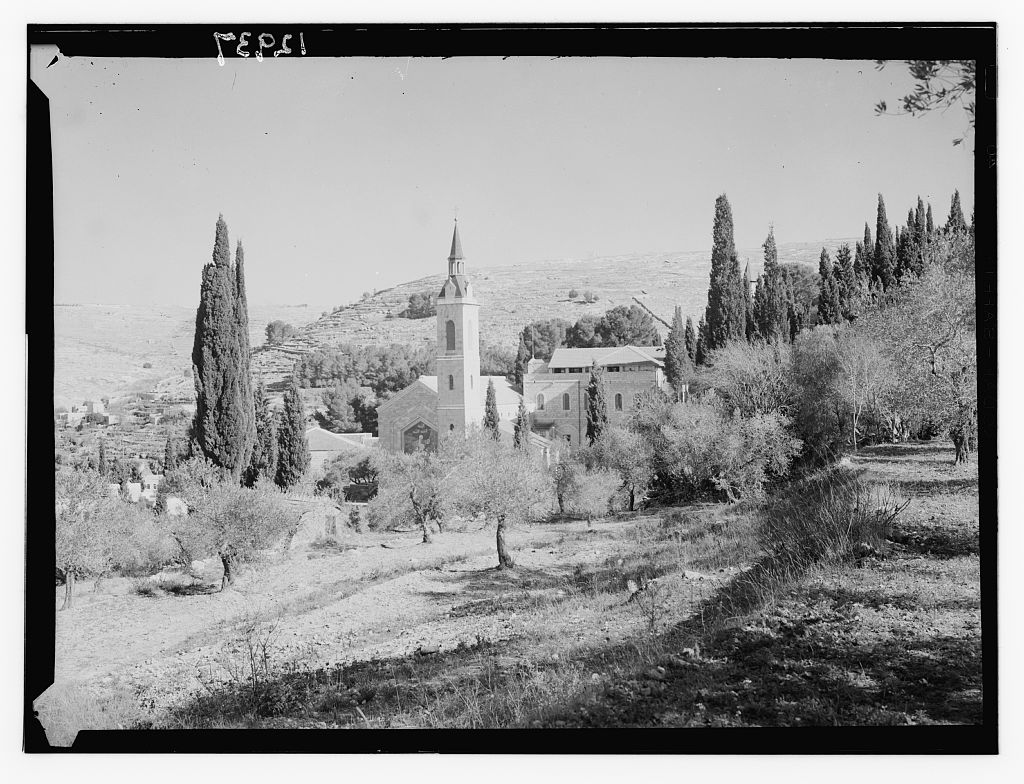
The Architecture of the 1955 Church of the Visitation
Antonio Barluzzi designed the Church of the Visitation Ein Karem in 1955, completing his architectural legacy as the foremost church builder in 20th-century in the Holy Land . Known as the “Architect of the Holy Land,” Barluzzi had already created the Church of All Nations, Dominus Flevit, and the Church of the Beatitudes . His method at Ein Karem was to make the archaeology visible rather than conceal it: Byzantine remains from the 5th century and Crusader foundations from the 12th century are incorporated as structural and decorative elements throughout the building.
You will find at the site a cistern in the courtyard, a limestone-lined water storage system dating to when Emperor Constantine legalized Christianity, and mosaic fragments with Greek inscriptions still visible in the lower church floor. Take a look at the Medieval limestone blocks, that make up the lower walls of the bell tower.
What Can Be Seen Inside the Church of the Visitation?
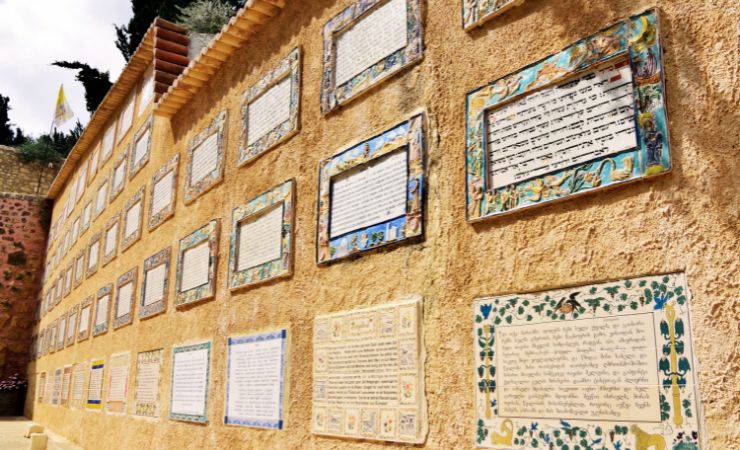
The Magnificat Courtyard — Forty-one ceramic plaques line the entrance courtyard, each displaying the Magnificat in a different language, ranging from Arabic and Armenian to Zulu and Vietnamese. The Crusader bell tower rises from the courtyard’s eastern edge, its base built from 12th-century masonry. This is where multilingual prayer services gather, and the ceramic work is close enough to read at eye level.
The Rock of Concealment — The lower chapel, reached by stairs, is built around a natural limestone formation that tradition identifies as the hiding place of Elizabeth and infant John during Herod’s soldiers’ search. Barluzzi made this geological feature the focal point of the altar. Frescoes depicting the Massacre of the Innocents surround it on the crypt walls, painted under Barluzzi’s direction by local artists in the 20th century.
Barluzzi’s Self-Portrait in the Ceiling — One detail easy to miss: the architect incorporated his own portrait into the ceiling mural’s angelic choir in the lower church. Look up and you will find Barluzzi himself looking back at you from the ceiling. It is a quiet signature that rewards visitors who look up rather than straight ahead.
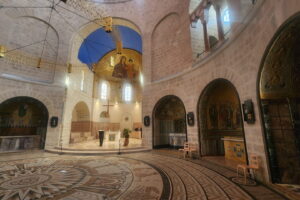
The Upper Church Frescoes — The main sanctuary is lined with frescoes of biblical women, Deborah, Judith, and Esther among them, placed deliberately to frame Mary’s visit within a longer tradition of female leadership in salvation history. Many visitors skip this upper church entirely, which celebrates women of the Bible who are so often overlooked, and that is a mistake worth avoiding. Clerestory windows flood the space with natural light, and the upper church is frequently overlooked by visitors who stop only at the crypt. It should not be skipped.
The Facade Mosaic — The exterior facade carries a large mosaic showing Mary’s arrival at Elizabeth’s house, with the Judean landscape rendered in ceramic tile behind the two figures. It is visible from the courtyard before entering and sets the visual theme for everything inside.
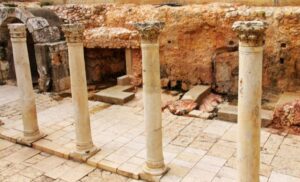
Byzantine and Crusader Floor Fragments — The lower church floor preserves mosaic fragments from the 5th-century Byzantine church that stood here before Barluzzi’s construction. Geometric patterns and partial Greek inscriptions remain legible. Medieval column bases and carved capitals from the Crusader period appear as structural components in the walls, giving the building a physical timeline that spans more than 1,600 years of Christian worship.
Is Ein Karem Actually the Biblical Site?
Luke 1:39 names only “a town in the hill country of Judea” without specifying Ein Karem. Five lines of evidence support the identification:
- Geography: Ein Karem sits at 750 meters elevation in the Judean Mountains, 8 kilometers west of Jerusalem, within the ancient tribal territory of Judah.
- Early pilgrimage records: The Bordeaux Pilgrim (333 CE) describes visiting a shrine “where John was born” in the Judean hills near Jerusalem, the earliest written link to this location.
- Medieval documentation: Pilgrims including Willibald (723 CE), Bernard the Monk (867 CE), and Saewulf (1102 CE) consistently name Ein Karem as both John the Baptist’s birthplace and the Visitation site.
- Archaeological finding: Franciscan Archaeological Institute excavations confirm unbroken Christian worship from the 5th century onward, through Byzantine, Crusader, and Ottoman phases.
- Place-name stability: “Ein Karem” means “Spring of the Vineyard” in Hebrew, preserved in Arabic as “Ain Karim,” suggesting linguistic continuity from antiquity.
Practical Information
The Church of the Visitation Ein Karem opens daily from 8:00 AM to 11:45 AM and 2:00 PM to 6:00 PM (winter hours may vary). Entry is free of charge. Modest dress is required. The church is partially wheelchair accessible, with ramps to the courtyard and main church, though the lower crypt requires stair access.
Additional Information
What happens at the Visitation according to the Bible?
When Mary greeted Elizabeth, John the Baptist leaped in Elizabeth’s womb in recognition of Jesus. Elizabeth then declared Mary “blessed among women”, words later incorporated into the Hail Mary prayer. The encounter is recorded in Luke 1:41-45 and took place during the reign of Herod the Great.
What are the opening hours for the Church of the Visitation Ein Karem?
The Church of the Visitation Ein Karem opens daily from 8:00 AM to 11:45 AM and 2:00 PM to 6:00 PM. Winter hours may be slightly reduced, so visitors should confirm current schedules before traveling. The church closes during lunch hours and observes Catholic liturgical calendar restrictions on certain feast days.
What is the Rock of Concealment in the Church of the Visitation?
The Rock of Concealment is a natural limestone formation in the church’s lower crypt where Christian tradition holds that Elizabeth hid with infant John the Baptist during Herod’s Massacre of the Innocents. According to legend, the mountain opened miraculously to provide shelter from Herodian soldiers. This rock formation now serves as the focal point of the lower chapel’s altar.
Are there facilities for pilgrimage groups at the Church of the Visitation?
The Magnificat courtyard accommodates group prayer services and is large enough for organized pilgrimage gatherings. The 41-language Magnificat plaques make multilingual liturgical readings practical on-site. Groups should arrange visits outside peak morning hours, as the site shares Ein Karem with the nearby Church of Saint John the Baptist.
Who manages and maintains the Church of the Visitation today?
The Franciscan Custody of the Holy Land owns and administers the Church of the Visitation, as it has since the 20th-century construction project. The Franciscan Archaeological Institute conducted the excavations that informed Barluzzi’s 1955 design and continues to document the site’s Byzantine and Crusader remains.
Sites Nearby the Church of the Visitation
Church of St. John Ba Harim: Traditionally believed to mark the birthplace of John the Baptist.
Mary’s Well: A spring that has been in use since ancient times and is located in the heart of the village.
Russian Orthodox Gorny Convent-Moscovia Monastery: This Russian Orthodox convent is also known as the “Convent of the Ascension”.
- The Sisters of Zion Monastery: This Catholic monastery is run by the Sisters of Zion, an order founded in the 19th century (see Convent of the Sisters of Zion in Jerusalem).
- Mount Herzl: Mount Herzl is the site of Israel’s national cemetery and other memorial and educational facilities.
Keep reading
Part of our Christian Pilgrimage Guide →