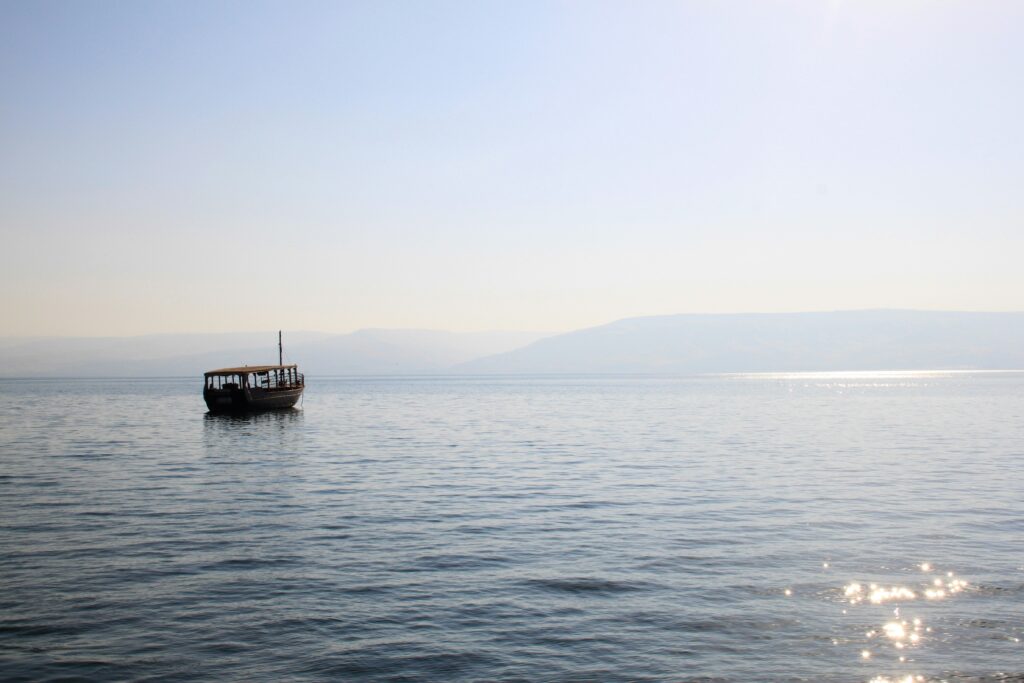
The Sea of Galilee is Israel’s largest freshwater lake and the lowest freshwater lake on Earth, sitting roughly 700 feet below sea level in northern Israel. It measures about 13 miles long and 8 miles wide and reaches a maximum depth of around 157 feet. Sad to say, the condition of the lake at the end of summer 2026 is difficult to see, years of drought and demand have left their mark. But stand at the water’s edge on a quiet morning and you will notice how sweet the water is and how serene being at the lake can be.
What names does the Sea of Galilee go by?
The lake has carried at least four names across recorded history: the Sea of Tiberias, Lake Gennesaret, Kinneret in Hebrew, and the Sea of Galilee. The Hebrew name Kinneret appears in the Hebrew Bible and likely comes from the word for “harp,” a reference to the lake’s curved outline. Palestinians and many Arabic speakers today call it Buhayrat Tabariyya, after the city of Tiberias on its western shore.
The lake supplies roughly 10 percent of Israel’s drinking water. It is fed by the Jordan River and by underground springs, and it drains south through the Jordan River toward the Dead Sea.
Why is the Sea of Galilee historically significant?
The shoreline has been continuously inhabited since the Neolithic period. During the first century CE, fishing villages including Capernaum, Bethsaida, and Chorazin lined the shore and became the geographic center of Jesus’ Galilean ministry. At that time, 230 boats regularly worked the lake, and the catch was exported across the Mediterranean world.
Herod Antipas built Tiberias around 20 CE, naming it after Emperor Tiberius. After the destruction of the Second Temple in 70 CE, the Galilee became the center of Jewish religious life. Tiberias was recognized as one of Judaism’s four holy cities, housed the Sanhedrin, and attracted major Talmudic scholars. The philosopher and physician Maimonides, who died in 1204, is buried there.
Christian pilgrimage to the lake began in earnest during the Byzantine period, when churches were built at Tabgha and the Mount of Beatitudes. The Crusaders added further construction, though many of those buildings were later destroyed. Modern Jewish agricultural settlement began with the founding of Degania Kibbutz in 1909, followed by comprehensive water management programs after Israeli independence in 1948.
Is the Sea of Galilee part of Israel?
Yes. The Sea of Galilee lies entirely within Israeli territory. Its eastern shore runs close to the border with Jordan, but the lake itself is under Israeli sovereignty. The Israel Nature and Parks Authority administers several of the archaeological sites around its shores.
What can you see and do at the Sea of Galilee?
Most pilgrimage sites cluster at the north end of the lake and are reachable from one another by a short drive. The water is fresh and calm, and if you are into water sports, this is the place to go. One practical note: stay away during Israeli national holidays, the crowds are genuinely overwhelming.
The Ancient Boat (Jesus Boat) — Discovered in 1986 when drought dropped the lake’s water level, this 2,000-year-old wooden fishing vessel now sits in a climate-controlled pavilion at Kibbutz Ginosar. The boat is 27 feet long and 7.5 feet wide. Carbon dating and wood analysis confirm its first-century origins, placing it squarely in the period of Jesus’ ministry. Visitors see the actual hull, preserved by years of careful conservation work after its excavation from the mud.
Capernaum — On the northern shore, this ancient fishing village was Jesus’ base during his Galilean ministry and is called “his own city” in the Gospels. The fourth-century limestone synagogue, built directly over an earlier basalt foundation from Jesus’ time, is the most photogenic structure on site. Archaeologists have also uncovered what tradition identifies as the house of Simon Peter, now protected beneath a modern Franciscan church. Walking the excavated first-century streets gives a clear sense of how compact and densely settled these lakeside communities were.
Mount of Beatitudes — This hilltop northwest of the lake is the traditional site of the Sermon on the Mount. An octagonal church designed by Italian architect Antonio Barluzzi in 1938 commemorates the eight beatitudes. The site’s elevation and natural bowl shape explain how Jesus could address large crowds on the hillside below without amplification. On a clear day the entire lake is visible from the church garden.
The Church of the Multiplication (Tabgha ) – On the northwestern shore houses fifth-century Byzantine floor mosaics depicting fish, birds, and local flora. The famous mosaic showing two fish flanking a basket of bread has become one of the most reproduced images in Christian art. The site’s name comes from the Greek Heptapegon, meaning seven springs, and those springs still flow today. The water bubbling up just outside the church wall is the same source that drew settlement here long before the Gospels were written.
Magdala — Excavated and opened in recent years, this first-century fishing town was the hometown of Mary Magdalene. The dig uncovered a synagogue from Jesus’ time with stone benches, frescoed walls, and a decorated stone table that may have held Torah scrolls during readings. Residential quarters, harbors, ritual baths, and market areas fill out the picture of daily life during the Second Temple period. The modern Magdala Center presents the finds alongside a chapel built to complement the ancient remains.
Hamat Tiberias National Park — Just south of Tiberias, this site preserves a fourth-century synagogue whose mosaic floors are among the most discussed in Israeli archaeology. The centerpiece is a zodiac wheel with the Greek sun god Helios at its center, an image that shows how Jewish communities of late antiquity absorbed and adapted Greco-Roman visual culture. Roman and Byzantine baths run alongside the synagogue, fed by natural hot springs that still reach 60 degrees Celsius. You can see the steam rising from the ground on cooler mornings.
Susita (Hippos) National Park — Perched on a plateau above the eastern shore, Susita was one of the ten Decapolis cities, a league of Greco-Roman urban centers in the region. The ruins include a Roman theater, a colonnaded main street, Byzantine churches with mosaic floors, and defensive walls. Excavations have traced continuous occupation from the Hellenistic period through the early Islamic era. The plateau’s height gives an unobstructed panorama of the entire lake, making the military logic of the site immediately obvious.
What else is around the lake?
Tiberias is the main city on the western shore and one of Judaism’s four holy cities. It has the tomb of Maimonides, natural hot springs used therapeutically since Roman times, old city walls, and a lakefront promenade lined with restaurants. Hotels, tour operators, and services for the whole region are based here.
Bethsaida, on the northern shore near the Jordan River’s entry into the lake, was the hometown of the apostles Peter, Andrew, and Philip. Excavations have uncovered city gates, residential areas, a cultic high place, and fishing weights that connect directly to the Gospel accounts.
Degania Kibbutz, founded in 1909 at the lake’s southern tip where the Jordan River exits, is Israel’s first kibbutz. Its museum covers the early settlement period and explains how communal farming communities developed the agricultural and fishing methods that shaped modern Galilee.
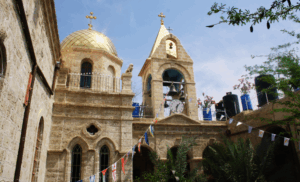
Church of the Twelve Apostles in Capernaum, built in 1925, has distinctive red domes and houses icons and frescoes depicting scenes from Jesus’ Galilean ministry. The courtyard looks out toward the water where many of the apostles fished before joining Jesus.
Practical information for visiting the Sea of Galilee
Spring and autumn are the most comfortable seasons. Most sites open around 8:00 AM and close at 5:00 PM, each with its own admission fee. A full circuit of the lake by car takes roughly two hours, which makes it possible to visit several sites in one day.
Be aware that there are fewer and fewer beaches open to the public at no charge. There is a fair chance you will need to pay just to sit at the water’s edge.
Additional Information
- Israel Nature and Parks Authority — Official government authority managing national parks around the Sea of Galilee
- Britannica – Sea of Galilee — Comprehensive geographical and historical information
Frequently Asked Questions
What is the best time of year to visit the Sea of Galilee?
The optimal visiting seasons are spring (March-May) and autumn (September-November) when temperatures are moderate and rainfall is minimal. Summer months can be quite hot, reaching over 35°C (95°F), while winter brings occasional rain but generally mild temperatures. The lake is suitable for swimming from April through October.
Can you swim in the Sea of Galilee?
Yes, swimming is permitted and popular at designated beaches around the lake. The water is fresh, clean, and generally safe for swimming, with several beaches offering facilities, lifeguards, and amenities. Tzemach Beach and various kibbutz-managed beaches provide the best swimming experiences with proper safety measures.
How long does it take to drive around the entire Sea of Galilee?
A complete circuit of the Sea of Galilee by car takes approximately 2-3 hours without stops, covering about 65 kilometers. The well-maintained roads offer scenic views and easy access to all major attractions.
How deep is the Sea of Galilee now?
The maximum recorded depth is about 157 feet. Actual water levels fluctuate with rainfall and extraction rates. The Israeli Water Authority sets annual “red lines”, minimum thresholds below which pumping is restricted, and publishes current levels on its website.
Did Jews live in Galilee?
Yes, continuously. After the destruction of the Second Temple in 70 CE, the Galilee became the center of Jewish religious and scholarly life. The Sanhedrin relocated there, and Tiberias became one of Judaism’s four holy cities, a status it still holds today.
Why is the Sea of Galilee so famous?
It is the geographic setting for a large portion of Jesus’ recorded ministry: the calling of the first disciples, the multiplication of loaves and fishes, and the Sermon on the Mount all took place on or near its shores. It also carries 3,000 years of Jewish history in the same compact area.
Is the Sea of Galilee part of Israel?
Yes, the lake lies entirely within Israeli territory. Its eastern shoreline runs near the Jordanian border, but Israeli sovereignty covers the full surface of the water. Several sites on its shores are managed by the Israel Nature and Parks Authority as national parks.
What biblical events took place at the Sea of Galilee?
The Sea of Galilee was central to Jesus’ ministry, witnessing events including the calling of the first disciples, the Sermon on the Mount, the multiplication of loaves and fishes, Jesus walking on water, and the miraculous catch of fish. Many of Jesus’ parables reference fishing and lake activities that would have been familiar to local audiences. The region served as Jesus’ primary base of operations during his three-year ministry.
Is it necessary to book boat trips in advance?
While walk-up availability often exists, booking boat trips in advance is recommended, especially during peak tourist seasons and Jewish holidays. Several operators in Tiberias offer various trip lengths from 45-minute scenic cruises to longer excursions with meals.
Nearby Sites
- The “Jesus Boat”: A Boat from the Time of Jesus on the Sea of Galilee: Detailed exploration of the ancient fishing vessel discovered in 1986.
- The Jesus Trail: Walking in Jesus’ Footsteps in the Galilee: A multi-day hiking route connecting sites associated with Jesus’ ministry throughout the Galilee region.
- Jordan River Baptismal Site: The traditional location where John the Baptist baptized Jesus, located south of the Sea of Galilee.
- Nazareth: Jesus’ hometown featuring the Basilica of the Annunciation and other sites commemorating his early life.
- Mount Tabor: The traditional site of Jesus’ Transfiguration, offering spectacular views of the Galilee region.
- Bet She’an National Park: Extensive Roman and Byzantine ruins including one of the best-preserved ancient theaters in Israel.
Keep reading
Part of our Galilee & Northern Israel Guide →