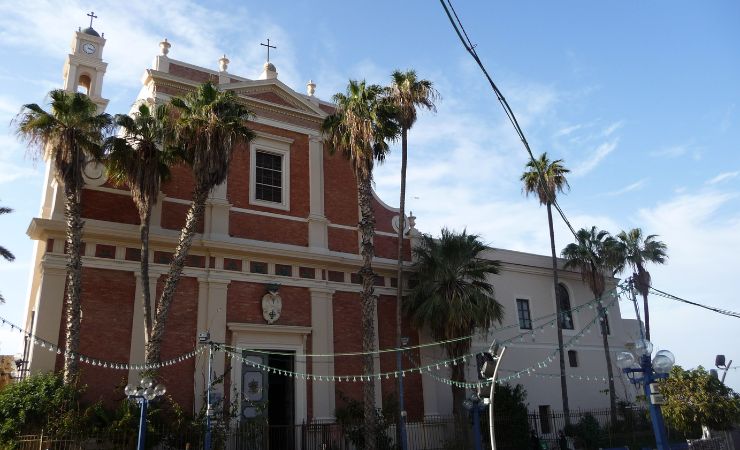
St. Peter's Church in Jaffa faces west toward the Mediterranean Sea to symbolize St. Peter's missionary journey from Jaffa to Rome, where he became the first Pope. This unique westward orientation differs from typical churches that face east, reflecting the church's connection to Peter's biblical vision and his departure from this ancient port city.
St. Peter’s Church rises above the ancient port of Old Jaffa as one of the most recognizable landmarks on Israel’s Mediterranean coast. Unlike nearly every other church in the Holy Land, St. Peter’s Church Jaffa faces west, with its altar oriented toward the sea rather than Jerusalem or the east. That deliberate westward orientation carries a specific theological meaning: it points toward Rome, the seat of the Catholic Church, affirming the spiritual authority to which this Franciscan community belongs.
Location
St. Peter’s Church sits at Kedumim Square (Kikar Kedumim) in Old Jaffa, perched on the promontory above the ancient harbor. The address is 1 Mifraz Shlomo Street, Jaffa, and the church is roughly a 20-minute walk south along the waterfront from central Tel Aviv.
Biblical Context
The resurrections of Tabitha
The site of St. Peter’s Church in Jaffa is tied to a significant biblical story involving Saint Peter. According to the Acts of the Apostles in the New Testament, Saint Peter performed a miracle here by resurrecting Tabitha, also known as Dorcas, a devoted follower of Christ known for her charitable work among widows in the Jaffa community. Tabitha had fallen ill and died, and upon Peter’s arrival, he cleared the room, knelt in prayer, and commanded her to rise. She opened her eyes, saw Peter, and sat up. The account in Acts 9 records that word of the miracle spread throughout Jaffa, and many people came to faith as a result.
Peter sent them all out of the room; then he got down on his knees and prayed. Turning toward the dead woman, he said, ‘Tabitha, get up.’ She opened her eyes, and seeing Peter she sat up. He took her by the hand and helped her to her feet.
Peter’s Vision
While staying with Simon the Tanner in Jaffa, just a short distance from where the church now stands, Peter received a vision that reshaped the boundaries of early Christianity. Three times he saw a sheet descend from heaven carrying animals considered ritually unclean under Jewish law, and three times a voice commanded him to eat. When Peter refused, the voice replied: “Do not call anything impure that God has made clean.” The vision arrived immediately before messengers from the Roman centurion Cornelius appeared at the door, and Peter understood it as divine instruction to bring the gospel to Gentiles. This moment, recorded in Acts 10, is widely regarded by historians of early Christianity as the theological turning point that transformed a Jewish sect into a universal faith. The house of Simon the Tanner, where the vision occurred, is still identifiable nearby in Old Jaffa.
He saw heaven opened and something like a large sheet being let down to earth by its four corners. It contained all kinds of four-footed animals, as well as reptiles and birds. Then a voice told him, ‘Get up, Peter. Kill and eat.’ ‘Surely not, Lord!’ Peter replied. ‘I have never eaten anything impure or unclean.’ The voice spoke to him a second time, ‘Do not call anything impure that God has made clean.’ This happened three times, and immediately the sheet was taken back to heaven.”
The Church's History
The story of St. Peter’s Church spans nearly a thousand years of destruction, rebuilding, and layered ownership. The earliest structure on this promontory was a medieval citadel built under the Crusaders and later restored by Louis IX of France during the Seventh Crusade in the 13th century. The Mamluks destroyed that church in 1264, though one of Louis IX’s round towers survived and was folded into the building that followed. Franciscan monks raised a new church here in 1654, intended mainly as a lodging and waypoint for Catholic pilgrims arriving by sea. That building was destroyed twice during the upheaval of the late 18th century, once during Napoleon’s 1799 campaign, and had to be rebuilt each time. The current structure, funded by Spain and built by the Franciscan Custody of the Holy Land, went up between 1888 and 1894, with a major renovation completed in 1903. It remains an active Franciscan parish today.
What to See at St. Peter's Church
St. Peter’s pairs a landmark exterior with a richly Baroque interior. The features worth looking for:
- Red-brick Spanish-colonial facade. Spain funded the 1888–1894 reconstruction, so the Franciscans modeled the front on the Spanish churches then common across Latin America. The warm brick breaks sharply from Old Jaffa’s pale limestone, making the church a beacon for pilgrims arriving by sea.
- The Banias rock and bronze cross. At the very top of the facade, a bronze cross rises from a rough stone block carried from Caesarea Philippi, today’s Banias in Israel’s far north, where Jesus told Peter, “You are Peter, and on this rock I will build my church” (Matthew 16:18). Since Petros means rock in Greek, the stone stands for both the apostle and his faith.
- The tree-shaped pulpit. The interior’s standout feature: a wooden pulpit carved as a lifelike tree, its thick trunk rising into a leafy, fruit-laden canopy that symbolizes the Tree of Life.
- The painted vaulted ceiling. A high Baroque ceiling in soft blue and lemon tones runs the length of the nave, above marble-clad walls and thick columns.
- The altar painting of Peter’s vision. Above the main altar at the western end of the nave hangs a large painting of Peter’s rooftop vision, the moment in Jaffa that opened the faith to the Gentiles.
- Stained glass from Munich. Made by the renowned artist Franz Xaver Zettler, four panels show the miraculous catch of fish, Christ handing Peter the keys, the Transfiguration, and the washing of the feet at the Last Supper. Most other windows depict Spanish saints, with Tabitha, Francis of Assisi, and the Immaculate Conception as the exceptions.
- Wall oil paintings. The fourteen Stations of the Cross line the walls, alongside a painting of St. George slaying the dragon.
- The Tabitha transept. Beside the altar, a dedicated painting commemorates Peter raising Tabitha from the dead, the miracle that took place in Jaffa.
The Crusader Rooms
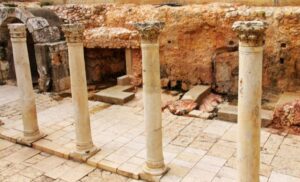
Outside and to the right of the sacristy lie two whole circular rooms with low ceilings and narrow fire embrasures, survivors of the 13th-century citadel that Louis IX of France rebuilt during his crusade. They are the oldest standing part of the complex: the remains of an earlier Byzantine church are said to lie buried beneath the Crusader fort, and within the adjoining monastery a large round citadel tower still stands, with a small stone chapel in its basement and a staircase up to the friars’ library. Napoleon is said to have lodged in these rooms after his troops stormed Jaffa in the March 1799 siege. A statue of Louis IX, canonized for his crusading, stands in the monastery courtyard.
Practical Information
Entry to the church is free of charge. The church is generally open to visitors Monday through Saturday from approximately 8:00 a.m. to noon and again from 3:00 p.m. to 5:00 p.m. Sunday hours may vary due to Mass schedules. The Crusader Rooms are inside the working Franciscan monastery and are not reliably open to visitors.
Modest dress is required: shoulders and knees should be covered.
Additional Information
Why does St. Peter’s Church in Jaffa face west instead of east?
Most Christian churches are oriented eastward, toward Jerusalem or the rising sun. St. Peter’s Church Jaffa faces west, toward the Mediterranean Sea, as a deliberate theological statement pointing toward Rome. The Franciscan order that built and administers the church maintains a formal allegiance to the papacy, and the westward orientation reflects that relationship architecturally. It also meant that pilgrims arriving by sea from Europe would see the church’s facade directly as their ship approached the harbor.
Who built St. Peter’s Church Jaffa and when?
The current structure was built by the Franciscan Custody of the Holy Land between 1888 and 1894, with a renovation completed in 1903. It replaced earlier churches on the same site, the oldest of which was a Crusader-era building restored by Louis IX of France in the 13th century and destroyed by the Mamluks in 1264. Franciscan monks constructed a new church on the site in 1654, but it was destroyed twice in the late 18th century before the present building was commissioned.
Is St. Peter’s Church Jaffa free to enter?
Yes, entry to St. Peter’s Church is free of charge. The church welcomes visitors as well as worshippers, and no ticket or reservation is required for general admission. Donations are appreciated. The church is administered by the Franciscan Custody of the Holy Land.
What are the opening hours of St. Peter’s Church Jaffa?
The church is generally open Monday through Saturday from approximately 8:00 a.m. to noon and from 3:00 p.m. to 5:00 p.m. Sunday hours vary due to Mass schedules and may be limited to worshippers. Hours can change without notice on Catholic holidays or during special liturgical periods, so it is advisable to verify before your visit.
What is the biblical significance of Jaffa and St. Peter’s Church?
Jaffa is the site of two major events in the Acts of the Apostles. Peter raised Tabitha (Dorcas) from the dead here, as recorded in Acts 9:36-42, and he received the vision of the sheet with unclean animals at the nearby house of Simon the Tanner, described in Acts 10. That second event is considered a pivotal moment in early Christian history, as it led Peter to bring the gospel to Gentiles for the first time. The church was built on this promontory specifically to commemorate Peter’s presence in Jaffa.
Nearby Sites
- Jaffa Flea Market – A bustling market where you can find a mix of antiques, handmade crafts, and local food.
- Jaffa Clock Tower – A historic clock tower located in the heart of Jaffa.
- House of Simon the Tanner – A site of biblical significance, offering insight into ancient and religious history.
- Jaffa’s Harbor – A picturesque harbor with a long history, offering scenic views and dining options.
Keep reading
Part of our Tel Aviv & Jaffa Guide →