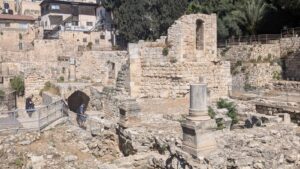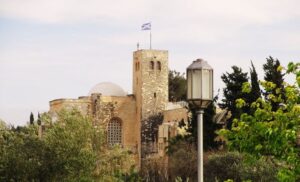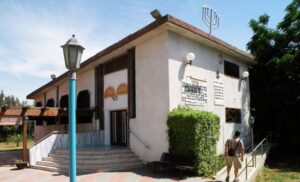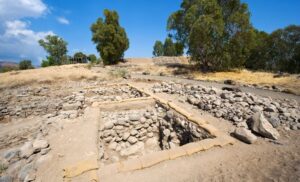
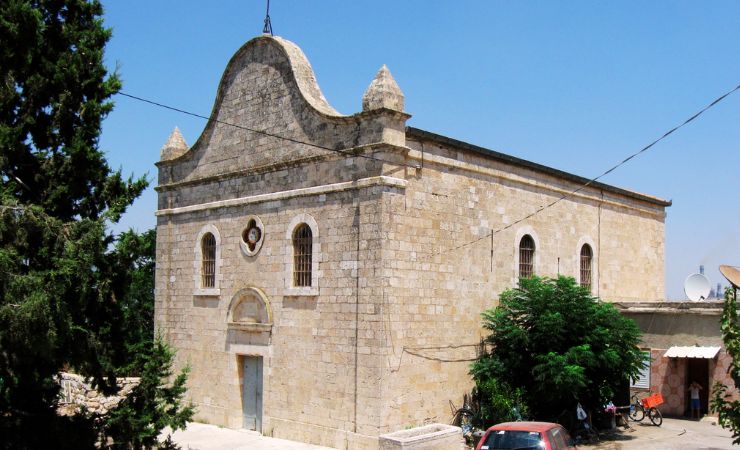
The Church in Nein, officially called the Church of the Resurrection of the Widow's Son, is a Roman Catholic church in northern Israel's village of Nein. It commemorates the biblical miracle where Jesus resurrected a widow's son, as recounted in Luke 7:11-17, marking this as the site of that transformative event.
The Church in Nein, officially known as the Church of the Resurrection of the Widow’s Son, marks one of the most poignant miracle sites in the New Testament. This Roman Catholic church commemorates the location where Jesus raised a widow’s only son from the dead, demonstrating both divine power and profound compassion.
Location of the Church of Nein
The Church in Nein occupies the center of the Arab village of Nain on Mount Moreh’s northern slope, 515 meters above sea level in Lower Galilee. The strategic hilltop position offers sweeping views across the Jezreel Valley, with Mount Tabor visible six kilometers to the east and the Mediterranean coast 40 kilometers to the west. Ancient Nain controlled the junction of roads connecting the Jordan Valley with the coastal plains.
Archaeological surveys suggest the modern village sits directly atop the biblical town, with pottery sherds and building foundations dating to the Roman period confirming continuous occupation. The church’s location corresponds to traditional accounts placing the miracle near Nain’s ancient gate, where funeral processions would exit the city toward burial grounds on surrounding hillsides.
Biblical context
Luke 7:11-17 records Jesus approaching Nain accompanied by his disciples and a large crowd. At the city gate, they encountered a funeral procession carrying the body of a young man, the only son of a widow. The timing proved providential, as Jewish burial customs required interment on the day of death, meaning the mother’s grief was at its most acute. Jesus, moved with compassion for the woman’s double loss of husband and son, approached the wooden bier and commanded the deceased to rise. The young man immediately sat up and began speaking, prompting witnesses to glorify God and declare that “a great prophet has arisen among us.”
This miracle holds unique significance within Jesus’ ministry as one of only three recorded resurrections he performed, alongside Jairus’ daughter and Lazarus.
Then he went up and touched the bier they were carrying him on, and the bearers stood still. He said, “Young man, I say to you, get up!” The dead man sat up and began to talk, and Jesus gave him back to his mother.
Luke 7:14-15
The theological significance of this event emerges from several key elements:
- Divine Authority Over Death: The resurrection demonstrated Jesus’ power over life and death, prefiguring his own future resurrection and establishing his credentials as the Son of God.
- Compassionate Intervention: Unlike other miracles that responded to requests for help, Jesus acted spontaneously out of compassion for the grieving widow, emphasizing his empathetic nature and concern for human suffering.
- Social Justice: In ancient Jewish society, widows without male relatives faced economic hardship and social marginalization. By restoring her son, Jesus ensured the woman’s security and status in the community.
- Messianic Fulfillment: The miracle echoed Old Testament prophetic traditions, particularly Elijah’s raising of the widow’s son at Zarephath, connecting Jesus to Israel’s prophetic heritage while surpassing earlier demonstrations of divine power.
Origin of the Church at Nein
Early Christian pilgrims began venerating the site as early as the 4th century, with the first church structure dating to the 4th or 5th century CE based on architectural fragments and foundation stones. Byzantine chronicles reference a basilica at Nain among the sacred sites visited by pilgrims traveling from Jerusalem to Galilee, indicating the location’s established importance by the 6th century. The church survived various periods of abandonment and reconstruction through the Crusader era, when European Christians rebuilt many Holy Land shrines.
The Franciscan Order acquired the property in 1881, assuming custodial responsibility for the site as part of their broader Holy Land mission. They discovered remnants of earlier Christian structures beneath the surface, including column capitals, mosaic fragments, and carved stone blocks bearing Christian symbols. The current Church in Nein was constructed between 1881 and 1885 on ancient foundations, incorporating archaeological elements from previous buildings into the new design.
Renovation efforts began in 2013 but faced temporary suspension due to local community concerns about construction disruption. Work resumed in 2017 and concluded in December 2019, when the church officially reopened to visitors. The renovation included structural reinforcement, restoration of interior frescoes, and improved visitor facilities while preserving historical architectural elements.
The church interior features Byzantine-style frescoes depicting the resurrection miracle, a preserved column from the original basilica, and a stone sarcophagus representing burial customs from Jesus’ era. Recent excavations have uncovered pottery sherds, coins, and architectural fragments from the Roman period (1st-3rd centuries CE), Byzantine period (4th-7th centuries CE), and Mamluk era (13th-14th centuries CE), confirming continuous religious activity at the site across multiple civilizations.
Practical Information
The church opens daily from 8:00 AM to 5:00 PM, with reduced hours on Sundays (2:00 PM to 5:00 PM) to accommodate local worship services.
Modest attire is required, with shoulders and knees covered for both men and women. Hats should be removed inside the church sanctuary. Shawls are available at the entrance for visitors who need additional coverage.
Additional Information
What miracle occurred at the Church in Nein?
Jesus raised a widow’s only son from the dead at this location, as recorded in Luke 7:11-17. The miracle took place when Jesus encountered a funeral procession leaving the city gate and was moved by compassion for the grieving mother. He touched the funeral bier, commanded the young man to rise, and immediately restored him to life.
When was the Church in Nein built?
The current Church in Nein was constructed by the Franciscans between 1881 and 1885, built on foundations of earlier Christian structures dating to the 4th-5th centuries CE. The site has been continuously venerated since the Byzantine period, with archaeological evidence confirming religious activity spanning over 1,600 years.
What archaeological remains can be seen at the Church in Nein?
Visitors can view a preserved Byzantine column from the original 5th-6th century basilica, pottery fragments and coins from Roman and Byzantine periods, and carved stone blocks bearing Christian symbols. Recent excavations have also uncovered structural remains from the Mamluk era, demonstrating the site’s continuous religious significance.
Sources and Additional Reading
Wikipedia – Nein
Nearby Sites
- Mount Tabor: A prominent biblical hill, traditionally recognized as the site of the Transfiguration of Jesus.
- Nazareth: The childhood home of Jesus, home of the Basilica of the Annunciation, Mary’s Well, and proximal to Mount Precipice.
- Jezreel Valley: A vast, fertile plain with historical significance, often referred to as the breadbasket of Israel.
- Megiddo: An ancient city with layers of ruins, believed to be the site of the future battle of Armageddon.
- Sepphoris: An archaeological site with well-preserved mosaics, once a major city in Galilee.
- The Wedding Church at Cana: Traditionally recognized as the site where Jesus performed his first miracle, turning water into wine.
Keep reading
Part of our Christian Pilgrimage Guide →