Dizengoff Square is a historic circular plaza in central Tel Aviv, built in 1934 and named for Zina Dizengoff, wife of the city's first mayor. It forms the centrepiece of Tel Aviv's UNESCO-listed White City Bauhaus district and is home to Yaacov Agam's iconic Fire and Water Fountain.
Dizengoff Square (officially Zina Dizengoff Square, Hebrew: כִּכָּר צִינָה דִיזֶנְגוֹף) the circular public plaza in central Tel Aviv. Built from 1934 and inaugurated in 1938, it forms the centrepiece of Tel Aviv’s UNESCO-designated White City — the world’s largest concentration of International Style (Bauhaus) architecture. Go ahead and stand in the middle of the square, taking in the architecture, the cafés, the people and the traffic circling around you. You will pick up something that has been running through this city since the day it was founded, a restlessness, a sense that everyone here is on their way somewhere and slightly pleased about it. Ninety years on, the square still has it.
What is Dizengoff Square in Tel Aviv?
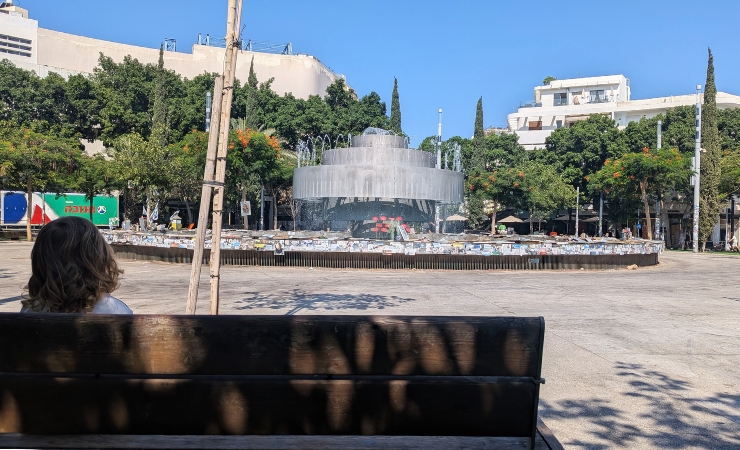
It might sound a little funny but Dizengoff Square is in fact circular in shape. It sits at the geographic and cultural center of Tel Aviv’s White City, the district designated a UNESCO World Heritage Site in 2003 as an outstanding example of early 20th-century urban planning and Bauhaus design. The square is encircled by six near-identical International Style buildings, all designed by architect Genia Averbuch, and anchored by Yaacov Agam’s celebrated Fire and Water fountain. The head of the Bauhaus Foundation Tel Aviv has described it as “the heart of the White City and probably the only real Bauhaus square all over the globe”.
The square is named in memory of Zina (Tzina) Dizengoff, wife of Meir Dizengoff, Tel Aviv’s first mayor, who served from 1922 to 1936. The Hebrew slang verb l’hizdangef — literally “to Dizengoff,” meaning to stroll leisurely along this artery, was coined as a testament to the square’s deep place in Tel Aviv’s everyday culture.
Historical Background
The square was designed by Genia Averbuch, who won a municipal design competition in 1934, a remarkable achievement given that she was one of the only women practising architecture in Mandatory Palestine at the time. Averbuch designed both the plaza itself and the facades of all six surrounding buildings, applying the hallmarks of the International Style: clean horizontal lines, rounded edges, flat roofs, and ribbon-like curved balconies with deep overhangs to shade residents from the Mediterranean sun.
By the 1970s, however, rising vehicular traffic had degraded the square’s original function. In 1978, architect Tsvi Lissar redesigned the site, elevating the plaza above street level on a split-level concrete platform. The elevated square remained in use for nearly four decades, though critics increasingly viewed the concrete platform as an urban eyesore that had severed the plaza from the surrounding city. Then, in 1986, Israeli kinetic artist Yaacov Agam installed his landmark Fire and Water fountain at the center of the elevated square, a donated gift to the city combining rotating rings, colorful geometric panels, water jets, fire bursts, and synchronised lighting. The fountain became one of the most recognised symbols of Tel Aviv almost immediately.
In 2016 the Tel Aviv municipality voted to demolish the concrete platform and restore the square to street level. This was completed in 2018.
The Result of a Silly Dispute
The Agam fountain was craned back into place in July 2018, but it came back bare. A long dispute between the artist and the municipality over the colours meant the vivid geometric panels — the whole point of the work — were never reinstalled. The city said it was waiting on Agam’s authorisation. Agam said the changes had gutted his vision. Neither of them blinked, and the fountain sat there grey while they didn’t.
I grew up with that fountain in colour. It turned, it played music, it threw water and fire, and you could stand in one spot and watch the whole thing change as you shifted your weight. Now I bring people to this square and I find myself apologising for it. A grey skeleton of the most joyful object this city ever built.
Agam died in June 2026, at 98. The argument is still going, now with his estate. Every time I walk past I think the same thing: someone will fix this eventually, and he won’t be here to see it.
Inside Dizengoff Square Tel Aviv: What to See
Since the 2018 renovation, Dizengoff Square has recovered much of the airy, pedestrian-oriented character that Genia Averbuch envisioned in 1934. The ground-level circular plaza is shaded by palms, lined with benches, and threaded by a cycling path — a deliberate contrast to the concrete elevated platform that stood here for forty years. Visitors arriving from Dizengoff Street step directly into the ring of Bauhaus buildings, with the Agam fountain visible at the centre, and the surrounding cafés and market stalls creating a sense of everyday urban life that was largely lost during the elevated-platform era.
The Circular Plaza and Roundabout — The restored ground-level plaza sits at the meeting point of six streets, returning the square to the roundabout layout that earned it the nickname the Étoile of Tel Aviv in the 1930s. Benches face inward toward the fountain, lawns fill the gaps between paths, and a dedicated cycling lane circles the perimeter. The geometry of the space, a pure circle surrounded by curved buildings, is immediately legible in a way the elevated concrete platform never was. Standing at the centre, you can see Dizengoff Street extending north and south, framed on both sides by the white-plastered facades of the Averbuch ring buildings.
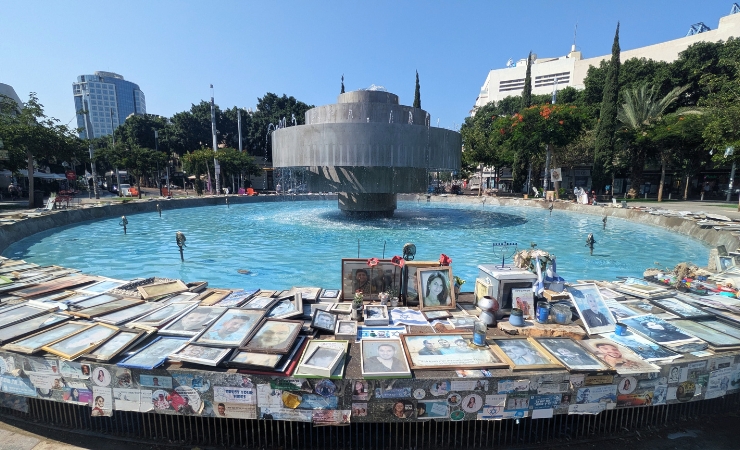
The Fire and Water Fountain (Yaacov Agam) — Yaacov Agam’s kinetic sculpture remains the visual anchor of Dizengoff Square, installed originally in 1986 and reinstalled following the 2018 renovation. The fountain operates as a timed performance: water jets arc from its base, programmed flames rise at intervals, and coloured lights play across the rotating geometric rings. As mentioned before, the fountain currently operates without the brightly coloured geometric panels that defined Agam’s original design.
Around the fountain you can see pictures of Israelis murdered in the October 7th attack as well as those of fallen soldiers who have been killed in Iron Swards war that followed. Find the time to remember them. It is important.
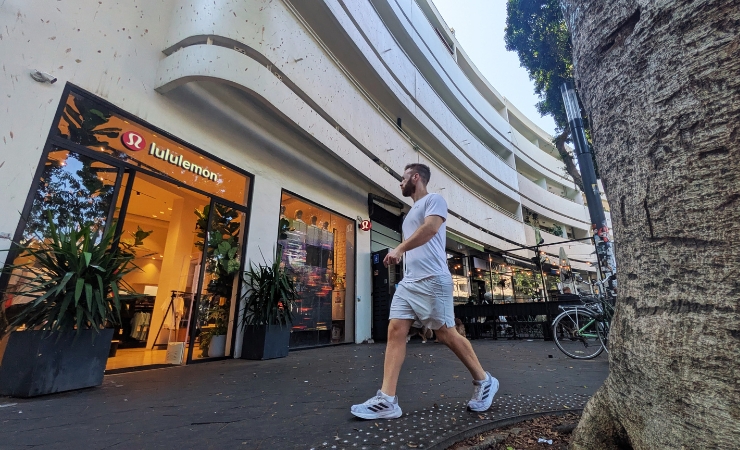
The International Style Ring Buildings — The six buildings encircling the square were all designed by Genia Averbuch as part of a single, unified composition, an approach almost without parallel in the White City. Their flat roofs, white-plastered walls, horizontal ribbon balconies, and rounded corner facades are the physical vocabulary of the International Style as it was practised in 1930s Tel Aviv.
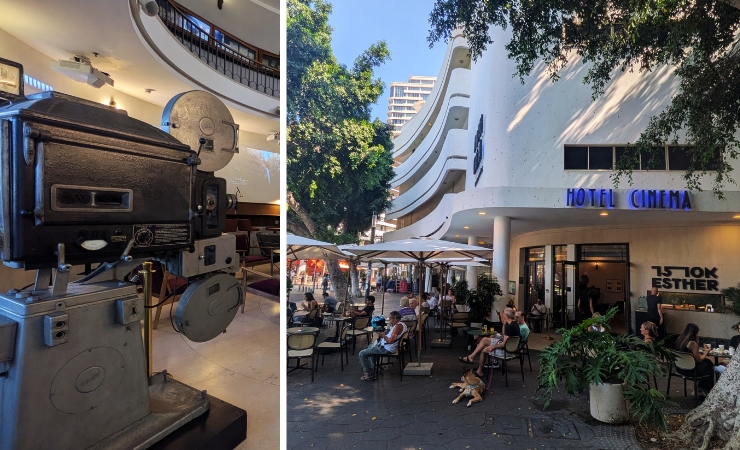
Cinema Hotel (former Esther Cinema) — At the foot of the square stands one of the most celebrated architectural restorations in Tel Aviv. The building was originally constructed in 1939 as the Esther Cinema, the first and largest cinema in Tel Aviv, with 1,000 seats, owned by a Yemeni immigrant family. The cinema eventually closed, and the building was restored and converted into the boutique Cinema Hotel in 2001. Walk into the lobby, nobody will stop you. There’s an original projector from the 1940s standing there, and old films from the period playing on the walls. It’s a lovely throwback, and it takes about two minutes.
Bauhaus Centre Tel Aviv — A short walk from the square at 77 Dizengoff Street, the Bauhaus Centre Tel Aviv offers the most structured introduction to the White City available to visitors. The centre hosts permanent and rotating exhibitions on International Style architecture, runs a specialist bookshop, and organises guided White City walking tours in English, Hebrew, French, and German. Tours depart from Dizengoff Square itself every Friday and Sunday at 10:00 AM, making the square the natural starting point for any serious architectural exploration of the district.
Creative Artists’ Fair and Friday Market — On Tuesdays and Fridays, the square hosts a Creative Artists’ Fair where local makers sell ceramics, jewellery, glasswork, and painting directly from their stalls. Friday mornings in particular bring a farmers’ market, street performers, and a density of visitors that reflects the square’s longstanding role as a social gathering point.
Visiting Dizengoff Square Tel Aviv: Practical Information
Dizengoff Square is a public open space in central Tel Aviv, accessible at all hours and free to enter.
The Agam Fire and Water fountain operates on a timed schedule; the fire and lighting effects are best seen after dark. The Bauhaus Centre at 77 Dizengoff Street is open Sunday to Thursday from 10:00 AM to 7:30 PM, Friday from 10:00 AM to 2:30 PM, and is closed on Saturdays. Guided White City walking tours depart from Dizengoff Square every Friday and Sunday at 10:00 AM.
Additional Information
- Tel Aviv Dismantles Dizengoff Square – ISRAEL21c — Detailed account of the 2017 demolition of the elevated square and the $15 million renovation project to return it to ground level; covers the history of the Agam fountain and the Hebrew slang ‘l’hizdangef.’
- Iconic Agam Fountain to be Moved from Dizengoff Square – Times of Israel — Reports on the NIS 60 million renovation decision, the removal of the Agam fountain for temporary storage, and the restoration plan.
- Dizengoff Square – Wikipedia — Comprehensive encyclopedic overview of the square’s history from 1934 inauguration through the 1978 elevation, the 1986 Agam fountain, and the 2016–2018 renovation.
- Britannica – Dizengoff Street — Britannica reference entry describing Dizengoff Square as a circular plaza and Tel Aviv’s focal point since the 1930s and its subsequent urban decline.
What is the significance of Dizengoff Square within Tel Aviv’s White City?
Dizengoff Square is considered the centrepiece of Tel Aviv’s White City, which was designated a UNESCO World Heritage Site in 2003. The UNESCO coordinates for the White City World Heritage Property are centred on the square itself. All six buildings encircling the plaza were designed by a single architect, Genia Averbuch, as a unified Bauhaus composition — a level of coherence rare anywhere in the White City. The head of the Bauhaus Foundation Tel Aviv has called it “probably the only real Bauhaus square all over the globe,” distinguishing it from other International Style districts where buildings were constructed piecemeal over time rather than as a planned ensemble.
Who was Zina Dizengoff, and why is the square named after her?
Zina (Tzina) Dizengoff was the wife of Meir Dizengoff, Tel Aviv’s first mayor, who served from 1922 to 1936. The square was built in her memory following her death, and its official Hebrew name is כִּכָּר צִינָה דִיזֶנְגוֹף (Kikar Tsina Dizengoff). Meir Dizengoff was a prominent Zionist leader central to Tel Aviv’s founding and was closely associated with the square’s early cultural life — he famously led the annual Adloyada Purim carnival parade through the surrounding streets, riding at its head on horseback. The street running through the square bears his own name rather than hers, creating an unusual situation where husband and wife are commemorated by adjacent landmarks.
What happened to Dizengoff Square in 1978, and why was the elevated platform demolished?
In 1978, architect Tsvi Lissar redesigned the square by raising it above street level on a split-level concrete platform to ease vehicular traffic congestion below, allowing Dizengoff Street, Pinsker Street, and Reines Street to pass underneath by car. The platform stood for nearly forty years but was widely criticised for physically disconnecting the plaza from the surrounding city and disrupting the original Bauhaus spatial logic of the square. In 2016, the Tel Aviv municipality voted to demolish it and restore the square to ground level at a cost of approximately NIS 60 million (around $15 million USD). Demolition began in January 2017, and the restored street-level square was completed in 2018.
Is the Agam Fire and Water Fountain currently operating in its original form?
The fountain was reinstalled after the 2018 renovation but is not currently displayed in its original form. Yaacov Agam’s 1986 design featured brightly coloured geometric panels alongside the kinetic rotating rings, water jets, fire bursts, and synchronised lighting. Following the renovation, a dispute between Agam’s estate and the Tel Aviv municipality over how the original colours should be restored meant the fountain was returned to the public without those coloured panels. The kinetic and pyrotechnic elements — water, fire, and light — do operate on a timed schedule, and the fountain remains a visually striking presence, particularly after dark when the fire and lighting effects are most dramatic.
When is the best time to visit Dizengoff Square?
Friday mornings between approximately 9:00 AM and 1:00 PM are the liveliest time to visit the square, when a farmers’ market, the Creative Artists’ Fair, and street performers converge on the plaza simultaneously. This also coincides with the Bauhaus Centre’s guided White City walking tour, which departs from the square at 10:00 AM every Friday. For the Agam fountain’s fire and lighting display, an evening visit is far more rewarding than a daytime one, since the fire jets and coloured lighting are substantially more visible after dark. Tuesday mornings also bring the Creative Artists’ Fair, with local ceramics, jewellery, glass, and painting on sale around the plaza.
Is there an admission charge to enter Dizengoff Square, and how do I get there?
Dizengoff Square is a free public plaza with no admission charge and no restricted opening hours. The square is located in central Tel Aviv at the intersection of Dizengoff Street, Reines Street, and Pinsker Street. Multiple Tel Aviv city bus routes stop along Dizengoff Street within metres of the square, making it straightforwardly accessible by public transport from anywhere in the city. If arriving by car, paid parking is available in surrounding streets and at the Dizengoff Centre car park approximately 300 metres to the south. The Bauhaus Centre at 77 Dizengoff Street, a short walk away, charges a separate admission for its tours and is closed on Saturdays.
Nearby Sites
- Rabin Square — About 600 metres south of Dizengoff Square, Rabin Square is Tel Aviv’s largest public plaza and the city’s main venue for political rallies, concerts, and public events. I
- Rothschild Boulevard — One of Tel Aviv’s most architecturally significant streets. The boulevard is walkable, tree-shaded, and dotted with cafés.
- Habima National Theatre — Israel’s national theatre and remains the country’s most prominent performing arts venue, staging productions in Hebrew year-round.
- Tel Aviv Museum of Art — Holds the largest collection of Israeli art in the world alongside significant holdings of Impressionist, post-Impressionist, and contemporary international work.
Keep reading
Part of our Tel Aviv & Jaffa Guide →