St. Gerasimus Monastery, located near the Jordan River in the Judean Desert, is one of the region's oldest monasteries, dating to the 5th century CE. Founded by St. Gerasimus, it became famous for the legend of a lion befriended by the saint. The active Greek Orthodox monastery preserves ancient traditions and desert monasticism history.
Just a few kilometers from the Jordan River, sits one of the region’s oldest and most storied monasteries: the Saint Gerasimus Monastery, or as it’s affectionately known in Arabic, Deir Hajla. Founded in the fifth century by a monk from Lycia, it has survived Persian invasions, earthquakes, centuries of abandonment, and rebuilding, and it remains an active Greek Orthodox monastery to this day.
Location
The St. Garasimus Monastery is located just a few km west of the Jordan River and north of the Dead Sea. It lies in a unique terrain known historically as the “Desert of the Jordan,” a semi-arid plain distinct from the Judean Desert. The site sits in Wadi Nahil, a relatively dry riverbed, offering a peaceful place for contemplation and discovery. It’s also just a short ride from Qasr al-Yahud, the traditional site of Jesus’ baptism.


The Site’s History
St. Gerasimus and the Lavra Life
Born in Lycia in Anatolia, Saint Gerasimus was no novice to monasticism when he arrived in the Jordan Valley. After attending the Fourth Ecumenical Synod at Chalcedon in 451 CE, he went on to become the founder and spiritual leader of monasticism in the wilderness of the Jordan. In 455 CE, he established a lavra—a kind of halfway point between hermitic isolation and communal monasticism.
Here’s how it worked:
Monday to Friday, monks lived in small, rock-hewn cells, scattered across the desert.
Saturday and Sunday, they gathered at the central coinobion (communal monastery) to share a warm meal, pray together, and trade handcrafts and supplies.
This system allowed for both solitude and spiritual companionship—a model that influenced other monastic communities throughout the region, including nearby Choziba Monastery.
Monks under Gerasimus followed strict rules: one cloak, one hood, a mat, a quilt, a pillow, and a single pottery urn for eating and wetting palms. No fires, no candles in their cells.
The Lion Legend
One of the monastery’s most beloved traditions is the story of Saint Gerasimus and the lion. The monk once came across a lion in pain, with a thorn lodged in its paw. Without hesitation, he pulled it out. From that moment on, the lion stayed by his side—protecting him and the monastery. One tale says the lion even rescued a stolen donkey from thieves, dragging it back alongside a camel.
This unusual “novice” became a symbol of loyalty, humility, and the surprising gentleness of even the wildest creatures.
The Lavra of Calamon
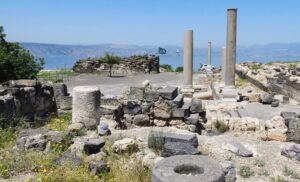
Around the same time Gerasimus built his community, another lavra—Laura of Calamon (Laura of the Reed Bush)—was established nearby, likely named for the reeds growing around ‘Ein Hajla. It’s tentatively identified near the current monastery, adding another layer of early Byzantine life to the site.
Destruction and Revival
614 CE: The Persian conquest devastated monastic life here. The monastery was destroyed and its monks massacred. Their bones now lie in the monastery’s crypt.
640 CE: The Arab conquest followed. Though the monastery was rebuilt, the broader monastic movement never fully recovered.
Crusader Period (1099 CE onward): Crusaders restored Deir Hajla. Pilgrim Abbot Daniel described it as the “monastery of the Holy Virgin at Kalamoniya,” housing 20 monks and a miraculous icon believed to have been painted by Luke the Evangelist. That icon is now preserved at the Greek Orthodox Patriarchate in Jerusalem.
Ottoman Period (16th–19th centuries): The monastery passed through different hands, including monks of the Order of St. Basil in 1522. Rebuilt in 1588, it later fell into ruin again. In the 1870s, the PEF’s Survey of Western Palestine described it as “an important ruin,” filled with fragments of marble mosaics and faint frescoes.
Modern Era (1875–1890): Greek monks from Mar Saba took over and began major renovations. Despite an earthquake in 1837, they restored the monastery by 1890. The current complex is largely the result of their efforts.
1960s onward: The monastic buildings received significant mid-century reconstruction—especially living quarters and guest areas—to support monks’ life and visiting pilgrims.
Post-1990s: Modern amenities like guest housing, artistic workshops, and new mosaics were added, revitalizing the monastery’s role as both spiritual retreat and active pilgrimage destination.
What Can Be Found at the Site
Here’s what you’ll find:
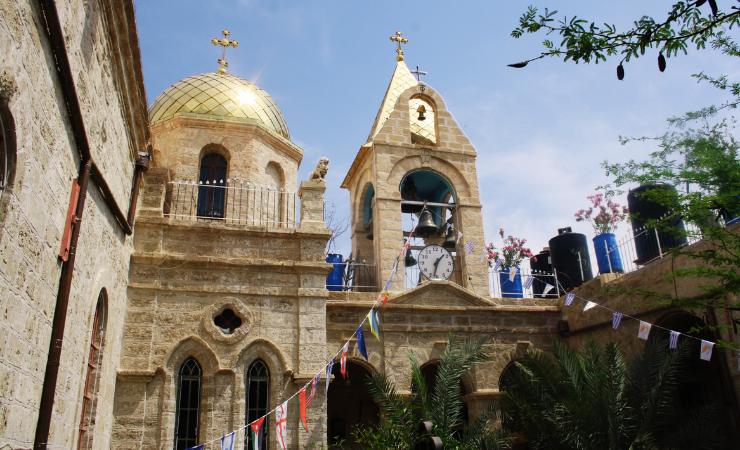
Surrounding wall enclosing the monastery, complete with the flags of Greece and the Orthodox Church.
Statue of a lion in the yard, honoring the famous story of St. Gerasimus and his four-legged companion.
- A peaceful inner courtyard surrounded by pale stone buildings. In the center is a well that taps into an ancient underground cistern—still functional.
- A bell tower built in 1952 rises above the complex.
The main church, located on the second floor. A luminous space crowned with a metal-coated dome. Consists of thick stone columns and walls covered in vibrant frescoes—some dating back to the Crusader era, others painstakingly restored in the 20th century. An ornate iconostasis (icon screen) separates the sanctuary from the nave, decorated with gilded icons of saints, biblical scenes from the Jordan Valley, and depictions of Mary and Jesus.
A crypt located beneath the church. Here you’ll find:
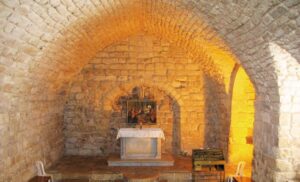
Cabinets with the remains of monks martyred during the Persian invasion of 614 CE and the devastating earthquake of 1837.
A painting of the Holy Family, with Mary nursing Jesus—a tender nod to the tradition that they paused here on their flight to Egypt.
Fragments of a 6th-century mosaic still visible on the floor.
Practical Information
St. Gerasimus Monastery is open to visitors and pilgrims daily, generally from early morning until early afternoon, with a midday break observed by the monks.
Entry to the monastery grounds is free of charge. No admission fee is collected, though donations are welcomed and help maintain the complex.
Modest dress is required for all visitors. Shoulders and knees must be covered; long skirts or trousers and a shawl or covering for the upper arms are expected inside the church. The monastery typically provides coverings for visitors who arrive underprepared, but bringing your own is courteous.
Additional Information
4th Century AD:
- 251-356 AD: Anthony “the Great” operates in the Egyptian desert, regarded as the father of all desert dwellers. He inspires the hermitic lifestyle that influences Judean Desert monasticism.
- Late 4th Century AD: Individual Christian hermits begin to settle in the “Desert of the Jordan,” marking the initial stages of monasticism in the area.
- 406 AD: Euthymius from Melitea, Armenia arrives in the Holy Land as a pilgrim and joins the Laura of Faran.
5th Century AD:
- 451 AD: Gerassimos (from Lycia, Anatolia), an abbot of 70 monks, attends the Fourth Ecumenical Synod at Chalcedon. He initially opposes but later supports its decisions.
- 455 AD: Gerassimos founds a new type of Laura, establishing a Coenobium at its center, near the later site of Deir Hajla. This is recognized as the founding date of the Holy Monastery of Saint Gerasimos of the Jordan.
- 460 AD: The original structure of the Monastery of Saint Gerasimos is built.
- 475 AD: Gerassimos dies. His memory is celebrated on March 4th.
6th Century AD:
- Early 6th Century: Monasteries and hermitages in the “Desert of the Jordan” multiply, especially during the reigns of Emperors Anastasius and Justinian.
7th Century AD:
- 614 AD: The Persian army invades Israel, destroying many Christian sites, including the Monastery of Saint Gerasimos, and massacring the monks.
- Circa 640 AD: The Muslim conquest brings an end to the widespread monastic movement in the Judean and Jordan deserts. The Monastery of Saint Gerasimos is restored after the Arab conquest but faces subsequent destruction and rebuilding.
- Early 9th Century: The Monastery of Saint Gerasimos is rebuilt.
- 1099 AD: The Crusaders occupy the Jericho oasis and restore a few abandoned Byzantine monasteries, including Deir Hajla.
- Early 12th Century: Abbot Daniel describes the monastery (then known as “monastery of the Holy Virgin at Kalamoniya”) as having protective walls and around 20 monks. He first mentions the tradition of the Holy Family stopping there.
- 12th Century: The monastery is restored under Patriarch John IX.
- Late 12th Century: The Lavra of Kalamonos is continuously inhabited.
13th Century AD:
- Late 13th Century: The actual monastery founded by Gerasimus (closer to ‘Ein Hajla) is abandoned after the final defeat of the Crusaders. The neighboring monastery at the site of Deir Hajla inherits its name, becoming the “monastery of Gerasimus.”
- 1283 AD: A German pilgrim reports only eight houses in the entire Jericho oasis, likely at ‘Ain Hajla.
- 1295 AD: An inscription in Jerusalem refers to income from “the village of Hajla” (identified with Deir Hajla).
14th Century AD:
- The place is called Bet Agla by Marino Sanuto.
15th Century AD:
- Late 15th Century: The monastery is in ruins and abandoned.
16th Century AD:
- 1522 AD: The site is temporarily inhabited by monks of the Order of St Basil, still known as the convent of Saint Jerome.
- 1588 AD: The monastery is rebuilt.
17th Century AD:
- First half of 17th Century: The monastery is in ruins and abandoned.
18th Century AD:
- The monastery, after being rebuilt in 1588, is destroyed almost a century and a half later.
19th Century AD:
- 1837 AD: A severe earthquake causes significant damage to the monastery.
- 1866-1877 AD: The site is examined during the PEF survey by Wilson, Conder, and Kitchener, appearing as “Kusr Hajlah” on maps.
- 1872-1875 AD: Conder and Kitchener describe the ruins of the medieval monastery, noting the presence of frescoes.
- April 1882 AD: C. R. Conder revisits the site and finds Greek monks from Mar Saba building a new monastery, having scraped off the frescoes.
- 1875 AD: The reconstruction of the monastery is concluded, giving it its current shape.
- 1890 AD: The last comprehensive renovation is carried out following the 1837 earthquake.
Modern Times:
- 2009 AD: The area around the monastery undergoes restorations and hosts a pilgrimage center, becoming open to the public.
- Present Day: The Monastery of Saint Gerasimos (Deir Hajla) continues to operate as a Greek Orthodox monastery.
What is St. Gerasimus Monastery and why is it significant?
St. Gerasimus Monastery, also called Deir Hajla, is a Greek Orthodox monastery in the Jordan Valley founded in 455 CE by Saint Gerasimus of Lycia. It is one of the oldest continuously affiliated monastic sites in the Holy Land and represents the Byzantine lavra system, in which monks balanced solitary desert life during the week with communal worship on weekends. The monastery also holds the tradition that the Holy Family rested on the site during the flight to Egypt, adding a significant layer of Christian pilgrimage meaning.
What is the story of the lion at St. Gerasimus Monastery?
According to a tradition recorded in the seventh-century text Pratum Spirituale by John Moschus, Saint Gerasimus healed a lion by removing a thorn from its paw. The lion then lived at the monastery, working alongside the monks as a helper. When Gerasimus died in 475 CE, the lion reportedly lay down on his grave and died of grief.
What can you see inside St. Gerasimus Monastery?
Visitors can explore the walled courtyard with its ancient water cistern and lion statue, the main church on the second floor with its gilded iconostasis and restored frescoes, and the crypt beneath the church. The crypt contains the bones of monks martyred in the Persian invasion of 614 CE, fragments of a sixth-century Byzantine mosaic floor, and a painting of the Holy Family. The crypt is one of the most moving spaces on the site.
Can I visit St. Gerasimus Monastery and Qasr al-Yahud on the same day?
Yes, and this is one of the most natural pairings in the lower Jordan Valley. The two sites are only a few minutes apart by car. Visiting St. Gerasimus Monastery in the morning, when it is most reliably open, and then continuing to Qasr al-Yahud, the traditional baptism site of Jesus, makes for a full and rewarding half-day. Wadi Qelt and Qumran are also within easy driving distance if you want to extend the day further.
Nearby Sites
- Qasr al-Yahud – Just a short drive east, this is the traditional spot where John baptized Jesus in the Jordan River.
- Wadi Qelt – A stunning desert gorge with trails and views of ancient cliffside monasteries.
- Qumran – The archaeological site where the Dead Sea Scrolls were discovered, revealing secrets of a desert-dwelling Jewish sect.
- Dead Sea – Only minutes away, you can float effortlessly in its salty waters and enjoy a sunset like no other.
Keep reading
Part of our Jordan Valley & Dead Sea Guide →