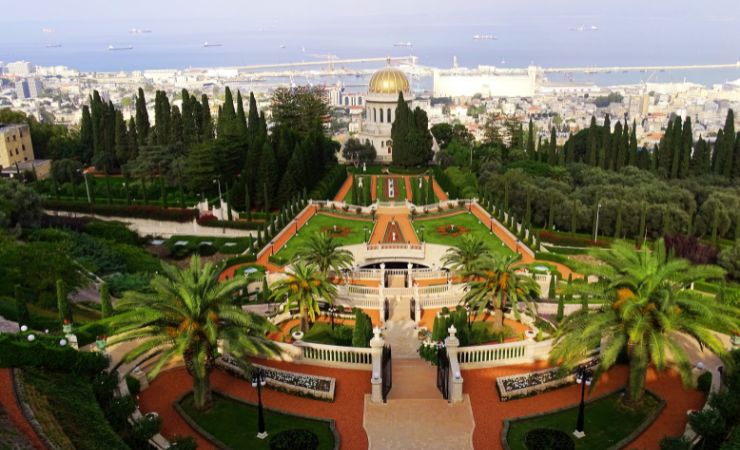
The Baháʼí Gardens in Haifa house the Baháʼí World Centre and were designated a UNESCO World Heritage Site in 2008 for their outstanding universal value. The terraced gardens feature 19 levels ascending Mount Carmel, incorporating Persian garden design principles with immaculate landscaping, geometric patterns, and the golden-domed Shrine of the Báb at their center.
An Introduction to the Bahá’í Faith
The Baháʼí Faith began in mid-19th-century Persia and today counts more than six million adherents across virtually every country on earth. Founded by Baháʼuʼlláh (1817 to 1892), whose name means “Glory of God” in Arabic, it teaches the oneness of God, the oneness of Faith, and the oneness of humanity, a message whose physical monuments you can walk through in Israel right now.
Who Founded the Baháʼí Faith?
The Baháʼí Faith grew out of the earlier Bábí movement. In 1844, a young merchant from Shiraz known as the Báb, born Siyyid ʻAlí-Muhammad in 1819, announced he was the promised Qáʼim awaited by Shia Muslims. The claim drew thousands of followers and violent opposition in equal measure.
Between 1844 and 1850, an estimated 20,000 Bábís were killed in systematic persecutions. The Báb himself was imprisoned, interrogated, and beaten before his public execution by firing squad in Tabriz on July 9, 1850. Baháʼí accounts record that the first volley cut only the ropes binding him, and soldiers found him back in his cell finishing a conversation with a disciple. A second firing squad completed the execution. His remains were hidden for fifty years, then transported to the Holy Land in 1899.
Baháʼuʼlláh, born Mírzá Husayn-ʻAlí Núrí into a wealthy northern Persian family, became a prominent supporter of the Báb and paid for it with imprisonment and exile. In 1852, chained inside the notorious Síyáh-Chál (Black Pit) dungeon in Tehran, he experienced what Baháʼís regard as his divine revelation. Released but banished, he spent ten years in Baghdad before the Ottoman Sultan summoned him to Constantinople (Istanbul). In 1868 he was exiled to the prison city of Akko, then part of Ottoman Syria, where he remained for the final 24 years of his life.
Despite confinement, he wrote prolifically. His Kitáb-i-Aqdas (Most Holy Book) sets out the fundamental laws and principles of the faith. His burial site at Bahjí, just north of Akko, became the Qiblih, the direction Baháʼís worldwide face in prayer.
What Does the Baháʼí Faith Believe?
Three core principles define the Baháʼí Faith: the oneness of God, the oneness of faith, and the oneness of humanity. Baháʼís hold that Abraham, Moses, Jesus, Muhammad, and other prophets each brought authentic revelation from the same divine source, calibrated to the needs of their era. Baháʼuʼlláh represents the most recent such manifestation for this age, a concept the faith calls progressive revelation.
Social teachings follow from those principles. The faith calls for the elimination of all prejudice, full equality of men and women, harmony between science and religion, and a global federal system of governance. This vision of the “Most Great Peace” includes a universal auxiliary language, international tribunals for conflict resolution, and economic structures that reduce extremes of wealth and poverty. Universal education, especially for women, on the grounds that educated mothers raise peace-minded generations, is central to Baháʼí community life.
What Symbols Define the Baháʼí Faith?
Sacred geometry and numerology run through Baháʼí architecture and garden design. The number 19 appears in the Baháʼí calendar of 19 months of 19 days each, plus four or five intercalary days. It also determines the 19 terraces of the gardens in Haifa, representing the Báb and his 18 disciples, the “Letters of the Living.” The number derives from the Arabic word “Wáhid” (unity), which equals 19 in the abjad letter-numeral system.
The nine-pointed star is the faith’s most recognized symbol. Nine, the highest single digit, represents completion and new beginning. In the garden plan, nine circles radiate symmetrically from the central axis of the Shrine of the Báb. The five-pointed star, the faith’s official emblem, represents the human body with arms and legs outstretched, signifying humanity’s relationship to the divine. Both symbols carry the Baháʼí theme of unity within diversity.
What Baháʼí Holy Sites Can You Visit in Israel?
Haifa (The Baháʼí Gardens)
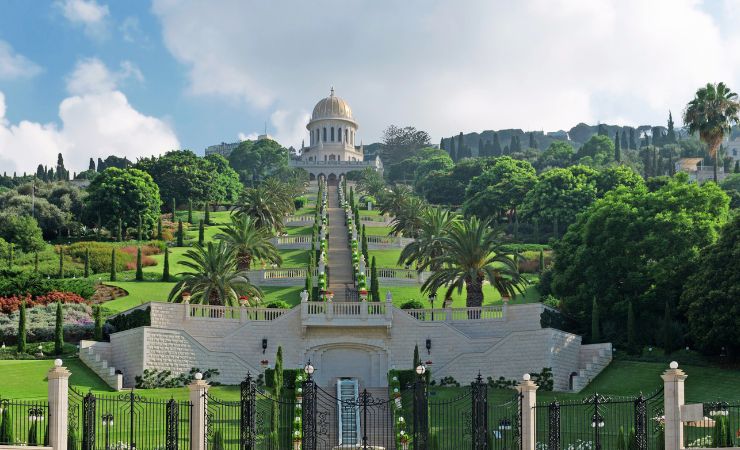
Shrine of the Báb and Terraced Gardens — Nineteen terraces climb Mount Carmel to the golden-domed shrine that holds the remains of the Báb, the faith’s herald; standing at the base and looking up the full length of the cascade is the view most visitors photograph first. The gardens are free and open to everyone; the shrine interior is reserved for Baháʼí pilgrims. Haifa’s single most-visited attraction, it draws roughly 750,000 visitors per year and earned UNESCO World Heritage status in 2008.
Baháʼí World Centre (the Arc) — The faith’s global administrative headquarters sits on Mount Carmel and includes the Seat of the Universal House of Justice, fronted by a long neoclassical colonnade whose white limestone columns are visible from the port below. The buildings are closed to tourists, though the surrounding Arc gardens can be viewed from outside. This is where the elected nine-member body that governs the worldwide Baháʼí community holds its sessions.
Acre (Akko) and Western Galilee
Shrine of Baháʼuʼlláh at Bahjí — Located just north of Acre, this is the holiest site in the Baháʼí Faith and the Qiblih, the point every Baháʼí faces during obligatory prayer. Formal gardens surround the shrine and are open to all visitors; the interior is for pilgrims only.
Mansion of Bahjí — The house beside the shrine where Baháʼuʼlláh spent his final years and died in 1892 is preserved with its original furnishings, giving the rooms a quiet, inhabited feel even now. Access is mainly arranged for Baháʼí pilgrims, so confirm arrangements before visiting.
House of ʻAbbúd (Akko Old City) — Inside the walled old city, this is where Baháʼuʼlláh lived after his release from strict confinement and where he wrote the Kitáb-i-Aqdas, the faith’s central book of laws. Open primarily to Baháʼí pilgrims.
House of ʻAbduʼlláh Páshá (Akko) — A later residence of ʻAbduʼl-Bahá, Baháʼuʼlláh’s son and successor, who received the first Western pilgrims here in rooms that have since been restored as a holy place. General public access is limited; contact the Baháʼí authorities in advance.
Mazraʼih Mansion and Ridván Garden — Mazraʼih, north of Acre, was the first home Baháʼuʼlláh occupied around 1877 after years confined inside the prison city; the Ridván Garden, a small island garden he called his “Verdant Isle,” was a place he cherished late in life. Both are maintained primarily as pilgrimage sites set within gardens.
Upcoming Baháʼí and Related Religious Observances
The Baháʼí calendar marks key holy days including the Festival of Ridván (April 21 to May 2), commemorating Baháʼuʼlláh’s declaration in 1863, and the Martyrdom of the Báb on July 9. Visitors planning a trip around religious observances should also be aware of nearby Islamic holidays such as Mawlid al-Nabi, which celebrates the birth of the Prophet Muhammad and falls on a different Gregorian date each year due to the lunar calendar.
Additional Information
What exactly is the Baháʼí Faith?
The Baháʼí Faith is a monotheistic faith founded in mid-19th-century Persia by Baháʼuʼlláh (1817 to 1892). It teaches the oneness of God, the oneness of all major religions, and the oneness of humanity, with more than six million followers spread across virtually every country today.
Is the Baháʼí Faith basically Islam?
No. The Baháʼí Faithemerged from a Shia Islamic context but is a fully independent faith. It recognizes Muhammad as a prophet yet goes further, accepting Baháʼuʼlláh as a later divine manifestation. Islamic law does not govern Baháʼí practice, and most Muslim authorities do not regard Baháʼís as Muslim.
Do Baháʼís believe in God?
Yes. Baháʼís are monotheists who believe in one unknowable God, the source of all creation. They hold that every major world religion, including Judaism, Christianity, Islam, and others, originates from that same God, with each prophet bringing revelation suited to his time.
What religion is the Baháʼí Faith most like?
Scholars often compare it to Islam in structure and to the Baháʼí concept of progressive revelation, which echoes ideas in both Islam and Christianity. Its emphasis on social justice and unity also parallels Quaker and Unitarian traditions. It remains doctrinally distinct from all of them.
How many wives can a Baháʼí man have?
The Kitáb-i-Aqdas permits a maximum of two wives, but only if both are treated with complete equality, a condition Baháʼí authorities acknowledge is virtually impossible to meet. In practice, monogamy is the standard the faith promotes and expects of its members.
What is the Baháʼí nine-pointed star?
The nine-pointed star is the Baháʼí Faith’s most recognized symbol. Nine, the highest single digit, represents completion. In Haifa’s garden plan, nine circles radiate from the Shrine of the Báb. The five-pointed star is the faith’s official emblem, representing the human body in relation to the divine.
Keep reading
Part of our Galilee & Northern Israel Guide →