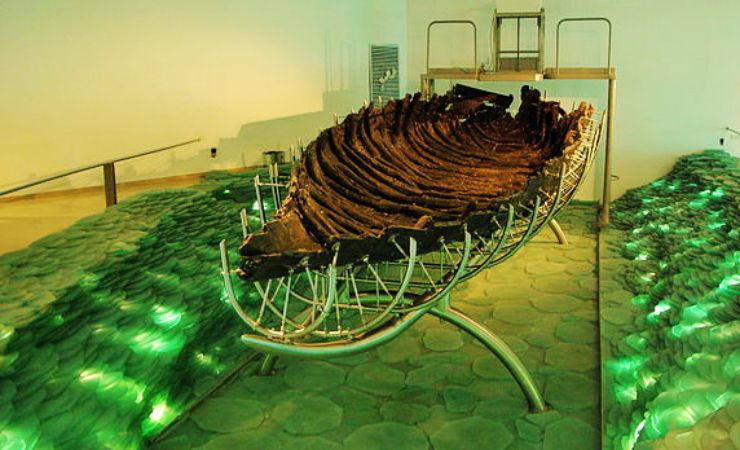
The "Jesus Boat" is a 2,000-year-old fishing vessel discovered in 1986 in the Sea of Galilee mud during a drought. Dating to the 1st century CE, this 27-foot wooden boat represents the type used by fishermen during Jesus's time. It is displayed at the Yigal Allon Museum at Kibbutz Ginosar on the northwestern shore of the Sea of Galilee.
In January 1986, two brothers walking along a receding shoreline spotted a faint oval outline pressed into the mud of the Sea of Galilee. What they had found was a 2,000-year-old wooden fishing boat, now known as The “Jesus Boat,” and it has drawn pilgrims, historians, and curious travelers to Kibbutz Ginosar ever since.
Where Is The "Jesus Boat" Located?
The “Jesus Boat” is displayed at the Yigal Allon Museum (also called the Yigal Allon Center) at Kibbutz Ginosar, on the northwestern shore of the Sea of Galilee. The museum sits approximately 210 meters below sea level, just steps from the water where the boat was originally found. The vessel rests inside a specially designed, climate-controlled pavilion built solely to preserve it.
How Was The "Jesus Boat" Discovered?
The discovery happened in January 1986, during one of the worst droughts in the region’s modern history. As the Sea of Galilee dropped to its lowest level in decades, the muddy lakebed began to expose artifacts buried for nearly 2,000 years.
Brothers Moshe and Yuval Lufan, local fishermen from Kibbutz Ginosar, spotted the boat’s outline protruding from the dried mud near the ancient site of Magdala, the hometown of Mary Magdalene. They contacted archaeologists immediately. The Israel Department of Antiquities launched an urgent, around-the-clock excavation before the lake waters returned.
The extraction took 11 days. Archaeologists injected polyurethane foam into the waterlogged hull to stabilize it, then removed the boat in sections using methods borrowed from underwater archaeology. The oxygen-poor sediment of the lake had kept the wood intact for two millennia.
The Biblical Connection
The Sea of Galilee, called Lake Kinneret in Hebrew, measures 21 kilometers long and 13 kilometers wide. Its shores are the setting for some of the most recognized moments in the Gospels: Jesus walking on water, calming a storm, performing a miraculous catch of fish, and calling his first disciples, all of them fishermen who worked these same waters.
And when he got into the boat, his disciples followed him. And behold, there arose a great storm on the sea, so that the boat was being swamped by the waves; but he was asleep. And they went and woke him, saying, ‘Save us, Lord; we are perishing.’ And he said to them, ‘Why are you afraid, O you of little faith?’ Then he rose and rebuked the winds and the sea, and there was a great calm. And the men marveled, saying, ‘What sort of man is this, that even winds and sea obey him?
The boat was found in the area ancient sources call Gennesaret, the exact location where the Gospels record Jesus and his disciples landing after his walk on water. No direct evidence links this specific vessel to Jesus or his disciples, but radiocarbon dating and pottery analysis confirm its construction between 100 BCE and 70 CE, squarely within Jesus’s lifetime. The discovery location near Magdala adds another layer: recent excavations there have uncovered a first-century synagogue and harbor installations that paint a detailed picture of life on the lake during the same era.
What Can Be Seen at the Yigal Allon Museum?
The Boat Itself — The centerpiece of the museum measures 8.27 meters long, 2.3 meters wide, and 1.25 meters high. Standing at eye level beside the hull, you can trace every patch and repair made by ancient hands over decades of hard use. The wood retains a dark, waterlogged color that makes the vessel look as though it was pulled from the lake last week rather than two thousand years ago.
Hull Construction and Joinery — The boat was built primarily from cedar planks set over oak frames, fastened with mortise-and-tenon joints secured by iron nails. Archaeologists identified at least 12 different types of wood in the hull, including reused timber recycled from older boats. The patchwork reflects the economic pressures of first-century Galilee, where nothing was wasted.
Artifacts Found Inside the Boat — Excavators recovered a small oil lamp of distinctly first-century Jewish design and a large storage jar typical of the period. These objects suggest the boat’s crew spent long shifts on the water, eating meals and fishing by lamplight through the night. Both artifacts are displayed alongside the vessel.
Capacity and Crew Layout — Interpretive panels explain that the boat accommodated four rowers in staggered positions, plus space for a mast and sail. As a fishing vessel it could carry a crew of five and a catch of up to 450 kilograms. Configured as a passenger ferry, it could transport as many as 15 people, details that align with Gospel accounts of Jesus traveling across the lake with his disciples and additional followers.
The Yigal Allon Center Context — The museum is part of the broader Yigal Allon Center (Beit Yigal Allon), an educational complex at Kibbutz Ginosar named for Israeli general and politician Yigal Allon. Beyond the boat pavilion, the center houses exhibitions on the history and archaeology of the Galilee region, offering context for what daily life looked like around the lake two thousand years ago.
Replica and Interpretive Film — A short documentary film screened at the museum tells the full story of the discovery and the painstaking 11-day excavation. The film brings the tension of that race against time to life, showing archival footage of the extraction operation and interviews with the Lufan brothers and the archaeologists who worked the site.
Practical Information for Visiting
The Yigal Allon Museum is open Sunday through Thursday from 8:00 AM to 5:00 PM, and Friday and Saturday from 8:00 AM to 4:00 PM.
The museum is wheelchair accessible, has adequate parking, and offers audio guides in multiple languages for an additional fee.
Additional Information
Danny the Digger
Jesus Boat official website offers comprehensive historical background.
Early Church History resources.
Where is The “Jesus Boat” now?
The “Jesus Boat” is displayed at the Yigal Allon Museum at Kibbutz Ginosar, on the northwestern shore of the Sea of Galilee, approximately 210 meters below sea level. It rests inside a climate-controlled pavilion built specifically to preserve the 2,000-year-old wooden hull.
When was the Jesus Boat discovered at the Sea of Galilee?
The Jesus Boat was discovered in January 1986 by two local fishermen brothers during an exceptional drought that lowered the Sea of Galilee’s water level. The vessel was found buried in the muddy lakebed near the ancient site of Magdala after being preserved underwater for nearly 2,000 years.
How do we know the Jesus Boat dates from the time of Jesus?
Radiocarbon dating and pottery analysis confirm the boat’s construction between 100 BCE and 70 CE, making it contemporaneous with Jesus’s lifetime. The construction techniques, wood types, and associated artifacts all correspond to first-century CE craftsmanship and daily life around the Sea of Galilee.
Where can visitors see the Jesus Boat today?
The Jesus Boat is displayed at the Yigal Allon Museum in Kibbutz Ginosar on the northwestern shore of the Sea of Galilee. The boat is housed in a specially designed climate-controlled pavilion that maintains optimal conditions for preserving the 2,000-year-old wood.
What makes the Jesus Boat so significant for Christian pilgrims?
While there’s no direct evidence linking this specific boat to Jesus, it represents the exact type of vessel that Jesus and his disciples would have used daily. The boat provides tangible evidence of maritime life during Jesus’s ministry and was discovered near sites mentioned in the Gospels, offering pilgrims a physical connection to biblical times.
How large was the Jesus Boat and what was it used for?
The boat measures 8.27 meters long, 2.3 meters wide, and 1.25 meters high. It was designed as a multi-purpose vessel that could serve as a fishing boat carrying five crew members and up to 450 kilograms of fish, or as a passenger ferry transporting up to 15 people across the Sea of Galilee.
What artifacts were found inside the Jesus Boat?
Archaeologists discovered a first-century Jewish oil lamp inside the boat and a large storage jar nearby. These artifacts suggest the boat was used by working fishermen who spent long hours on the water, eating meals and working by lamplight during night fishing expeditions.
Nearby Sites
- The Synagogue at Magdala: This is one of the oldest synagogues in the world, dating back to the first century, and is located in the ancient town of Magdala, the hometown of Mary Magdalene.
- Church of Beatitudes: Situated on the Mount of Beatitudes, this Roman Catholic church designed by Antonio Barluzzi is believed to be the location where Jesus delivered the Sermon on the Mount.
- Capernaum: Known as the town of Jesus, Capernaum is an ancient fishing village on the northern shore of the Sea of Galilee where Jesus lived and preached.
- The Church of the Multiplication: Located in Tabgha, this modern church is built on the site of 4th and 5th-century churches and commemorates the biblical miracle of the multiplication of the loaves and fishes.
Keep reading
Part of our Christian Pilgrimage Guide →