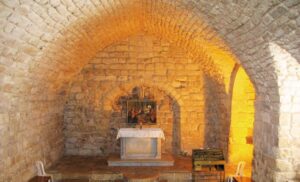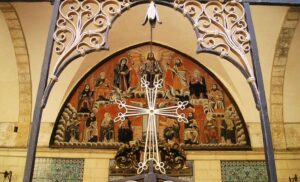
The Convent of the Sisters of Zion is a Roman Catholic establishment in Jerusalem's Old City, founded in 1857. It houses the Church of Ecce Homo (1862), named after Pontius Pilate's declaration "Behold the Man." The complex preserves ancient Roman pavement and architectural remains from the Second Temple period.
The Convent of the Sisters of Zion is a Roman Catholic establishment founded in 1857 by Marie-Alphonse Ratisbonne, a French Jewish convert to Catholicism. The convent encompasses the Church of Ecce Homo, founded in 1862, also known as the Basilica of Ecce Homo that derives its name from Pontius Pilate’s “Ecce homo” speech (Latin for “Behold the man”), believed to have taken place on the stone pavement below the church. The site preserves remarkable remains of Hadrian’s second-century Roman architecture alongside one of Christianity’s most significant pilgrimage destinations.
Location
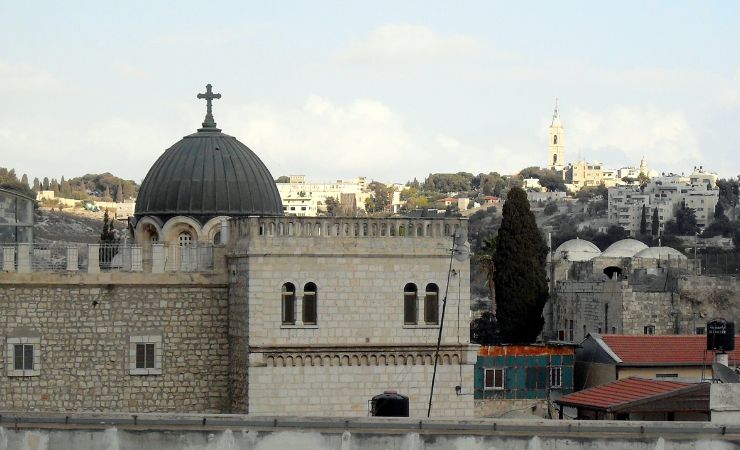
The Convent of the Sisters of Zion occupies a prime position along the Via Dolorosa in Jerusalem’s Old City Jerusalem’s history, approximately 200 meters from the Lion’s Gate. The complex sits at the intersection of the Via Dolorosa and the northern continuation of the Tyropoeon Valley road, placing it within walking distance of the Church of Flagellation and St. Anne’s Church. This strategic location marks the second station of the Via Dolorosa, the traditional route Jesus took carrying his cross to Calvary.
Historical Context
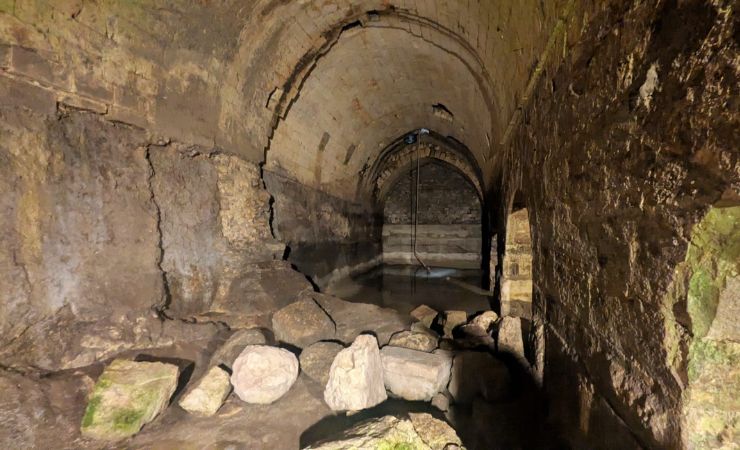
During the first century BC, Herod the Great constructed a massive open-air pool in this area, part of his extensive building projects throughout the city. The pool served both practical and ceremonial purposes for Jerusalem’s growing population during the Second Temple period.
Following the destruction of Jerusalem in 70 CE and the city’s rebuilding as Aelia Capitolina, Roman Emperor Hadrian transformed the area around 135 CE. He commissioned the construction of arched vaulting over Herod’s pool, converting it into an enormous rainwater cistern. Above this underground reservoir, Hadrian erected a monumental triple-arched gateway that served as the eastern entrance to Aelia Capitolina’s forum, demonstrating Rome’s architectural mastery and urban planning expertise.
The northern arch of Hadrian’s gateway remains preserved today under the apse of the Basilica of Ecce Homo. The central span of this same gateway crosses the Via Dolorosa as the famous Ecce Homo Arch, while archaeological evidence suggests the southern span once stood where the Church of the Condemnation now operates.
The Convent of the Sisters of Zion owes its modern foundation to Marie-Alphonse Ratisbonne, a remarkable figure whose personal transformation shaped the site’s contemporary identity. Born into a prominent Jewish banking family in Strasbourg, Ratisbonne experienced a dramatic religious conversion in Rome’s Church of Sant’Andrea delle Fratte in 1842. This event, which he attributed to a vision of the Virgin Mary, led him to embrace Catholic priesthood and dedicate his life to fostering Jewish-Christian dialogue.
Ratisbonne arrived in Jerusalem in 1857 and immediately recognized the historical and spiritual significance of this location. He purchased the site and began construction of the Church of Ecce Homo in 1862, deliberately incorporating the ancient Roman arch into the church’s design. The convent expanded systematically over subsequent decades, acquiring surrounding Arab homes and establishing various charitable works including a medical dispensary that served the local community regardless of religious affiliation.
The Modern Church of the Convent of the Sisters of Zion
Ground Level:
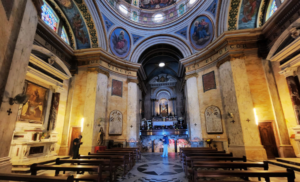
The Church of Ecce Homo presents visitors with a remarkable fusion of ancient Roman engineering and 19th-century ecclesiastical architecture. The most striking feature remains Hadrian’s preserved northern arch of the triple gateway, which forms the structural foundation of the church’s apse. This massive limestone arch, dating to 135 CE, displays the sophisticated construction techniques of Roman master builders. The interior incorporates original Roman masonry while accommodating modern liturgical needs, creating an atmosphere that connects contemporary worship with two millennia of history.
The Ecce Homo arch visible on the Via Dolorosa represents the central span of Hadrian’s original triumphal gateway. Architectural analysis reveals that this gateway followed standard Roman design principles, with each arch measuring approximately 6 meters in width and rising to heights that once dominated Jerusalem’s eastern skyline.
Below Ground Level:
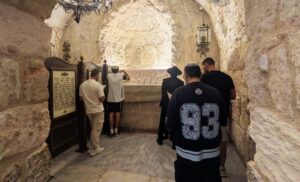
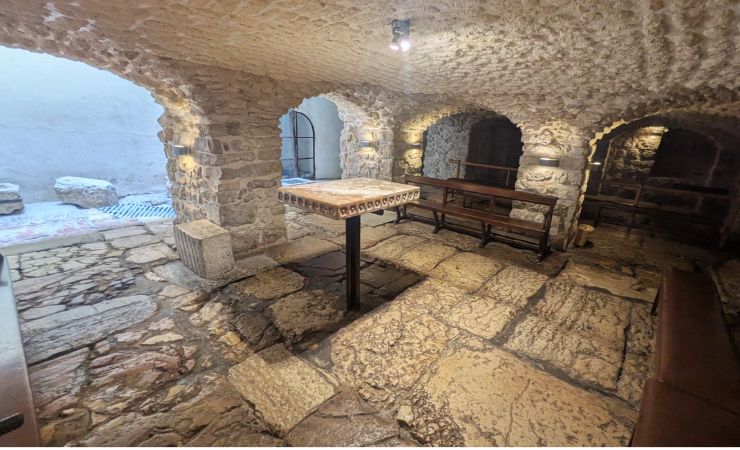
The convent’s lower level reveals one of Jerusalem’s most significant archaeological discoveries: an extensive pavement of Roman flagstones dating to the second century CE. These massive basalt stones, each weighing several tons, stretch across an area of approximately 2,500 square meters beneath the convent complex. The flagstones extend, though to a lesser degree, under the Church of the Condemnation that houses the first and second stations of the Via Dolorosa.
Archaeological excavations in 1864 revealed intricate engravings carved into these flagstones by Roman soldiers. The most significant discovery includes a detailed game board for “Basilicus,” a dice game popular among Roman legionaries. The game involved the crowning of a mock king, often a condemned prisoner who would be ridiculed before execution. This discovery led early researchers, including the convent’s founding sisters, to identify these flagstones as the Lithostrotos or Gabbatha mentioned in John 19:13, where Pontius Pilate conducted Jesus’ trial.
Modern archaeological scholarship suggests these flagstones formed part of Hadrian’s eastern forum rather than the original Antonia Fortress pavement. However, the possibility remains that after the fortress’s destruction in 70 CE, its stones were salvaged and reused in Hadrian’s construction projects, a common practice in ancient urban development. The exceptional preservation of these flagstones provides visitors with a tangible connection to Roman-era Jerusalem and the historical context of the Passion narrative.
The Modern Church of the Convent of the Sisters of Zion
The Convent of the Sisters of Zion welcomes visitors Monday through Saturday from 8:30 AM to 5:00 PM, with closures on Sundays and major Christian holidays.
Visitors should observe modest dress requirements: covered shoulders and knees are mandatory for both men and women.
The site offers limited wheelchair accessibility to the main church level, but the underground archaeological areas require navigating several flights of stairs.
Additional Information
What is the significance of the Ecce Homo Arch at the Convent of the Sisters of Zion?
The Ecce Homo Arch is the central span of a triple-arched Roman gateway built by Emperor Hadrian around 135 CE. The arch gets its name from the Latin phrase “Ecce Homo” meaning “Behold the man,” which Pontius Pilate spoke when presenting Jesus to the crowd. While the arch itself dates to the second century, its location along the Via Dolorosa has made it a significant pilgrimage site for Christians worldwide.
Can visitors see the ancient Roman flagstones at the Sisters of Zion Convent?
Yes, visitors can access the underground level of the convent to view extensive Roman flagstones dating to the second century CE. These massive basalt stones cover approximately 2,500 square meters and feature carvings made by Roman soldiers, including game boards for “Basilicus,” a dice game involving the crowning of a mock king. The flagstones are believed by some to be part of the original Lithostrotos mentioned in the Gospel of John.
Who was Marie-Alphonse Ratisbonne and why did he found the Sisters of Zion Convent?
Marie-Alphonse Ratisbonne was a French Jewish banker who converted to Catholicism in 1842 following what he described as a vision of the Virgin Mary in Rome. Born into a prominent Jewish banking family in Strasbourg, Ratisbonne became a Catholic priest and dedicated his life to Jewish-Christian dialogue. He founded the Sisters of Zion Convent in Jerusalem in 1857, purchasing this historically significant site and building the Church of Ecce Homo in 1862 to preserve both its archaeological importance and spiritual significance.
Nearby Sites
- Church of the Condemnation: Another significant religious site, believed to be where Jesus took up his cross.
- Church of the Flagellation: A serene sanctuary marking the spot where Jesus was believed to have been scourged.
- The Pool of Bethesda: An ancient pool historically associated with healing miracles performed by Jesus.
Keep reading
Part of our Christian Pilgrimage Guide →