The Church of the Condemnation and Imposition of the Cross is a Roman Catholic church within the Franciscan monastery in Jerusalem's Old City. It marks the traditional Second Station of the Cross, where Jesus received his cross after being condemned by Pontius Pilate. The church shares the monastery compound with the Church of the Flagellation.
The Church of the Condemnation and Imposition of the Cross is a Roman Catholic church located within the Franciscan monastery in the Old City of Jerusalem. This monastery also houses the Church of the Flagellation. Both churches are significant landmarks on the Via Dolorosa, with the Church of the Condemnation marking the traditional Second Station of the Cross where Christian pilgrims commemorate Jesus receiving the cross after his condemnation by Pontius Pilate.
Location
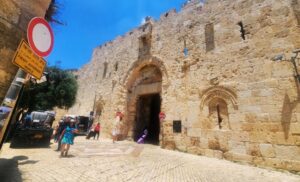
The Church of the Condemnation and Imposition of the Cross stands on the Via Dolorosa near the Lion’s Gate, one of the eastern gates of the Old City of Jerusalem. The church occupies a prime location in the Muslim Quarter, approximately 50 meters from the Temple Mount’s northwestern corner. .
Biblical Context
The Church of the Condemnation and Imposition of the Cross commemorates two pivotal events from the New Testament that occurred following Jesus’ trial before Pontius Pilate.
Condemnation
After Jesus’ interrogation and the crowd’s demand for his crucifixion, Pontius Pilate condemned him to death. The Gospel of John records this decisive moment: “Then Pilate handed him over to them to be crucified” (John 19:16). Christian sites in Israel tradition places this condemnation at the site now marked by the church.
Imposition of the Cross
Following the death sentence, Roman soldiers forced Jesus to carry the wooden crossbeam to the place of execution. The Gospel accounts describe how they “led him away to crucify him” after placing a crown of thorns on his head and mocking him as “King of the Jews.”
And after twisting some thorns into a crown, they put it on his head… and led him away to crucify him
Matthew 27:29-31
Historical Context
The Church of the Condemnation marks the traditional site where Jesus received his cross after Pontius Pilate’s condemnation. This belief is supported by the discovery of massive Roman flagstones beneath both this church and the adjacent Convent of the Sisters of Zion. Early recent archaeological research investigations identified these stones as part of Gabbatha, the stone pavement mentioned in John 19:13 where Pilate sat in judgment. However, more recent archaeological evidence suggests these pavement stones were actually part of a second-century forum built by Emperor Hadrian during the construction of Aelia Capitolina, the Roman city established on the ruins of Jerusalem after 135 CE.
The current church structure has a complex history spanning multiple civilizations. Byzantine Christians first erected a church on this site in the 4th or 5th century CE. During the Islamic period, the building served as a mosque before the Franciscans acquired the property and restored it as a Catholic church in 1904. The Franciscan Custody of the Holy Land has maintained the site since then, preserving both its religious significance and archaeological treasures.
Architectural Highlights
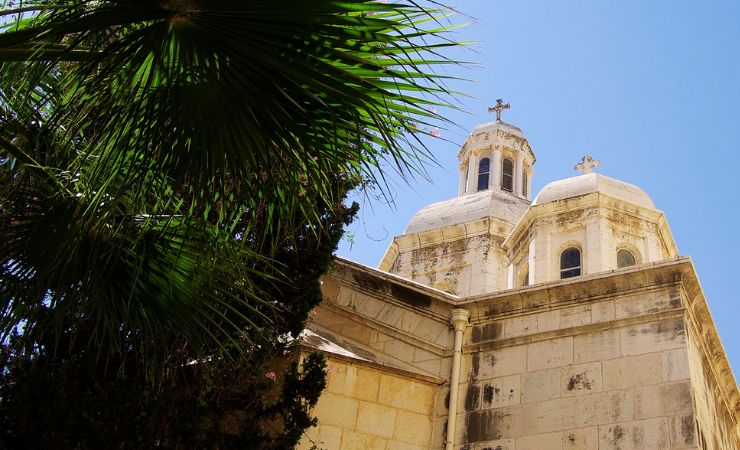
The Church of the Condemnation features distinctive architectural elements that blend modern design with ancient foundations. The building’s most striking feature consists of five white domes, each supported by a cylindrical drum fitted with stained-glass windows depicting scenes from Christ’s Passion. These windows cast colorful light patterns across the interior throughout the day, creating an atmosphere conducive to prayer and contemplation.
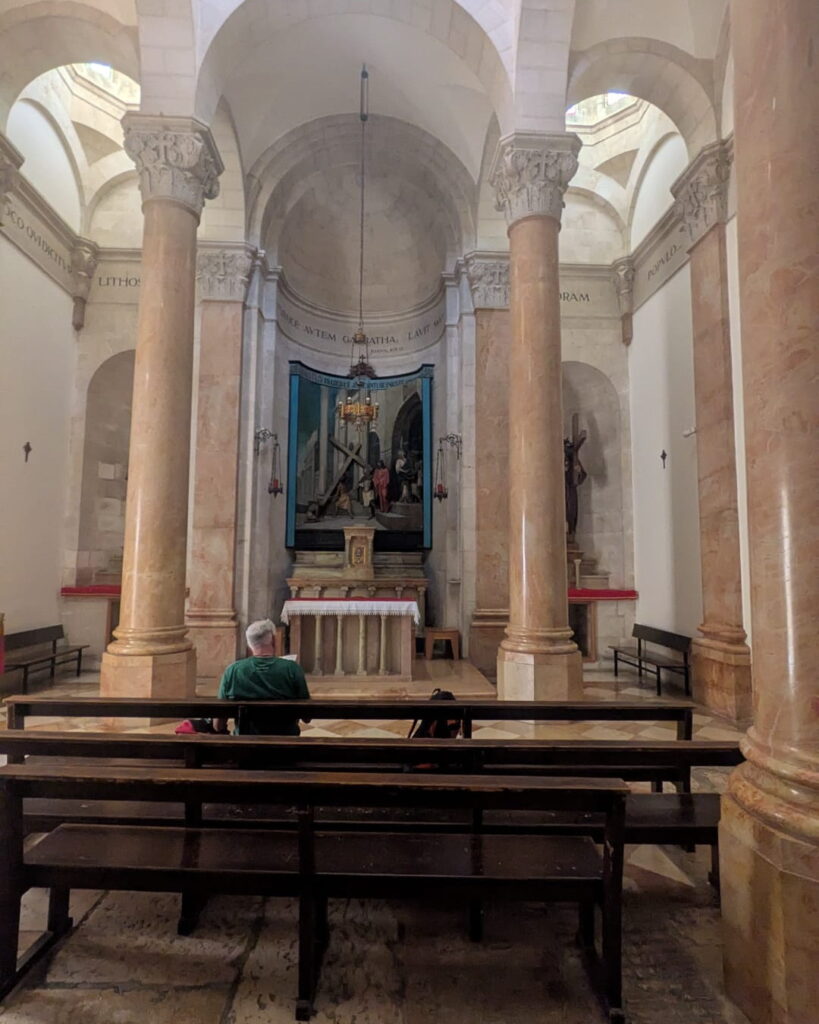
Inside the church, visitors encounter papier-mâché relief sculptures mounted in the apse that illustrate key moments from the Passion narrative. One prominent scene shows Pontius Pilate pronouncing the death sentence, while another depicts John the Apostle attempting to shield the Virgin Mary from witnessing Jesus carrying the cross down the Via Dolorosa. These artistic representations help pilgrims visualize the biblical events commemorated at this location.
The interior walls display additional artwork, including a mural of Pontius Pilate washing his hands in symbolic rejection of responsibility for Jesus’ death, and another showing Roman soldiers forcing the crossbeam onto Jesus’ shoulders. Four pink marble columns support the church’s ceiling, while decorative pilasters line many of the walls. The altar area features miniature Corinthian columns that echo classical Roman architectural traditions.
Archaeological features add historical depth to the church’s religious significance. Adjacent to the western wall, excavated Roman-period pavement remains visible behind protective glass. These large, striated stones were designed with grooves to prevent horses and other animals from slipping, typical of Roman street construction in the 1st and 2nd centuries CE. Additional archaeological highlights include:
Ancient Pavement: The extensive stone flooring beneath the church complex may represent portions of the Roman Antonia Fortress courtyard, where Jesus could have stood during his trial before Pilate according to traditional accounts.
Byzantine Mosaics: Excavations have uncovered colorful mosaic fragments beneath the current floor level, indicating the presence of an earlier Byzantine church or chapel that preceded the modern structure.
Crusader-era Relics: Stone carvings and architectural fragments from the medieval period demonstrate the site’s continuous religious importance during the Crusader Kingdom of Jerusalem (1099-1291 CE).
Multilingual Inscriptions: Stone tablets bearing inscriptions in Latin, Greek, and Arabic reflect the international nature of pilgrimage to this site across different historical periods.
Practical Information
The Church of the Condemnation and Imposition of the Cross welcomes visitors year-round as part of the Franciscan monastery complex. The church opens daily from 8:00 AM to 6:00 PM during summer months (April through September) and from 8:00 AM to 5:00 PM in winter (October through March). Admission is free, though donations are appreciated for maintenance and restoration work.
Visitors should dress modestly when entering the church, with covered shoulders and knees required for both men and women.
Additional Information
What is the significance of the Church of the Condemnation in Christian tradition?
The Church of the Condemnation marks the Second Station of the Cross, where Christian tradition places Jesus receiving his cross after Pontius Pilate condemned him to crucifixion. This site represents a crucial moment in the Passion narrative, when Jesus accepted the instrument of his death and began his final journey to Golgotha.
Can visitors see the ancient Roman pavement mentioned in the Bible?
Yes, visitors can view sections of Roman-era stone pavement through protective glass panels inside the church. While originally thought to be the biblical Gabbatha where Pilate judged Jesus, archaeologists now believe these stones were part of a second-century forum built by Emperor Hadrian. The pavement still provides valuable insight into Roman Jerusalem’s appearance during the New Testament period.
How does the Church of the Condemnation connect to the broader Via Dolorosa pilgrimage route?
The church represents the second of fourteen traditional Stations of the Cross along the Via Dolorosa. Pilgrims typically visit after the nearby Church of the Flagellation and continue toward the Church of the Holy Sepulchre, following the route believed to trace Jesus’ final journey. The church provides an essential stop for understanding the complete Passion narrative as commemorated in Jerusalem.
Nearby Sites
- The Church of the Holy Sepulchre: Located further along the Via Dolorosa, this church is believed to be the site of Jesus’ crucifixion, burial, and resurrection.
The Pools of Bethesda: An ancient reservoir mentioned in the Gospel of John, where Jesus healed a paralyzed man. (John 5:1-15).
St. Anna’s Church: A beautiful 12th-century Crusader church known for its remarkable acoustics and serene atmosphere.
The Roman Cardo Maximus: Once the main street in ancient Roman cities, Jerusalem’s Cardo is a significant archaeological site that offers a glimpse into the city’s rich history.
- Church of the Flagellation: Another significant station on the Via Dolorosa, this church marks the spot where Jesus was said to have been scourged.
Keep reading
Part of our Christian Pilgrimage Guide →