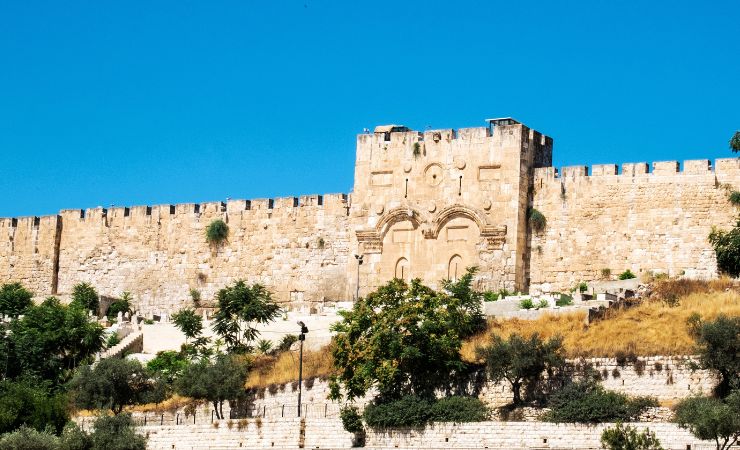
The Golden Gate (Sha'ar Harahamim or "Gate of Mercy") is a sealed entrance on Jerusalem's Temple Mount eastern wall. Built in the 6th-7th century CE, it was sealed by Suleiman the Magnificent in 1541. Jewish tradition holds the Messiah will enter through this gate, while Islamic tradition associates it with Judgment Day.
The Golden Gate Jerusalem stands as one of the most spiritually significant entrances to the Old City. Known as Sha’ar Harachamim (Gate of Mercy) in Hebrew and Bab al-Dhahabi (Golden Gate) in Arabic, this ancient portal carries the weight of millennia of religious expectation and divine promise.
This sealed eastern entrance holds profound religious significance for Judaism, Christianity, and Islam. Each tradition views the Golden Gate Jerusalem as central to their understanding of messianic prophecy and divine judgment, making it one of the most theologically important structures in the Holy City.
Location
The Golden Gate Jerusalem sits prominently on the eastern wall of the Temple Mount, approximately 200 meters south of the Lion’s Gate. This strategic location places it directly opposite the Mount of Olives, separated by the historic Kidron Valley. The gate’s eastern orientation holds special significance in biblical prophecy, as many scriptures speak of the Messiah approaching Jerusalem from the east.
Significance in Monotheistic Religions
Judaism
Jewish tradition holds that the Golden Gate Jerusalem will be the entrance point for the Messiah when he arrives to redeem the world. The prophet Ezekiel describes this eastern gate in his vision of the restored Temple: “Then he brought me back to the outer gate of the sanctuary which faces toward the east, but it was shut” (Ezekiel 44:1-2). According to the Talmud, this gate was also called Shushan Gate, named after the Persian capital of Susa, reflecting the historical connection between the Jewish community and the Persian Empire.
The gate’s connection to Yom Kippur ceremonies adds another layer of significance. Historical sources describe how, during the Second Temple period, a ceremony involved sending a scapegoat through this gate to the wilderness, symbolically carrying away the sins of the people. This ritual underscores the gate’s association with divine mercy and forgiveness.
Christianity
Christian tradition closely links the Golden Gate Jerusalem to Jesus’s triumphant entry into Jerusalem on Palm Sunday. The Gospel accounts describe Jesus approaching from the Mount of Olives, and many scholars believe his procession passed through this eastern entrance. According to Christian apocryphal texts, this gate also holds significance as the place where Mary’s parents, Joachim and Anna, met after receiving the angel’s announcement of Mary’s future birth.
The gate’s sealed state resonates with Christian eschatology, representing the awaited Second Coming of Christ. Many pilgrims view the sealed entrance as a powerful symbol of prophecy awaiting fulfillment, particularly in light of Jesus’s own prophecy about his return to Jerusalem.
And many spread their garments in the way: and others cut down branches off the trees, and strawed them in the way. And they that went before, and they that followed, cried, saying, Hosanna; Blessed is he that cometh in the name of the Lord.
Mark 11 8-10
Islam
Islamic tradition reveres the Golden Gate Jerusalem as Bab al-Tawba (Gate of Repentance) or Bab al-Rahma (Gate of Mercy). According to Islamic eschatology, this gate will play a central role in the Day of Judgment when Allah will gather all humanity for final judgment. The Quran and Hadith literature describe how the righteous will pass through this gate to enter Paradise, while it will remain closed to the wicked.
The Golden Gate: Historical Background
Ancient Beginnings
Archaeological evidence suggests that an eastern gate existed at this location during the First Temple period in the 10th century BCE. Solomon’s Temple featured an eastern entrance that aligned with the sunrise, reflecting ancient Near Eastern religious practices where temples faced east toward the rising sun. The Babylonian Talmud mentions that during the Second Temple period (516 BCE – 70 CE), the gate was called Shushan Gate, decorated with an image of the Persian capital Susa as a tribute to Persian support for the Temple’s reconstruction.
During the Second Temple period, this eastern entrance served multiple ceremonial functions. The high priest would pass through this gate during the Yom Kippur scapegoat ceremony, and according to the Mishnah, it was one of the main entrances for pilgrims arriving from the Mount of Olives.
Roman, Byzantine and Arab Influence
The Romans completely destroyed the Second Temple and its gates in 70 CE, leaving the site in ruins for decades. Archaeological surveys reveal that the area remained largely abandoned until the Byzantine period. Emperor Constantine’s legalization of Christianity in 313 CE marked the beginning of renewed interest in Jerusalem’s holy sites.
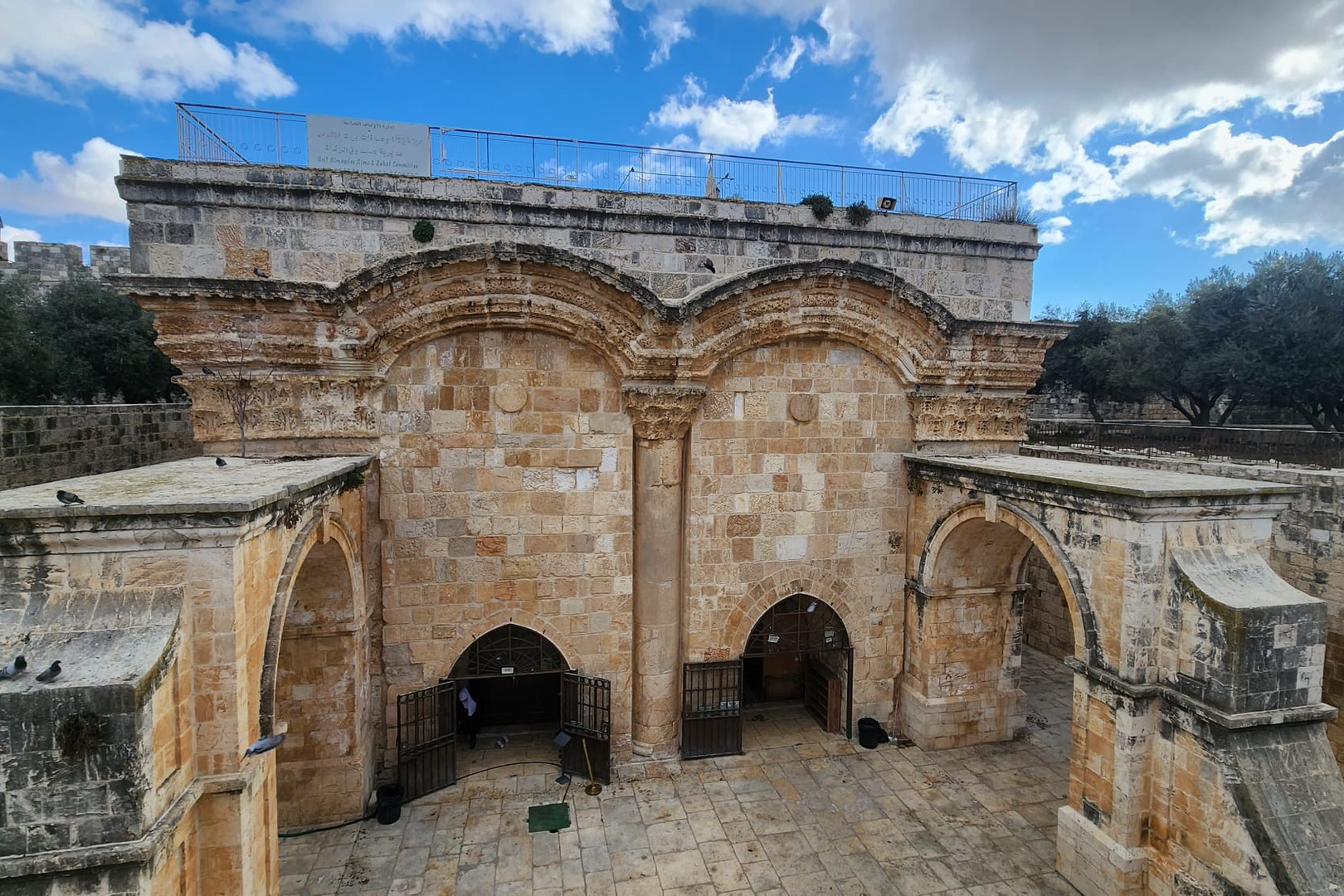
The current structure’s foundations date to the 6th or 7th century CE, when Byzantine builders constructed a new gate over the ancient ruins. Historical chronicles record that Emperor Heraclius made a dramatic entrance through this gate in 628 CE, walking barefoot while carrying fragments of the True Cross recovered from Persian captivity. This event, commemorated as the Feast of the Exaltation of the Holy Cross, cemented the gate’s significance in Christian tradition.
Under early Islamic rule following the conquest of Jerusalem in 638 CE, the gate remained open and functional. Muslim historians document its use for religious processions and ceremonial entries by caliphs and religious leaders visiting the Haram al-Sharif (Temple Mount).
Crusaders
During the Crusader period (1099-1187), the Golden Gate Jerusalem took on renewed Christian significance. The Crusaders restricted access to the gate, opening it only twice yearly: on Palm Sunday to commemorate Jesus’s entry into Jerusalem, and on the Feast of the Exaltation of the Holy Cross in September. These carefully choreographed ceremonies attracted pilgrims from across the Christian world.
Crusader modifications to the gate included Gothic architectural elements and Christian symbols carved into the stonework. Some of these decorative features remain visible despite later Islamic modifications. When Saladin recaptured Jerusalem in 1187, he initially kept the gate functional but gradually restricted its use as political tensions increased.
Sealing and the Ottoman Era
The Mamluk period (13th-15th centuries) saw the first attempts to control access to the gate through iron barriers, though it remained technically passable. The decisive sealing came under Ottoman rule in the 16th century when Sultan Suleiman the Magnificent ordered the gate permanently blocked with massive stone blocks in 1541.
Multiple theories explain Suleiman’s decision. Ottoman records suggest practical military concerns, as the eastern wall presented a vulnerable point for potential invaders approaching from the Mount of Olives. However, local tradition and some historical sources indicate awareness of Jewish messianic expectations centered on this gate. By sealing it, Ottoman authorities may have sought to prevent any messianic movements from using the gate as a rallying point.
The Ottomans reinforced the closure by establishing a Muslim cemetery directly in front of the gate. This strategic placement served multiple purposes: it provided additional physical barrier, respected Islamic burial traditions that protect grave sites, and played on Jewish laws of ritual purity that traditionally restrict priestly access to cemeteries.
The Graveyard in Front of the Golden Gate
The Muslim cemetery directly in front of the Golden Gate Jerusalem represents more than a simple burial ground. Established during the Ottoman period, this cemetery contains graves dating from the 16th century to the present day. The oldest marked graves include Ottoman officials and religious leaders, while more recent burials include members of prominent Jerusalem families.
The cemetery’s strategic placement reflects sophisticated religious and political calculations. Islamic tradition holds that burial near holy sites brings spiritual merit, making this location highly desirable for Muslim families. Simultaneously, the placement creates a barrier that operates on multiple levels of religious law and custom, affecting Jewish, Christian, and Islamic approaches to the sealed gate.
The graves include simple stone markers alongside elaborate Ottoman-period tombs with decorative inscriptions in Arabic and Ottoman Turkish. Some tombstones feature Quranic verses about resurrection and judgment, themes that resonate with the gate’s eschatological significance across all three monotheistic faiths.
Additional Information
Why is the Golden Gate in Jerusalem sealed?
The Golden Gate Jerusalem was permanently sealed in 1541 by Ottoman Sultan Suleiman the Magnificent. Historical sources suggest multiple reasons: military defense concerns, as the eastern wall presented a vulnerable entry point, and religious considerations related to Jewish messianic traditions that prophesy the Messiah will enter through this gate. The Ottomans also placed a Muslim cemetery in front of the gate to further ensure it remained closed.
What is inside the sealed Golden Gate?
Behind the sealed stone blocks lie two parallel vaulted chambers with cross-vaulted ceilings supported by ancient columns. These halls contain architectural elements from different periods, including Byzantine capitals and Islamic decorative features. A staircase leads from these chambers up to the Temple Mount platform level. Some historical accounts describe remnants of ancient mosaics and carved inscriptions within these chambers.
When will the Golden Gate Jerusalem be opened?
According to Jewish, Christian, and Islamic traditions, the Golden Gate Jerusalem will be opened in the messianic age or at the end of times. Jewish prophecy states the Messiah will enter through this gate, Christian tradition connects it to Jesus’s Second Coming, and Islamic belief links it to the Day of Judgment. Currently, there are no plans by any governing authority to physically open the sealed gate.
What does the name “Golden Gate” mean?
The name “Golden Gate” derives from the Greek “Porta Aurea” and Latin “Porta Aurea,” though the gate itself is not made of gold. In Hebrew, it’s called “Sha’ar Harachamim” (Gate of Mercy), and in Arabic, “Bab al-Dhahabi” (Golden Gate) or “Bab al-Rahma” (Gate of Mercy). The “golden” designation likely refers to its eastern orientation toward the sunrise and its spiritual significance rather than any golden appearance.
How old is the current Golden Gate structure?
The visible structure of the Golden Gate Jerusalem primarily dates to the Byzantine period (6th-7th centuries CE), built over foundations from earlier periods including the Second Temple era. The current sealed appearance reflects Ottoman modifications from 1541 when Sultan Suleiman ordered it permanently blocked. Archaeological evidence suggests gates have existed at this location for over 2,500 years, making it one of Jerusalem’s most ancient entrance points.
Nearby Sites
- Mount of Olives: This it’s believed to be the place where Jesus entered Jerusalem. Many Stories from the New Testament take place there.
- Garden of Gethsemane: Located at the foot of the Mount of Olives, it’s where Jesus prayed the night before his crucifixion. The Church of All Nations and the Grotto of Gethsemane are located in the gardens.
- Church of Mary Magdalene: A stunning Russian Orthodox church with golden domes, it stands as a tribute to Mary Magdalene.
- Kidron Valley: This Kidron Valley wraps the City of David from the east and holds significant burial tombs like the Tomb of Absalom, The Tomb of Benei Hezir, and the Tomb of Zechariah.
Keep reading
Part of our Jerusalem Travel Guide →