The Stella Maris Monastery sits atop Mount Carmel in Haifa and serves as the world center of the Carmelite Order. This 19th-century church honors the prophet Elijah, who according to tradition sought refuge in a cave beneath the monastery. The site features stunning Byzantine-style interior decorations and panoramic views of Haifa Bay.
Stella Maris Church sits at the top of Mount Carmel in Haifa, and the building looks more like a castle or vault than a typical church, thick walls, tiny windows, a design the Carmelites required for safety during the Ottoman period. Before you step inside, pause at the entrance and look up: a bronze arm emerges from the Carmelite crest gripping a sword, representing the prophet Elijah. Many visitors walk straight past the bronze doors without a second glance, which is a mistake, because they are among the finest metalwork on the site.
Where is Stella Maris Church, and what is it?
Stella Maris Church is the world center of the Carmelite Order, located on the western slope of Mount Carmel in Haifa, Israel, overlooking the Mediterranean Sea. The current church and monastery were inaugurated in 1836 and were later recognized as a Minor Basilica by Pope Gregory XVI. The Discalced Carmelite monks live and worship here year-round.
Who founded the Carmelite Order at Mount Carmel?
Albert Avogadro, the Latin Patriarch of Jerusalem, wrote the Carmelite rule of life in the early 13th century for the hermits already living on Mount Carmel. That document is the legal and spiritual foundation of the Carmelite Order. The order’s full name, Order of the Brothers of Our Lady of Mount Carmel, points directly back to those hermits and to the mountain where this church now stands.
What is the history of Stella Maris?
The Carmelite story on Mount Carmel begins in the 12th century, when religious hermits inspired by the Prophet Elijah settled in the mountain’s caves during the Kingdom of Jerusalem. By the early 13th century they asked Albert Avogadro, the Latin Patriarch of Jerusalem, for a written rule of life. His response established the Carmelite Order, formally known as the Order of the Brothers of Our Lady of Mount Carmel.
The fall of Acre to the Mamluks in 1291 forced the monks out of the Holy Land entirely. The order spread across Europe; King Saint Louis brought six Carmelites back to France in 1254. The Discalced branch returned to Mount Carmel in 1631, building a small monastery on the promontory at Mount Carmel, but Zahir al-Umar evicted them in 1761 and demolished the building.
The Carmelites rebuilt on the site believed to sit directly above Elijah’s cave. Napoleon’s 1799 campaign destroyed that structure, and Abdullah Pasha of Acre demolished it completely in 1821. The present church opened in 1836.
What does "Stella Maris" mean?
“Stella Maris” is Latin for “Star of the Sea,” a title traditionally given to the Virgin Mary. Christian tradition uses the image of a navigational star to describe Mary’s role as a guide for believers in difficulty. The Carmelite Order adopted this title because their rule was formally dedicated to Our Lady of Mount Carmel. The words “Ave Maris Stella” (“Hail, Star of the Sea”) are set into the floor at the church entrance, so visitors literally walk across the dedication as they arrive.
What can be seen inside and outside Stella Maris Church?
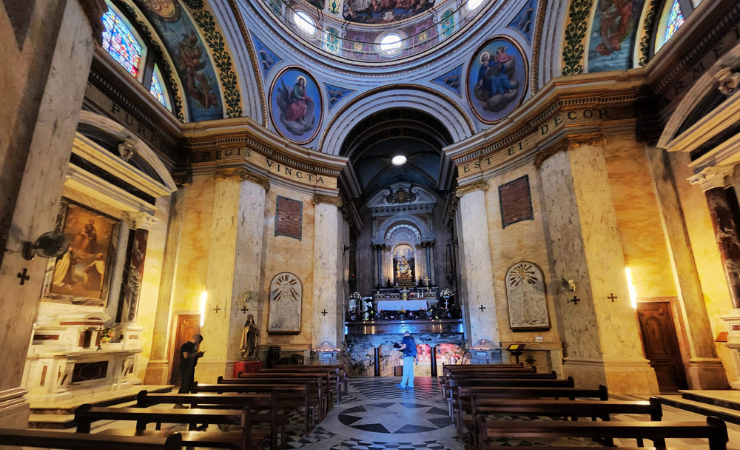
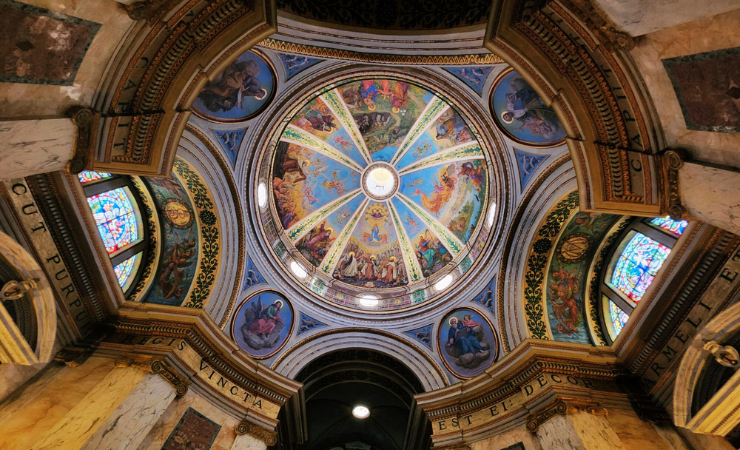
The painted dome — Lay brother Luigi Poggi painted the dome between 1924 and 1928. The scenes cover both Testaments: Elijah rising to heaven in a fiery chariot, King David with his harp, the prophets Daniel, Ezekiel, and Isaiah, the Holy Family, and the founding figures of the Carmelite Order. Latin verses from scripture run around the base of the dome in a continuous band.
The altar and statue of Our Lady of Mount Carmel — The raised altar occupies the eastern end of the church. Above it stands a statue of Mary holding the infant Jesus, with the Scapular in her right hand. Two biblical verses frame the space: “Thine head upon thee is like Carmel” (Song of Solomon 7:5) and “The excellency of Carmel and Sharon, they shall see the glory of the LORD” (Isaiah 35:2).
Elijah’s cave beneath the altar — A cave measuring roughly 3 by 5 meters sits under the altar, where tradition holds that Elijah the Prophet once sheltered. A Latin inscription reads: “This cave was once the dwelling of the great leader and father of the prophets, Elijah the Tishbite.” Behind marble columns, a stone altar occupies the center of the cave, with a statue of Elijah above it. Three commemorative markers near the entrance honor early Carmelite figures: Berthold, St. Brocardus, and Prosper.
The memorial plates — Many people walk past the two wall plaques that deserve close attention. One bears a Star of David and commemorates Edith Stein, the Jewish-born Carmelite nun killed at Auschwitz in 1942. The other, marked with a rose, honors Mariam Bawardi, a Carmelite beatified in 1983 and canonized in 2015. Both women are among the most significant figures in modern Carmelite history.
Art, light, and the organ — The north wall has a marble-framed panel flanked by reddish columns, showing St. Teresa and St. John of the Cross looking toward St. Joseph holding the infant Jesus, linking the church to the 16th-century Discalced reform. A nearby stained-glass window depicts the scene from 2 Kings 2: Elijah taken up in a fiery chariot as Elisha watches and collects his mantle. On the western wall, a grand organ is played during services and concerts.
The French soldiers’ pyramid — On the monastery’s western terrace, between palm trees with a direct view of the sea, a small pyramid-shaped stone topped with an iron cross marks the resting place of 200 French soldiers killed by Ottoman forces in 1799. Their remains were gathered in 1804 and interred here in 1827. The Latin inscription quotes 2 Samuel 1:27: “How are the mighty fallen, and the weapons of war perished!” A second iron cross nearby commemorates French sailors who died aboard the Chateau-Renaud during a naval attack on Acre.
Practical information
Stella Maris Church is open to visitors daily from 06:00 to 12:00 and from 15:00 to 18:00, though hours shift on major feast days and during liturgical services, so checking with the monastery before your visit is sensible. Admission is free. Dress modestly before entering: covered shoulders and knees are expected for both men and women, and the Carmelite community takes this seriously.
Additional Information
Ancient Times / Biblical Period:
- 10th-9th Century BCE (approx.): Prophet Elijah is active on Mount Carmel. He goes to the top of Carmel, casts himself down, and holds a contest with the false prophets (1 Kings 18:42). Carmelite tradition holds that Elijah stayed in a cave now located under the altar of the Stella Maris church. Later Jewish tradition also associates a cave in the area with Elijah’s follower, Elisha.
Roman/Byzantine Period:
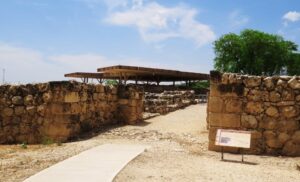
- A Roman/Byzantine site exists at the area of Stella Maris, with some findings displayed at the monastery entrance. A chapel is believed to date back to the Byzantine Empire, and a medieval Greek church (Abbey of St. Margaret) also existed on the current site.
Crusader Period:
- Late 12th Century: Frenchman Berthold (died 1188), a Crusader, leads a group of hermits who go into seclusion in the caves on Mount Carmel, inspired by Prophet Elijah’s simple way of life. This marks the outset of the Carmelite Order, named after Mount Carmel.
- Between 1206 and 1214: The leader and prior (referred to as ‘Brother B,’ sometimes believed to be Saint Brocard or Saint Bertold) asks Albert Avogadro, the Latin Patriarch of Jerusalem, to provide a written rule of life for the hermits. This establishes the “Order of the Brothers of Our Lady of Mount Carmel” (Carmelites) and gives them official recognition.
- Around 1226: The Carmelite hermits build their first small church (St. Brocardus) dedicated to Our Lady, near their grottos in the e-Siah (now Nahal Siakh) brook on the western slopes of Mount Carmel.
- Around 1240: The first Carmelite convents are founded in Europe.
- 1254: King Louis IX of France, returning from a Crusade, brings six Carmelites back to France, promoting their expansion in Europe.
- 1291: With the Mamluk siege and conquest of Acre (the capital of the Crusader Kingdom of Jerusalem), the Arabs defeat the Crusaders. Carmelite monks are butchered, and their church is destroyed. Survivors emigrate to Europe and do not return to the Holy Land for over two and a half centuries.
Ottoman Period:
- Mid-17th Century: Carmelite hermits return to the Holy Land, residing in caves below Stella Maris.
- 1631: Father Prosper of the Holy Spirit (Prosper), a Spanish monk and head of the Discalced Carmelite community, arrives in the Holy Land and establishes a makeshift monastery on the promontory of Mount Carmel, near the lighthouse. This marks the return of the Discalced branch of the Order.
- 1761: Zahir al-Umar, the ruler of Galilee, orders the Carmelites to vacate their site and demolishes the monastery. The friars move to their present location, directly above a grotto where Elijah is said to have lived, clearing ruins of a medieval Greek church and a Byzantine chapel.
- 1799: During Napoleon Bonaparte’s campaign, the monastery serves as a hospital for sick and wounded French soldiers. After Napoleon retreats following his failed siege of Acre, 200 wounded French soldiers are left behind and butchered by the Ottomans. The monastery is demolished.
- 1804: The bones of the butchered French soldiers are collected.
- 1821: Abdullah Pasha of Acre orders the complete destruction of the ruined church to prevent its use as a fort. Its masonry is used to build his summer palace and a lighthouse.
- 1827: A cornerstone is laid for the re-establishment of the Stella Maris monastery. The collected bones of the French soldiers are buried in the garden under a memorial stone.
- 1836: The fort-like Stella Maris monastery, built under the orders and supervision of Brother Giovanni Battista Cassini, is completed and opened. Its ground floor has thick walls and small, barred openings for defense.
- 1839: Pope Gregory XVI bestows the title of Minor Basilica on the sanctuary, and it is known as “Stella Maris” (Star of the Sea).
- July 31, 1883: Laurence Oliphant publishes an article titled “St. Elias festivals and Carmelite Monastery,” describing his visit and the festivals held there on July 20 with 6,000 visitors. He notes the influential role of the monastery in the newly founded city of Haifa.
20th Century:
- 1924-1928: Luigi Poggi, a lay brother of the Church, decorates the ceiling of the church dome with scenes of Elijah, David, prophets, the Holy Family, and Carmelite founders.
- 1950s-1960s: Franciscan archaeologist Bellarmino Bagatti conducts excavations, bringing to light primitive grottos and remains of successive buildings, including a large chapel.
Is Stella Maris a biblical name?
The phrase “Stella Maris” does not appear verbatim in the Bible. It is a Latin title applied to the Virgin Mary by medieval theologians, drawn from imagery of stars as guides. The 9th-century scholar Jerome is often credited with linking the name to Mary, though the exact attribution is debated among scholars.
Who owns and operates Stella Maris Church?
The Discalced Carmelite Order owns and operates Stella Maris Church and Monastery. The Discalced branch, reformed by St. Teresa of Avila and St. John of the Cross in 16th-century Spain, returned to the Holy Land in 1631 and has maintained a continuous presence on Mount Carmel since the current church opened in 1836.
What name did Jesus call Mary?
In the Gospels, Jesus addresses his mother as “Woman” (Greek: gynai), notably at the wedding at Cana (John 2:4) and from the cross (John 19:26). He does not use the title Stella Maris; that designation developed in later Christian tradition as a devotional title, not a scriptural one.
What is the Carmelite emblem above the church entrance?
The emblem shows a crowned arm gripping a sword, taken from the prophet Elijah’s declaration of zeal for God in 1 Kings 19:10. In the Carmelite tradition, that arm and sword belong to Elijah, not to Jesus, setting this emblem apart from similar imagery used in other Catholic orders.
Nearby Sites
Mukhraka (Keren Carmel): This site is believed to be where Prophet Elijah confronted the prophets of Baal. It holds significant religious importance and offers panoramic views of the surrounding areas.
Bahá’í Gardens: These terraced gardens cascade down Haifa’s hillside, culminating in the golden-domed Shrine of the Báb. Itis a recognized as a UNESCO World Heritage Site.
Elijah’s Cave: This cave is where it is believed the Prophet Elijah hid after his confrontation with the prophets of Baal. It’s a pilgrimage site for Jews, Muslims, Druze, and Christians.
- German Colony: The German Colony is Haifa’s restored historic district. With its well-preserved buildings, vibrant restaurants, and cafes, it’s a delightful blend of history and modern-day culture.
Keep reading
Part of our Christian Pilgrimage Guide →