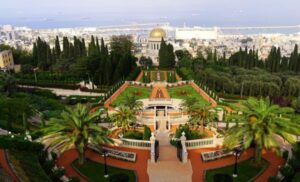
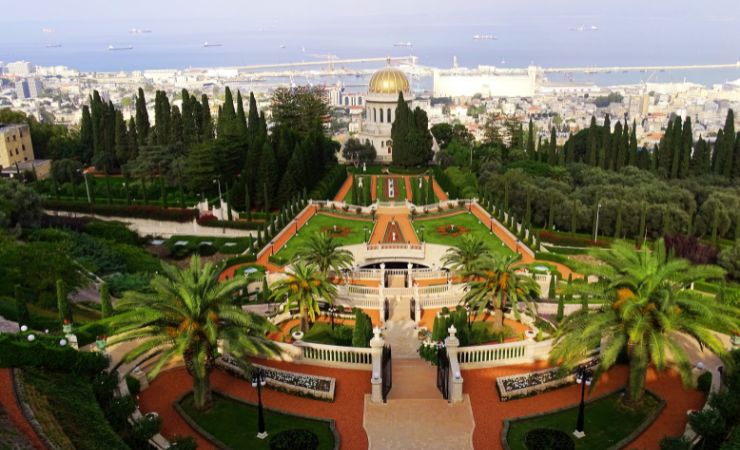
The Baháʼí Gardens in Haifa house the Baháʼí World Centre and were designated a UNESCO World Heritage Site in 2008 for their outstanding universal value. The terraced gardens feature 19 levels ascending Mount Carmel, incorporating Persian garden design principles with immaculate landscaping, geometric patterns, and the golden-domed Shrine of the Báb at their center.
The Bahá’í Gardens in Haifa represent both the spiritual heart of the Bahá’í Faith and one of Israel’s most significant architectural achievements. These terraced gardens surround the golden-domed Shrine of the Báb and house the administrative headquarters of this global religion. UNESCO recognized the site in 2008 Israel as having “outstanding universal value” for its unique combination of sacred architecture, landscape design, and spiritual significance.
Location
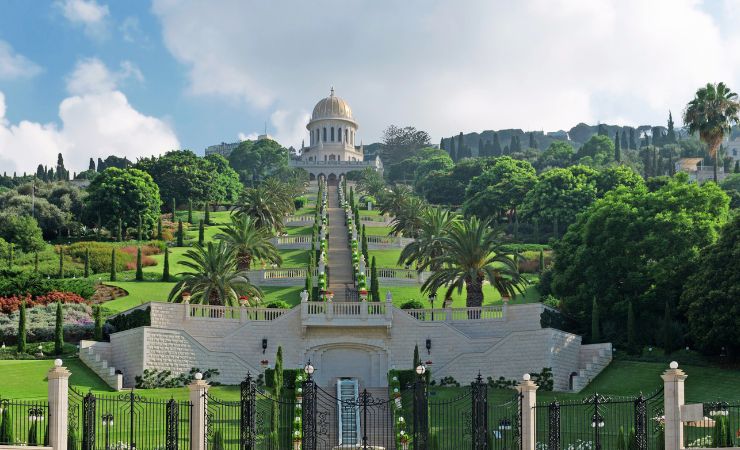
The Baháí Gardens occupy a prominent position on the northern slope of Mount Carmel in Haifa, stretching approximately one kilometer in length from the German Colony at sea level to the summit of the mountain. The site consists of nineteen terraced levels that create a dramatic stepped landscape visible from across Haifa Bay.
Introduction to the Baháʼí Religion
The Bahá’í Faith emerged in mid-19th century Persia as a monotheistic religion founded by Bahá’u’lláh (1817-1892), whose title means “Glory of God” in Arabic. It grew from the earlier Bábí movement, begun in 1844 when a young merchant known as the Báb proclaimed his mission. With over six million adherents in nearly every country, it is among the most geographically widespread religions despite its recent origins—a reach reflecting its message of universal unity and the elimination of prejudice.
The Báb, born Siyyid ‘Alí-Muhammad in Shiraz in 1819, announced that he was the promised Qá’im awaited by Shia Muslims. His teachings drew thousands of followers but fierce opposition; an estimated 20,000 Bábís were killed between 1844 and 1850, and the Báb himself was executed by firing squad in Tabriz on July 9, 1850. His remains were hidden for fifty years before being transported to the Holy Land in 1899.
Bahá’u’lláh, born Mírzá Husayn-‘Alí Núrí into a wealthy Persian family, became a prominent supporter of the Báb and suffered imprisonment and exile. In 1852, chained in Tehran’s Síyáh-Chál dungeon, he experienced what Bahá’ís consider his divine revelation. Banished from Persia, he spent ten years in Baghdad, was summoned to Constantinople, and in 1868 was exiled to the prison city of Akko, where he lived his final 24 years and continued writing works such as the Kitáb-i-Aqdas, which contains the faith’s fundamental laws. His burial site at Bahjí became the Qiblih for Bahá’ís worldwide.
The faith centers on three principles: the oneness of God, of religion, and of humanity. Bahá’ís believe all major religions are successive revelations from one divine source, each prophet—Abraham, Moses, Jesus, Muhammad, and others—bringing teachings suited to their age, with Bahá’u’lláh the most recent. This progressive revelation accompanies emphasis on eliminating prejudice, the equality of men and women, the harmony of science and religion, and global governance. Its vision of the “Most Great Peace” foresees lasting unity through a universal auxiliary language, international tribunals, reduced economic extremes, and universal education—especially for women, whose role in raising peaceful generations the faith stresses.
Sacred Geometry and Numerology
Sacred geometry and numerology permeate Bahá’í architecture and garden design. The number 19 is especially significant, shaping the Bahá’í calendar of 19 months of 19 days and the 19 terraced garden levels in Haifa, which represent the Báb and his 18 disciples, the “Letters of the Living.” Its meaning derives from the Arabic word “Wáhid” (unity), which equals 19 in the abjad numerical system.
The nine-pointed star, the most recognizable Bahá’í symbol, represents the completeness of the divine attributes manifested through Bahá’u’lláh, the ninth major religious figure in Bahá’í reckoning—nine being the highest single digit, symbolizing completion. This appears in the nine circles radiating from the Shrine of the Báb. The five-pointed star, the faith’s official symbol, represents the human form with outstretched limbs. Both express unity in diversity, reflecting the Bahá’í vision of a harmonious civilization that retains its cultural variety.
The Baháʼí Gardens
Why Haifa?
Haifa’s selection as the spiritual center of the Bahá’í Faith stems from direct instructions given by Bahá’u’lláh during his imprisonment in nearby Akko. In 1890, while visiting the area that would later house the gardens, Bahá’u’lláh pointed to a specific spot on Mount Carmel and declared it the final resting place for the remains of the Báb. He also designated the mountain as the location for the faith’s administrative headquarters, calling it the “Mountain of the Lord” in reference to biblical prophecies. These decisions transformed Haifa and Akko into the two holiest cities for Bahá’ís worldwide, with Haifa serving as the center for spiritual and administrative guidance, while Akko remains the site of the most sacred shrine and the direction of prayer.
The Bahá’í World Centre in Haifa coordinates the activities of over six million Bahá’ís across 235 countries and territories. The complex houses several institutions, including the Universal House of Justice, the faith’s supreme governing body elected every five years by representatives from national Bahá’í communities worldwide. The International Teaching Centre, Centre for the Study of the Sacred Texts, and International Archives also operate from the site. The Archives building contains original manuscripts and relics from the faith’s founders, including the original copies of Bahá’u’lláh’s most important works and personal effects of both the Báb and Bahá’u’lláh. This concentration of religious authority and historical artifacts makes Haifa the undisputed center of Bahá’í institutional life.
The Gardens
The Baháʼí Gardens represent a masterpiece of landscape architecture that transforms religious symbolism into living beauty. Iranian architect Fariborz Sahba designed the terraces to embody key Bahá’í principles: unity in diversity, harmony between humanity and nature, and the integration of Eastern and Western aesthetic traditions. Every element serves both practical and symbolic purposes, from the precise geometric patterns that reflect divine order to the careful selection of plants that thrive in Mediterranean conditions while representing different global regions. The gardens function as an outdoor temple where visitors experience spiritual elevation through the ascending terraced levels, each offering increasingly expansive views of Haifa Bay and the surrounding landscape.
Construction began in 1987 following two decades of planning that involved soil analysis, drainage studies, and extensive consultations with botanists and landscape engineers. The project required moving approximately 100,000 cubic meters of earth and stone to create the terraced structure, with each level carefully engineered for proper water drainage and plant sustainability. Water conservation techniques, implemented since the 1950s, include underground cisterns that collect rainwater, drip irrigation systems, and the strategic use of mulching to retain soil moisture. The gardens employ a hierarchical planting scheme: the central terraces feature elaborate seasonal displays with over 1,000 varieties of roses, while the outer zones utilize native Mediterranean species such as rosemary, oleander, carob, and olive trees. This approach minimizes water usage while providing habitat for local bird species and maintaining year-round visual interest.
Main Monuments and Features
The Shrine of the Báb
The golden-domed Shrine of the Báb dominates the central terrace and serves as both the architectural and spiritual focal point of the entire complex. The original simple stone structure, built between 1900 and 1909 to house the remains of the Báb, received its distinctive superstructure between 1948 and 1953 under the direction of Shoghi Effendi, the Guardian of the Bahá’í Faith. Canadian architect William Sutherland Maxwell designed the expansion using Chiampo stone from Italy for the walls and 12,000 gilded tiles from the Netherlands for the dome. The interior features intricate geometric patterns in marble and mosaic work, with Persian carpets covering the floors. Nine rooms surround the central chamber containing the Báb’s remains, each decorated with calligraphy from Bahá’í sacred writings and illuminated by crystal chandeliers.
The Shrine of Baháʼu’lláh
Located 22 kilometers north in Bahjí, near Akko, the Shrine of Baháʼu’lláh occupies the holiest site in the Bahá’í world. The modest single-story building, originally constructed as a residence for a wealthy landowner, was purchased by Bahá’ís in 1929 and converted into a shrine. The structure maintains its original Ottoman architectural features, including arched windows, tile work, and a traditional courtyard design. Unlike the elaborate terraces in Haifa, the gardens surrounding this shrine emphasize natural beauty with mature trees, grass lawns, and seasonal flowers. The site includes the original mansion where Bahá’u’lláh spent his final years, now preserved as a museum containing his personal belongings, furniture, and writing materials.
The Arc Buildings
The Arc Buildings crown the upper terraces of Mount Carmel and house the administrative heart of the worldwide Bahá’í community. The complex consists of five main structures arranged along a 600-meter arc: the Centre for the Study of the Sacred Texts (completed 1975), the International Archives Building (1957), the Seat of the Universal House of Justice (1983), the Centre for the Study of the Sacred Texts extension (1999), and the International Teaching Centre Building (2001). Each building incorporates neoclassical elements with Eastern influences, using Jerusalem stone and marble columns to create architectural unity. The International Archives, designed to resemble the Parthenon, houses original manuscripts, photographs, and artifacts from the faith’s history, including the Báb’s prayer beads and locks of Bahá’u’lláh’s hair. The Seat of the Universal House of Justice features a distinctive dome and serves as the meeting place for the nine-member council that guides the global Bahá’í community.
The Terraced Gardens
The 19 terraced levels extend 1 kilometer down the northern face of Mount Carmel, creating what many visitors describe as the “Hanging Gardens of Haifa.” Each terrace measures approximately 60 meters in width, connected by a central stairway that contains 700 steps flanked by twin water channels. The design incorporates Persian garden traditions (chahar bagh) with European formal garden techniques, creating geometric patterns that remain visually striking when viewed from Haifa Bay below. The project, which cost an estimated $250 million and took 13 years to complete, required the expertise of over 1,000 workers, including stone masons from Italy, gardeners from various countries, and engineers specializing in water management systems.
The terraces showcase more than 450 plant species carefully selected for their beauty, symbolic meaning, and adaptation to local growing conditions. Seasonal displays include tulips and daffodils in spring, roses and hibiscus in summer, and chrysanthemums and cyclamens in autumn. Palm trees, cypresses, and other evergreens provide year-round structure, while flowering trees such as jacaranda, magnolia, and cherry create seasonal highlights. The gardens incorporate sophisticated irrigation technology, including computer-controlled systems that adjust watering schedules based on weather conditions, soil moisture levels, and seasonal plant requirements. Nine concentric circles, visible primarily from aerial views, radiate from the Shrine of the Báb, each planted with different species to create subtle patterns that reinforce the sacred geometry of the design.
All structural elements, including retaining walls, staircases, and decorative features, utilize local Galilee stone quarried specifically for the project. The stone, known for its warm golden color that complements the Shrine’s dome, weathers naturally to blend with the surrounding landscape. Ornamental elements include carved balustrades, decorative urns, and geometric stone inlays that incorporate both Islamic and Western design motifs. The central water channels, fed by recycled rainwater and treated wastewater, create cooling microclimates while providing the sound of flowing water that enhances the meditative atmosphere. LED lighting systems, installed in phases since 2009, illuminate the terraces each evening, creating a dramatic nighttime spectacle visible throughout Haifa and across the bay.
Practical Information
Visiting Hours and Admission
The Baháí Gardens offer free admission to all visitors year-round. The gardens are open daily from 9:00 AM to 5:00 PM, with extended hours until 6:00 PM during summer months (April through September). The Shrine of the Báb interior is open for viewing Monday through Thursday from 9:00 AM to 12:00 PM, though access requires advance booking through the official website or visitor center.
Dress Code and Conduct
Visitors must dress modestly, covering shoulders and knees. Sleeveless shirts, shorts, short skirts, and revealing clothing are not permitted. Hats and sunglasses should be removed when entering shrine buildings. Photography is allowed in the gardens but prohibited inside shrine buildings. Smoking, eating, drinking (except water), and loud conversation are not permitted anywhere on the grounds. Pets are not allowed except for registered service animals.
Accessibility
The terraced nature of the gardens creates challenges for visitors with mobility limitations. However, accessible viewing areas are available at both the upper entrance (Yefe Nof Street) and lower entrance (Hatzionut Avenue). Wheelchair-accessible restrooms are located at both entrance points. Special arrangements for visitors with disabilities can be made by contacting the visitor services in advance.
Additional Information
1817: Mirza Hussein Ali, later known as Bahá’u’lláh, is born into a noble family in the Iranian province of Nur.
1844: The Báb announces his mission. (The Templars in Palestine expect the return of Christ in this year.) Bahá’u’lláh becomes a follower of the Báb.
August 1852: Bahá’u’lláh, while confined in an underground dungeon, relates receiving the announcement of his divine calling.
1853: Bahá’u’lláh’s property is confiscated, and he and his family are expelled from their native land to Baghdad.
1853 – 1863: Bahá’u’lláh resides in Baghdad for ten years, including two spent wandering alone in the mountains of Kurdistan.
Prior to 1863: Before complying with an order from the the Sultan of Turkey to move to Istanbul, Bahá’u’lláh announces his divine mission to the followers of the Báb, most of whom accept his claim and become Bahá’ís.
1868: The Turkish Sultan banishes Bahá’u’lláh to ‘Akko, then a remote outpost of the Ottoman Empire, used for political prisoners.
Between 1868 and 1877: Bahá’u’lláh spends nine years of confinement, first in the citadel and then within the walls of the Old City of ‘Akko. During this period, while still confined, he formulates the fundamental laws and principles of the Bahá’í religion in the “Most Holy Book” (Kitáb-i-Aqdas).
1877 onwards (last twelve years of his life): Bahá’u’lláh is allowed to move about freely and live in the countryside north of ‘Akko, spending his last twelve years in relative comfort in the mansion that stands in the centre of the Bahá’í Gardens in ‘Akko.
1890: Bahá’u’lláh determines the location for the resting place of the Báb in Haifa.
29 May 1892: Bahá’u’lláh passes away at the age of 75. His remains are buried in a small building next to the mansion in ‘Akko, known as the “Shrine of Bahá’u’lláh”.
1900 – 1909: The simple ashlar masonry mausoleum for the Báb is built on Mount Carmel in Haifa, including a cistern for water collection.
1909: The first gardens are planted around the Báb’s mausoleum in Haifa. The bones of the Báb are brought to the Holy Land and buried in the simple stone structure on Mount Carmel.
1922 – 1957: As much land as possible is purchased around the Shrine of the Báb in Haifa to expand and protect the property for future development. Several formal gardens with a blend of Eastern and Western styles are designed and installed around the Haifa site, including nine small terraced gardens.
1929: Shoghi Effendi renovates Bahá’u’lláh’s house in Bahji, Akko.
1948 – 1953: Shoghi Effendi directs the development of the golden-domed superstructure around the Shrine of the Báb in Haifa.
1987: Canadian architect-engineer Fariborz Sahba is commissioned to design and construct 18 terraced gardens above and below the Shrine of the Báb in Haifa.
1990s: The city of Haifa decides to renovate the “German Colony”. The Bahá’í establishment requests the municipality to shift a street in the German Colony by 10 degrees to align with the axis between the Shrine of the Báb and the Shrine of Bahá’u’lláh. A compromise is reached where the street is lined with roundabouts, invisibly shifting slightly at each roundabout to create a final tilt of less than one degree that, if extended, would point to the Shrine of Bahá’u’lláh.
2000: UNESCO recognizes the “outstanding universal value” of the Bahá’í Gardens in Haifa and ‘Akko and adds them to the list of World Heritage sites.
2001: The extensive landscaping begun in 1987 for the terraced gardens of the Shrine of the Báb is completed.
2008 (July): The Bahá’í Gardens in Haifa and ‘Akko are inscribed on the UNESCO World Heritage List, specifically on July 8, 2008.
Is the Bahai Gardens Haifa UNESCO site free to visit?
Yes, admission to the Baháí Gardens is completely free for all visitors. The gardens are open daily from 9:00 AM to 5:00 PM, with no entrance fees or ticket requirements. However, guided tours must be booked in advance through the official website or visitor center.
How long does it take to visit the Bahai Gardens UNESCO World Heritage site?
A complete visit to the Baháí Gardens typically takes 1-2 hours, depending on your pace and interests. Guided tours last approximately 45 minutes and cover the main terraces and historical background. Independent visitors often spend additional time exploring the upper and lower viewing areas and taking photographs.
What makes the Bahai Gardens Haifa a UNESCO World Heritage site?
UNESCO recognized the Baháí Gardens in 2008 for their outstanding universal value as both religious shrines and masterpieces of landscape architecture. The site demonstrates exceptional artistic achievement in its integration of Eastern and Western design traditions, its spiritual significance to the global Bahá’í community, and its innovative approach to sustainable garden design in a Mediterranean climate.
Can you enter the Shrine of the Báb at the UNESCO Bahai Gardens?
The interior of the Shrine of the Báb is open for viewing Monday through Thursday from 9:00 AM to 12:00 PM, but access requires advance booking through the official Bahá’í Gardens website. Visitors must dress modestly and remove shoes before entering the sacred space.
How are the Bahai Gardens connected to the UNESCO site in Akko?
The Baháí Gardens in Haifa and the Shrine of Baháʼu’lláh in Akko are both part of the same UNESCO World Heritage designation, representing the two holiest sites of the Bahá’í Faith. The central axis of the Haifa terraces aligns directly with the Akko shrine, located 22 kilometers to the north, creating a symbolic connection between the burial places of the faith’s two central figures.
Nearby Sites
The German Colony Plaza: Features restored homes built by the German Templar society in the late 19th and early 20th centuries.
Elijah’s Cave – A traditional pilgrimage site believed to be where the prophet Elijah sought refuge, sacred to Jews, Christians, Muslims, and Druze.
Stella Maris Church – A 19th-century Carmelite church and monastery on Mount Carmel, offering panoramic views and honoring the prophet Elijah.
Mukhraka (Muhraka) – A hilltop Carmelite monastery marking the site of Elijah’s biblical confrontation with the prophets of Baal, with expansive views over the Jezreel Valley.
Keep reading
Part of our Galilee & Northern Israel Guide →