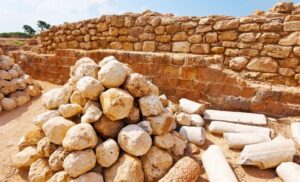
The Pool of Siloam is an ancient water reservoir located on the southern slope of the Wadi Hilweh in Jerusalem's City of David. It served as a major water source during both the First and Second Temple periods and is mentioned in the New Testament as the site where Jesus healed a blind man.
The Pool of Siloam represents one of Jerusalem’s most significant archaeological discoveries, linking biblical narratives across both Temple periods. Located on the southern slope of the Wadi Hilweh in the City of David, this ancient water reservoir served critical functions for over a millennium, from King Hezekiah’s defensive preparations in the 8th century BCE to the miraculous healing recorded in the New Testament.
Credit Ian Scott, CC BY-SA 2.0, via Wikimedia Commons
Location
The Pool of Siloam sits on the southern slope of the Wadi Hilweh, which many archaeologists consider the original site of ancient Jerusalem. The pool lies outside the walls of the Old City to the southeast, approximately 70 yards (64 meters) from the later Byzantine pool that was mistakenly identified as the biblical site for centuries. Fed by waters from the Gihon Spring through the famous Siloam Tunnel, this location provided Jerusalem with a crucial water source protected within the city’s defensive perimeter.
During the time of the First Temple
King Hezekiah commissioned the Pool of Siloam during the late 8th century BCE as part of his extensive preparations for the Assyrian siege of Jerusalem in 701 BCE. The pool represented a masterpiece of ancient engineering, securing Jerusalem’s water supply by connecting the Gihon Spring to a protected reservoir within the city through the newly constructed Siloam Tunnel. This 533-meter underground passage replaced an older, more vulnerable Canaanite water system that enemy forces could easily compromise. The Israel Antiquities Authority excavations of Hezekiah’s tunnel, discovered in 1880 with its famous inscription, confirms the biblical account of this remarkable defensive strategy. Archaeological evidence suggests that multiple work crews began digging from opposite ends, meeting with remarkable precision in the middle of the bedrock.
The rest of the events in Hezekiah’s reign, including the extent of his power and how he built a pool and dug a tunnel to bring water into the city, are recorded in The Book of the History of the Kings of Judah.
During the time of the Second Temple
During the Second Temple period, the Pool of Siloam gained renewed significance in the Acra district, Jerusalem’s Lower City. Thousands of Jewish pilgrims used the pool for ritual purification before ascending to the Temple Mount for religious festivals. The stepped design accommodated different water levels throughout the year while providing easy access for the the Land of Israel tradition of purification. The recently excavated Pilgrimage Road connected the pool directly to the Temple courts, forming part of the sacred journey that observant Jews made during the major festivals of Passover, Sukkot, and Shavuot. According to the Gospel of John, Jesus performed one of his most significant miracles at this location, healing a man born blind and instructing him to wash in the pool’s waters.
When he had said this, he spat on the ground, made some mud with the saliva, and put it on the man’s eyes. ‘Go,’ he told him, ‘wash in the Pool of Siloam’ (this word means ‘Sent’). So the man went and washed, and came home seeing.
The Romans destroyed the pool and buried it with debris after the First Jewish–Roman War in 70 CE. Winter rains subsequently washed alluvium from the surrounding hills into the valley and down Mount Zion’s slopes, creating silt layers up to 4 meters thick in some areas that completely concealed the ancient structure.
Archaeologists rediscovered this historic pool in autumn 2004 during routine sewer excavation work. Workers uncovered stone steps that led researchers to hypothesize they had found remains from the Second Temple period. Extensive excavations confirmed this theory, and the Israel Antiquities Authority formally announced the discovery on August 9, 2005.
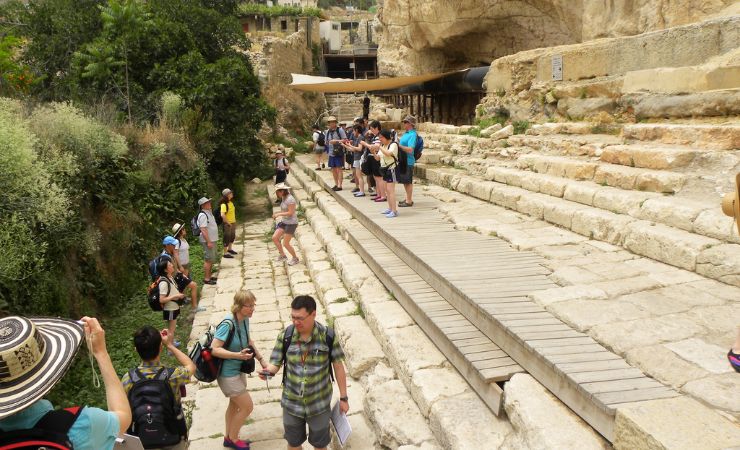
Excavations revealed the pool measured 225 feet (69 meters) wide with a soft trapezoidal shape rather than a perfect rectangle. The structure features three sets of five steps leading to platforms before reaching the bottom, a design that accommodated Jerusalem’s varying seasonal water levels. While the visible pool shows sophisticated stone construction, archaeologists discovered evidence of an earlier plastered version beneath. Coins from Alexander Jannaeus’s reign (103-76 BCE) found embedded in the plaster lining provide a terminus ante quem for the pool’s reconstruction during the Hasmonean period, showing continuous use and improvement across .
Practical Information
Location: City of David Archaeological Park, Silwan, East Jerusalem
Opening Hours: Sunday-Thursday: 8:00 AM – 5:00 PM, Friday: 8:00 AM – 3:00 PM, Saturday: 9:00 AM – 5:00 PM (hours may vary seasonally)
Admission: Adult tickets start at 65 NIS (approximately $18 USD). Combined tickets with City of David and Hezekiah’s Tunnel available for 85 NIS (approximately $24 USD)
Dress Code: Comfortable walking shoes required. Modest dress recommended for religious site
Parking: Limited parking available at City of David visitor center. Public transportation and walking from Old City recommended
Full Excavation Underway (2023-2026)
The Israel Antiquities Authority launched a comprehensive excavation project for the entire Pool of Siloam in January 2023, marking the first complete archaeological investigation of the site in over 2,000 years. This ambitious undertaking became possible after changes in property ownership allowed researchers access to previously inaccessible areas.
Lead archaeologist Zeev Orenstein raises the intriguing possibility of discovering remnants of King Hezekiah’s original Pool of Siloam beneath the Herodian-period construction. This discovery would require excavating below the currently visible Second Temple period structure, a decision that the Israel Antiquities Authority will evaluate based on preliminary findings. The complete excavation process will require approximately five years and proceeds in coordination with the ongoing of the adjacent Pilgrimage Road, creating a comprehensive picture of ancient Jerusalem’s sacred geography.
The modern excavation employs advanced archaeological techniques including ground-penetrating radar, 3D mapping, and detailed stratigraphic analysis to preserve maximum information about each historical layer. These methods allow researchers to document the pool’s evolution from Hezekiah’s original construction through its Second Temple period modifications and eventual destruction and burial.
Full Excavation Underway (2023-2026)
The Israel Antiquities Authority launched a comprehensive excavation project for the entire Pool of Siloam in January 2023, marking the first complete archaeological investigation of the site in over 2,000 years. This ambitious undertaking became possible after changes in property ownership allowed researchers access to previously inaccessible areas.
Lead archaeologist Zeev Orenstein raises the intriguing possibility of discovering remnants of King Hezekiah’s original Pool of Siloam beneath the Herodian-period construction. This discovery would require excavating below the currently visible Second Temple period structure, a decision that the Israel Antiquities Authority will evaluate based on preliminary findings. The complete excavation process will require approximately five years and proceeds in coordination with the ongoing of the adjacent Pilgrimage Road, creating a comprehensive picture of ancient Jerusalem’s sacred geography.
The modern excavation employs advanced archaeological techniques including ground-penetrating radar, 3D mapping, and detailed stratigraphic analysis to preserve maximum information about each historical layer. These methods allow researchers to document the pool’s evolution from Hezekiah’s original construction through its Second Temple period modifications and eventual destruction and burial.
Additional Information
Where exactly is the Pool of Siloam located in Jerusalem?
The Pool of Siloam sits on the southern slope of Wadi Hilweh in the City of David area, outside the Old City walls to the southeast. The authentic biblical pool lies about 70 yards from the later Byzantine pool that was mistakenly identified as the original site for centuries.
What is the difference between the biblical Pool of Siloam and the Byzantine pool?
The biblical Pool of Siloam dates to the Second Temple period and measures 225 feet wide with distinctive stepped sides. The Byzantine pool was built in the 5th century CE by Empress Eudocia and is significantly smaller. Until 2004, the Byzantine pool was incorrectly identified as the site of Jesus’s healing miracle.
Can visitors walk through Hezekiah’s Tunnel to reach the Pool of Siloam?
Yes, visitors can walk through the 533-meter Hezekiah’s Tunnel, which connects the Gihon Spring to the Pool of Siloam. The tunnel walk takes about 30-45 minutes and requires wading through ankle-deep water. This experience is included in many City of David tour packages.
What archaeological discoveries have been made at the Pool of Siloam?
Archaeologists have uncovered evidence of multiple construction phases, including an earlier plastered pool beneath the stone structure. Coins from Alexander Jannaeus’s reign found in the plaster provide dating evidence. The ongoing excavations since 2023 continue to reveal new insights about the pool’s construction and use.
Why is the Pool of Siloam significant for both Jewish and Christian visitors?
For Jewish visitors, the pool represents King Hezekiah’s engineering achievement and served as a ritual purification site before Temple worship. For Christians, it’s the location where Jesus healed a man born blind, as recorded in John 9:6-7. The pool thus holds meaning across both religious traditions.
Nearby Sites
- City of David: An archaeological site that is known to be the original urban core of ancient Jerusalem. It was here that King David established his capital and where the history of Jerusalem as the capital of the Jewish people began.
- Hezekiah’s Tunnel: This is an impressive ancient water tunnel from the 8th century BCE that was carved under the City of David in Jerusalem.
- Dung Gate: The Dung Gate is one of the Gates of the Old City of Jerusalem.
- Jerusalem Archaeological Park: An fascinating archeological park close to the Dung Gate. Direct access from the Pool of Siloam through the underground Roman drainage system.
- The Western Wall: A revered Jewish site, being the last remnant of the Second Jewish Temple and a place of prayer and pilgrimage for centuries.
- King David’s Tomb: King David’s Tomb is a site traditionally believed to be the burial place of David, the second king of the United Kingdom of Israel and Judah, located on Mount Zion in Jerusalem.
Keep reading
Part of our Christian Pilgrimage Guide →