King David's Tomb is traditionally located on Mount Zion in Jerusalem, within a building complex that also contains the Cenacle (Last Supper site). The tomb marks the believed burial place of King David, who united Israel and established Jerusalem as its capital around 1000 BCE. Today it serves as an active Jewish prayer site.
When you enter the tomb compound, look up at the column standing just inside the entrance: it is a surviving remnant of the Ania Church, a massive structure built by the Emperor Justinian in the 6th century. That single column sets the tone for everything here, layer after layer of history compressed into one small building on Mount Zion. King David’s Tomb occupies the ground floor of a complex that also holds the Cenacle, the traditional site of the Last Supper. Jews, Christians, and Muslims have all prayed within these walls. The site marks the believed burial place of the king who united Israel and established Jerusalem as its capital around 1000 BCE, and it remains an active Jewish prayer space today.
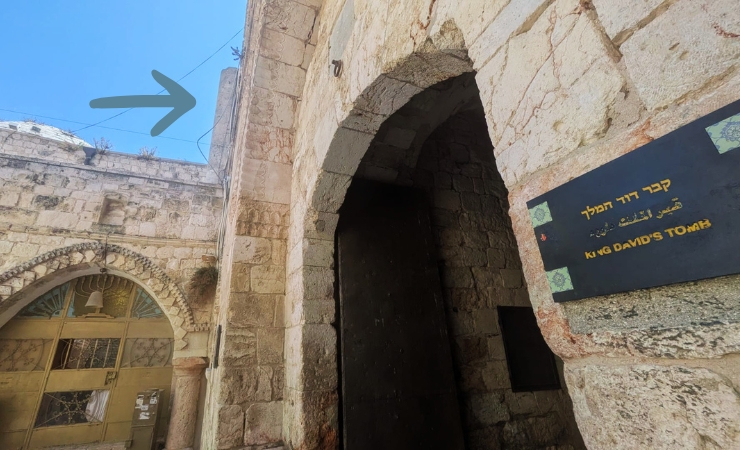
Where exactly is King David's Tomb?
King David’s Tomb is on Mount Zion, roughly 200 meters south of Jaffa Gate and the Old City walls. It sits beside the Dormition Abbey and looks out toward the Temple Mount across the Kidron Valley. Visitors enter through a stone courtyard that leads to the building’s ground-floor entrance.
The complex overlooks both the Jewish Quarter and the ancient City of David below. From 1948 to 1967, when Jordan controlled the Old City and barred Israeli Jews from the Western Wall, the building’s rooftop was the closest point from which they could pray toward their holiest site.
What Does the Bible Say About Where David Was Buried?
The biblical account is direct: King David “rested with his ancestors and was buried in the City of David” (1 Kings 2:10). First Chronicles 29:28 adds that “he died at a good old age, having enjoyed long life, wealth and honor.” The Book of Nehemiah, written centuries later, references David’s sepulcher as a recognizable landmark, placing the burial site within identifiable reach well into the Second Temple period.
Archaeological consensus puts the ancient City of David on the narrow ridge southeast of the current Old City, where excavations have uncovered remains of David’s Jerusalem. Most subsequent kings of Judah were also buried “with their fathers in the City of David,” pointing to a royal necropolis at Jerusalem’s original core. The exact location within that area is still unknown.
How did the tomb end up on Mount Zion?
Different stories show how religious tradition gradually settled on Mount Zion despite the historical evidence pointing elsewhere.
The association of King David’s Tomb with Mount Zion developed during the Byzantine period, around the 4th century CE, as Christianity gained official status in the Roman Empire. Early Christian pilgrims venerated sites across the Holy Land based on local belief rather than physical evidence, and Mount Zion became part of that tradition.
The geographical problem is real. Modern Mount Zion is the southwestern hill outside the Old City walls, an area that was uninhabited during David’s reign in the 10th century BCE. Jerusalem only expanded to include this western hill during the late First Temple period, centuries after David lived.
The 12th-century Jewish traveler Benjamin of Tudela recorded legends about workmen discovering David’s tomb on Mount Zion, accounts that borrowed elements from the historian Josephus but relocated them to this site.
Is King David's Tomb authentic? What scholars think
The scholarly consensus leans against Mount Zion as David’s actual burial place, primarily because the site was outside Jerusalem’s boundaries in the 10th century BCE. The biblical City of David, where Scripture says he was buried, is on the southeastern ridge now excavated as the City of David National Park.
Ermete Pierotti’s 1859 exploration claimed to find rock-cut caves beneath Mount Zion’s western slope that he identified as David’s true burial place, but his account lacked rigorous documentation and no later research has substantiated it. Pinkerfeld’s 1951 work pointed toward a Roman-era synagogue, not a 10th-century BCE royal tomb. Barkai’s First Temple-period cave is the most significant discovery to date, though he stops short of connecting it directly to David.
For observant Jews, the site is a place of prayer. For Christian pilgrims, it is inseparable from the Cenacle above. For Muslim visitors, it carries the memory of four centuries of Islamic worship. The question of historical authenticity and the fact of lived religious meaning exist side by side here.
What can you see inside King David's Tomb?
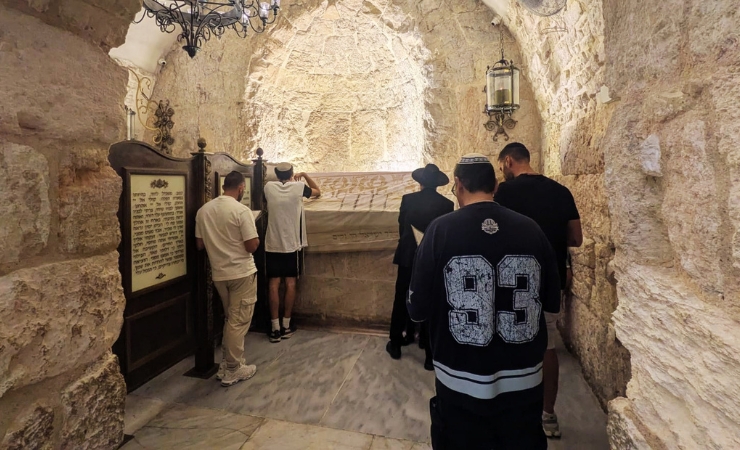
The cenotaph — The room’s centerpiece is a large stone cenotaph measuring approximately 3 by 1.5 meters, carved in Gothic style during the Crusader period. Blue velvet fabric covers the monument, embroidered with a crown, a harp, Torah scrolls, and Hebrew inscriptions. Standing beside it, you can trace the raised gold threadwork with your fingers.
Ancient hewn stone walls — Large sections of dressed stone are exposed along the room’s walls, predating the Crusader construction above them. Jacob Pinkerfeld’s 1951 excavation found architectural features suggesting the structure originally functioned as a late Roman-period synagogue, possibly from the 2nd or 3rd century CE. He identified a niche in the ancient wall facing the Temple Mount, interpreted as a housing for a Torah ark.
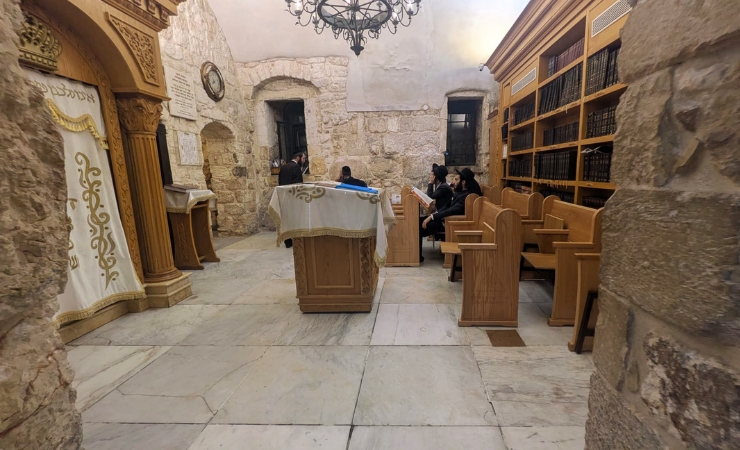
The active prayer space — The tomb chamber is divided by a mechitza into separate men’s and women’s sections. The men’s area has a small prayer hall filled with religious books, and on any given morning you will hear the low murmur of men davening beside the cenotaph. You should not expect to stay inside the actual tomb area for more than a minute or two; most visitors enter, say a short prayer, kiss the tomb, and leave.
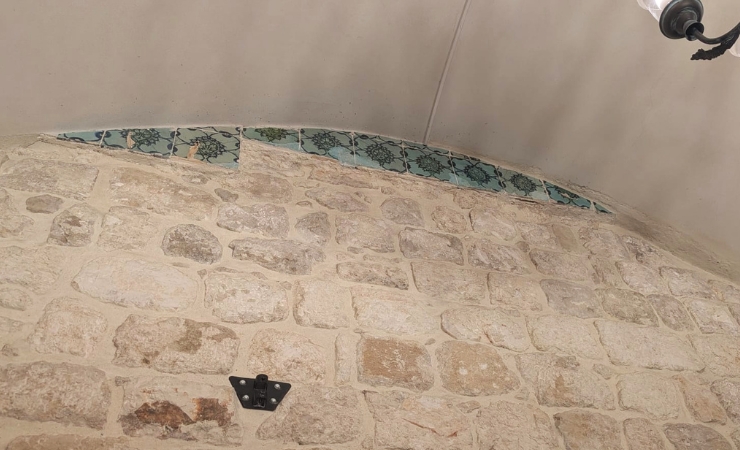
Ottoman ceramic tile remnants — When you enter the tomb chamber, look up at the wall opposite the cenotaph: you can still see fragments of 17th-century Ottoman ceramic tiles with geometric patterns and calligraphy, direct physical evidence of the building’s four centuries as a mosque. In December 2012, a 30-year-old ultra-Orthodox man entered and smashed 17 of those tiles; two weeks later additional vandals destroyed most of what remained. The Israel Antiquities Authority chose not to restore them, citing the impossibility of authentic reconstruction, and conserved the surviving fragments in place. You can read more about this below.
The rooftop overlook (not to be missed) — Take the stairs inside the complex to a rooftop with a direct sightline to the Temple Mount. This is the same vantage point that served Israeli Jews barred from the Western Wall between 1948 and 1967, and the view across the valley is one of the most nicest panoramas in Jerusalem.
Practical Information
A tip for planning your visit: ascend to the Room of the Last Supper first, then walk the roof, and descend to King David’s Tomb on the ground floor before heading out. That sequence follows the building’s natural layout and avoids backtracking through the courtyard.
While you are in the compound, do not miss Martef Hashoa, the Chamber of the Holocaust, the first Holocaust museum established in Israel. It opened in December 1949, about a year and a half after Israel’s founding, and its entrance is only steps from the tomb.
Opening Hours: Sunday-Thursday: 8:00 AM – 6:00 PM; Friday: 8:00 AM – 2:00 PM; Saturday: After Sabbath until 11:00 PM. Hours may vary during Jewish holidays.
Admission: Free entry for all visitors.
Dress Code: Modest attire required.
Additional Information
Control over King David’s Tomb has changed hands repeatedly, and each transition left a physical mark on the building.
During the Crusader period in the 12th century, Franciscan monks established their headquarters in the complex, treating the upper room as the Last Supper site while allowing Jewish access to the lower tomb chamber. That arrangement lasted until 1452, when Mamluk Sultan Barsbay seized the area and converted it into a mosque. The Franciscans kept the upper Cenacle until 1523, when Ottoman authorities expelled them entirely.
Under Ottoman rule the whole complex became Muslim sacred property managed by the al-Dajani family. They installed a minaret and transformed both floors into mosque spaces, though limited Christian and Jewish visits were permitted under supervision. Artisans added ceramic tiles and calligraphy to the tomb chamber walls during this period, decorations that stayed in place for more than 400 years.
The 1948 Arab-Israeli War brought another shift. With Jordan holding the Old City and the Western Wall cut off, Mount Zion remained on the Israeli side of the ceasefire line, and King David’s Tomb became the holiest Jewish site accessible within Israel. The Diaspora Yeshiva movement took over the building, converting the former mosque into a Jewish prayer space and establishing Torah study programs there.
Since 1967, when Israel reunited Jerusalem and Jews regained access to the Western Wall, the tomb’s role as the primary Jewish pilgrimage site has lessened. It remains active for Jewish prayer and Torah study, while Franciscan pilgrims continue visiting the Cenacle above. The layered, multi-faith history creates ongoing tensions over access and the building’s management.
I’m writing about this because I believe this is a warning sign for any Religious fanaticism. In December 2012, a 30-year-old ultra-Orthodox man entered the tomb chamber and systematically smashed 17 of the 17th-century Ottoman ceramic tiles lining its walls. His stated reason was that he had been told prayers for finding a wife would only be answered if he prayed directly against the bare stone beneath the decoration. Two weeks later, additional vandals returned and destroyed most of what remained.
The tiles were not incidental decoration. Installed during the building’s four centuries as a mosque, they were accomplished examples of Ottoman ceramic work carrying geometric patterns and calligraphic inscriptions that documented the site’s Islamic period as directly as any written record.
The Israel Antiquities Authority faced immediate criticism from historians and archaeologists who argued that leaving the damage unrestored set a dangerous precedent. The IAA defended its decision on the grounds that authentic reconstruction was impossible and that its mandate centered on preserving genuine ancient material rather than producing modern facsimiles. Whether that outcome is a reasonable response to an irreversible loss or an institutional failure remains a point of disagreement among preservation professionals.
Biblical Period (Approx. 10th Century BCE)
- Approx. 1000 BCE: King David conquers the Jebusite fortress called the “stronghold of Zion,” which becomes his palace and the City of David.
- Approx. 965 BCE: King David dies and is buried in the City of David (according to the Bible).
- First Temple Period (approx. 960 BCE – 586 BCE): Most of the Judean kings of the House of David are buried “with their fathers” in the City of David.
- Late First Temple Period: The city of Jerusalem expands westward, and the western hill comes to be known as Mount Zion.
Second Temple Period (Approx. 516 BCE – 70 CE)
- Post-Exile (after 539 BCE): The tombs of the House of David are still known and mentioned as a landmark in Jerusalem in the Book of Nehemiah.
- Around 2nd Century BCE: The first book of Maccabees mentions Mount Zion.
- First Century CE: The Apostle Peter refers to the location of David’s tomb as commonly known in his sermon on the day of Pentecost.
Roman Period (Approx. 1st – 4th Centuries CE)
- Circa 2nd Century CE: Jacob Pinkerfeld proposes that the lower part of the current David’s Tomb structure was originally a 2nd-century, late-Roman synagogue.
Byzantine Period (Approx. 4th – 7th Centuries CE)
- 4th Century CE: The Pilgrim of Bordeaux reports finding David buried in Bethlehem.
- Antiquity: The house with the Upper Room is known as “Holy Zion, Mother of Churches.”
Early Islamic Period (Approx. 7th – 10th Centuries CE)
- No earlier than 10th Century CE: Muslims begin to venerate David’s tomb on Mount Zion, possibly following Christian and Jewish leads.
Crusader and Mamluk Periods (Approx. 11th – 16th Centuries CE)
- 12th Century: Jewish pilgrim Benjamin of Tudela recounts a tale of workmen discovering David’s tomb on Mount Zion, incorporating details from Josephus.
- 1230: The Franciscan Order is established in Jerusalem with their headquarters in the Cenacle on Mount Zion.
- 1332: The Franciscans obtain the Cenacle from the Egyptian Sultan, Melek-el-Nasr.
- 1429: Mamluk Sultan Barsbay takes part of the lower floor of the complex from the Franciscans and converts the tomb chamber into a mosque.
- 1430: Possession of the tomb chamber alternates between Muslims and Franciscans.
- 1452: The tomb of David is handed over to the Muslims by the Franciscan monks.
Ottoman Period (Approx. 16th – 20th Centuries CE)
- 1523: Muslim authorities expel the Franciscans from the entire building (including the Cenacle and the tomb).
- 1524: The “chapel of the Holy Spirit” (the Cenacle) is transformed into a mosque, as evidenced by an inscription.
- 1536–41: Suleiman the Magnificent rebuilds Jerusalem’s walls, leaving Mount Zion outside the city.
- 1548: Ottoman Sultan decides the entire mountain is Muslim sacred property, transferring the site to the management of Sheikh al-Dajani. The structure is turned into a mosque and a minaret is added.
- 17th Century: Ottoman-era ceramic tiles are added to the walls of the tomb chamber.
- 1913: French-Jewish scholar Raymond Weill begins excavations in the City of David, seeking the royal tombs. He finds eight structures (T1-T8) he interprets as tombs.
British Mandate Period (1920-1948)
- The site is considered “absolutely under the authority of the Moslem Waqf of Nebi Daud,” who arrange access for visitors of all faiths. Christians are permitted to enter the Cenaculum but not to pray, and Jews are allowed to pray once a year if the political situation allows.
- 1923-1924: Raymond Weill conducts a second excavation, uncovering a ninth tomb (T9).
Israeli Control and Recent Events (1948 – Present)
- 1948: After the Arab-Israeli War, the southern part of Mount Zion, including the Tomb, is on the Israeli side of the Green Line.
- 1948-1967: With the eastern part of the Old City occupied by Jordan and inaccessible to Jews, Jewish pilgrims visit David’s Tomb on Mount Zion and pray from the rooftop overlooking the Western Wall. The Diaspora Yeshiva Jewish seminary group begins administering the building.
- 1951: Archaeologist Jacob Pinkerfeld works in the lower parts of the structure and interprets them as the remains of a synagogue later used by Judeo-Christians.
- 1967: The Six-Day War results in the reclamation of Jewish holy places in the Old City, leading to a decline in the status of David’s Tomb as the primary Jewish pilgrimage site.
- 2000: Pope John Paul II conducts a mass in the Coenaculum during his visit to Israel.
- 2008: A statue of King David, gifted by the Russian Charitable Foundation of St. Nicholas the Wonderworker, is installed near the David’s Tomb compound. It is negatively received by some ultra-Orthodox Jewish community members.
- 2009: Pope Benedict XVI visits the Coenaculum.
- December 2012: A 30-year-old ultra-Orthodox man is caught smashing 17th-century Islamic tiles in the tomb chamber, stating he did it to help him find a wife. The damage is described as total. More ceramic tiles at the site are vandalized in 2013.
- 2018: The statue of King David on Mount Zion is dismantled after being vandalized multiple times.
Has King David’s tomb been found?
No confirmed tomb has been found. Dr. Gabi Barkai excavated a First Temple-period burial cave beneath the Mount Zion cenotaph dating to the 8th to 6th centuries BCE, but he does not identify it as David’s tomb. The biblical City of David on the southeastern ridge remains the most historically plausible burial zone.
Can you visit King David’s grave?
Yes. The site is open to the public daily. Men and women enter separate prayer sections divided by a mechitza. Modest dress is required. The actual tomb chamber is small; most visitors spend about a minute inside, say a prayer, and exit. There is no admission fee.
Is there any historical evidence for King David?
Yes. The Tel Dan Stele, discovered in northern Israel in 1993 and dating to the 9th century BCE, contains the phrase “House of David,” the oldest known extra-biblical reference to David’s dynasty. Khirbet Qeiyafa also provides archaeological evidence of a Davidic-era fortified city in the Elah Valley.
Does King David’s bloodline still exist today?
Many Jewish families claim Davidic descent, particularly through the Exilarchs of Babylon. However, no claim can be verified by modern genealogical or genetic standards. Jewish tradition holds that the future Messiah will descend from David’s line, keeping the question of his lineage theologically significant.
Is King David’s Tomb on Mount Zion or in the City of David?
Scholars favor the City of David, the southeastern ridge, as the biblically correct location. The Mount Zion identification emerged in the Byzantine period (4th century CE) and was reinforced by medieval pilgrimage accounts. Excavations show Mount Zion was outside Jerusalem’s boundaries during the 10th century BCE.
Where is David’s grave according to the New Testament?
Acts 2:29 states that David “died and was buried, and his tomb is here to this day,” a remark the Apostle Peter made in Jerusalem around 30 CE. That reference confirms the tomb was a known Jerusalem landmark in the 1st century, though it does not specify Mount Zion as the location.
Sites Nearby
- Dormition Abbey: This massive basilica, located on Mount Zion, commemorates the “falling asleep” (death) of the Virgin Mary.
- Zion Gate: One of the eight gates in the walls of the Old City of Jerusalem, Zion Gate leads directly into the Armenian and Jewish Quarters.
- The Jewish Quarter: This is one of the four traditional quarters of the Old City of Jerusalem. It is home to several important sites, including the Broad Wall, the Hurva Synagogue, the Roman Cardo, and the Western Wall.
- Cenacle (The Room of the Last Supper): Located in the same building complex as King David’s Tomb, the Cenacle is traditionally believed to be the site of the Last Supper.
Keep reading
Part of our Jewish Heritage Guide →