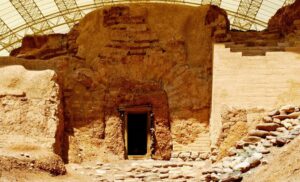
Qumran National Park preserves the archaeological site where the Dead Sea Scrolls were discovered between 1947 and 1956. Located near the Dead Sea's northwest shore, the site contains ruins of an ancient settlement believed to have been inhabited by the Essenes, a Jewish sect. The park features excavated structures, caves, and a visitors center explaining the scrolls' significance to Judaism and Christianity.
Qumran National Park sits on an arid plateau near the northwest shore of the Dead Sea, roughly 13 kilometers south of Jericho. The site became the stage for one of the greatest archaeological discoveries of the 20th century: the Dead Sea Scrolls. Recovered from eleven limestone caves between 1947 and 1956, these ancient manuscripts illuminate the religious and social world of Second Temple Judaism and raise compelling questions about the origins of early Christianity.
Qumran’s Geographical Location
Qumran sits approximately 1.5 kilometers from the Dead Sea’s northwest shoreline, perched on a marl terrace at the base of the Judean Desert cliffs.
Connections to Early Christianity
The practices of the Qumran community, particularly their focus on purification, communal living, and messianic expectations, share striking parallels with early Christianity. The Community Rule scroll describes a ritual meal of bread and wine presided over by a priestly figure, a practice that resonates with early Christian liturgy. Some scholars speculate that John the Baptist may have been influenced by Essene teachings, given his emphasis on ritual cleansing and apocalyptic warnings. He is known to have lived and preached in the Judean wilderness, the same region where the Qumran sect settled. While no direct evidence links Jesus or his disciples to the Qumran sect, their shared eschatological worldview, including the expectation of a final judgment, a priestly messiah, and the renewal of the covenant, suggests a common cultural and religious environment. Visitors with an interest in early Christian origins often find Qumran one of the most thought-provoking stops on any pilgrimage itinerary.
Who Lived in Qumran: The Essenes as Described by Flavius Josephus
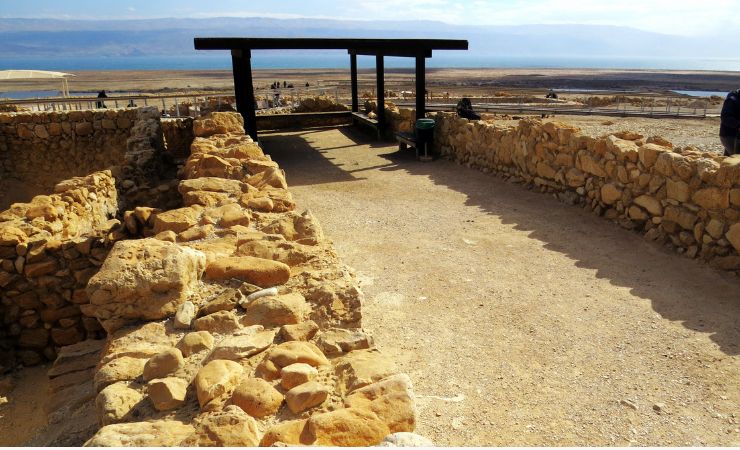
Excavations at Qumran began in 1951, led by Dominican friar and archaeologist Roland de Vaux of the École Biblique in Jerusalem. Working through the mid-1950s, de Vaux and his team revealed a settlement occupied in two main phases, roughly from the late 2nd century BCE until its destruction by the Romans around 68 CE. The findings revealed a small but highly organized settlement, designed to support a communal lifestyle centered on religious practice. Key structures and artifacts uncovered include:
- The Scriptorium: This long, narrow room contained plastered benches, inkwells made of bronze and ceramic, and dried ink residue. The physical setup strongly suggests scribal work, and some of the Dead Sea Scrolls may have been copied here.
- Ritual Baths (Mikvaot): At least ten stepped pools have been identified at the site, reflecting the community’s intense concern with ritual purity. Water was channeled from a nearby wadi through an elaborate aqueduct system.
- Dining Hall: A large rectangular room adjacent to a pantry where over a thousand dishes were found stacked, likely used for communal meals that carried religious significance for the sect.
- Pottery Workshop: Evidence of a working kiln was found here, along with cylindrical jars nearly identical to those that housed the Dead Sea Scrolls in the caves, suggesting the community produced its own storage vessels.
- Cemetery: A large burial ground containing over 1,100 graves, laid out in orderly north-south rows, predominantly male. The disciplined arrangement and near-absence of female remains in the main field support the view that this was an ascetic, likely celibate, community.
These discoveries paint a picture of a sectarian group living in disciplined seclusion, widely identified with the Essenes described by ancient sources including Flavius Josephus, Philo of Alexandria, and the Roman writer Pliny the Elder, who specifically placed an Essene settlement on the western shore of the Dead Sea.
Who Lived in Qumran: Flavius Josephus and the Essenes
Flavius Josephus, a Jewish historian of the 1st century CE, provides one of the earliest and most detailed accounts of the Essenes in his works The Jewish War and Antiquities of the Jews. He describes them as a Jewish sect distinct from the Pharisees and Sadducees, numbering approximately four thousand members across Judea, and emphasizes their ascetic lifestyle, communal living, and devotion to purity. His account was written within a generation of the destruction of Qumran, giving it considerable historical weight.
Josephus’s descriptions align closely with the practices inferred from the Qumran site:
- Communal Ownership: The Essenes pooled resources and lived collectively, mirroring the communal structures found at Qumran. Josephus notes that new members surrendered their property to the community upon full initiation, a process that took three years.
- Purity and Ritual Cleansing: Josephus highlights their frequent use of water for purification, reflected in the many mikvaot at Qumran and the elaborate aqueduct system that supplied them.
- Apocalyptic Beliefs: The Essenes awaited divine intervention and a final battle between good and evil, a belief also central to sectarian Dead Sea Scrolls like the War Scroll, which describes a forty-year eschatological conflict between the “Sons of Light” and the “Sons of Darkness.”
Some scholars suggest that the Essenes’ beliefs and practices influenced early Christian figures like John the Baptist, who emphasized repentance and ritual purification in the same wilderness region.
The Dead Seas Scrolls
The Discovery of the Scrolls
The discovery of the Dead Sea Scrolls began in early 1947, when a young Bedouin shepherd from the Ta’amireh tribe, Muhammad edh-Dhib, stumbled upon a cave near Qumran while searching for a stray goat. Inside, he found clay jars containing ancient manuscripts wrapped in linen. This accidental find sparked a decade of intensive exploration, during which archaeologists and local Bedouins uncovered eleven caves filled with thousands of fragments from over 900 manuscripts. Written in Hebrew, Aramaic, and Greek, these texts date from the 3rd century BCE to the 1st century CE, making them roughly a thousand years older than the previously known oldest Hebrew biblical manuscripts. Among the first scholars to recognize their significance was Eliezer Lipa Sukenik, an archaeologist from the Hebrew University of Jerusalem. In late 1947, amid the political turmoil leading up to Israel’s independence, Sukenik made a daring journey to Bethlehem to acquire three scrolls from an antiquities dealer. These included a nearly complete Isaiah Scroll, a commentary on the Book of Habakkuk, and the “Community Rule,” a text outlining the sect’s regulations and initiation procedures. Sukenik’s son, Yigael Yadin, later played a pivotal role in expanding the collection. In 1954, Yadin successfully negotiated the purchase of four additional scrolls that had been smuggled to the United States and advertised in the Wall Street Journal under the headline “The Four Dead Sea Scrolls.” These included the War Scroll and the Genesis Apocryphon. Thanks to the combined efforts of Sukenik and Yadin, these invaluable manuscripts were preserved and brought to Israel, where they are now housed in the Shrine of the Book at the Israel Museum in Jerusalem.
Contents of the Dead Sea Scrolls
The Dead Sea Scrolls include a wide variety of texts:
- Biblical Texts: These are the oldest surviving copies of many books of the Hebrew Bible, such as Isaiah, Psalms, and Deuteronomy. The Great Isaiah Scroll, found intact in Cave 1, is over 7 meters long and remains one of the most remarkable manuscript survivals in history. Notably, the only canonical book absent from the collection is Esther.
Sectarian Writings: Texts like the Community Rule and the War Scroll offer direct insight into the beliefs, rituals, and apocalyptic expectations of the Qumran sect. The Copper Scroll, unique among the finds, is inscribed on thin rolled copper and lists dozens of locations where gold, silver, and other treasures were supposedly hidden. - Apocryphal and Pseudepigraphal Works: These include books like Jubilees and Enoch, which were not included in the Hebrew Bible but were influential in Jewish and early Christian thought during the Second Temple period.
Why is the Book of Esther Missing?
The absence of the Book of Esther among the Dead Sea Scrolls remains a subject of genuine debate among scholars. One possible explanation is theological: the sect at Qumran may have rejected Esther because it contains no explicit mention of God and centers on events at a foreign royal court, priorities that would have conflicted with their strict religious outlook. A second theory relates to disputes over the biblical canon during the Second Temple period. Esther’s inclusion in the Jewish canon was still being contested at the time, and the Qumran community may not have recognized it as authoritative. A third possibility is physical loss: Esther may have existed at Qumran but failed to survive due to natural deterioration or the destruction of the site by Roman forces around 68 CE.
The Dead Seas Scrolls
Qumran National Park is managed by the Israel Nature and Parks Authority and is open year-round. Standard opening hours are Sunday through Thursday and Saturday from 8:00 AM to 5:00 PM (last entry 4:00 PM), and Friday from 8:00 AM to 4:00 PM (last entry 3:00 PM).
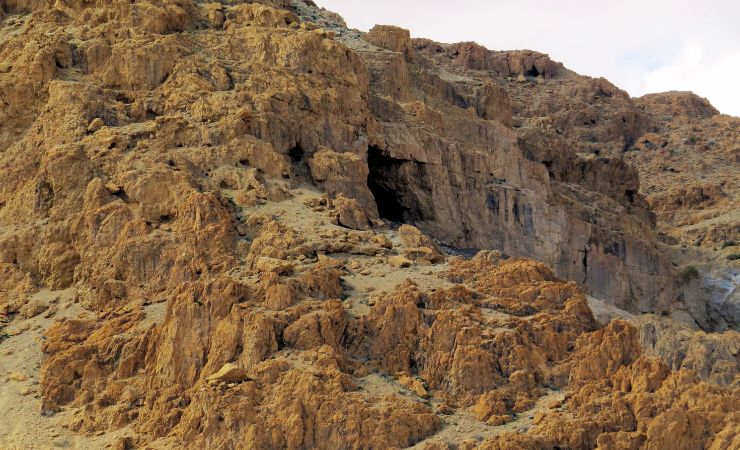
The park includes a visitor center with a short introductory film about the discovery of the scrolls, a well-marked outdoor trail through the ruins of the ancient settlement, and a viewing platform overlooking Cave 4, the cave that yielded the largest number of scroll fragments. The walk through the site takes approximately 45 to 60 minutes at a relaxed pace.
Additional Information
How long does a visit to Qumran National Park take?
Most visitors spend between one and two hours at the park. The introductory film in the visitor center runs about 15 minutes, and a leisurely walk through the excavated ruins and to the Cave 4 overlook takes roughly 45 to 60 minutes. Those who want to read every interpretive panel or join a guided tour may want to allow up to two hours.
Can you enter the caves where the Dead Sea Scrolls were found?
The caves are not open for visitor entry. Cave 4, the most productive of the scroll caves and the most visible from the site, can be viewed clearly from a designated overlook platform. The park provides good signage explaining which caves yielded which manuscripts, and the visitor center film covers the discovery story in detail.
Where are the Dead Sea Scrolls kept today?
The majority of the scrolls are housed in the Shrine of the Book, a wing of the Israel Museum in Jerusalem specifically built to display them. The building’s distinctive white dome is designed to evoke the lids of the clay jars in which the scrolls were found. A smaller number of fragments are held at the Jordan Museum in Amman and at institutions around the world.
What is the significance of the Dead Sea Scrolls for Jewish history?
The scrolls pushed back the known textual history of the Hebrew Bible by roughly a thousand years and confirmed the remarkable consistency of the biblical text over that span. They also revealed the rich diversity of Jewish religious thought during the Second Temple period, a time when groups like the Pharisees, Sadducees, Zealots, and Essenes each held distinct interpretations of Jewish law and messianic expectation.
Nearby Sites
- Masada National Park: A UNESCO World Heritage Site and a dramatic symbol of Jewish resistance against Rome.
- Ein Gedi Nature Reserve: A lush desert oasis with waterfalls, wildlife, and hiking trails.
- Ein Gedi Synagogue: An ancient synagogue showcases the spiritual and artistic heritage of the Judean Desert.
- Qasr el-Yahud, located near the Jordan River, is revered as the traditional site where John the Baptist baptized Jesus, making it a significant pilgrimage destination for Christians worldwide.
Keep reading
Part of our Jordan Valley & Dead Sea Guide →