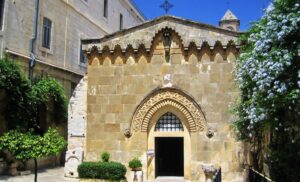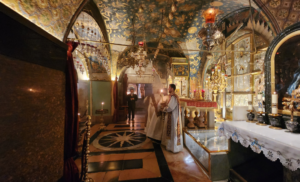
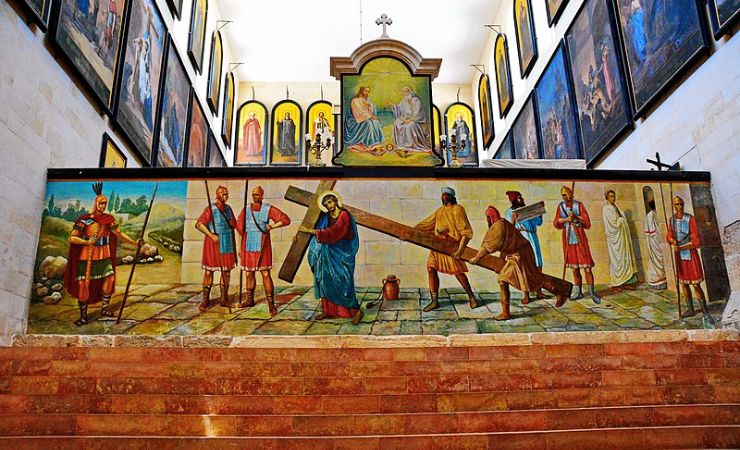
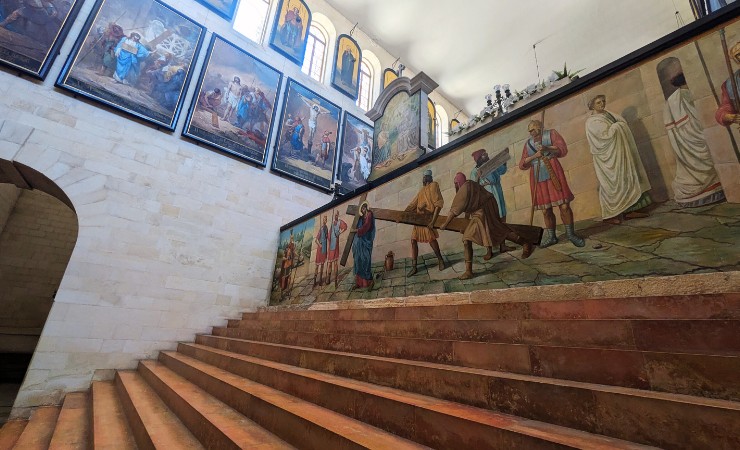
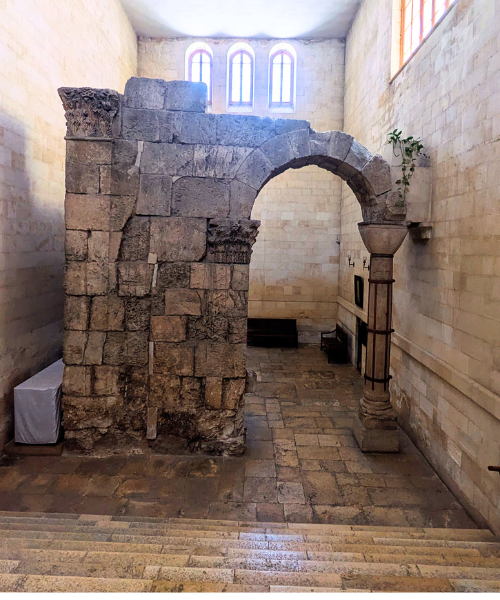
The Alexander Nevsky Church is a Russian Orthodox church in Jerusalem built between 1896 and 1903. Named after the medieval Russian prince and saint, it features a distinctive Roman arch from Hadrian's triumphal gate, incorporated into its structure during construction. The church showcases traditional Russian Orthodox architecture with its green domes and ornate interior decorations.
The Alexander Nevsky Church sits within Jerusalem’s Christian Quarter as a remarkable fusion of Russian Orthodox worship and archaeological exhibition. Built between 1896 and 1903 by the Imperial Orthodox Palestine Society, this unique structure takes its name from Saint Alexander Nevsky, the 13th-century Russian prince who defended Orthodox Christianity against Western invaders. The church preserves beneath its floors some of Jerusalem’s most significant discoveries, including a Roman triumphal arch from Emperor Hadrian’s era and remnants of the original entrance to Constantine’s fourth-century Basilica of the Holy Sepulchre.
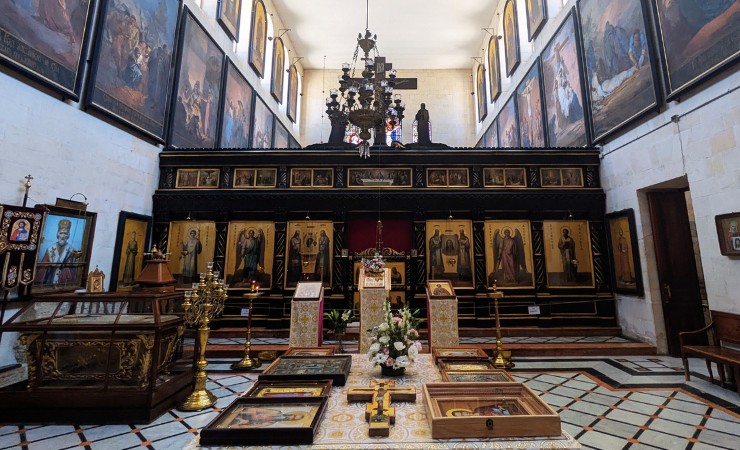
Credit Ian Scott, CC BY-SA 2.0, via Wikimedia Commons
Location
The Alexander Nevsky Church occupies a prime position in the Christian Quarter of Jerusalem’s Old City, just 100 meters east of the Church of the Holy Sepulchre along the Via Dolorosa. The church entrance faces the bustling pilgrim path that connects the Ethiopian Monastery with the main Christian holy sites. Its location on the ancient Roman Cardo Maximus places it directly above layers of Jerusalem’s most significant historical periods, from the time of Christ through the Byzantine era to the Crusader period.
Historical Context and Architecture
Russian involvement at this sacred site began in 1856 when Senator Boris Mansurov purchased the property from the Ethiopian Orthodox Church on behalf of the Imperial Orthodox Palestine Society. The original plan called for constructing a Russian consulate and pilgrim hostel to serve the thousands of Orthodox believers who made the difficult journey to the Holy Land each year.
The discovery of extraordinary archaeological remains in 1883 transformed the project entirely. Under the direction of Archimandrite Antonin Kapustin, excavations revealed structures spanning nearly two millennia, including what appeared to be the threshold of an ancient city gate and portions of a Roman triumphal arch. These findings were so significant that Russian authorities abandoned the consulate plan and redirected their attention to building a church that could preserve and display these treasures.
The church honors Saint Alexander Nevsky (1220-1263), the Russian prince who became a national hero for his victories against German and Swedish forces. More importantly for Orthodox believers, he protected faith from Western Catholic influence during the Northern Crusades. The choice of this patron saint reflected Russia’s broader ambitions in the Holy Land, where Orthodox, Catholic, and Protestant powers competed for influence over Christian pilgrimage sites.
Construction between 1896 and 1903 required careful engineering to preserve the ancient remains while creating a functional worship space above them. The architects incorporated the archaeological discoveries directly into the church’s design, with glass floors and viewing platforms allowing visitors to see the excavated structures below. The building’s exterior displays the Imperial Orthodox Palestine Society’s symbol atop its facade, featuring the Chi-Rho monogram representing Christ’s name in Greek letters.
This architectural approach made the Alexander Nevsky Church unique among Jerusalem’s religious buildings. Rather than simply occupying space above ancient ruins, the structure integrates them as central features of the worship experience, creating what amounts to a functioning archaeological museum within an active Orthodox chapel.
Archaeological Findings at the Alexander Nevsky Church
The excavations beneath the Alexander Nevsky Church revealed a remarkable sequence of historical layers that illuminate nearly 2,000 years of Jerusalem’s development. These discoveries transformed what began as a simple construction project into one of the most significant archaeological sites in the Old City.
Hadrian’s Arch and Roman Forum
- A grand stone arch, known as a “victory arch,” was built during Emperor Hadrian’s reign in the 2nd century AD. This monumental structure forms part of Hadrian’s comprehensive rebuilding of Jerusalem as Aelia Capitolina following the Bar Kokhba Revolt. The arch represents one of four similar structures Hadrian erected throughout the city, including the famous Ecce Homo Arch on the Via Dolorosa.
- Excavations revealed extensive remains of a Roman forum beneath the arch. This civic complex served as the administrative and commercial center of Hadrian’s rebuilt city. The forum’s stone paving and architectural elements demonstrate the scale of Roman urban planning in second-century Jerusalem. The stones flanking the arch mark what archaeologists believe was a formal entrance into this main forum area.
Herodian Period Walls and the Judgment Gate Tradition
- Massive wall foundations from the late first century BC reveal the sophisticated building techniques of Herod the Great’s era. These walls, constructed with precisely cut ashlar stones, demonstrate the high-quality craftsmanship characteristic of Herodian architecture throughout Jerusalem. The wall sections visible today show evidence of multiple construction phases and later modifications during the Roman period.
- Christian tradition identifies the opening between these walls as the threshold of the “Judgment Gate,” where Roman officials pronounced death sentences and posted written charges against condemned prisoners. While this identification remains debated among scholars, the gate’s proximity to Calvary and the Church of the Holy Sepulchre lends some credence to the tradition. Archaeological evidence suggests this area did function as a formal entrance to the city during the Second Temple period.
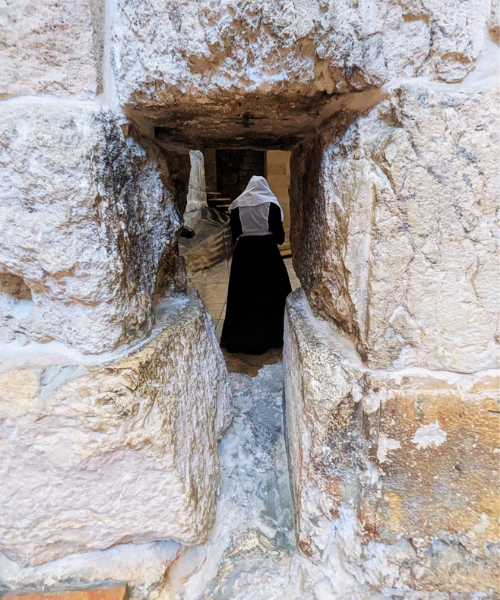
- A small opening in the wall, known as the “Eye of the Needle,” draws its name from Jesus’s teaching about the difficulty of a rich man entering heaven. Pilgrims traditionally attempt to squeeze through this narrow passage, believing it guarantees salvation, though this practice has no historical basis in first-century Jewish or Christian sources.
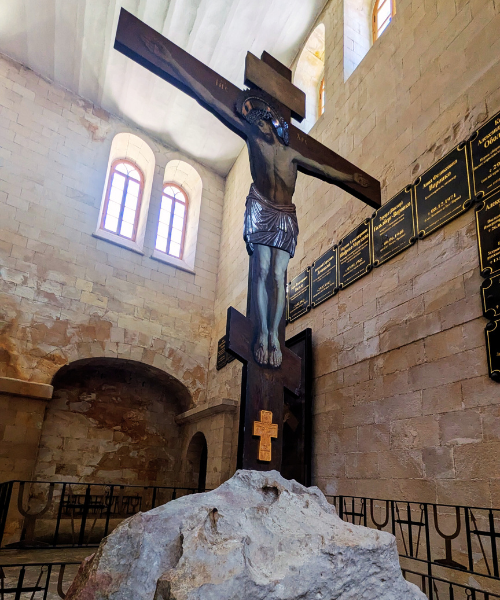
- Below the altar area, a stone crucifix marks a piece of rock identified by tradition as originating from Calvary. Beneath this display, archaeologists preserved a section of ancient paving stones that may have formed part of the road system connecting the city’s gates during the Roman period. While the connection to Jesus’s path cannot be proven archaeologically, the stones certainly date to the appropriate historical period.
Constantine’s Basilica Remains
- Among the most significant discoveries was a black stone column that once formed part of the original entrance to Constantine’s Basilica of the Holy Sepulchre, completed in 330 AD. The column’s distinctive black color indicates it was quarried from sources outside the Jerusalem region, probably from Egypt or Asia Minor, reflecting the imperial resources Constantine devoted to his Holy Land building projects.
- This column originally stood along the Roman Cardo Maximus, the city’s main north-south street, which formed the ceremonial approach to the basilica. The discovery of this architectural element at the Alexander Nevsky Church site confirms historical accounts of the basilica’s grand eastern entrance, which greeted pilgrims arriving from the city center along the Roman Cardo Maximus.
- Similar black columns have been identified at other locations along the ancient Via Dolorosa, including Station VII, and in the reconstructed Cardo excavation in the Jewish Quarter, suggesting Constantine’s architects used this distinctive stone to mark the most important Christian sites throughout the city.
The Mysterious Pilaster Wall
- The most puzzling archaeological feature within the chapel consists of the substantial remains of a 10-meter wall decorated with engaged columns (pilasters). This architectural element combines Roman building techniques with decorative features that closely resemble the style used in Herod’s Temple complex.
- The wall’s construction method and ornamental details suggest a date sometime between the first century BC and the fourth century AD, but scholars disagree about its specific purpose and dating. Some archaeologists propose it belonged to one of Hadrian’s Roman temples built during the second century, while others argue it represents reused Herodian stones incorporated into later construction projects.
- A recent theory proposed by archaeologist Shimon Gibson suggests the wall formed part of Constantine’s Holy Sepulchre complex, deliberately designed to echo the architectural style of the destroyed Jewish Temple. This interpretation would explain both the wall’s Herodian appearance and its integration into the fourth-century Christian building program, though the theory remains controversial among scholars specializing in American Schools of Oriental Research of the Byzantine period.
Practical Information
Opening Hours: Daily 9:00 AM to 5:00 PM (winter), 9:00 AM to 7:00 PM (summer). Closed during Orthodox services on Sundays and major religious holidays.
Admission: 15 NIS (approximately $4.50 USD) for adults. Students and seniors receive a 50% discount with valid ID. Children under 12 enter free with accompanying adults.
Accessibility: The main church level is wheelchair accessible via the entrance ramp. However, the lower archaeological areas require descending stairs and are not accessible for mobility-impaired visitors.
Additional Information
Roman and Byzantine Periods (1st Century AD – 7th Century AD):
- 1st Century AD (Time of Christ):Remains of massive walls from the time of King Herod are present at the Alexander Nevsky Church site.
- A stone of an ancient road, possibly walked by Jesus on his way to crucifixion, is present at the Alexander Nevsky Church site.
- 2nd Century AD:Emperor Hadrian builds a “victory arch” at the Alexander Nevsky Church site, one of four in Jerusalem (including the Ecce Homo Arch).
- Remnants of a Roman forum built during Hadrian’s time are present under the Alexander Nevsky Church.
- 4th Century AD:AD 330: Constantine the Great builds the Basilica of the Holy Sepulchre, with a main entrance on the Roman Cardo Maximus. A column made of black stone, part of this entrance, is found at the Alexander Nevsky Church site.
Ottoman and British Mandate Periods (16th Century – Mid-20th Century):
- 1847: The Russian Orthodox Ecclesiastical Mission in Jerusalem is first opened.
- 1853-1856: Crimean War, leading to Russian defeat and a shift in power relations in the Orient.
- 1856:The land where the Alexander Nevsky Church stands is sold by the Ethiopian church to Russian senator Boris Mansurov.
- March 1, 1857: Prince Alexander Gorchakov drafts an instruction to the Head of the Jerusalem Mission, proposing to strengthen Russia’s position in the Orient through religious means.
- November 1859: Clearing of debris begins on the “Russian domain.”
- April 11, 1861: Grand Duke Constantine orders the purchase of land next to the Holy Sepulchre.
- March 1883: Vasily Khitrovo proposes scholarly research in the Holy Land and excavations on the “Russian domain” near the Holy Sepulchre. Grand Duke Sergei offers funding.
- 1883: Excavations begin at the site of the Alexander Nevsky Church, attracting worldwide attention and leading to the discovery of the “Judgement Gate” threshold and Constantine’s 4th-century church remains.
- January 2, 1884: Grand Duke Sergei declares the high success of the excavations, including finding traces of the Second Wall and the Gate to Golgotha.
- 1887: A firman (Sultan’s decree) is granted for construction, though work was already underway
- 1891: The Alexander Nevsky Church building is consecrated by Archimandrite Antonin (Kapustin).
- November 27, 1894: The Palestine Society proposes consecrating the church to Saint Alexander Nevsky in memory of the late Tsar Alexander III.
- 1896-1903: The Alexander Nevsky Church is built.
What makes the Alexander Nevsky Church unique among Jerusalem churches?
The Alexander Nevsky Church combines active Orthodox worship with a comprehensive archaeological museum beneath its floors. Unlike other Jerusalem churches built over ancient sites, this Russian Orthodox church was specifically designed to showcase its archaeological discoveries, including Hadrian’s Roman triumphal arch, Byzantine-era remains, and possible Herodian period walls. Visitors can view these 2,000-year-old structures through glass floors and dedicated viewing areas while attending religious services above.
Can you see the Roman arch at Alexander Nevsky Church?
Yes, visitors can clearly view Hadrian’s second-century Roman triumphal arch through glass viewing panels in the church floor. This victory arch, one of four constructed by Emperor Hadrian throughout Jerusalem, remains remarkably well-preserved and forms the centerpiece of the archaeological display. The arch originally marked the entrance to Hadrian’s main forum in his rebuilt city of Aelia Capitolina.
What is the Eye of the Needle at Alexander Nevsky Church?
The “Eye of the Needle” refers to a small opening in the ancient wall beneath the Alexander Nevsky Church. This narrow passage draws its name from Jesus’s teaching about the difficulty of a rich man entering heaven. Many pilgrims attempt to squeeze through this opening, believing it guarantees salvation, though this practice has no historical basis in first-century Christian tradition.
How close is Alexander Nevsky Church to the Church of the Holy Sepulchre?
The Alexander Nevsky Church sits approximately 100 meters east of the Church of the Holy Sepulchre along the Via Dolorosa pilgrim route. This proximity places it within easy walking distance of Christianity’s most sacred site, making it an ideal addition to any Holy Land pilgrimage itinerary. The church’s location also provides historical context for understanding the layout of ancient Jerusalem’s Christian quarter.
Nearby Sites
- Church of the Redeemer: Just around the corner from the Alexander Nevsky Church, this Lutheran church offers a stunning view of Jerusalem from its bell tower.
- Via Dolorosa: This path, marked by 14 Stations of the Cross, is believed to be the route Jesus took on his way to crucifixion.
- Church of the Flagellation: Located near the start of the Via Dolorosa, this Roman Catholic church commemorates the spot where Jesus Christ was flogged by Roman soldiers before his journey carrying the cross.
- Moristan: This is a complex of streets and shops in the Christian Quarter of Jerusalem. It was the location of the first hospital of the Knights Hospitaller.
- Jaffa Gate: One of the seven main open gates in Jerusalem’s Old City Walls.
Keep reading
Part of our Christian Pilgrimage Guide →