The Church of the Multiplication stands on the northern shore of the Sea of Galilee, commemorating Jesus's miracle of feeding five thousand people with five loaves and two fish. The site features a Byzantine-era church with famous mosaic floors depicting bread baskets and fish, making it a major pilgrimage destination for Christians visiting the Holy Land.
The Church of the Multiplication stands on the northwestern shore of the Sea of Galilee as one of the most venerated Christian pilgrimage sites in the Holy Land. This sacred site commemorates Jesus’s miracle of feeding 5,000 people with five loaves of bread and two fish, as recorded in all four Gospels. The church preserves remarkable 5th-century Byzantine mosaics and sits above the ruins of earlier Christian sanctuaries dating back to the 4th century.
Location
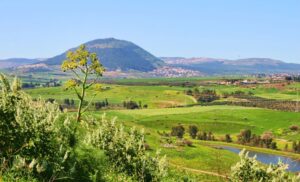
The Church of the Multiplication sits in Tabgha, a fertile area along the northwestern shore of the Sea of Galilee, approximately two kilometers south of Capernaum. The name Tabgha derives from the Greek “Heptapegon,” meaning “seven springs,” referring to the natural warm springs that flow into the Sea of Galilee at this location. These springs create a microclimate that supports lush vegetation year-round, making this area particularly suitable for the large gatherings described in the Gospel accounts. The site occupies a natural amphitheater-like slope that gently descends toward the lake, providing an ideal setting for the multitudes who came to hear Jesus speak.
Biblical Context
The Church of the Multiplication commemorates the miracle of the feeding of the 5,000, recorded in all four Gospels (Matthew 14:13-21, Mark 6:30-44, Luke 9:10-17, and John 6:1-15). According to these accounts, Jesus withdrew by boat to a deserted place near Bethsaida, but crowds followed him on foot. Moved with compassion, Jesus healed their sick and taught them throughout the day. When evening approached and the disciples suggested sending the crowds away to buy food, Jesus instead took five barley loaves and two fish from a young boy’s lunch. After blessing the food, Jesus distributed it through his disciples, miraculously feeding the entire multitude. The Gospel of Matthew specifically mentions that 5,000 men were fed, not counting women and children, suggesting the actual number may have exceeded 10,000 people. Twelve baskets of leftover fragments were collected afterward, emphasizing the abundance of the miracle. Early Christian tradition, supported by the testimony of pilgrims like Egeria in the late 4th century, identified the Tabgha area as the location where this event occurred.
The Church of the Multiplication through the Ages
Early Beginnings
The first chapel at Tabgha was constructed in the mid-4th century CE, during the reign of Emperor Constantine when Christianity gained imperial support throughout the Roman Empire. Archaeological evidence suggests this initial structure was a simple single-nave church measuring approximately 15 by 9 meters. The Spanish pilgrim Egeria, who documented her journey to the Holy Land, described finding a “grassy field which has sufficient hay and many palm trees and nearby seven springs.” Her account provides the earliest written testimony of Christian veneration at this site, noting that pilgrims already recognized Tabgha as the location of the feeding miracle. The 4th-century church featured a simple altar built directly over a natural limestone rock, which early Christians believed was the exact spot where Jesus blessed the loaves and fish.
The Byzantine Era
During the early 5th century, under Byzantine patronage, the modest chapel was demolished and replaced with a magnificent three-nave basilica. This expansion reflected the growing importance of Tabgha as a pilgrimage destination and the Byzantine Empire’s investment in Holy Land sanctuaries. The new basilica featured elaborate floor mosaics created by master craftsmen, including the famous loaves and fishes mosaic that survives today. The church complex included auxiliary buildings for pilgrims, monks’ quarters, and a guest house, transforming the site into a major pilgrimage center.
The basilica’s location along the ancient Via Maris trade route, which connected Egypt with Damascus and Mesopotamia, provided both opportunities and challenges. While the proximity brought numerous visitors and pilgrims, it also constrained the building’s northern expansion due to the roadway’s presence. The architects ingeniously adapted to this limitation by extending the complex eastward toward the lake shore, creating terraced gardens and courtyards that enhanced the site’s natural beauty.
The Church’s Revival
Persian invasions in 614 CE, followed by the Arab conquest in 638 CE, led to the basilica’s gradual abandonment and eventual destruction. For over 1,300 years, the site remained in ruins, with only scattered stones and fragments of mosaics visible above ground. Local Arab villagers occasionally used the ancient stones for construction, but the exact location of the church was never entirely forgotten.
Modern archaeological investigations began in the 1930s under German archaeologists who uncovered the Byzantine foundations and mosaics. The decisive moment came in the 1980s when the German Association of the Holy Land, working with Benedictine monks from Dormition Abbey, initiated the complete restoration project. The new Church of the Multiplication was consecrated in 1982, built directly over the Byzantine foundations using modern materials that complement the ancient architecture.
The Current Church
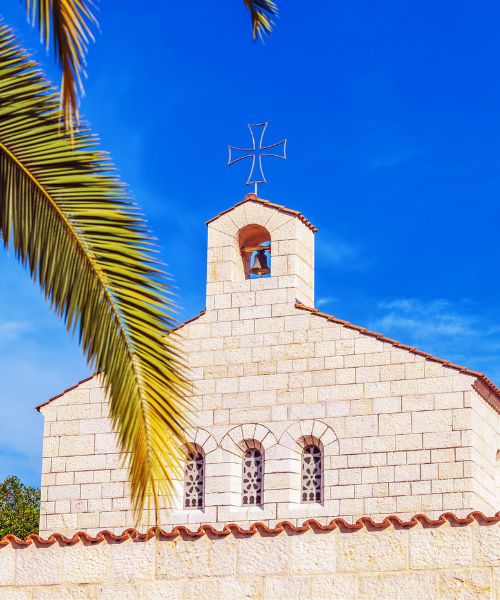
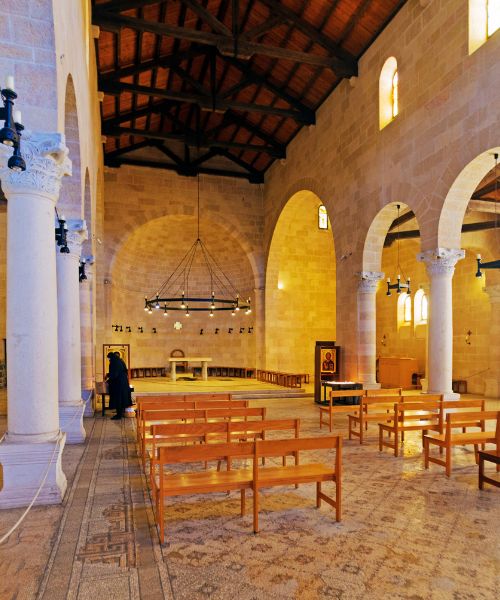
The modern Church of the Multiplication, completed in 1982, faithfully reconstructs the layout and dimensions of its 5th-century Byzantine predecessor. German architects and archaeologists worked with Benedictine monks to create a structure that honors both the site’s ancient history and contemporary liturgical needs. The church follows the traditional basilica design with a central nave flanked by two side aisles, separated by rows of limestone columns that echo the original Byzantine supports.
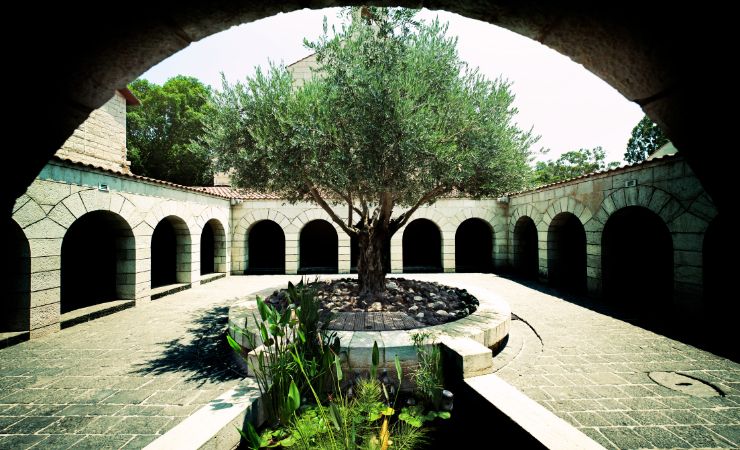
Visitors enter through a peaceful courtyard garden planted with native Galilean flora, including olive trees, cypresses, and flowering shrubs that create an atmosphere of contemplation. The church’s interior maintains natural lighting through carefully positioned windows and skylights, illuminating the spectacular 5th-century floor mosaics without damaging them. Modern climate control systems protect these ancient artworks while ensuring visitor comfort.
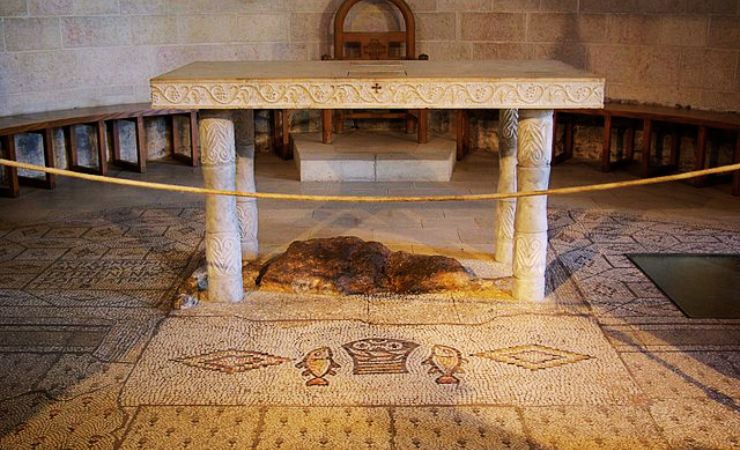
The Church of the Multiplication’s focal point remains the Rock of the Multiplication, positioned beneath the main altar exactly where the Byzantine altar stood. This limestone outcrop, measuring approximately two meters in diameter, is traditionally venerated as the exact location where Jesus blessed the loaves and fish. The rock’s surface shows evidence of ancient Christian veneration, including small carved crosses and worn areas from centuries of pilgrims’ touch. A bronze inscription in Latin and German marks the rock’s significance for contemporary visitors.
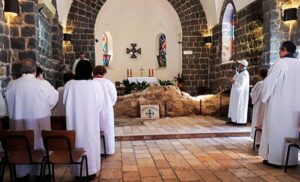
The current church accommodates approximately 200 worshippers and hosts daily Masses in multiple languages, maintaining the site’s role as a living place of worship rather than merely a historical monument. Benedictine monks from the nearby monastery provide pastoral care and guide pilgrimage groups through the church’s biblical and archaeological treasures.
Archeological Findings
- The 5th Century Mosaic Floor: The remarkable Byzantine-era floor mosaic, discovered intact beneath centuries of debris, represents one of the finest examples of early Christian art in the Holy Land. The central medallion depicts a wicker basket containing four loaves of bread, flanked by two fish, directly referencing the miracle of multiplication. Scholars interpret the four visible loaves as representing the bread distributed to the people, while the fifth loaf remains metaphorically present on the altar above. The fish depicted are local Galilee species, specifically St. Peter’s fish (tilapia), demonstrating the artists’ familiarity with local conditions.
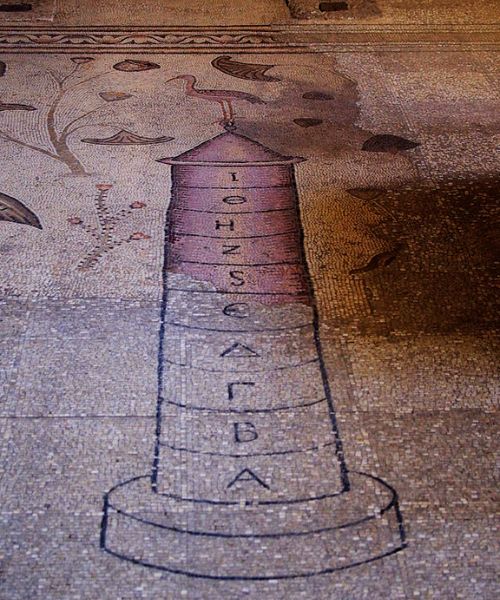
- The Nile Mosaic: A sophisticated mosaic panel near the church entrance features exotic birds, aquatic plants, and a detailed representation of a Nilometer, an ancient Egyptian device used to measure the Nile River’s flood levels. This imagery was extremely popular throughout the Byzantine Empire and appears in sites across Israel, including Sepphoris, Beit She’an, and Gaza. The Nilometer symbolized prosperity and divine blessing, as the Nile’s annual flood determined Egypt’s agricultural abundance. Byzantine Christians adopted this imagery to represent God’s provision and the abundance of divine grace, making it particularly appropriate for a church commemorating Jesus’s miraculous feeding.
- Architectural Remains: Excavations have revealed foundations of multiple building phases, including remains of the 4th-century chapel beneath the 5th-century basilica floor. Stone baptismal fonts, marble column capitals with cross motifs, and fragments of liturgical furnishings demonstrate the site’s continuous Christian use. A portion of an ancient road, likely part of the Via Maris trade route, was discovered along the church’s northern wall, confirming historical accounts of the site’s strategic location.
What Can Be Seen
Visitors to the Church of the Multiplication encounter several significant features that bring the biblical narrative to life:
- The Rock of the Multiplication: Positioned directly beneath the main altar, this limestone outcrop is traditionally venerated as the exact location where Jesus blessed the loaves and fish. The rock shows evidence of centuries of Christian devotion, with small carved crosses and worn areas from pilgrims’ touch.
- Byzantine Floor Mosaics: The centerpiece 5th-century mosaic depicts a basket with four loaves and two fish, representing the miracle of the feeding. Surrounding geometric and floral patterns demonstrate the sophistication of Byzantine Christian art.
- The Nilometer Mosaic: This intricate panel features exotic birds, plants, and an ancient Egyptian flood-measuring device, symbolizing divine abundance and provision.
- Original Byzantine Walls: Portions of the 5th-century basilica walls are preserved and visible, showing original construction techniques and decorative elements.
- Archaeological Displays: Glass panels in the floor reveal excavated foundations and artifacts from multiple historical periods, allowing visitors to see the site’s stratified history.
- Memorial Garden: The peaceful courtyard contains plants native to ancient Galilee, creating an atmosphere conducive to meditation and prayer.
Additional Information
Where exactly is the Church of the Multiplication located?
The Church of the Multiplication is located in Tabgha, on the northwestern shore of the Sea of Galilee, approximately 2 kilometers south of Capernaum. The site sits near the seven natural springs that give Tabgha its name (from the Greek “Heptapegon”). This location places it directly on the ancient Via Maris trade route and provides easy access to other significant Christian pilgrimage sites around the Sea of Galilee.
What is the significance of the loaves and fishes mosaic?
The 5th-century Byzantine mosaic floor depicts a wicker basket containing four visible loaves of bread flanked by two fish, directly representing the miracle of the feeding of the 5,000. The mosaic is historically significant as one of the earliest artistic depictions of this miracle and demonstrates remarkable preservation after 1,500 years. The fish depicted are local Galilee species, showing the ancient artists’ attention to geographical accuracy in their religious art.
What archaeological evidence supports this as the location of the miracle?
While no archaeological evidence can definitively prove the exact location of biblical miracles, the Church of the Multiplication site has strong historical support dating to the 4th century CE. The Spanish pilgrim Egeria documented Christian veneration here in the late 4th century, and continuous archaeological layers show unbroken Christian worship from the Byzantine period onward. The natural setting with seven springs creating a suitable gathering place for large crowds supports the traditional identification.
What should I wear when visiting the Church of the Multiplication?
The Church of the Multiplication enforces a modest dress code requiring covered shoulders and knees for all visitors regardless of gender. Long pants or skirts and shirts with sleeves are required, and visitors in inappropriate attire may be refused entry. This is a functioning religious site, so respectful attire demonstrates appropriate reverence for both the sacred space and the worshipping community.
Sources and Additional Reading
Nearby Sites
- The Church of the Primacy of Saint Peter: Traditionally believed to be where Jesus reinstated Peter as the chief among the Apostles.
- Capernaum: Also known as ‘The Town of Jesus,’ it was here that Jesus spent a significant period of his ministry, and where many miracles were performed.
- Mount of Beatitudes: A short drive uphill from the church, is traditionally believed to be the location of Jesus’s ‘Sermon on the Mount.’ At the top of the mount is the Franciscan, Church of Beatitudes, constructed by architect Antonio Barluzzi.
- Kursi National Park: On the eastern shores of the Sea of Galilee, this park houses the remains of a Byzantine monastery and is linked to the miracle of the ‘Swine of Gergesa.’
- Bethsaida: Ancient remains of this city, once a fishing village and birthplace of several of Jesus’s disciples.
Keep reading
Part of our Christian Pilgrimage Guide →